From Surf Wiki (app.surf) — the open knowledge base
Ice jam
Accumulation of ice in a river

Accumulation of ice in a river
Ice jams occur when the ice that is drifting down-current in a river comes to a stop, for instance, at a river bend, when it contacts the river bed in a shallow area, or against bridge piers. Doing so increases the resistance to flow, thereby inducing an increase in water level upstream of the jam (referred to as backwater). Ice jams are thus a main cause for flooding during the winter. In addition, when the jam is released, depending on the conditions under which this happens, the amount of water that was retained behind the jam can also lead to flooding downstream of where the jam occurred. Ice jam floods are generally less predictable and can also be faster than open-water floods.
Mechanisms
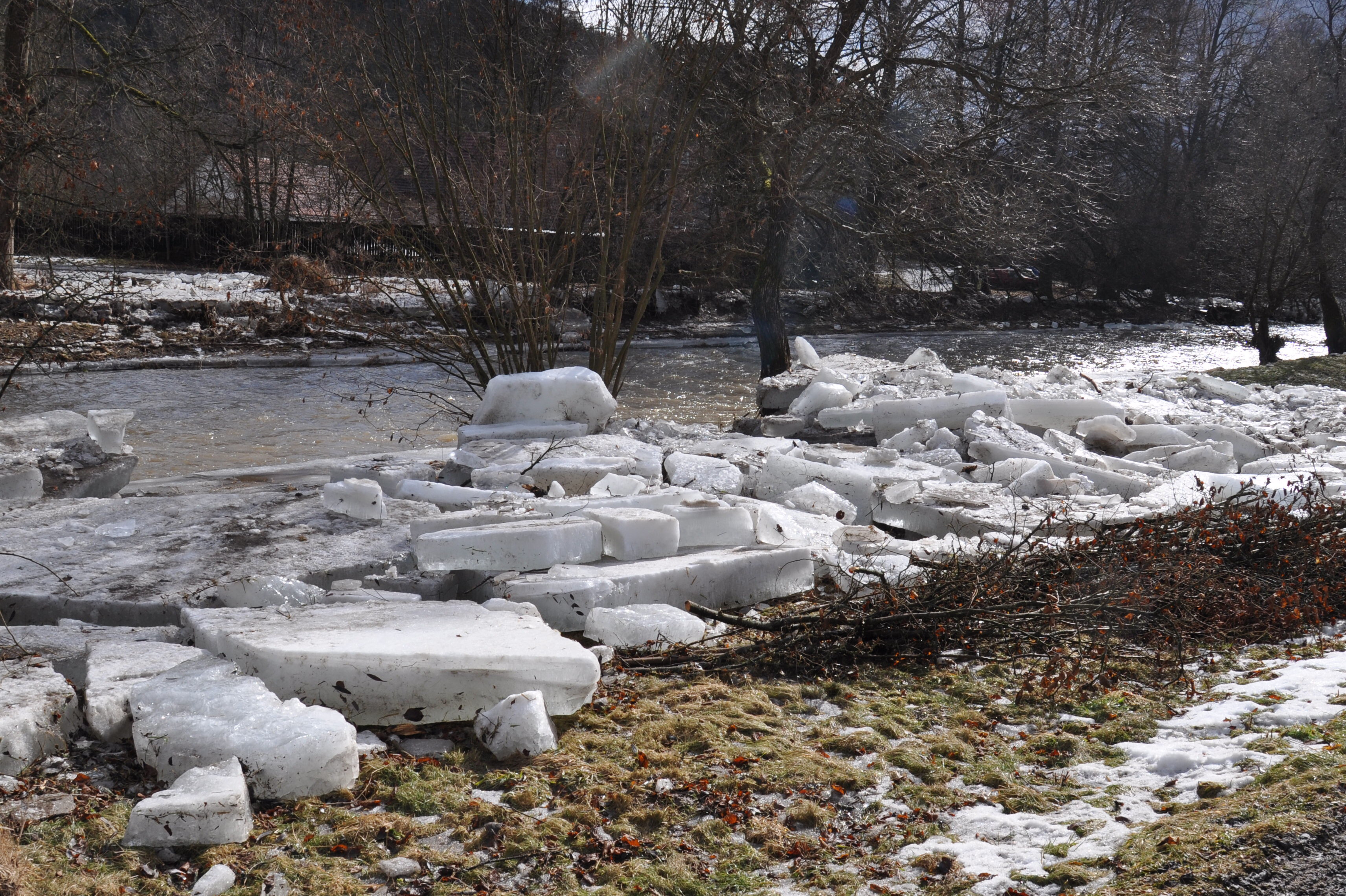
Ice jams on rivers usually occur in the springtime as the river ice begins to break up, but may also occur in early winter during freeze-up. The break-up process is described in three phases: pre-break-up, break-up and final drive. Pre-break-up usually begins with increased springtime river flow, water level, and temperatures fracturing the river ice and separating it from the shore. Changes in river height from dam releases may also affect the pre-break-up. During the break-up, the ice in areas of rapids is carried downstream as an ice floe and may jam on still frozen sections of ice on calm water or against structures in the river such as the Honeymoon Bridge, destroyed in 1938 by an ice jam. Smaller jams may dislodge, flow downstream and form a larger jam. During the final drive, a large jam will dislodge and take out the remaining jams, clearing the river of ice in a matter of hours. Ice jams usually occur in spring, but they can happen as winter sets in when the downstream part becomes frozen first. Freeze-up jams may be larger because the ice is stronger and temperatures are continuing to cool unlike a spring break-up when the environment is warming, but are less likely to suddenly release water.
Three types of natural ice jams can occur:
- a surface jam, a single layer of ice in a floe on calm water;
- a narrow-channel or wide-channel jam; and
- a hanging jam, the accumulation of river ice at slow current areas which only occur during freeze-up.
Ice jams also occur at sharp bends in the river, at human-constructed objects such as bridge piers, and at confluences.
Occurrences and consequences
.jpg)
In the Northern Hemisphere, northerly flowing rivers tend to have more ice jams because the upper, more southerly reaches thaw first and the ice gets carried downstream into the still-frozen northerly part. There are three physical hazards of ice jams. The jam induces flow restriction, either or both because of increased friction along the ice under surface and because of a decrease in the channel's cross-sectional area. An example is the 2009 Red River Flood and the 2009 Alaska floods. The second type of hazard occurs as the ice jam breaks apart, and a sudden surge of water breaks through flooding areas downstream of the jam (see below). Such a surge occurred on the Saint Lawrence River in 1848. The third hazard is that the ice buildup and final drive may damage structures in or near the river and boats in the river. Ice jams may scour the river bed, causing damage or benefit to wildlife habitats and possibly damage to structures in the river.
Javes

Minutes to weeks can go by before break-up. Release mechanisms include mobilization of the ice cover downstream which was maintaining the jam in place, the formation of an open lead immediately downstream of it, and increasing discharge. Several known thresholds (water levels, discharge, discharge rate, side resistance, boundary constraints and flexural criterion) may provide an indication of when such a break-up can occur.
Ice jam flood risk
Establishing ice jam flood risk involves the following steps:
Description of ice jam formation
Understanding the formation of ice jams on rivers is crucial. Historical data on the co-location of ice jam formations is also useful.
Flood hazard mapping
This involves creating profiles of the area, including agent profiles and water levels along the river. The goal is to produce a risk map for the study area.

Risk calculation
Risk is calculated by combining hazard and vulnerability. Hazard is usually associated with flood intensity, extent, depth, and probability. Vulnerability involves exposure and susceptibility of different types of residential and commercial buildings within the floodplain area or in between specification periods of floods.
Damage assessment
Damage is assessed in terms of structural damage and content damage at different depths of flooding. A certain depth might have certain damages created for the exposure.
Software tools
The process involves using software tools (possibly GIS) to add data layers, calculate flood depths, and extrapolate water levels for the transects to the downtown area. The water levels are obtained from a stochastic modelling framework for the water channel.
Prediction and mitigation

Early warnings of an ice jam include using trained observers to monitor break-up conditions and ice motion detectors.
The prevention of ice jams may be accomplished by
- weakening the ice before the break-up by cutting or drilling holes in the ice;
- weakening the ice by dusting it with a dark colored sand; or
- controlling the timing of the break-up using ice breakers, towboats, hovercraft, or amphibious excavators. However, the movement of migratory fish is known to be related to freeze-up and break-up, so affecting ice break-up may affect fish migration.
Where floods threaten human habitation, the blockage may be artificially cleared. Ice blasting using dynamite may be used, except in urban areas, as well as other mechanical means such as excavation equipment, or permanent measures such as ice control structures and flood control. Occasionally, military aircraft have been used to bomb ice jams with limited success as part of an effort to clear them.
References
References
- (2025). "On floods caused by river ice: An overview of mitigation measures". National Research Council of Canada.
- Ashton, G.D.. (1986). "River and Lake Ice Engineering". Book Crafters Inc..
- (1995). "River ice jams". Water Resources Publications.
- Lindenschmidt, Karl-Erich. (2024). "Introduction". Springer International Publishing.
- (2008). "River ice breakup". Water Resources Publications, LLC.
- (2016-03-01). "Celerities of waves and ice runs from ice jam releases". Cold Regions Science and Technology.
- Dingman, S. Lawrence. (2009). "Fluvial Hydraulics". Oxford University Press.
- (1996). "Ice Jam Flooding and Mitigation: Lower Platte River Basin, Nebraska". DIANE Publishing.
- Beltaos, S.. (1995). "River Ice Jams". Water Resources Publication.
- Alfred, Randy. (2010-03-30). "March 30, 1848: Niagara Falls Runs Dry".
- {{Britannica. 281150. ice jam
- (2013-03-13). "Ice Jams". Nws.noaa.gov.
- Jasek, M., and Beltaos, S. 2008. Ice-jam release: javes, ice runs and breaking fronts. In River ice breakup. Edited by S. Beltaos. Water Resources Publications, Highland Ranch, CO
- Beltaos, Spyros. (2013-01-01). "Hydrodynamic characteristics and effects of river waves caused by ice jam releases". Cold Regions Science and Technology.
- Beltaos, Spyros. (2017-07-01). "Hydrodynamics of storage release during river ice breakup". Cold Regions Science and Technology.
- (2016-03-01). "Celerities of waves and ice runs from ice jam releases". Cold Regions Science and Technology.
- (2021-09-01). "A systematic evaluation of criteria for river ice breakup initiation using River1D model and field data". Cold Regions Science and Technology.
- (2024). "River Ice Processes and Ice Flood Forecasting".
- (August 2000). "Cazenovia Creek Ice-Control Structure". US Army Corps of Engineers.
- Donnelly, John. (2007-03-12). "Vermont's capital braces for possible river flooding". Boston Globe.
- Staff writer. (2006-02-07). "Ice Dams: Taming An Icy River". Popular Mechanics.
- Smith, Stephen H.. (January 19, 2018). "York's Past: Aerial bombing breaks Susquehanna ice jams". The York Daily Record.
- Daniszewski, John. (2001-05-18). "Russian Planes Bomb Ice Jam". Los Angeles Times.
- Sridharan, Vasudevan. (2016-04-19). "Russian fighter jets bomb 40km ice-jam to prevent flooding in Vologda". International Business Times UK.
This article was imported from Wikipedia and is available under the Creative Commons Attribution-ShareAlike 4.0 License. Content has been adapted to SurfDoc format. Original contributors can be found on the article history page.
Ask Mako anything about Ice jam — get instant answers, deeper analysis, and related topics.
Research with MakoFree with your Surf account
Create a free account to save articles, ask Mako questions, and organize your research.
Sign up freeThis content may have been generated or modified by AI. CloudSurf Software LLC is not responsible for the accuracy, completeness, or reliability of AI-generated content. Always verify important information from primary sources.
Report