From Surf Wiki (app.surf) — the open knowledge base
Hydrazoic acid
Unstable and toxic chemical compound

Unstable and toxic chemical compound
Azoimide Azic acid | NFPA-H = 4 | NFPA-F = 0 | NFPA-R = 3 Lithium azide Potassium azide Hydrazine
Hydrazoic acid, also known as hydrogen azide, azic acid or azoimide, is a compound with the chemical formula . It is a colorless, volatile, and explosive liquid at room temperature and pressure. It is a compound of nitrogen and hydrogen, and is therefore a pnictogen hydride. It was first isolated in 1890 by Theodor Curtius. The acid has few applications, but its conjugate base, the azide ion, is useful in specialized processes.
Hydrazoic acid, like its fellow mineral acids, is soluble in water. Undiluted hydrazoic acid is dangerously explosive with a standard enthalpy of formation ΔfHo (l, 298K) = +264 kJ/mol. When dilute, the gas and aqueous solutions (
Production
The acid is usually formed by acidification of an azide salt like sodium azide. Normally solutions of sodium azide in water contain trace quantities of hydrazoic acid in equilibrium with the azide salt, but introduction of a stronger acid can convert the primary species in solution to hydrazoic acid. The pure acid may be subsequently obtained by fractional distillation as an extremely explosive colorless liquid with an unpleasant smell.
:
Its aqueous solution can also be prepared by treatment of barium azide solution with dilute sulfuric acid, filtering the insoluble barium sulfate.
It was originally prepared by the reaction of aqueous hydrazine with nitrous acid:
:
With the hydrazinium cation this reaction is written as:
:
Other oxidizing agents, such as hydrogen peroxide, nitrosyl chloride, trichloramine or nitric acid, can also be used to produce hydrazoic acid from hydrazine.
Destruction prior to disposal
Hydrazoic acid reacts with nitrous acid:
:
This reaction is unusual in that it involves compounds with nitrogen in four different oxidation states.
Reactions
In its properties hydrazoic acid shows some analogy to the halogen acids, since it forms poorly soluble (in water) lead, silver and mercury(I) salts. The metallic salts all crystallize in the anhydrous form and decompose on heating, leaving a residue of the pure metal. It is a weak acid (pKa = 4.75.{{cite book
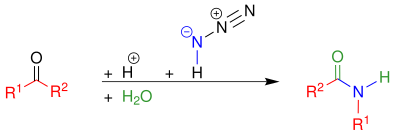
Hydrazoic acid may react with carbonyl derivatives, including aldehydes, ketones, and carboxylic acids, to give an amine or amide, with expulsion of nitrogen. This is called Schmidt reaction or Schmidt rearrangement.
Dissolution in the strongest acids produces explosive salts containing the aminodiazonium ion , for example:{{cite book
: The ion is isoelectronic to diazomethane .
The decomposition of hydrazoic acid, triggered by shock, friction, spark, etc. produces nitrogen and hydrogen:
:
Hydrazoic acid undergoes unimolecular decomposition at sufficient energy:
:
The lowest energy pathway produces NH in the triplet state, making it a spin-forbidden reaction. This is one of the few reactions whose rate has been determined for specific amounts of vibrational energy in the ground electronic state, by laser photodissociation studies. In addition, these unimolecular rates have been analyzed theoretically, and the experimental and calculated rates are in reasonable agreement.
Toxicity
Hydrazoic acid is volatile and highly toxic. It has a pungent smell and its vapor can cause violent headaches. The compound acts as a non-cumulative poison.
Applications
2-Furonitrile, a pharmaceutical intermediate and potential artificial sweetening agent has been prepared in good yield by treating furfural with a mixture of hydrazoic acid () and perchloric acid () in the presence of magnesium perchlorate in the benzene solution at 35 °C.
The all gas-phase iodine laser (AGIL) mixes gaseous hydrazoic acid with chlorine to produce excited nitrogen chloride, which is then used to cause iodine to lase; this avoids the liquid chemistry requirements of COIL lasers.
References
References
- Pradyot Patnaik. ''Handbook of Inorganic Chemicals''. McGraw-Hill, 2002, {{ISBN. 0-07-049439-8
- {{Cite EB1911
- "Dictionary of Inorganic and Organometallic Compounds". Chapman & Hall.
- Curtius, Theodor. (1890). "Ueber Stickstoffwasserstoffsäure (Azoimid) N3H". Berichte der Deutschen Chemischen Gesellschaft.
- (2016-03-10). "Reactive Force Field for Liquid Hydrazoic Acid with Applications to Detonation Chemistry". The Journal of Physical Chemistry C.
- Gonzalez-Bobes, F. et al Org. Process Res. Dev. 2012, 16, 2051-2057.
- Treitler, D. S. et al Org. Process Res. Dev. 2017, 21, 460-467.
- L . F. Audrieth, C. F. Gibbs Hydrogen Azide in Aqueous and Ethereal Solution" Inorganic Syntheses 1939, vol. 1, pp. 71-79.
- {{Greenwood&Earnshaw2nd
- Greenwood, pp. 461–464.
- Tutton, A. E.. (October 1890). "Hydrazoic Acid—A New Gas". Nature.
- (1990). "Overtone-excited {{chem". Journal of Chemical Physics.
- (2008). "Understanding the rate of spin-forbidden thermolysis of {{chem". Journal of Chemical Physics.
- P. A. Pavlov. (1986). "Synthesis of 5-substituted furannitriles and their reaction with hydrazine". Khimiya Geterotsiklicheskikh Soedinenii.
- B. Bandgar. (2006). "Organic reactions in water. Transformation of aldehydes to nitriles using NBS under mild conditions". Synthetic Communications.
This article was imported from Wikipedia and is available under the Creative Commons Attribution-ShareAlike 4.0 License. Content has been adapted to SurfDoc format. Original contributors can be found on the article history page.
Ask Mako anything about Hydrazoic acid — get instant answers, deeper analysis, and related topics.
Research with MakoFree with your Surf account
Create a free account to save articles, ask Mako questions, and organize your research.
Sign up freeThis content may have been generated or modified by AI. CloudSurf Software LLC is not responsible for the accuracy, completeness, or reliability of AI-generated content. Always verify important information from primary sources.
Report