From Surf Wiki (app.surf) — the open knowledge base
Hybrid regime
Regime combining autocratic and democratic features

Regime combining autocratic and democratic features
A hybrid regime is a type of political system often created as a result of an incomplete democratic transition from an authoritarian regime to a democratic one (or vice versa). Hybrid regimes are categorized as having a combination of autocratic features with democratic ones and can simultaneously hold political repressions and regular elections. According to some definitions and measures, hybrid regimes are commonly found in developing countries with abundant natural resources such as petro-states. Although these regimes experience civil unrest, they may be relatively stable and tenacious for decades at a time. There has been a rise in hybrid regimes since the end of the Cold War.
The term hybrid regime arises from a polymorphic view of political regimes that oppose the dichotomy of autocracy or democracy. Modern scholarly analysis of hybrid regimes focuses attention on the decorative nature of democratic institutions (elections do not lead to a change of power, different media broadcast the government point of view and the opposition in parliament votes the same way as the ruling party, among others), from which it is concluded that democratic backsliding, a transition to authoritarianism is the most prevalent basis of hybrid regimes. Some scholars also contend that hybrid regimes may imitate a full dictatorship.
Overall, there is no consensus among researchers about how hybrid regimes should be defined or measured. Accordingly, there is much disagreement about which countries are considered to be hybrid regimes, and any description of what typical hybrid regimes look like needs to be seen in the context of specific definitions and measures.
Definition
Scholars vary on the definition of hybrid regimes based on their primary academic discipline. According to Christoph Mohamad-Klotzbach, "Some scholars argue that deficient democracies and deficient autocracies can be seen as examples of hybrid regimes, whereas others argue that hybrid regimes combine characteristics of both democratic and autocratic regimes." Scholars also debate if these regimes are in transition or are inherently a stable political system.
In 1995 Terry Karl introduced the notion of "hybrid" regime, which was simply defined as "combining democratic and authoritarian elements".
According to professor Matthijs Bogaards hybrid types are:
Pippa Norris defined hybrid regimes as:
Henry E. Hale defined hybrid regimes as;
Leonardo Morlino defined hybrid regimes as;
Professor Jeffrey C. Isaac defined hybrid regimes as:
History
The third wave of democratization from the 1970s onward has led to the emergence of hybrid regimes that are neither fully democratic nor fully authoritarian. Neither the concept of illiberal democracy, nor the concept of electoral authoritarianism fully describes these hybrid regimes.
Since the end of the Cold War, such regimes have become the most common among undemocratic countries. At the end of the process of transformation of authoritarian regimes, limited elections appear in one way or another when liberalization occurs. Liberal democracy has always been assumed while in practice this process basically froze "halfway".
In relation to regimes that were previously called "transitional" in the 1980s, the term hybrid regime began to be used and was strengthened according to Thomas Carothers:
Hybrid regimes have evolved to lean more authoritarian while keeping some democratic traits. One of the main issues with authoritarian rule is the ability to control the threats from the masses, and democratic elements in hybrid regimes can reduce social tension between the masses and the elite. After the third wave of democratization, some regimes became stuck in the transition to democracy, causing the creation of weak democratic institutions. This results from a lack of institutional ownership during critical points in the transition period leading the regime into a gray zone between democracy and autocracy.
These developments have caused some scholars to believe that hybrid regimes are not poorly functioning democracies, but rather new forms of authoritarian regimes. Defective democratic stability is an indicator to explain and measure these new forms of autocracies. Additionally, approval ratings of political leaders play an important role in these types of regimes, and democratic elements can drive up the ratings of a strongman leader creating a tool not utilized previously. Today, 'hybrid regime' is a term used to explain a growing field of political development where authoritarian leaders incorporate elements of democracy that stabilize their regimes.
Indicators

According to Guillermo O'Donnell, Philippe C. Schmitter, Larry Diamond and Thomas Carothers, signs of a hybrid regime include:
- The presence of external attributes of democracy (elections, multi-party system, legal opposition).
- A low degree of representation of the interests of citizens in the process of political decision-making (incapacity of associations of citizens, for example trade unions, or that they are in state control).
- A low level of political participation.
- The declarative nature of political rights and freedoms (formally there is in fact difficult implementation).
- A low level of trust in political institutions by the citizenry.
Transition types
Autocratization
Democratization
Measurement
Main article: Democracy indices
There are various democratic freedom indices produced by academic researchers, and intergovernmental non-governmental organizations that publish assessments of the worlds political systems, according to their own definitions, and many of them include measures of hybrid regimes. However, because these various indices use different definitions and methodologies, they often disagree on which countries should be classified as hybrid regimes.
Democracy Index
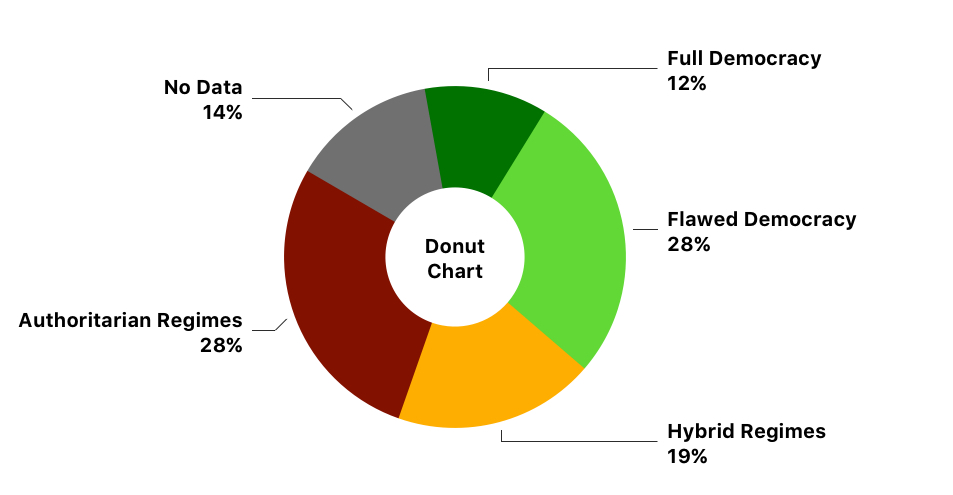
According to the Democracy Index compiled by the Economist Intelligence Unit there are 34 hybrid regimes, representing approximately 20% of countries, encompassing 17.2% to 20.5% of the world's population.
"The EIU Democracy Index is based on ratings across 60 indicators, grouped into five categories: electoral process and pluralism, civil liberties, the functioning of government, political participation and political culture." The Democracy Index defines hybrid regimes with the following characteristics:
- Electoral fraud or irregularities occur regularly
- Pressure is applied to political opposition
- Corruption is widespread and rule of law tends to be weak
- Media is pressured and harassed
- There are issues in the functioning of governance

Full democracies Flawed democracies Hybrid regimes Authoritarian regimes ]] As of 2024 the countries considered hybrid regimes by the "Democracy Index" are:
- Romania
- Papua New Guinea
- Senegal
- Paraguay
- Malawi
- Zambia
- Peru
- Fiji
- Bhutan
- Liberia
- Armenia
- Hong Kong
- Honduras
- Madagascar
- Mexico
- Georgia
- Ecuador
- Tanzania
- Bosnia and Herzegovina
- Kenya
- Morocco
- Ukraine
- Tunisia
- El Salvador
- Nepal
- Guatemala
- Uganda
- Gambia
- Bangladesh
- Benin
- Sierra Leone
- Bolivia
- Turkey
- Ivory Coast
- Nigeria
- Angola
Global State of Democracy Report
According to the "Global State of Democracy Report" by International Institute for Democracy and Electoral Assistance (IDEA), there are twenty hybrid regimes. "International IDEA compiles data from 12 different data sources, including expert surveys and observational data includes the extent to which voting rights are inclusive, political parties are free to form and campaign for office, elections are free, and political offices are filled through elections." IDEA defined hybrid regimes as:
As of 2021 the countries considered hybrid regimes by the "Global State of Democracy Report" are:
- Angola
- Benin
- Côte d'Ivoire
- Democratic Republic of the Congo
- Ethiopia
- Gabon
- Jordan
- Kuwait
- Kyrgyzstan
- Libya
- Mauritania
- Morocco
- Mozambique
- Nigeria
- Serbia
- Singapore
- Tanzania
- Togo
- Tunisia
- Turkey
V-Dem Democracy Indices

According to the V-Dem Democracy Indices compiled by the V-Dem Institute at the University of Gothenburg there are 65 hybrid regimes. V-Dem's "Regimes of the World" indicators identify four political regimes: closed autocracies, electoral autocracies, electoral democracies, and liberal democracies.
According to the V-Dem Institute:
A mere 13% of the world's population reside in liberal democracies, and 16% in electoral democracies. }}
Freedom House

Freedom House ratings for European Union and surrounding states, in 2019 ]] Freedom House measures the level of political and economic governance in 29 countries from Central Europe to Central Asia.
"Freedom House assign scores to countries and territories across the globe on 10 indicators of political rights (e.g., whether there is a realistic opportunity for opposition parties to gain power through elections) and 15 indicators of civil liberties (e.g., whether there is a free and independent media)." Freedom House classifies transitional or hybrid regimes as:
In 2024, Freedom House classified 11 of 29 countries analyzed as "Transitional or Hybrid Regimes":
- Armenia
- Georgia
- Albania
- Bosnia and Herzegovina
- Kosovo
- Ukraine
- Hungary
- Moldova
- Serbia
- North Macedonia
- Montenegro
Typology
According to Yale professor Juan José Linz, there are three main types of political systems today: democracies, totalitarian regimes and, sitting between these two, authoritarian regimes with many different terms that describe specific types of hybrid regimes.
Academics generally refer to a full dictatorship as either a form of authoritarianism or totalitarianism over a "hybrid system". Authoritarian governments that conduct elections are in many scholars view not hybrids, but are successful well-institutionalized stable authoritarian regimes. Democratic elements can simultaneously serve authoritarian purposes and contribute to democratization.
Electoral authoritarianism
Electoral authoritarianism means that democratic institutions are imitative and, due to numerous systematic violations of liberal democratic norms, in fact adhere to authoritarian methods. Electoral authoritarianism can be competitive and hegemonic, and the latter does not necessarily mean election irregularities. A. Schedler calls electoral authoritarianism a new form of authoritarian regime, not a hybrid regime or illiberal democracy. Moreover, a purely authoritarian regime does not need elections as a source of legitimacy while non-alternative elections, appointed at the request of the ruler, are not a sufficient condition for considering the regime conducting them to be hybrid.
Electoral autocracy
Illiberal democracy
Dominant-party system
Delegative democracy
Dictablanda
Guided democracy
Liberal autocracy
Semi-democracy
Defective democracy
Embedded democracy
Competitive authoritarian regimes
Competitive authoritarianism is a subtype of authoritarianism and of the wider hybrid regime type. This regime type was defined to encapsulate states that contain formal democratic institutions that rulers view as the principal means of obtaining and exercising legitimate political authority against a real opposition and other semblances of democratic political society, in which officials violate election freedom and fairness in order to retain power. The officials interfere with opposition organisations, failing to respect minimum conventional standards democracy.
Three main instruments are used within competitive authoritarian regimes to maintain political power: the self-serving use of state institutions (regarding abuses of electoral and judicial institutions such as voter intimidation and voter fraud); the overuse of state resources (to gain influence and/or power over proportional representation media, and use legal resources to disturb constitutional change); and the disruption of civil liberties (such as freedom of speech/press and association).
In the post-Soviet era, continuing into the 2010s, the number of competitive authoritarian regimes increased.
Notes
References
Sources
References
- Gagné, Jean-François. (Mar 10, 2015). "Hybrid Regimes". Oxford University Press (OUP).
- Plattner, Marc F.. (1969-12-31). "Is Democracy in Decline?".
- (2019-09-07). "Hybrid Concepts and the Concept of Hybridity".
- Urribarri, Raul A. Sanchez. (2011). "Courts between Democracy and Hybrid Authoritarianism: Evidence from the Venezuelan Supreme Court". Wiley.
- Göbel, Christian. (2011). "21st Century Political Science: A Reference Handbook". SAGE Publications, Inc..
- Tlemcani, Rachid. (2007-05-29). "Electoral Authoritarianism".
- (2022-05-19). "What is Hybrid Democracy?".
- Zinecker, Heidrun. (2009). "Regime-Hybridity in Developing Countries: Achievements and Limitations of New Research on Transitions". [Oxford University Press, Wiley, The International Studies Association].
- (2017-09-23). "Index".
- (2015). "Comparing autocracies in the early Twenty-first Century: Volume 1: Unpacking Autocracies - Explaining Similarity and Difference". Taylor & Francis.
- (2018). "The Surprising Instability of Competitive Authoritarianism". Journal of Democracy.
- (2002). "The Rise of Competitive Authoritarianism". Project Muse.
- "Competitive Authoritarianism: Hybrid Regimes After the Cold War".
- "Hybrid Regimes".
- Mufti, Mariam. (Jun 22, 2018). "What Do We Know about Hybrid Regimes after Two Decades of Scholarship?". Cogitatio.
- "Home - IDEA Global State of Democracy Report".
- Schedler, Andreas. (Aug 1, 2013). "The Politics of Uncertainty". Oxford University Press.
- Brooker, P.. (2013). "Non-Democratic Regimes". Bloomsbury Publishing.
- Schmid, Jonas Willibald. (2025). "Electoral autocracies, hybrid regimes, and multiparty autocracies: same, same but different?". Democratization.
- Cassani, Andrea. (September 3, 2013). "Hybrid what? Partial consensus and persistent divergences in the analysis of hybrid regimes". SAGE.
- Ekman, Joakim. (2009). "Political Participation and Regime Stability: A Framework for Analyzing Hybrid Regimes". International Political Science Review.
- Baker, A.. (2021). "Shaping the Developing World: The West, the South, and the Natural World". SAGE.
- (2018). "How Dictatorships Work". Cambridge University Press.
- Riaz, Ali. (2019). "Voting in a Hybrid Regime". Springer.
- Schmotz, Alexander. (2019-02-13). "The Handbook of Political, Social, and Economic Transformation". Oxford University Press.
- Morlino, Leonardo. (2011-11-01). "Changes for DemocracyActors, Structures, Processes". Oxford University Press.
- (2016). "Политология: Учебное пособие". ХГУ НУА.
- Schulmann, Ekaterina. (15 August 2014). "Царство политической имитации". Ведомости.
- (2020). "Democracy and Globalization: Anger, Fear, and Hope". Taylor & Francis.
- Bogaards, Matthijs. (2009). "How to classify hybrid regimes? Defective democracy and electoral authoritarianism". Democratization.
- Norris, Pippa. (2017). "Is Western Democracy Backsliding? Diagnosing the Risks". Elsevier.
- Hale, Henry E.. (2010). "Eurasian Polities as Hybrid Regimes: The Case of Putin's Russia". SAGE Publications.
- Hameed, Dr. Muntasser Majeed. (2022-06-30). "Hybrid regimes: An Overview". IPRI Journal.
- Isaac, J. C.. (1998). "Democracy in Dark Times". Cornell University Press.
- (2021). "Foundations of comparative politics: democracies of the modern world".
- Huntington, S. P.. (2012). "The Third Wave: Democratization in the Late 20th Century". University of Oklahoma Press.
- Matthijs Bogaards. 2009. *How to Classify Hybrid Regimes? Defective Democracy and Electoral Authoritarianism". ''Democratization'' 16 (2): 399–423.
- Gagné, Jean-François. (2019-05-02). "Hybrid Regimes".
- (6 March 2017). "Political Science: A Global Perspective". SAGE.
- Andreas Schedler, ed. (2006). ''Electoral Authoritarianism: The Dynamics of Unfree Competition''. Boulder, Colorado: Lynne Rienner.
- link. (2021-07-29 .)
- Dam, Caspar ten. (Feb 17, 2017). "Democratic Transition, Transformation and Development in times of War and Peace: Conceptualisations and Observations".
- (2018-09-04). "Authoritarianism: What Everyone Needs to Know". Oxford University Press.
- "Foundations of Comparative Politics".
- (2008-06-01). "Hybrid regimes and the challenges of deepening and sustaining democracy in developing countries". South African Journal of International Affairs.
- (2012). "Origins and Outcomes of Electoral Institutions in African Hybrid Regimes: A Comparative Perspective". German Institute of Global and Area Studies (GIGA).
- Ekman, Joakim. (2009). "Political Participation and Regime Stability: A Framework for Analyzing Hybrid Regimes". International Political Science Review.
- (2019). "The Handbook of Political, Social, and Economic Transformation".
- Treisman, Daniel. (2011). "Presidential Popularity in a Hybrid Regime: Russia under Yeltsin and Putin". American Journal of Political Science.
- Morlino, Leonardo. (July 2009). "Are there hybrid regimes? Or are they just an optical illusion?". European Political Science Review.
- "Global Dashboard".
- (2021-12-31). "Nations in Transit Methodology".
- Greenwood, Shannon. (2022-12-06). "Appendix A: Classifying democracies".
- Schmid, Jonas Willibald. (2025). "Electoral autocracies, hybrid regimes, and multiparty autocracies: same, same but different?". Democratization.
- Schmid, Jonas Willibald. (2025). "Electoral autocracies, hybrid regimes, and multiparty autocracies: same, same but different?". Democratization.
- "Democracy Index 2024".
- (2021-11-22). "The Global State of Democracy".
- (2021-12-31). "FAQs – The Global State of Democracy Indices".
- International Institute for Democracy and Electoral Assistance. (2021). "The Global State of Democracy 2021: Building resilience in a Pandemic Era".
- "Democracy Report 2025, 25 Years of Autocratization – Democracy Trumped?".
- (March 2021). "V-Dem Codebook v11".
- (March 19, 2018). "Regimes of the World (RoW): Opening New Avenues for the Comparative Study of Political Regimes". Cogitatio.
- (2022-05-23). "State of the world 2021: autocratization changing its nature?". Democratization.
- [[Freedom House]]. (2019-02-06). "Democracy in Retreat". Freedom in the World.
- "Countries and Territories".
- Dobratz, B.A.. (2015). "Power, Politics, and Society: An Introduction to Political Sociology". Taylor & Francis.
- (2000). "Totalitarian and Authoritarian Regimes". Lynne Rienner Publisher.
- (3 February 2014). "Reader's Guide to the Social Sciences". Routledge.
- (10 September 2015). "History for the IB Diploma Paper 2 AuthoritariaAuthoritarian States (20th Century)". Cambridge University Press.
- (2009). "Totalitarian and Authoritarian Dictators: A Comparison of Fidel Castro and Alfredo Stroessner". Journal of Latin American Studies.
- Schedler, Andreas. (2009). "The SAGE Handbook of Comparative Politics". SAGE Publications Ltd.
- link. (2022-12-30 ; [https://muse.jhu.edu/article/16690/summary T. Karl 1995] {{Webarchive). link. (2021-03-01 ; [https://scholar.google.com/citations?hl=en&user=VPgc_xUAAAAJ#d=gs_md_cita-d&u=%2Fcitations%3Fview_op%3Dview_citation%26hl%3Den%26user%3DVPgc_xUAAAAJ%26citation_for_view%3DVPgc_xUAAAAJ%3AZeXyd9-uunAC%26tzom%3D-180 L. Diamond 1999] {{Webarchive). link. (2023-01-31 ; [https://scholar.google.com/citations?user=RJER1xQAAAAJ#d=gs_md_cita-d&u=%2Fcitations%3Fview_op%3Dview_citation%26hl%3Den%26user%3DRJER1xQAAAAJ%26citation_for_view%3DRJER1xQAAAAJ%3Au5HHmVD_uO8C%26tzom%3D-180 A. Schedler 2002] {{Webarchive). link. (2022-12-30)
- [[Barbara Geddes]] — Why Parties and Elections in Authoritarian Regimes?; Department of Political Science; March 2006
- Brancati, Dawn. (May 11, 2014). "Democratic Authoritarianism: Origins and Effects". Annual Reviews.
- Schedler, Andreas. (May 15, 2015). "Emerging Trends in the Social and Behavioral Sciences". Wiley.
- Гудков, Лев. (2009). "Природа "Путинизма"". Вестник общественного мнения. Данные. Анализ. Дискуссии..
- (April 2002). "Elections Without Democracy: The Rise of Competitive Authoritarianism". Journal of Democracy.
- (2010-08-16). "Competitive Authoritarianism". Cambridge University Press.
- (2020). "The New Competitive Authoritarianism". Journal of Democracy.
- Diamond, Larry. (April 2002). "Elections Without Democracy: Thinking About Hybrid Regimes". Journal of Democracy.
- Mufti, Mariam. (2018-06-22). "What Do We Know about Hybrid Regimes after Two Decades of Scholarship?". Politics and Governance.
This article was imported from Wikipedia and is available under the Creative Commons Attribution-ShareAlike 4.0 License. Content has been adapted to SurfDoc format. Original contributors can be found on the article history page.
Ask Mako anything about Hybrid regime — get instant answers, deeper analysis, and related topics.
Research with MakoFree with your Surf account
Create a free account to save articles, ask Mako questions, and organize your research.
Sign up freeThis content may have been generated or modified by AI. CloudSurf Software LLC is not responsible for the accuracy, completeness, or reliability of AI-generated content. Always verify important information from primary sources.
Report