From Surf Wiki (app.surf) — the open knowledge base
Hurricane Bob (1979)
Category 1 Atlantic hurricane in 1979

Category 1 Atlantic hurricane in 1979
| Field | Value |
|---|---|
| name | Hurricane Bob |
| image | Bob 1979-07-10 2100Z.jpg |
| caption | Bob intensifying over the Gulf of Mexico on July 10 |
| formed | |
| dissipated |
- Louisiana
- Mississippi
- Tennessee
- Kentucky
- Indiana
- Ohio
Hurricane Bob was the first Atlantic tropical cyclone to be officially designated using a masculine name after the discontinuation of Joint Army/Navy Phonetic Alphabet names. Bob brought moderate damage to portions of the United States Gulf Coast and areas farther inland in July 1979. The storm was the first hurricane in the Gulf of Mexico to form in the month of July since 1959, and was the fifth tropical cyclone to form during the annual hurricane season. Though the origin of Bob can be traced back to a tropical wave near the western coast of Africa in late June, Bob formed from a tropical depression in the southwestern Gulf of Mexico on July 9. Tracking in a general northward direction, favorable conditions allowed for quick strengthening. Less than a day after formation, the system reached tropical storm intensity, followed by hurricane intensity on July 11. Shortly after strengthening into a hurricane, Bob reached its peak intensity with maximum sustained winds of 75 mph and a minimum barometric pressure of 986 mbar (hPa; 29.12 inHg). At the same intensity, Bob made landfall west of Grand Isle, Louisiana, and rapidly weakened after moving inland. However, the resulting tropical depression persisted for several days as it paralleled the Mississippi and Ohio rivers. On July 16, the system emerged into the western Atlantic, where it was subsequently absorbed by a nearby low-pressure area.
Widespread offshore and coastal evacuations took place along the United States Gulf Coast in preparation for Hurricane Bob. Effects from the hurricane on the United States were mostly marginal and typical of a minimal hurricane. The cyclone produced a moderate storm surge, damaging some coastal installments and causing coastal inundation. Strong winds were also associated with Bob's landfall, though no stations observed winds of hurricane force. The winds downed trees and blew out windows, in addition to causing widespread power outages. Heavy rainfall was also reported in some locations, peaking at 7.16 in in Louisiana. Further inland, the torrential rains led to flooding in Indiana, resulting in more considerable damage as opposed to the coast. Bob also spawned eight tornadoes, with two causing significant damage. Overall, Bob was responsible for one death and $20 million in damage.
Meteorological history
The origin of Hurricane Bob can be traced to a tropical wave that was first located near Cape Verde towards the end of June. The disturbance tracked westward with minimal signs of development, and reached the northwestern Caribbean Sea on July 6. The following day, the tropical system tracked across the Yucatán Peninsula the following day, and upon emerging into the Gulf of Mexico, the cluster of storms began to develop a weak circulation center. This enabled for more rapid tropical cyclogenesis, and at 1200 UTC on July 9, the disturbance was analyzed to have organized into a tropical depression – the third of such in the Atlantic that year. The depression strengthened rather quickly, and on the morning of July 10 a United States Air Force reconnaissance flight indicated that the tropical cyclone had strengthened to tropical storm intensity while situated 740 mi south of Louisiana. At the time the flight measured a minimum barometric pressure of 998 mbar (hPa; 29.47 inHg).
Upon reaching tropical storm intensity, Bob began to curve further northward as opposed to its prior, northeasterly track, due to the presence of a strengthening, upper-level trough to the storm's west. The trough greatly enhanced atmospheric conditions around Bob, allowing for the tropical cyclone to intensify rapidly. Though the hurricane's maximum sustained winds would hold steady at 75 mph for approximately the ensuing twelve hours, the storm's barometric pressure would fluctuate before reaching a minimum of 981 mbar (hPa; 28.98 inHg) at 1200 UTC that day; this would be Bob's lowest documented barometric pressure. At around the same time, the hurricane made landfall west of Grand Isle, Louisiana. After moving inland, Bob quickly weakened due to land interaction, and was a mere tropical depression by July 12. However, the resulting depression would maintain its intensity for the next several days. On July 13, the low-pressure area drifted into southern Ohio and afterwards curved eastward. On July 16, Bob's remnants moved into the western Atlantic, where they were subsequently absorbed by another low-pressure area.
Preparations
As Bob moved towards the U.S. Gulf Coast, the National Weather Service issued gale warnings for coastal regions extending from Vermilion Bay, Louisiana to Biloxi, Mississippi at 1600 UTC on July 10. These warnings were upgraded to hurricane warnings upon Bob's strengthening to such an intensity. During the storm's existence, forecasts and predictions from the National Hurricane Center were of greater accuracy than on average.
In preparation for the storm, 8,000 offshore oil workers were evacuated. On land, 2,500 residents and tourists on Grand Isle were also evacuated.
Impact
Effects in the United States as a result of Bob were typical of a minimal hurricane, and were not of considerable nature. At the coast, Bob caused moderate storm surge, resulting in coastal waters rising to as high as 5 ft above normal. The rough seas sunk several boats and caused significant damage to piers. A levee on Grand Isle was breached by the surge, resulting in some coastal inundation. Minor beach erosion occurred on the coast of Mississippi. In Mobile County, Alabama, the wave action damaged cars near the shore and disrupted seafood operations in the Bayou La Batre area.
Strong winds were reported in association with the storm, but no station documented sustained winds within hurricane force. The highest wind observation was taken on an oil rig off the coast of Louisiana, which clocked sustained winds at 63 mph. However, the strongest wind gust in association with the hurricane was measured in Bay St. Louis, Mississippi, at 64 mph. In addition, widespread power outages impacted 53,000 electricity customers in the city's area. Similar incidents took place in Houma, Louisiana. In Lafitte, Louisiana, two men were blown off of the roof of a marina, and one of them was killed; this would be the only death associated with the hurricane. Further east, in Florida, trees and power lines were downed in Niceville.
Hurricane Bob also produced a widespread area of rain that was heavy in localized areas. Rainfall associated with the hurricane peaked at 7.16 in in Louisiana, where the storm made landfall. Statewide rainfall totals peaked at 6.64 and in Pascagoula, Mississippi and Robertsdale, Alabama, respectively. Further inland, the remnants of Bob dropped heavy rainfall in the Midwestern United States, peaking at 5.72 in at a station in Indiana University Bloomington. In addition to the strong winds and heavy rain, Bob produced eight tornadoes across the southern United States. One of these tornadoes caused $27,500 in damage after striking areas of Biloxi, Mississippi. Overall, Hurricane Bob caused approximately $20 million in damage. However, $15 million in damage resulted from flooding in Indiana, with the rest of the storm's monetary impacts arising from coastal regions.
Notes
References
References
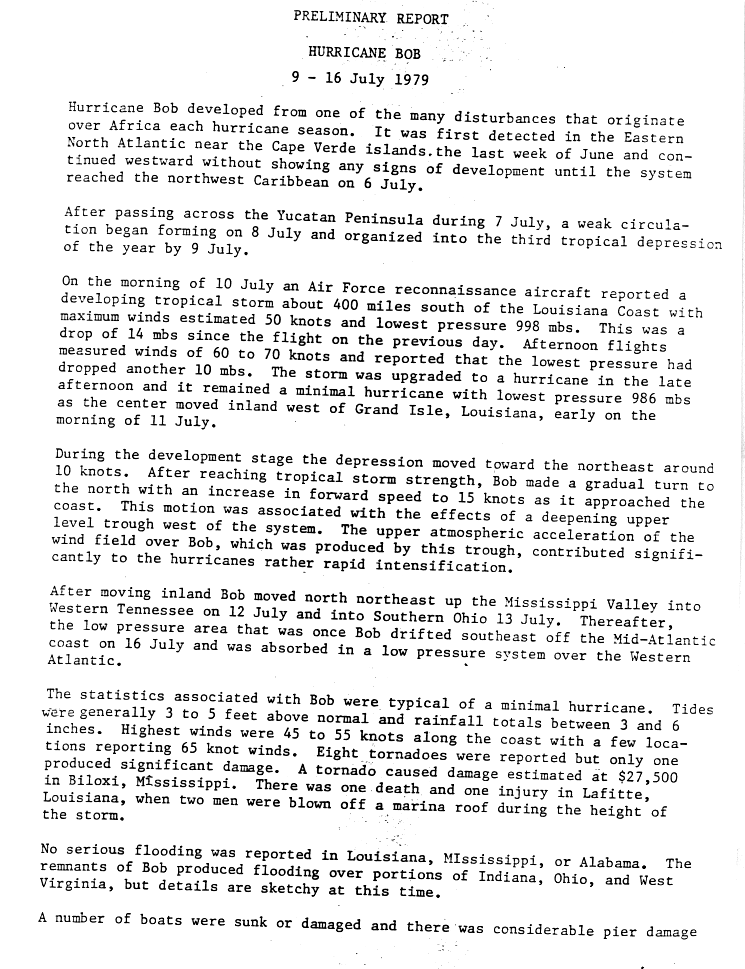
- National Hurricane Center. "Preliminary Report for Hurricane Bob, Page 1". United States National Oceanic and Atmospheric Administration.
- Schmid, Randolph E.. (May 27, 1979). "Men to Share Hurricane Blame". Palm Beach Post-Times.
- (July 12, 1979). "Severe Weather Kills 1, Injures 4". Florence Times Daily.
- (July 11, 1979). "Hurricane Bob Is First of the Season". Pittsburgh Post-Gazette.
- (July 11, 1979). "Hurricane Bob Aims For Louisiana". Daytona Beach Morning Journal.
- Roth, David M.. "Hurricane Bob - July 9-16, 1979". United States National Oceanic and Atmospheric Administration's Weather Prediction Center.
- Roth, David M.. "Tropical Cyclone Rainfall for the Gulf Coast". United States National Oceanic and Atmospheric Administration's Weather Prediction Center.
- Roth, David M.. "Tropical Cyclone Rainfall for the Midwest". United States National Oceanic and Atmospheric Administration's Weather Prediction Center.
This article was imported from Wikipedia and is available under the Creative Commons Attribution-ShareAlike 4.0 License. Content has been adapted to SurfDoc format. Original contributors can be found on the article history page.
Ask Mako anything about Hurricane Bob (1979) — get instant answers, deeper analysis, and related topics.
Research with MakoFree with your Surf account
Create a free account to save articles, ask Mako questions, and organize your research.
Sign up freeThis content may have been generated or modified by AI. CloudSurf Software LLC is not responsible for the accuracy, completeness, or reliability of AI-generated content. Always verify important information from primary sources.
Report