From Surf Wiki (app.surf) — the open knowledge base
Human-powered hydrofoil
Small hydrofoil watercraft
Small hydrofoil watercraft

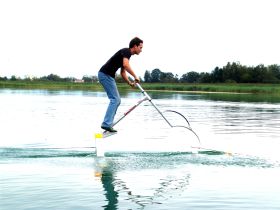
A human-powered hydrofoil is a small hydrofoil watercraft propelled entirely by the muscle power of its operator(s). Hydrofoils are the fastest water-based vehicles propelled solely by human power. They can reach speeds of up to 34 km/h, |access-date= 2008-04-29 |archive-date= 2008-09-16 |archive-url= https://web.archive.org/web/20080916224552/http://stuff.tv/News/Pumpabike-personal-hydrofoil/3096/ |url-status= dead | access-date = 2013-02-10}} easily exceeding the world records set by competitive rowing which stand at about 20 km/h. This speed advantage is achieved since hydrofoils lack a submerged body to provide buoyancy, greatly reducing the drag force.
Propulsion
Means of propulsion include screw propellers, as in hydrocycles; aircraft propellers, as in the Decavitator; paddles, as in a Flyak; oars, as in the Yale hydrofoil sculling project;{{cite web | access-date = 2016-07-06}} and flapping wings, as detailed below.
Flapping wing propulsion
Flapping wing propulsion devices are hydrofoils that produce propulsion by forcing a foil to move up and down in the water. The forward motion of the foil then generates lift as in other hydrofoils. A common design consists of a large foil at the stern that is used both for propulsion and keeping the passenger above the water, connected to a smaller foil at the bow used for steering and longitudinal stability. Riders operate the vehicle by bouncing up and down on a small platform at the stern, whilst holding onto a steering column. |access-date = 2008-04-29 |url-status = dead |archive-url = https://web.archive.org/web/20070319032433/http://gadgetshow.five.tv/jsp/5gsmain.jsp?lnk=401&featureid=219&pageid=-1&show=s5e5§ion=Features |archive-date = 2007-03-19 |access-date=2008-04-29 It is started and landed from the shore, or preferably from a dock, and requires a bit of experience. When moving too slowly, it will sink, and the range of possible speeds is 9 -.
Several variations on the design have been developed:
- The Wasserläufer was a forerunner of the design developed in Germany during the 1950s.{{cite web | access-date = 2013-02-10}}
- The Flying Fish was developed by Allan Abbott and Alec Brooks in 1984.{{cite web | access-date = 2013-12-31}}
- The Pogofoil, with pontoons for flotation, was developed in the US in 1989.{{cite web | access-date = 2013-02-10}}
- The Trampofoil was developed in Sweden in 1998.{{cite web | access-date = 2013-02-10}}
- The AquaSkipper was developed the US in 2003.{{cite web | access-date = 2013-02-10}}{{cite web | access-date = 2013-02-10}}
- The Pumpabike was developed in South Africa in 2004.{{cite web | access-date = 2013-02-10}}
Electric assist hydrofoils
- The Hydrofoiler XE-1 is a Hydrofoil electric bike developed in New Zealand in 2011 onwards.
References
References
- (6 October 2017). "Hydrofoil water bike to launch before Christmas".
This article was imported from Wikipedia and is available under the Creative Commons Attribution-ShareAlike 4.0 License. Content has been adapted to SurfDoc format. Original contributors can be found on the article history page.
Ask Mako anything about Human-powered hydrofoil — get instant answers, deeper analysis, and related topics.
Research with MakoFree with your Surf account
Create a free account to save articles, ask Mako questions, and organize your research.
Sign up freeThis content may have been generated or modified by AI. CloudSurf Software LLC is not responsible for the accuracy, completeness, or reliability of AI-generated content. Always verify important information from primary sources.
Report