From Surf Wiki (app.surf) — the open knowledge base
Honeycomb housing

Honeycomb housing is an urban planning model pertaining to residential subdivision design.
The defining hexagonal tessellation, or "honeycomb" pattern, consists of multiple housing clusters containing 5–16 houses and centered around a courtyard in a cul-de-sac arrangement at its smallest unit of organization. Multiple clusters are connected to each other to form larger cul-de-sac communities with up to 42 houses in total. These courtyard communities are in turn also connected to one another, making up a distinct neighborhood of up to 300 houses.
The honeycomb concept was first introduced in Malaysia as an alternative to terrace houses and the predominantly rectilinear form of residential layouts.
| [[File:Hexagonal courtyard neighbourhood.jpg | thumb | 140px | alt= plan of a small courtyard neighbourhood. | A small courtyard neighbourhood.]] | [[File:Cul-de-sac neighbourhood.jpg | thumb | 140px | alt= a cul-de-sac neighbourhood composed from three connected courtyards | A cul-de-sac community composed from three connected courtyards.]] | [[File:Honeycomb neighbourhood.jpg | thumb | 205px | alt=a honeycomb neighbourhood | A honeycomb neighbourhood.]] |
|---|
It can also be described as a new form of cul-de-sac layout.
From Cul-de-sac to Honeycomb
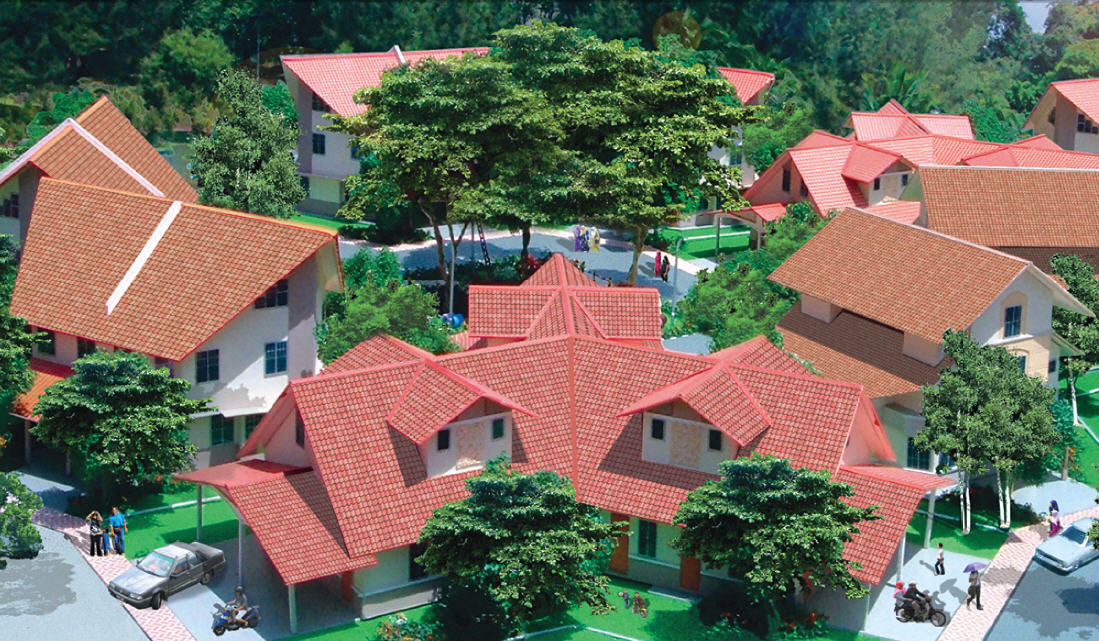

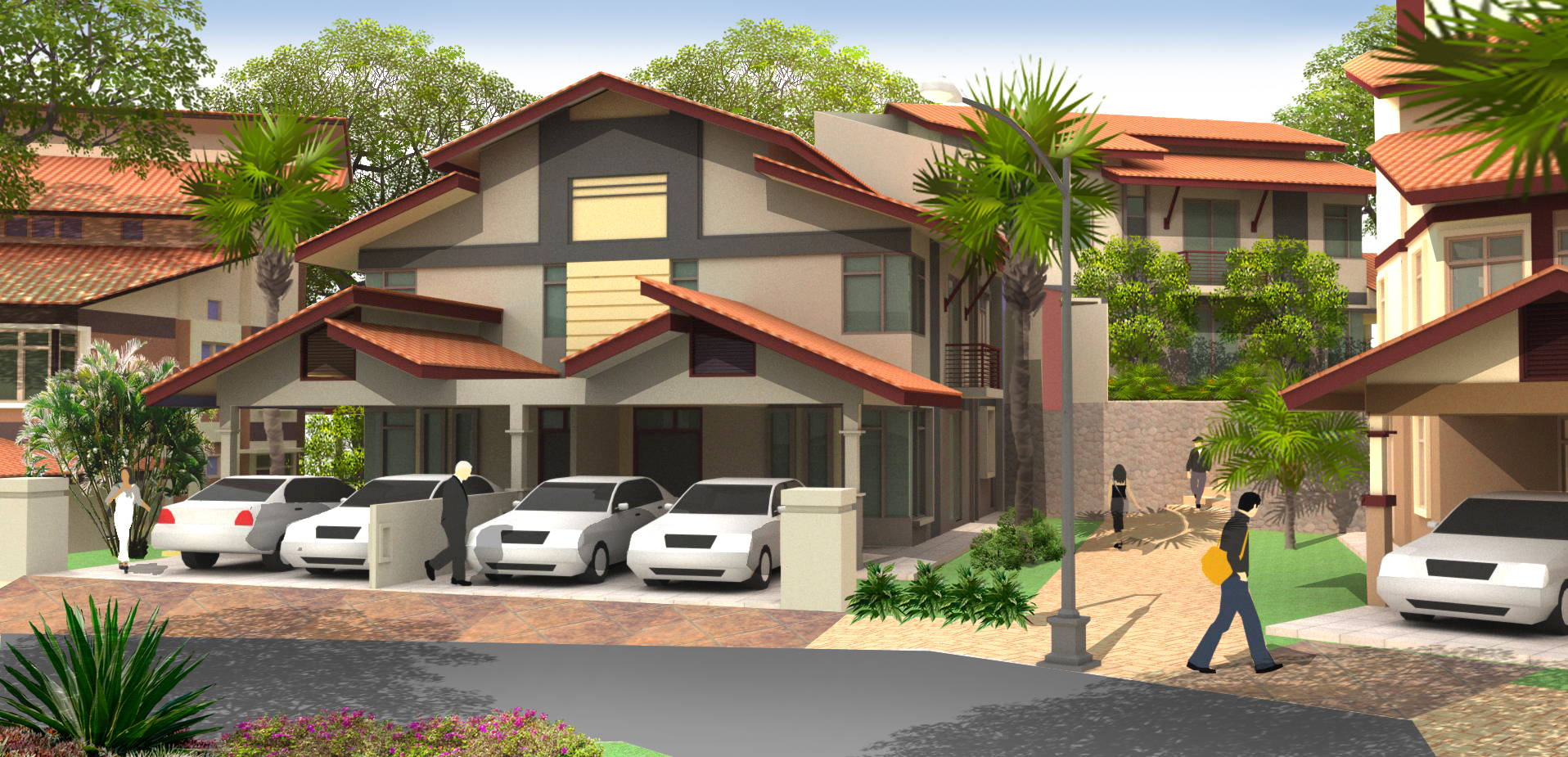
Cul-de-sacs are popular: they are perceived as being safer, more exclusive and neighbourly. According to one study, between the 'grid', 'loops' and cul-de-sacs, the latter were the most popular. These houses are used in Malaysia.
Since houses are built around a small park with plentiful shady trees, this communal garden is easily accessible to all in the cul-de-sac, allowing it to act as a social focus that can encourage social interaction and neighborly spirit.
The courtyard area is a "defensible space" as well, as it acts naturally to reduce crime in the sense that strangers are quickly spotted. The short winding roads put a stop to speeding traffic, and certain to dissuade snatch thieves on motorcycles – therefore becoming safe for children, pedestrians and cyclists.
Apart from the social advantages, it is also claimed that compared to the terrace house layout, the honeycomb layout uses land efficiently and offers savings in the cost of infrastructure.
The honeycomb Layout may be said to be inspired from the geometrical design of Islamic tiles and the structure of beehives. Introduced by Kuala Lumpur-based architect Mazlin Ghazali, it has received a patent, that is expired as of 2024.
Honeycomb Housing projects under construction
The honeycomb concept has been applied to a hillside development on 14 acres of land at Kampung Nong Chik the edge of Johor Bahru business district in a development which advertises a modern version of the traditional village or "kampong" lifestyle.
Criticism
Being so new, many developers would worry about the difficulty of obtaining approvals from the local authorities and so hesitate to be the first to adopt the honeycomb concept. Another problem is that the houses are not rectangular and the house design ends up with odd corners in the house. Another criticism comes from followers ‘fengshui’, the ancient Chinese art of geomancy, who believe that in a cul-de-sac 'the chi energy coming to a house placed at the end of a road is usually fast, so the energy is pernicious and non-beneficial. Instead of bringing good fortune, it brings misfortune'.
Nowadays cul-de-sacs are often frowned upon in planning circles, especially by supporters of the New Urbanism: However the Honeycomb housing concept – which allows relatively high density – does appear to overcome some of the concerns here.
References
References
- (2005). "Tessellation Planning and Honeycomb Housing". Journal of the Malaysian Institute of Planners.
- Eran Ben-Joseph (1995), "Livability and Safety of Suburban Street Patterns: a Comparative Study", Working Paper 641, Berkeley, CA: University of California
- Alter, Lloyd. (7 April 2008). "Reinventing the Cul-de-Sac".
- Umakanthan, G.. (4 June 2005). "Building Like A Bee". [[New Straits Times]].
- Hashim, Habsah. (September 2005). "Harmonious Community Living in Urban Neighbourhoods: A Case of Central Shah Alam". 8th. International Asian Planning Schools Association Congress.
- (September 2005). "Incorporating Children in Neighbourhood Design and Planning". 8th International Asian Planning Schools Association Congress.
- Mazlin Ghazali, Mohd Peter Davis (December 2005), "Affordable Honeycomb Housing", Architecture Malaysia: Journal of the Malaysian Institute of Architects Volume 17 Issue 6 pp.36–40
- "Method of subdividing a plot of land for housing and a housing subdivision so formed".
- George Lam (2009), "HA: ideas and Concepts", Pace Publishing Limited, Hong Kong; pp 166–168
- E. Jacqui, Chan. (26 October 2009). "City & Country: Good take-up for unsold stock".
- "What To Do If You Live in a Cul-De-Sac".
- Gorrie, Peter. (29 March 2008). "End of the road for the cul-de-sac?".
- Alter, Lloyd. (7 April 2008). "Reinventing the Cul-de-Sac".
This article was imported from Wikipedia and is available under the Creative Commons Attribution-ShareAlike 4.0 License. Content has been adapted to SurfDoc format. Original contributors can be found on the article history page.
Ask Mako anything about Honeycomb housing — get instant answers, deeper analysis, and related topics.
Research with MakoFree with your Surf account
Create a free account to save articles, ask Mako questions, and organize your research.
Sign up freeThis content may have been generated or modified by AI. CloudSurf Software LLC is not responsible for the accuracy, completeness, or reliability of AI-generated content. Always verify important information from primary sources.
Report