From Surf Wiki (app.surf) — the open knowledge base
Homebrew Computer Club
Computer hobbyist users' group in California
Computer hobbyist users' group in California
The Homebrew Computer Club was an early computer hobbyist group in Menlo Park, California, which met from March 1975 to December 1986. The club had an influential role in the development of the microcomputer revolution and the rise of that aspect of the Silicon Valley information technology industrial complex.
Several high-profile hackers and computer entrepreneurs emerged from its ranks, including Steve Jobs and Steve Wozniak, the founders of Apple Computer. With its newsletter and monthly meetings promoting an open exchange of ideas, the club has been described as "the crucible for an entire industry" as it pertains to personal computing.
History

The Homebrew Computer Club was an informal group of electronic enthusiasts and technically minded hobbyists who gathered to trade parts, circuits, and information pertaining to DIY construction of personal computing devices. It was started by Gordon French and Fred Moore who met at the Community Computer Center in Menlo Park. They both were interested in maintaining a regular, open forum for people to get together to work on making computers more accessible to everyone.
The first meeting of the club was held on March 5, 1975, in French's garage in Menlo Park, San Mateo County, California, on the occasion of the arrival in the area of the first Micro Instrumentation and Telemetry Systems (MITS) Altair 8800 microcomputer, a unit sent for review by People's Computer Company. Steve Wozniak credits that first meeting as the inspiration to design the Apple I.{{cite book |last=Wozniak |first=Steve |title=iWoz |url=https://archive.org/details/iwozcomputergeek00wozn |url-access=registration |year=2006 |publisher=W.W. Norton & Company |isbn=978-0-393-33043-4 |page=150 |url-access=registration |author-link1=Paul Freiberger |author-link2=Michael Swaine (technical author)}}
An anecdote from member Thomas "Todd" Fischer relates that after the more-or-less "formal" meetings the participants often reconvened for an informal, late night "swap meet" in the parking lot of the Safeway store down the road, as SLAC campus rules prohibited such activity on campus property. Others, at the suggestion of Roger Melen, convened at The Oasis, a bar and grill they considered a pub located on El Camino Real in nearby Menlo Park, recalled years later by a member as "Homebrew's other staging area". As Steven Levy wrote about the Oasis gatherings:
The Oasis closed on March 7, 2018, due to unaffordable rent. Its Menlo Park building is a historical landmark; in 2019 the building became home to a venture capital firm, Pear VC.
The 1999 made-for-television movie Pirates of Silicon Valley (and the book on which it is based, Fire in the Valley: The Making of the Personal Computer) describes the role the Homebrew Computer Club played in creating the first personal computers, although the movie took the liberty of placing the meeting in Berkeley and misrepresented the meeting process.
Many of the original members of the Homebrew Computer Club continue to meet (), having formed the 6800 Club, named after the Motorola (now Freescale) 6800 microprocessor. Occasionally and variously renamed after the release of the 6800, 6809, and other microprocessors, the group continues to meet monthly in Cupertino, California.
Members
Most of the members were hobbyists but had an electronic engineering or computer programming background. They came to the meetings to talk about the Altair 8800, to review other technical topics, and to exchange schematics and programming tips.
From the ranks of this club came the founders of many microcomputer companies, including Steve Wozniak and Steve Jobs (Apple Computer), Harry Garland and Roger Melen (Cromemco), Thomas "Todd" Fischer (IMSAI Division, Fischer-Freitas Company), George Morrow (Morrow Designs), Paul Terrell (Byte Shop), Adam Osborne (Osborne Computer), and Bob Marsh (Processor Technology). John Draper was a member of the club, as was Jerry Lawson (creator of the first cartridge-based video game system, Fairchild Channel F).
Li-Chen Wang, developer of Palo Alto Tiny Basic and graphics software for the Cromemco Dazzler, was a club member, and Lee Felsenstein was moderator of the club meetings. Steve Inness was a primary designer of one of the early cell phone touch screens as well as a business partner with John Draper. Liza Loop was an early member and the first woman to join.
Others went on to other pursuits, such as Dan Werthimer, who is a researcher in the search for extraterrestrial intelligence.
Newsletter
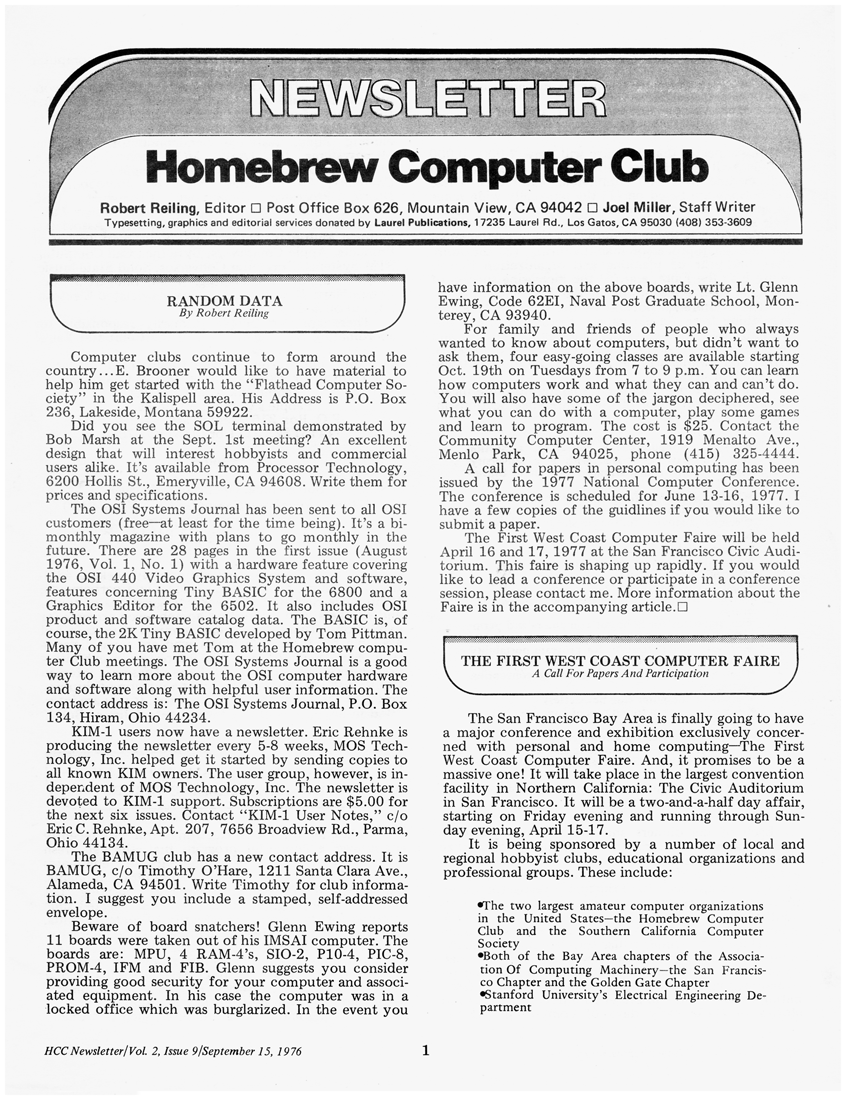
The Homebrew Computer Club's newsletter was one of the most influential forces in the formation of the culture of Silicon Valley. Created and edited by its members, it initiated the idea of the personal computer, and helped its members build the original kit computers, like the Altair. One such influential event was the publication of Bill Gates's "Open Letter to Hobbyists", which lambasted the early hackers of the time for violating the copyrights of commercial software programs.
Paul Terrell, partner in Repco who was the exclusive sales rep company for MITS in Northern California, was a member of the club and would provide information at the meetings about the progress of the Altair 8800 in the factory and provide copies of the MITS Newsletter to members. He later started Byte Shop, an affordable computer store in Mountain View, California, and bought the first 50 Apple I Computers from Steve Jobs and Steve Wozniak after they did a demonstration of the Apple I at a meeting at SLAC.
The first issue of the newsletter was published on March 15, 1975, and continued through several designs, ending after 21 issues in December 1977. The newsletter was published from a variety of addresses in the early days, but later submissions went to a P.O. box address in Mountain View, California.
The second volume began on January 31, 1976, and included sections for A LETTER FROM MITS, CASSETTE UPDATE, TINY BASIC, MEETING FACILITIES, SOFTWARE, PROBLEMS, MEETING-1, and ALTAIR 680.
Reunions
There have been several reunions of the Homebrew Computer Club over the years, including a reunion of the original members on March 5, 2001 and a 30-year anniversary celebration on November 5, 2005.
On August 1, 2025 the Computer History Museum hosted an event titled "The Homebrew Computer Club at 50" as part of the Vintage Computer Festival. The speakers included Lee Felsenstein, Liza Loop, Harry Garland, and Daniel Kottke. Participating remotely (via Zoom) were Ted Nelson, Bob Marsh, and Dan Sokol.
In popular culture
The club is depicted in the films Pirates of Silicon Valley (1999) and Jobs (2013), as well as in the PBS documentary series Triumph of the Nerds (1996). However, the depiction of how the club worked was not entirely accurate.
References
References
- McCracken, Harry. (November 12, 2013). "For One Night Only, Silicon Valley's Homebrew Computer Club Reconvenes".
- "Homebrew And How The Apple Came To Be". atariarchives.org.
- [[John Markoff]], ''[[What the Dormouse Said]]'' ({{ISBN. 0-670-03382-0)
- Ganapati, Priya. (March 5, 2009). "March 5, 1975: A Whiff of Homebrew Excites the Valley".
- (February 24, 2018). "Silicon Valley pub that helped birth PC industry to close because of high rent". Conde Nast.
- [http://www.bambi.net/bob/homebrew_reunion_article.txt Balin, Fred. "Homebrew's 26th Birthday Commemoration." Email dated March 20, 2001]
- (1984). "Hackers". Anchor press/Doubleday.
- (29 August 2019). "Pear Ventures eyes historic digs in historic Menlo Park building". Venture Capital Journal.
- (23 March 2007). "The Future of Business: The Essentials". Cengage Learning.
- Robert M. Collins. (22 August 2009). "Transforming America: Politics and Culture During the Reagan Years". Columbia University Press.
- [http://www.vintagecomputing.com/index.php/archives/545 "Interview: Jerry Lawson, Black Video Game Pioneer"]. Vintage Computing and Gaming, February 24, 2009.
- "Memoir of a Homebrew Computer Club Member".
- (January 13, 2007). "The Twilight Years of Cap'n Crunch". Wall Street Journal.
- "Steve Inness – Davis".
- O'Mara, Margaret Pugh. (2019). "The Code : Silicon Valley and the Remaking of America".
- Benjamin, Marina. (2003). "Rocket Dreams: How the Space Age Shaped Our Vision of a World Beyond". Simon and Schuster.
- [http://archive.computerhistory.org/resources/access/text/2012/10/102702231-05-01-acc.pdf Oral History of Lee Felsenstein] {{Webarchive. link. (December 27, 2014 . Interviewed by Kip Crosby. [[Computer History Museum]] 2008, CHM Reference number: X4653.2008)
- McCracken, Harry. (August 23, 2007). "The Man Who Jump-Started Apple". [[PC World]].
- "Homebrew Computer Club Newsletters, 1975–1977".
- Shustek, Len. "Len Shustek on the Homebrew Computer Club".
- "The Homebrew Computer Club 30 Year Retrospective".
- "The Homebrew Computer Club at 50".
This article was imported from Wikipedia and is available under the Creative Commons Attribution-ShareAlike 4.0 License. Content has been adapted to SurfDoc format. Original contributors can be found on the article history page.
Ask Mako anything about Homebrew Computer Club — get instant answers, deeper analysis, and related topics.
Research with MakoFree with your Surf account
Create a free account to save articles, ask Mako questions, and organize your research.
Sign up freeThis content may have been generated or modified by AI. CloudSurf Software LLC is not responsible for the accuracy, completeness, or reliability of AI-generated content. Always verify important information from primary sources.
Report