From Surf Wiki (app.surf) — the open knowledge base
Home appliance
Machine for household uses

Machine for household uses
| Field | Value | |
|---|---|---|
| name | Home appliance | |
| image | Breville.jpg | alt=two electric kettles, a drip coffee maker, and a toaster on a table top |
| caption | Home appliances may be used in kitchens. | |
| industry | Food and beverages, health care | |
| application | Kitchens and laundry rooms | |
| power_source | Electric, battery powered, natural gas | |
| wheels | In some cases | |
| inventer | James sharp (gas stove) | |
| examples | Refrigerator, toaster, kettle, microwave oven, blender |
A home appliance, also referred to as a domestic appliance, an electric appliance or a household appliance, is a machine which assists in household functions such as cooking, cleaning and food preservation.
The domestic application attached to home appliance is tied to the definition of appliance as "an instrument or device designed for a particular use or function". Collins English Dictionary defines "home appliance" as: "devices or machines, usually electrical, that are in your home and which you use to do jobs such as cleaning or cooking". The broad usage allows for nearly any device intended for domestic use to be a home appliance, including consumer electronics as well as stoves, refrigerators, toasters and air conditioners.
The development of self-contained electric and gas-powered appliances, an American innovation, emerged in the early 20th century. This evolution is linked to the decline of full-time domestic servants and desire to reduce household chores, allowing for more leisure time. Early appliances included washing machines, water heaters, refrigerators, and sewing machines. The industry saw significant growth post-World War II, with the introduction of dishwashers and clothes dryers. By the 1980s, the appliance industry was booming, leading to mergers and antitrust legislation. The US National Appliance Energy Conservation Act of 1987 mandated a 25% reduction in energy consumption every five years. By the 1990s, five companies dominated over 90% of the market.
Major appliances, often called white goods, include items like refrigerators and washing machines, while small appliances encompass items such as toasters and coffee makers. Product design shifted in the 1960s, embracing new materials and colors. Consumer electronics, often referred to as brown goods, include items like TVs and computers. There is a growing trend towards home automation and internet-connected appliances. Recycling of home appliances involves dismantling and recovering materials.
History
While many appliances have existed for centuries, the self-contained electric or gas powered appliances are a uniquely American innovation that emerged in the early twentieth century. The development of these appliances is tied to the disappearance of full-time domestic servants and the desire to reduce the time-consuming activities in pursuit of more recreational time. In the early 1900s, electric and gas appliances included washing machines, water heaters, refrigerators, kettles and sewing machines. The invention of Earl Richardson's small electric clothes iron in 1903 gave a small initial boost to the home appliance industry. In the Post–World War II economic expansion, the domestic use of dishwashers, and clothes dryers were part of a shift for convenience. Increasing discretionary income was reflected by a rise in miscellaneous home appliances.
In America during the 1980s, the industry shipped $1.5 billion worth of goods each year and employed over 14,000 workers, with revenues doubling between 1982 and 1990 to $3.3 billion. Throughout this period, companies merged and acquired one another to reduce research and production costs and eliminate competitors, resulting in antitrust legislation.
The United States Department of Energy reviews compliance with the National Appliance Energy Conservation Act of 1987, which required manufacturers to reduce the energy consumption of the appliances by 25% every five years.
In the 1990s, the appliance industry was very consolidated, with over 90% of the products being sold by just five companies. For example, in 1991, dishwasher manufacturing market share was split between General Electric with 40% market share, Whirlpool with 31%, Electrolux with 20%, Maytag with 7% and Thermador with just 2%.
Major appliances
Main article: Major appliance
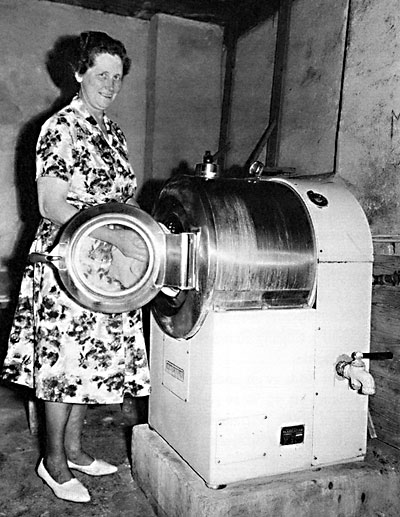
Major appliances, also known as white goods, comprise major household appliances and may include: air conditioners, dishwashers, clothes dryers, drying cabinets, freezers, refrigerators, kitchen stoves, water heaters, washing machines, trash compactors, microwave ovens, and induction cookers. White goods were typically painted or enameled white, and many of them still are.
Small appliances
Main article: Small appliance
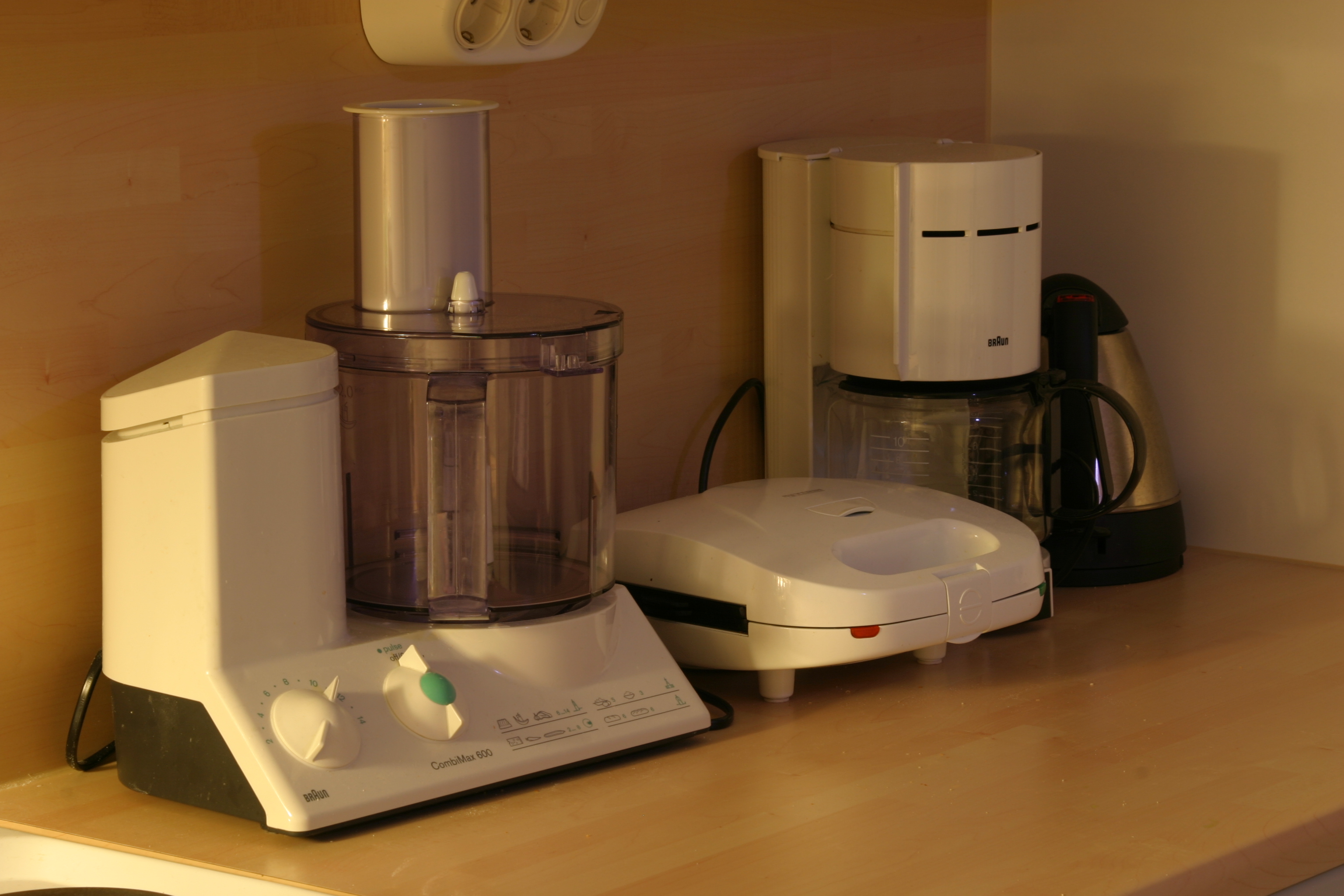

Small appliances are typically small household electrical machines, also very useful and easily carried and installed. Yet another category is used in the kitchen, including: juicers, electric mixers, meat grinders, coffee grinders, deep fryers, herb grinders, food processors, electric kettles, waffle irons, coffee makers, blenders, rice cookers, toasters and exhaust hoods.
Product design
In the 1960s the product design for appliances such as washing machines, refrigerators, and electric toasters shifted away from Streamline Moderne and embraced technological advances in the fabrication of sheet metal. A choice in color, as well as fashionable accessory, could be offered to the mass market without increasing production cost. Home appliances were sold as space-saving ensembles.
Consumer electronics
Main article: Consumer electronics
Consumer electronics (or home electronics) are electronic (analog or digital) equipment intended for everyday use, typically in private homes. Consumer electronics include devices used for entertainment, communications and recreation. In British English, they are often called "brown goods" by producers and sellers, to distinguish them from "white goods" which are meant for housekeeping tasks, such as washing machines and refrigerators, although nowadays, these could be considered brown goods, some of these being connected to the Internet. Some such appliances were traditionally finished with genuine or imitation wood, hence the name. This has become rare but the name has stuck, even for goods that are unlikely ever to have had a wooden case (e.g. camcorders). In the 2010s, this distinction is absent in large big box consumer electronics stores, which sell both entertainment, communication, and home office devices and kitchen appliances such as refrigerators. The highest selling consumer electronics products are compact discs. Examples are: home electronics, radio receivers, TV sets, VCRs, CD and DVD players, digital cameras, camcorders, still cameras, clocks, alarm clocks, computers, video game consoles, HiFi and home cinema, telephones and answering machines.
Life spans
A survey conducted in 2020 of more than thirteen thousand people in the UK revealed how long appliance owners had their appliances before needing to replace them due to a fault, deteriorating performance, or the age of the appliance.
| Appliance | Longest average estimated lifespan | Shortest average estimated lifespan |
|---|---|---|
| Washing machine | 21 years | 13 years |
| Tumble dryer | 24 years | 17 years |
| Dishwasher | 22 years | 13 years |
| Built-in oven | 29 years | 23 years |
| Fridge freezer | 24 years | 14 years |
| Fridge | 29 years | 18 years |
Home automation
Main article: Home automation
There is a trend of networking home appliances together, and combining their controls and key functions. For instance, energy distribution could be managed more evenly so that when a washing machine is on, an oven can go into a delayed start mode, or vice versa. Or, a washing machine and clothes dryer could share information about load characteristics (gentle/normal, light/full), and synchronize their finish times so the wet laundry does not have to wait before being put in the dryer.
Additionally, some manufacturers of home appliances are quickly beginning to place hardware that enables internet connectivity in home appliances to allow for remote control, automation, communication with other home appliances, and more functionality enabling connected cooking. Internet-connected home appliances were especially prevalent during recent Consumer Electronics Show events.
Recycling
Main article: Appliance recycling
Appliance recycling consists of dismantling waste home appliances and scrapping their parts for reuse. The main types of appliances that are recycled are T.V.s, refrigerators, air conditioners, washing machines, and computers. It involves disassembly, removal of hazardous components and destruction of the equipment to recover materials, generally by shredding, sorting and grading.
Notes
References
References
- "Household Appliance".
- "Appliance".
- "Definition of household appliances". Collins Dictionary.
- "white goods". [[Collins English Dictionary]].
- "brown goods". Collins English Dictionary.
- (1994). "Encyclopedia of American Industries Volume 1". Gale Research.
- George. (January 2018). "Antique Electric Waffle Irons 1900-1960: A History of the Appliance Industry in 20th Century America". Trafford Publishing.
- "White Goods". Data monitor, Static.scrib.
- (2003). "History of Modern Design: Graphics and Products Since the Industrial Revolution". Laurence King.
- "brown goods". [[Collins English Dictionary]].
- McDermott, Catherine. (30 October 2007). "Design: The Key Concepts". Routledge.
- (17 August 2007). "Compact disc hits 25th birthday". [[BBC News]].
- Pratt, Martin. "How long should you expect your large kitchen appliances to last?".
- (1 September 2014). "Getting Smarter All the Time: The Appliance Landscape Continues to Evolve with the Rise of Internet-Connected Devices". BNP Media.
- (10 December 2013). "Home appliance makers connect with open source 'Internet of things' project".
- "Appliance Science: The Internet of Toasters (and other things)".
- (February 2015). "The Internet of uncertainty". Hydraulics & Pneumatics.
- (15 January 2015). "Appliances of the Future Will Be Able to 'Talk' over Internet". [[The Mercury (South Africa).
- (2014). "Recycling of WEEE plastics: A review". The Journal of Material Cycles and Waste Management.
- "appliance (definition)".
- (29 May 2014). "Best Small Appliances — Small Appliance Reviews".
- "Efficient Appliances Save Energy -- and Money". Natural Resources Defense Council.
- Bulletin, Manila. (9 November 2014). "Tips to ensure safety of home appliances".
This article was imported from Wikipedia and is available under the Creative Commons Attribution-ShareAlike 4.0 License. Content has been adapted to SurfDoc format. Original contributors can be found on the article history page.
Ask Mako anything about Home appliance — get instant answers, deeper analysis, and related topics.
Research with MakoFree with your Surf account
Create a free account to save articles, ask Mako questions, and organize your research.
Sign up freeThis content may have been generated or modified by AI. CloudSurf Software LLC is not responsible for the accuracy, completeness, or reliability of AI-generated content. Always verify important information from primary sources.
Report