From Surf Wiki (app.surf) — the open knowledge base
Holmesina
Extinct genus of armadillo-like mammals

Extinct genus of armadillo-like mammals
(NALMA: Blancan-Rancholabrean) (SALMA: Uquian-Lujanian) ~
- H. floridanus Robertson 1976
- H. major
- H. occidentalis Hoffstetter 1952
- H. paulacoutoi Cartelle & Bohórquez 1985
- H. rondoniensis
- H. septentrionalis Leidy 1889 |Chamytherium Martin & Neuner, 1979 |Chlamytherium Lund, 1839 |Chlamydotherium Lund, 1841 |{{collapsible list|bullets=true|title=H. septentrionalis: |Chlamytherium septentrionalis Sellards 1915 |Glyptodon septentrionalis Leidy 1889
Holmesina is an extinct genus of pampathere, a group of armadillo-like xenarthrans that were distantly related to extant armadillos. Like armadillos, and unlike the other extinct branch of megafaunal cingulates the glyptodonts, the shell was made up of flexible plates which allowed the animal to move more easily.
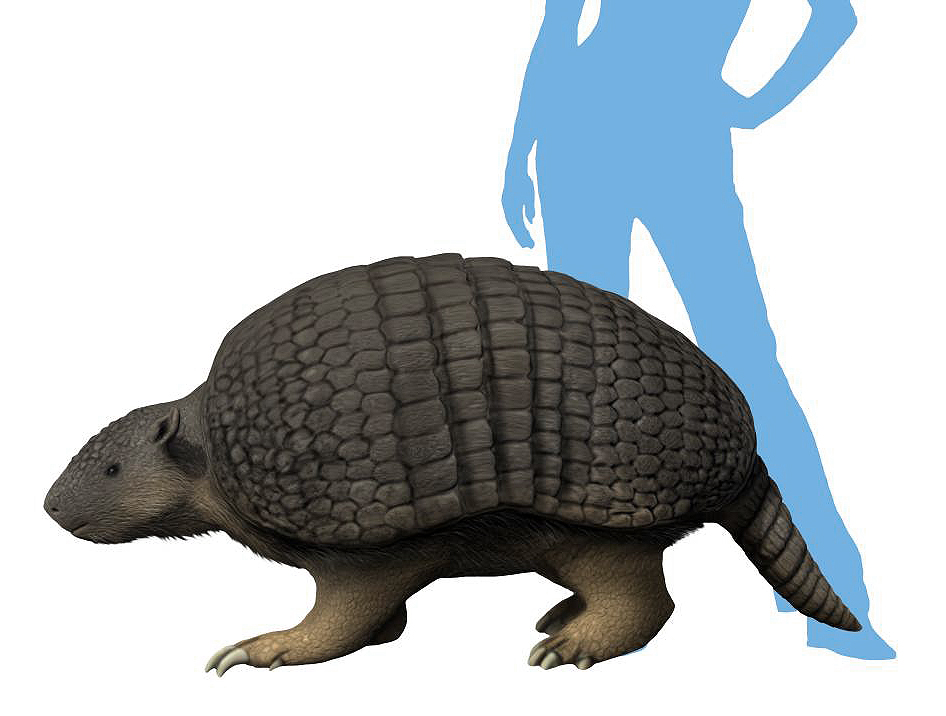
Holmesina individuals were much larger than any modern armadillo: They could reach a length of 2 m, and a weight of 227 kg, while the modern giant armadillo does not attain more than 54 kg.
Taxonomy
Joseph Leidy initially described Holmesina fossils from Florida as Glyptodon septentrionalis in 1889. However, shortly after a close relationship with the pampatheriids was realized, wherein the finds were reassigned to the South American Pampatherium ("Chlamytherium") humboldtii, therein revised to its own species, Chlamytherium septentrionalis, by Elias Howard Sellards in 1915. After additional fossils from Texas were described, George Gaylord Simpson assigned the finds to its own genus, Holmesina, in 1930.
Distribution
They traveled north during the faunal interchange, and adapted well to North America, like the ground sloths, glyptodonts, armadillos, capybaras, and other South American immigrants. During the Late Pleistocene, Holmesina dispersed from North America back into South America, as evidenced by the morphological similarity of Late Pleistocene species in South America. Their fossils are found from Brazil to the United States,{{cite web | access-date = 17 December 2021}} mostly in Texas and Florida.
Diet
Holmesina species were herbivores that grazed on coarse vegetation; armadillos are mostly insectivorous or omnivorous. H. paulacoutoi was a generalist plant-eater but had a preference for C4 plants; it has been estimated based on δ13C and δ18O values from fossils from Sergipe in Brazil that grasses made up 55% of the diet of H. paulacoutoi, with a further 29% being fruits and 16% being leaves.
Palaeopathology
Three H. cryptae specimens have been described bearing evidence of bacterial and fungal infections, along with sand flea ectoparasitism.
References
References
- "Yahoo! Groups".
- Cahn, Alvin R.. (1922). "''Chlamytherium septentrionalis'', a Fossil Edentate New to the Fauna of Texas". Journal of Mammalogy.
- (1930). "''Holmesina septentrionalis'', extinct giant armadillo of Florida". American Museum of Natural History.
- (1 October 2005). "Paleobiogeography of the late Pleistocene pampatheres of South America". [[Journal of South American Earth Sciences]].
- Vizcaíno, S. F.. (1998). "Skull Shape, Masticatory Apparatus, and Diet of ''Vassallia'' and ''Holmesina'' (Mammalia: Xenarthra: Pampatheriidae): When Anatomy Constrains Destiny". Journal of Mammalian Evolution.
- (December 2021). "Isotopic paleoecology (δ13C, δ18O) of two megamammals assemblages from the late pleistocene of Brazilian intertropical region". [[Journal of South American Earth Sciences]].
- (14 July 2020). "Isotopic paleoecology (δ13C, δ18O) of a late Pleistocene vertebrate community from the Brazilian Intertropical Region". Revista Brasileira de Paleontologia.
- (August 2021). "Damaged armour: Ichnotaxonomy and paleoparasitology of bioerosion lesions in osteoderms of Quaternary extinct armadillos". [[Journal of South American Earth Sciences]].
This article was imported from Wikipedia and is available under the Creative Commons Attribution-ShareAlike 4.0 License. Content has been adapted to SurfDoc format. Original contributors can be found on the article history page.
Ask Mako anything about Holmesina — get instant answers, deeper analysis, and related topics.
Research with MakoFree with your Surf account
Create a free account to save articles, ask Mako questions, and organize your research.
Sign up freeThis content may have been generated or modified by AI. CloudSurf Software LLC is not responsible for the accuracy, completeness, or reliability of AI-generated content. Always verify important information from primary sources.
Report