From Surf Wiki (app.surf) — the open knowledge base
HMS Victoria (1887)
Late 19th-century Royal Navy battleship
Late 19th-century Royal Navy battleship
| Field | Value | ||||||
|---|---|---|---|---|---|---|---|
| section1 | {{Infobox ship/image | ||||||
| image | HMS Victoria (1887) William Frederick Mitchell.jpg | ||||||
| image_caption | HMS *Victoria* by William Frederick Mitchell | ||||||
| section2 | {{Infobox ship/career | ||||||
| country | United Kingdom | ||||||
| flag | |||||||
| name | HMS *Victoria* | ||||||
| namesake | Queen Victoria | ||||||
| builder | Armstrong, Mitchell & Co. Elswick yard | ||||||
| original_cost | £845,000 | ||||||
| yard_number | 490 | ||||||
| laid_down | 13 June 1885 | ||||||
| launched | 9 April 1887 | ||||||
| commissioned | March 1890 | ||||||
| nickname | *"The Slipper"; | ||||||
| fate | Accidentally rammed and sunk, 22 June 1893 | ||||||
| section3 | {{Infobox ship/characteristics | ||||||
| header_caption | |||||||
| class | *Victoria*-class ironclad | ||||||
| displacement | 11020 LT | ||||||
| length | 340 ft | ||||||
| beam | 70 ft | ||||||
| draught | 26 ft | ||||||
| power | *8000 ihp (natural draught) | ||||||
| *{{convert | 14482 | ihp | kW | abbr | on}} (forced draught) | ||
| propulsion | *2 × Humphreys & Tennant triple-expansion engines | ||||||
| speed | *16 kn (natural draught) | ||||||
| *{{convert | 17.3 | kn | mph km/h | abbr | on}} (forced draught) | ||
| complement | 430; as flagship: 583 | ||||||
| *2 × [[BL 16.25 inch Mk I naval gun | BL {{convert | 16.25 | in | mm | adj | on | sigfig=3}} gun]]s |
| *1 × [[BL 10 inch gun Mk I - IV | BL {{convert | 10 | in | mm | adj | on | sigfig=3}} gun]] |
| *12 × [[BL 6 inch gun Mk III IV VI | BL {{convert | 6 | in | mm | adj | on | sigfig=3}} gun]]s |
| *6 × {{convert | 14 | in | mm | abbr | on}} torpedo tubes | ||
| armour | ***Belt:** 18 in | ||||||
| *Bulkheads: {{convert | 16 | in | cm | abbr | on}} | ||
| *Turrets: {{convert | 17 | in | cm | abbr | on}} | ||
| *Redoubt: {{convert | 18 | in | cm | abbr | on}} | ||
| *Forward screen to battery: {{convert | 6 | in | cm | abbr | on}} | ||
| *After screen to battery: {{convert | 3 | in | cm | abbr | on}} | ||
| *Conning Tower: {{convert | 14 | in | cm | abbr | on}} (sides), 2 in (top) | ||
| *Deck: {{convert | 3 | in | cm | abbr | on}} | ||
| section4 | {{Infobox ship/service record | ||||||
| partof | Mediterranean Fleet | ||||||
| commanders | Captain Maurice Bourke |
-
Victoria and her sister ship together were known as "The Pair of Slippers"
-
14482 ihp (forced draught)
-
2 × propellers
-
17.3 kn (forced draught)
-
2 × BL 16.25 in guns
-
1 × BL 10 in gun
-
12 × BL 6 in guns
-
12 × 6-pounder (57 mm) guns
-
6 × 14 in torpedo tubes
-
Bulkheads: 16 in
-
Turrets: 17 in
-
Redoubt: 18 in
-
Forward screen to battery: 6 in
-
After screen to battery: 3 in
-
Conning Tower: 14 in (sides), 2 in (top)
-
Deck: 3 in
'*HMS *Victoria''''' was the lead ship in her class of two battleships of the Royal Navy. On 22 June 1893, she collided with near Tripoli, Lebanon, during manoeuvres and quickly sank, killing 358 crew members, including the commander of the British Mediterranean Fleet, Vice-Admiral Sir George Tryon. One of the survivors was executive officer John Jellicoe, later commander-in-chief of the British Grand Fleet at the Battle of Jutland.
Design
Victoria was constructed at a time of innovation and rapid development in ship design. Her name was originally to be Renown, but this was changed to Victoria while still under construction to celebrate Queen Victoria's Golden Jubilee, which took place the year the ship was launched. Her arrival was accompanied by considerable publicity. She was the largest, fastest and most powerful ironclad afloat, with the heaviest guns.
She was the first battleship to be propelled by triple-expansion steam engines. These were constructed by Humphrys, Tennant and Company of Deptford and had cylinders of diameters 43 in, 62 in and 96 in with stroke of 4 ft. They produced 12000 ihp under forced draught, or 7500 ihp under open draught. She was also the first Royal Navy ship to be equipped with a steam turbine which was used to run a dynamo.
A detailed model of the ship was exhibited at the Royal Navy exhibition in 1892, and another in silver was given to Queen Victoria by the officers of the Royal Navy and Royal Marines as a Jubilee gift.
Design limitations
Despite the ship's many impressive features, compromises in the design meant that she proved less than successful in service.
The ship was nicknamed 'the Slipper' (or when with her sister ship , also attached to the Mediterranean squadron, 'the pair of Slippers') because of a tendency for her low foredeck to disappear from view in even slight seas, and especially, as a result of the low forward deck and raised aft superstructure, for the two ships' humorously perceived resemblance to the indoor footwear.
The original plan was for main armament fore and aft, and the eventual layout, which followed that of the preceding ironclad battleship , was a compromise that meant the ship could only fire her main armament sideways or forward. It was found that if the guns were fired directly forward, the recoil buckled the deck. [[File:HMS Victoria BL16.25 gun drawing.jpg|300px|left|thumb|Section showing a BL 16.25 in gun. The weight of the guns contributed to instability of the ship and necessitated a low bow.]]
The gun barrels were found to be so heavy that they drooped when installed on their mountings, and could fire only 75 rounds before barrel wear became excessive.
Her main armour extended only along some 162 ft of her total 340 ft length varying from 16 - thick. By comparison, the French battleship Amiral Baudin, constructed at a similar time, had 21.5 in armour along her whole length. However, the British design produced a faster ship with greater range and larger guns.
Captains and fleet commanders
Victoria was first commissioned in March 1890 by Captain J. E. Stokes, who took the ship to the Mediterranean. This crew then swapped ships with the crew of Camperdown, so that Captain J. C. Burnell now took command. The ship was now flagship of the Mediterranean squadron commanded by Vice-Admiral Sir Anthony Hoskins. In 1891, Sir George Tryon succeeded as fleet commander and Captain Maurice Bourke became the new flag captain onboard Victoria.
1892 grounding
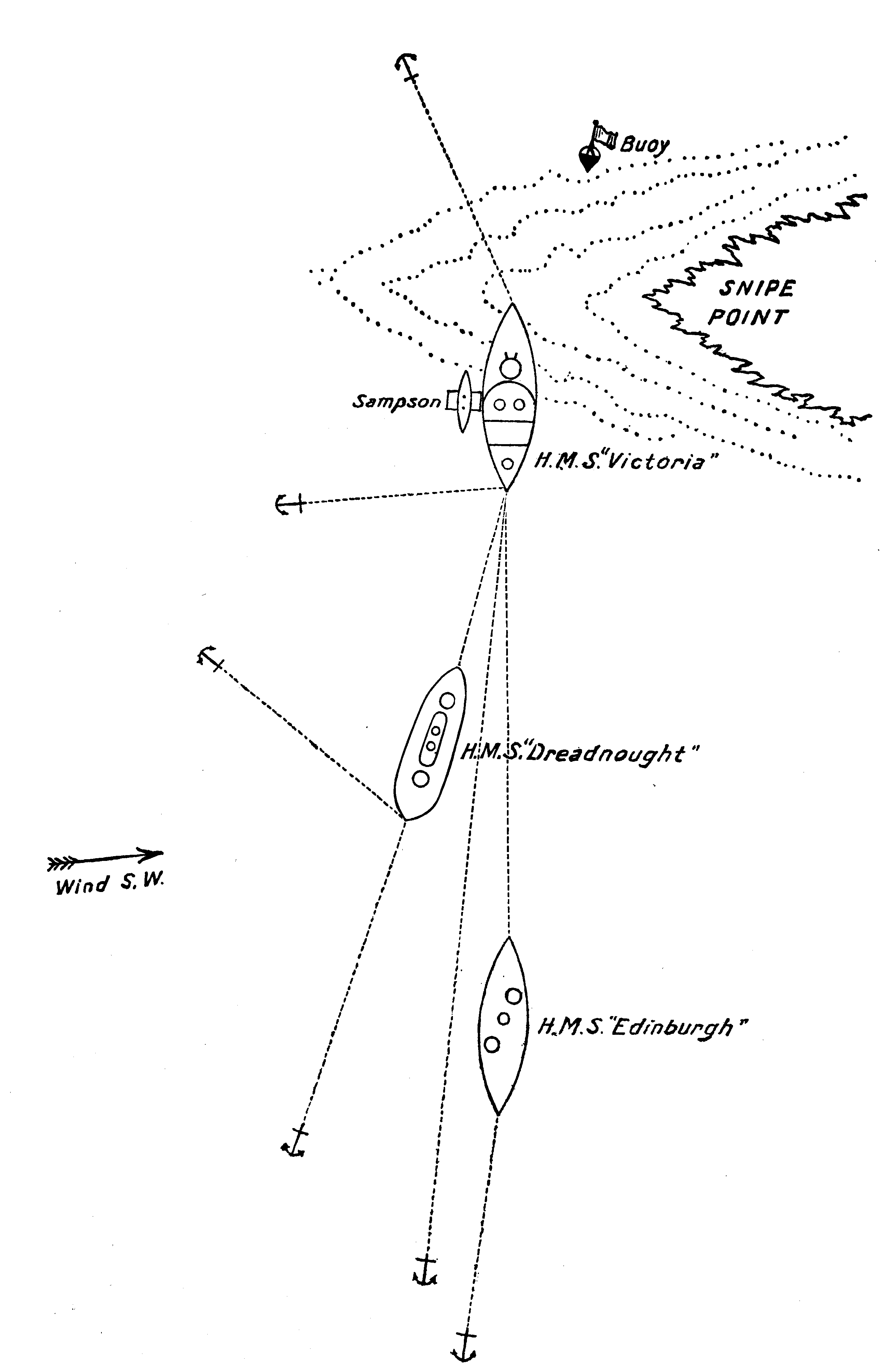
On 29 January 1892, Victoria ran aground at Snipe Point near Platea on the Greek coast. Platea had been selected as a convenient friendly port for British ships to use as a base for exercises with torpedoes and mines, and each ship of the Mediterranean Fleet would go there in turn during the winter. Torpedoes would be launched from fast-moving ships in real battle conditions, but it was desirable to practise this in relatively shallow waters so that the torpedoes could be recovered afterwards (they were supposed to float once their motors stopped, but sometimes sank). Captain Bourke had appreciated the potential difficulties of operating his ship in shallow waters, and had ordered a crew to set out a buoy offshore at the place where the water shoaled to 60 ft. But the crew missed the shallowest point, and Victoria grounded on the rocky shoal at 9 kn and stuck fast. The fore end of the ship ended up 7 ft higher out of the water than would be normal, as momentum drove it up onto the shoal. The ship's bottom was damaged, and three compartments flooded. The stern, however, was still in 66 ft of water. Admiral Tryon was notified and departed for the scene in , also ordering a dockyard tug Sampson with pumping equipment and hawsers. – a torpedo-depot ship – was already at Platea and made two attempts to tow Victoria free. These failed, but she assisted with laying anchors to hold the rear of the ship steady until further help could arrive. , , , and were also called to the scene.
Victoria was lightened by removing 1253 LT, including 475 LT of coal thrown overboard. The leaks were patched up by creating temporary bulkheads and using timber and Portland cement to block holes. Dreadnought and Edinburgh each had hawsers attached to Victoria so they could pull astern. Sampson was lashed alongside so that she could pull backwards, and Victorias own engines were run astern. This was sufficient to move the ship, and she was refloated on the evening of 4 February. [[File:The stranding of HMS 'Victoria' - The Graphic 1892.jpg|thumb|Victoria in the dry dock at Malta. [[The Graphic]] 1892]]The ship proceeded to the new Hamilton Dock in Malta for repairs, being the first ship to use it. The hull plating was ripped and torn for a distance of 70 ft, with some plates being folded into 'S' shapes, although the mild steel bent rather than cracked. Repairs were completed in time for the summer fleet cruise in May.
Sinking
Main article: Sinking of HMS Victoria
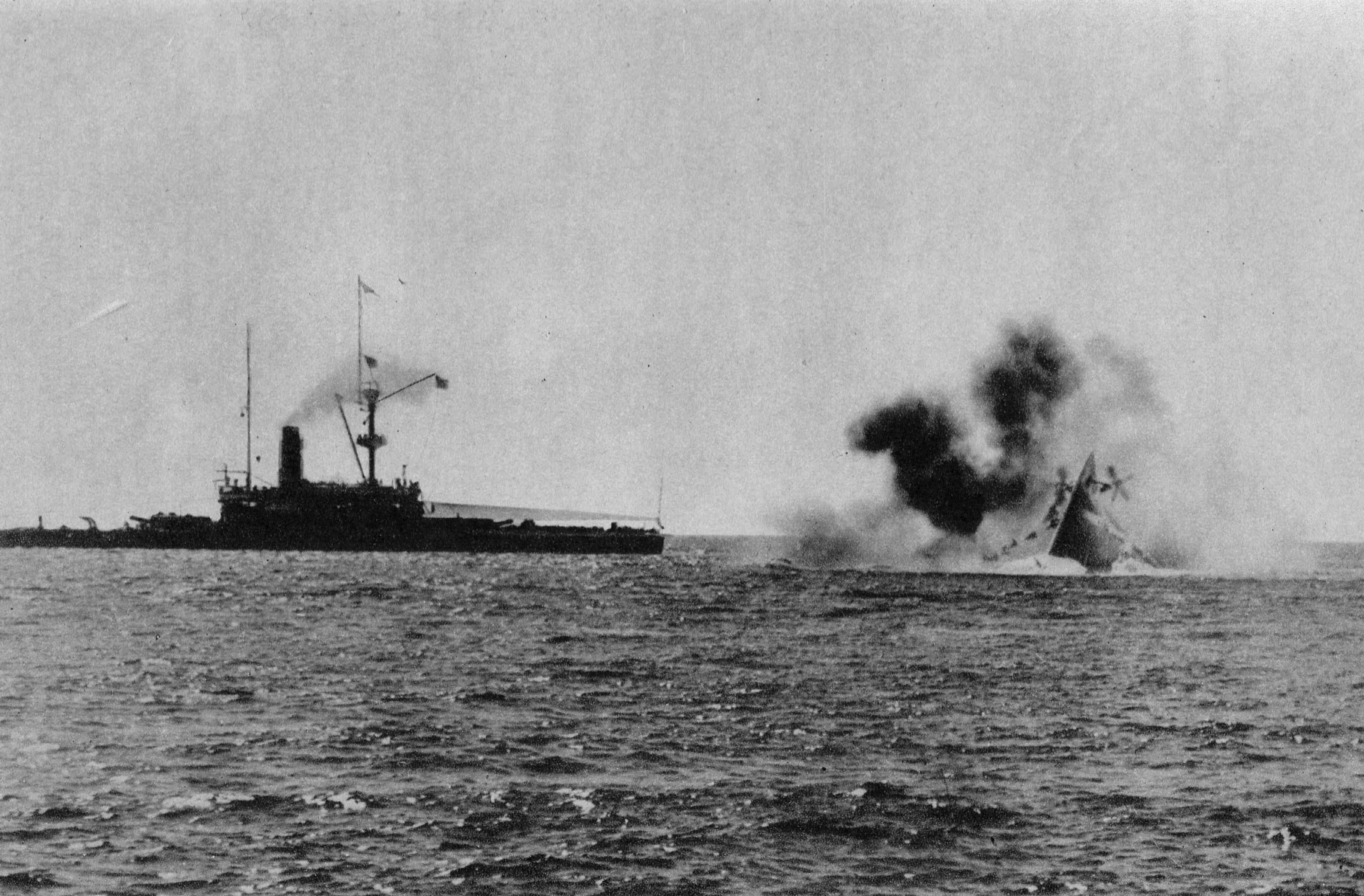
On 22 June 1893, Victoria was leading the Mediterranean Fleet's annual exercises in the Eastern Mediterranean. The ship was at the head of a division of ships, while 1,200 yd to starboard was a second division of five ships led by . Admiral Tryon ordered a manoeuvre that was to see each ship turn, one after the other in formation, to steam in the opposite direction.{{cite journal
Wreck site
After a search that lasted ten years, the wreck was discovered on 22 August 2004 in 140 m of water by the Lebanese-Austrian diver Christian Francis, aided by the British diver Mark Ellyatt. She stands vertically with the bow and some 30 m of her length buried in the mud, with the stern pointing directly upwards towards the surface. This position is not unique among shipwrecks as first thought, as the Russian monitor also rests like this. The unusual attitude of this wreck is thought to have been due to the heavy single turret forward containing the main armament coupled with the still-turning propellers driving the wreck downwards.
References
Bibliography
- {{cite book
- Andrew Gordon, The Rules of the Game: Jutland and British Naval Command, John Murray.
- David Brown, Warrior to Dreadnought: Warship development 1860–1905, Chatham Publishing.
- Richard Hough, Admirals in Collision, Hamish Hamilton, London. Copyright 1959.
- Louis Decimus Rubin, The Summer the Archduke Died: Essays on Wars and Warriors, University of Missouri Press, [2008],
- Rear-Admiral C. C. Penrose Fitzgerald, Life of Vice-Admiral Sir George Tryon K.C.B., William Blackwood and sons, Edinburgh and London, 1897
- The Times, The Loss of HMS Victoria, 2 November 1893, page 4, issue 34098, column A. (Admiralty minutes describing the sinking)
- *Minutes of Proceedings at a Court-Martial held on board her Majesty's ship Hibernia at Malta, on Monday, the seventeenth day of July 1893; and by adjournment, every day thereafter (Sunday excepted) to the Twenty-seventh day of July 1893, to enquire into the loss of her Majesty's ship Victoria *, Her Majesty's Stationery Office, printed by Darling & son Ltd, 1893.
References
- Hough, pp. 47–48.
- Hough, p. 48.
- (24 June 1893). "The Mediterranean Disaster". The Times.
- (1974). "Man of War a History of the Combat Vessel". Mcgraw-hill Inc.
- ''The Times'', 24 June 1893, issue 33986, page 7, 'Terrible naval disaster'.
- Fitzgerald pp. 333–336.
- Fitzgerald pp. 336–338.
- Blanford, Nicholas. (4 September 2004). "Divers discover British ship wreck after 111 years". [[The Daily Star (Lebanon).
This article was imported from Wikipedia and is available under the Creative Commons Attribution-ShareAlike 4.0 License. Content has been adapted to SurfDoc format. Original contributors can be found on the article history page.
Ask Mako anything about HMS Victoria (1887) — get instant answers, deeper analysis, and related topics.
Research with MakoFree with your Surf account
Create a free account to save articles, ask Mako questions, and organize your research.
Sign up freeThis content may have been generated or modified by AI. CloudSurf Software LLC is not responsible for the accuracy, completeness, or reliability of AI-generated content. Always verify important information from primary sources.
Report