From Surf Wiki (app.surf) — the open knowledge base
Hiking
Walking as a hobby, sport, or leisure activity
Walking as a hobby, sport, or leisure activity

A hike is a long, vigorous walk, usually on trails or footpaths in the countryside. Since hiking often involves going up mountains, it is also often used synonymously with mountaineering. Walking for pleasure developed in Europe during the eighteenth century. Long hikes as part of a religious pilgrimage have existed for a much longer time. "Hiking" is the preferred term in Canada and the United States; the term "walking" is used in these regions for shorter, particularly urban walks. In the United Kingdom and Ireland, the word "walking" describes all forms of walking, whether it is a walk in the park or backpacking in the Alps. The word hiking is also often used in the UK, along with rambling, hillwalking, and fell walking (a term mostly used for hillwalking in northern England). The term bushwalking is endemic to Australia, having been adopted by the Sydney Bush Walkers Club in 1927. In New Zealand a long, vigorous walk or hike is called tramping. It is a popular activity with numerous hiking organizations worldwide, and studies suggest that all forms of walking have health benefits.
Related terms
In the United States, Canada, Ireland, and the United Kingdom, hiking means walking outdoors on a trail, or off trail, for recreational purposes. A day hike refers to a hike that can be completed in a single day. However, in the United Kingdom, the word walking is also used, as well as rambling, while walking in mountainous areas is called hillwalking. In Northern England, Including the Lake District and Yorkshire Dales, fell walking describes hill or mountain walks, as fell is the common word for both features there.
Hiking sometimes involves bushwhacking and is sometimes referred to as such. This specifically refers to difficult walking through dense forest, undergrowth, or bushes where forward progress requires pushing vegetation aside. In extreme cases of bushwhacking, where the vegetation is so dense that human passage is impeded, a machete is used to clear a pathway. The Australian term bushwalking refers to both on and off-trail hiking. Common terms for hiking used by New Zealanders are tramping (particularly for overnight and longer trips), walking or bushwalking. Trekking is the preferred word used to describe multi-day hiking in the mountainous regions of India, Pakistan, Nepal, North America, South America, Iran, and the highlands of East Africa. Hiking a long-distance trail from end-to-end is also referred to as trekking and as thru-hiking in some places. In North America, multi-day hikes, usually with camping, are referred to as backpacking.
History

The poet Petrarch is frequently mentioned as an early example of someone hiking. Petrarch recounts that on April 26, 1336, with his brother and two servants, he climbed to the top of Mont Ventoux (1912 m), a feat which he undertook for recreation rather than necessity. The exploit is described in a celebrated letter addressed to his friend and confessor, the monk Dionigi di Borgo San Sepolcro, composed some time after the fact. However, some have suggested that Petrarch's climb was fictional.
Jakob Burckhardt, in The Civilization of the Renaissance in Italy (in German in 1860) declared Petrarch "a truly modern man", because of the significance of nature for his "receptive spirit"; even if he did not yet have the skill to describe nature. Petrarch's implication that he was the first to climb mountains for pleasure, and Burckhardt's insistence on Petrarch's sensitivity to nature have been often repeated since. There are also numerous references to Petrarch as an "alpinist", although Mont Ventoux is not a hard climb, and is not usually considered part of the Alps. This implicit claim of Petrarch and Burckhardt, that Petrarch was the first to climb a mountain for pleasure since antiquity, was disproven by Lynn Thorndike in 1943. There were ascents accomplished during the Middle Ages; Lynn Thorndike mentions that "a book on feeling for nature in Germany in the tenth and eleventh centuries, noted various ascents and descriptions of mountains from that period", and that "in the closing years of his life archbishop Anno II, Archbishop of Cologne (c. 1010 – 1075) climbed his beloved mountain oftener than usual".
Other early examples of individuals hiking or climbing mountains for pleasure include the Roman Emperor, Hadrian, who ascended Mount Etna during a return trip from Greece in 125 CE. In 1275, Peter III of Aragon claimed to have reached the summit of Pic du Canigou, a 9134-foot mountain located near the southern tip of France. The first ascent of any technical difficulty to be officially verified took place on June 26, 1492, when Antoine de Ville, a chamberlain and military engineer for Charles VIII, King of France, was ordered to ascend Mont Aiguille. Because ropes, ladders and iron hooks were used during the ascent, this event is widely recognized as being the birth of mountaineering. Conrad Gessner, a 16th Century physician, botanist and naturalist from Switzerland, is widely recognized as being the first person to hike and climb for sheer pleasure.
However, the idea of taking a walk in the countryside only really developed during the 18th century in Europe, and arose because of changing attitudes to the landscape and nature associated with the Romantic movement. In 1790 William Wordsworth set off on an extended tour of France, Switzerland, and Germany, which he describes in his autobiographical poem The Prelude (1850). Walking tours were popular in the 19th century, In earlier times walking generally indicated poverty and was also associated with vagrancy. In previous centuries long walks were undertaken as part of religious pilgrimages and this tradition continues throughout the world.
Pilgrimages
In earlier times people mainly hiked for practical reasons, or on religious pilgrimages. Numerous modern hiking trail follow such ancient routes. The British National Trail the North Downs Way closely follows that of the Pilgrims' Way to Canterbury.
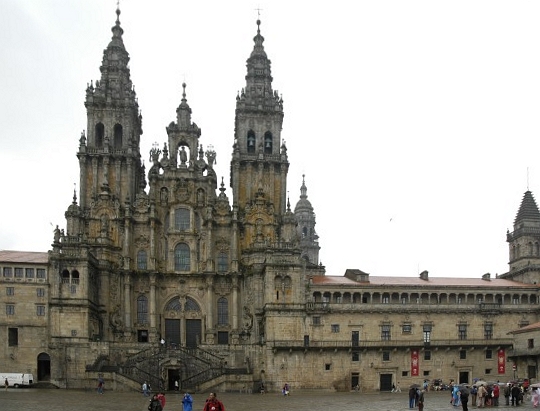
The ancient pilgrimage, the Camino de Santiago, or Way of St. James, has become more recently the source for a number of long-distance hiking routes. This is a network of pilgrims' ways leading to the shrine of the apostle Saint James the Great in the cathedral of Santiago de Compostela in Galicia in northwestern Spain. Many follow its routes as a form of spiritual path or retreat for their spiritual growth.
The French Way is the most popular of the routes and runs from Saint-Jean-Pied-de-Port on the French side of the Pyrenees to Roncesvalles on the Spanish side and then another 780 km on to Santiago de Compostela through the major cities of Pamplona, Logroño, Burgos and León. A typical walk on the Camino francés takes at least four weeks, allowing for one or two rest days on the way. Some travel the Camino on bicycle or on horseback. Paths from the cities of Tours, Vézelay, and Le Puy-en-Velay meet at Saint-Jean-Pied-de-Port. The French long-distance path GR 65 (of the Grande Randonnée network), is an important variant route of the old Christian pilgrimage way.
The Abraham Path is a cultural route believed to have been the path of Islamic, Christian, and Jewish patriarch Abraham's ancient journey across the Ancient Near East. The path was established in 2007 as a pilgrimage route between Urfa, Turkey, possibly his birthplace, and his final destination of the desert of Negev.
German-speaking world
The Swiss scientist and poet Albrecht von Haller's poem Die Alpen (1732) is an historically important early sign of an awakening appreciation of the mountains, though it is chiefly designed to contrast the simple and idyllic life of the inhabitants of the Alps with the corrupt and decadent existence of the dwellers in the plains.
Numerous travellers explored Europe on foot in the last third of the 18th century and recorded their experiences. A significant example is Johann Gottfried Seume, who set out on foot from Leipzig to Sicily in 1801, and returned to Leipzig via Paris after nine months.
United Kingdom
Main article: Walking in the United Kingdom, Walking in London
Thomas West, a Scottish priest, popularized the idea of walking for pleasure in his guide to the Lake District of 1778. In the introduction he wrote that he aimed to encourage the taste of visiting the lakes by furnishing the traveller with a Guide; and for that purpose, the writer has here collected and laid before him, all the select stations and points of view, noticed by those authors who have last made the tour of the lakes, verified by his own repeated observations. To this end he included various 'stations' or viewpoints around the lakes, from which tourists would be encouraged to enjoy the views in terms of their aesthetic qualities. Published in 1778 the book was a major success.
Another famous early exponent of walking for pleasure was the English poet William Wordsworth. His famous poem Tintern Abbey was inspired by a visit to the Wye Valley made during a walking tour of Wales in 1798 with his sister Dorothy Wordsworth. Wordsworth's friend Coleridge was another keen walker and in the autumn of 1799, he and Wordsworth undertook a three-week tour of the Lake District. John Keats, who belonged to the next generation of Romantic poets began, in June 1818, a walking tour of Scotland, Ireland, and the Lake District with his friend Charles Armitage Brown.
More and more people undertook walking tours through the 19th century, of which the most famous is probably Robert Louis Stevenson's journey through the Cévennes in France with a donkey, recorded in his Travels with a Donkey (1879). Stevenson also published in 1876 his famous essay "Walking Tours". The subgenre of travel writing produced many classics in the subsequent 20th century. An early American example of a book that describes an extended walking tour is naturalist John Muir's A Thousand Mile Walk to the Gulf (1916), a posthumously published account of a long botanizing walk, undertaken in 1867.
Due to industrialisation in England, people began to migrate to the cities where living standards were often cramped and unsanitary. They would escape the confines of the city by rambling about in the countryside. However, the land in England, particularly around the urban areas of Manchester and Sheffield, was privately owned and trespass was illegal. Rambling clubs soon sprang up in the north and began politically campaigning for the legal 'right to roam'. One of the first such clubs was 'Sunday Tramps' founded by Leslie White in 1879. The first national grouping, the Federation of Rambling Clubs, was formed in London in 1905 and was heavily patronized by the peerage.
Access to Mountains bills, that would have legislated the public's 'right to roam' across some private land, were periodically presented to Parliament from 1884 to 1932 without success. Finally, in 1932, the Rambler's Right Movement organized a mass trespass on Kinder Scout in Derbyshire. Despite attempts on the part of the police to prevent the trespass from going ahead, it was successfully achieved due to massive publicity. However, the Mountain Access Bill that was passed in 1939 was opposed by many walkers' organizations, including The Ramblers, who felt that it did not sufficiently protect their rights, and it was eventually repealed.
The effort to improve access led after World War II to the National Parks and Access to the Countryside Act 1949, and in 1951 to the creation of the first national park in the UK, the Peak District National Park. The establishment of this and similar national parks helped to improve access for all outdoors enthusiasts. The Countryside and Rights of Way Act 2000 considerably extended the right to roam in England and Wales.
United States
An early example of an interest in hiking in the United States is Abel Crawford and his son Ethan's clearing of a trail to the summit of Mount Washington, New Hampshire in 1819. This 8.5-mile path is the oldest continually used hiking trail in the United States. The influence of British and European Romanticism reached North America through the transcendentalist movement, and both Ralph Waldo Emerson (1803–82) and Henry David Thoreau (1817–62) were important influences on the outdoors movement in North America. Thoreau's writing on nature and on walking include the posthumously published "Walking" (1862)". His earlier essay "A Walk to Wachusett" (1842) describes a four-day walking tour Thoreau took with a companion from Concord, Massachusetts to the summit of Mount Wachusett, Princeton, Massachusetts and back. Established in 1876, the Appalachian Mountain Club has the distinction of being the oldest hiking club in America. It was founded to protect the trails and mountains in the northeastern United States. Prior to its founding, four other hiking clubs had already been established in America. This included the very short-lived (first) Rocky Mountain Club in 1875, the White Mountain Club of Portland in 1873, the Alpine Club of Williamstown in 1863, and the Exploring Circle, which was established by four men from Lynn, Massachusetts in 1850. Although not a hiking club in the same sense as the clubs that would emerge later, the National Park Service recognizes the Exploring Circle as being "the first hiking club in New England." All four of these clubs would disband within a few years of their founding.
Despite clubs such as the Appalachian Mountain Club, hiking during the early twentieth century was still primarily in New England, San Francisco, and the Pacific Northwest. Eventually, there were similar clubs formed in the Midwest and following the Appalachian range. As interest grew hiking culture was spread throughout the nation.
The Scottish-born, American naturalist John Muir (1838 –1914), was another important early advocate of the preservation of wilderness in the United States. He petitioned the U.S. Congress for the National Park bill that was passed in 1890, establishing Yosemite and Sequoia National Parks. The Sierra Club, which he founded, is now one of the most important conservation organizations in the United States. The spiritual quality and enthusiasm toward nature expressed in his writings inspired others, including presidents and congressmen, to take action to help preserve large areas of undeveloped countryside. He is today referred to as the "Father of the National Parks". In 1916, the National Park Service was created to protect national parks and monuments.
In 1921, Benton MacKaye, a forester, conceived the idea of what would become America's first National Scenic Trail, the Appalachian trail (AT). The AT was completed in August 1937, running from Maine to Georgia. The Pacific Crest Trail ("PCT") was first explored in the 1930s by the YMCA hiking groups and was eventually registered as a complete border to border trail from Mexico to Canada.
Destinations

National parks are often important hiking destinations, such as National Parks of England and Wales; of Canada; of New Zealand, of South Africa, etc.
Frequently, nowadays long-distance hikes (walking tours) are undertaken along long-distance paths, including the National Trails in England and Wales, the Kungsleden (Sweden) and the National Trail System in the United States. The Grande Randonnée (France), Grote Routepaden, or Lange-afstand-wandelpaden (The Netherlands), Grande Rota (Portugal), Gran Recorrido (Spain) is a network of long-distance footpaths in Europe, mostly in France, Belgium, the Netherlands and Spain. There are extensive networks in other European countries of long-distance trails, as well as in Canada, Australia, New Zealand, Nepal, and to a lesser extent other Asiatic countries, like Turkey, Israel, and Jordan. In the mountains of Norway, Sweden, Austria, Slovenia, Switzerland, Germany, France, and Italy walking tours can be made from 'hut-to-hut', using an extensive system of mountain huts.
In the late 20th-century, there has been a proliferation of official and unofficial long-distance routes, which mean that hikers now are more likely to refer to using a long-distance way (Britain), trail (US), The Grande Randonnée (France), etc., than setting out on a walking tour. Early examples of long-distance paths include the Appalachian Trail in the US and the Pennine Way in Britain.
Organized hiking clubs emerged in Europe at approximately the same time as official hiking trails. These clubs established and upheld their own paths during the 19th and 20th centuries, prioritizing the development of extended hiking routes. In 1938, one of the first long-distance hiking trails in Europe, the Hungarian National Blue Trail, was established, stretching approximately 62 miles (100 km).
Asia
In the Middle East, the Jordan Trail is a 650 km (400 miles) long hiking trail in Jordan established in 2015 by the Jordan Trail Association. And Israel has been described as "a trekker's paradise" with over 9,656 km (6,000 miles) of trails.
In southwestern Turkey the Lycian Way is a marked long-distance trail around part of the coast of ancient Lycia. It is over 500 km in length and stretches from Hisarönü (Ovacık), near Fethiye, to Geyikbayırı in Konyaaltı about 20 km from Antalya. It was conceived by Briton Kate Clow, who lives in Turkey. It takes its name from the ancient civilization, which once ruled the area.
The Great Himalaya Trail is a route across the Himalayas. The original concept of the trail was to establish a single long distance trekking trail from the east end to the west end of Nepal that includes a total of roughly 1,700 kilometres (1,100 mi) of path. The proposed trail will link together a range of the less explored tourism destinations of Nepal's mountain region.
Latin America
In Latin America, Peru and Chile are important hiking destinations. The Inca Trail to Machu Picchu in Peru is very popular and a permit is required. The longest hiking trail in Chile is the informal 3,000 km (1,850 mi) Greater Patagonia Trail that was created by a non-governmental initiative.
Africa
In Africa a major trekking destination is Mount Kilimanjaro, a dormant volcano in Tanzania, which is the highest mountain in Africa and the highest single free-standing mountain in the world: 5895 m above sea level and about 4900 m above its plateau base.
According to the Kilimanjaro National Park Authority, 467,190 travelers visited Mount Kilimanjaro between 2013 and 2022, with over 45,000 climbers recorded in 2023.
Equipment
Main article: Hiking equipment
The equipment required depends on a variety of factors, such as terrain, climate and time of year. Hikers have traditionally worn sturdy hiking boots Boots, however, are still common in mountainous terrain. The Mountaineers club recommends a list of "Ten Essentials" equipment for hiking, including a compass, sunglasses, sunscreen, a head lamp, a first aid kit, a fire starter, and a knife. Other recommend items are a hat, gloves, and an emergency blanket. A GPS navigation device can also be helpful and trekking poles are also recommended, especially when carrying a heavy backpack.
Environmental impact
Natural environments are often fragile and may be accidentally damaged and some species are very sensitive to the presence of humans, especially around mating season. Many hikers adopt the philosophy of Leave No Trace, following strict practices on dealing with food waste, and other impacts on the environment. Fire is a particular source of danger.
Etiquette
Main article: Trail ethics
Because hikers may come into conflict with other users of the land or may harm the natural environment, hiking etiquette has developed.
- When two groups of hikers meet on a steep trail, a custom has developed in some areas whereby the group moving uphill has the right-of-way.
- Various organizations recommend that hikers generally avoid making loud sounds, such as shouting or loud conversation, playing music, or the use of mobile phones. However, in bear country, hikers use intentional noise-making as a safety precaution to avoid startling bears.
- The Leave No Trace movement offers a set of guidelines for low-impact hiking: "Leave nothing but footprints. Take nothing but photos. Kill nothing but time. Keep nothing but memories".
- Hikers are advised not to feed wild animals, because they will become a danger to other hikers if they become habituated to human food, and may have to be killed, or relocated.
- Hikers are advised to verify whether tour operators adhere to fair treatment practices for their support crews, including providing proper wages and working conditions for porters.
Hazards
Hiking can be hazardous because of terrain, inclement weather, potential to get lost, or pre-existing medical conditions. The dangerous circumstances hikers can face include specific accidents or physical ailments. It is especially hazardous in high mountains, crossing rivers and glaciers, and when there is snow and ice. At times hiking may involve scrambling, as well as the use of ropes, ice axes and crampons and the skill to properly use them.
Potential hazards involving physical ailments may include dehydration, frostbite, hypothermia, sunburn, sunstroke, or diarrhea, and such injuries as ankle sprains, or broken bones. Hypothermia is a danger for all hikers and especially inexperienced hikers. Weather does not need to be very cold to be dangerous since ordinary rain or mist has a strong cooling effect. In high mountains a further danger is altitude sickness. This typically occurs only above 2500 m, though some are affected at lower altitudes. Risk factors include a prior episode of altitude sickness, a high degree of activity, and a rapid increase in elevation.
Other threats include attacks by animals (e.g., bears, snakes, and insects such as ticks that carry Lyme) or contact with noxious plants (e.g., poison ivy, poison oak, poison sumac. Lightning is also a threat, especially on high ground.
Walkers in high mountains may encounter hazardous snow and ice conditions. Year round glaciers are potentially hazardous. The crossing of rivers may be dangerous and requires special techniques.
Border crossings
Borders can be poorly marked and in 2009, Iran imprisoned three Americans for hiking across the Iran-Iraq border. It is illegal to cross into the US on the Pacific Crest Trail from Canada. Going south to north it is more straightforward and a crossing can be made, if advanced arrangements are made with Canada Border Services. Within the Schengen Area, which includes most of the E.U., and associated nations like Switzerland and Norway, there are no impediments to crossing by path, and borders are not always obvious.
Winter hiking
Hiking in winter offers additional opportunities, challenges and hazards. Crampons may be needed in icy conditions, and an ice ax is recommended on steep, snow covered paths. Snowshoes and hiking poles, or cross country skis are useful aid for those hiking in deep snow.
Cross country skiing is a form of winter hiking and in Norway the Norwegian Trekking Association maintains over 400 huts stretching across thousands of kilometres of trails which hikers can use in the summer and skiers in the winter. For longer routes in snowy conditions, hikers may resort to ski touring, using special skis and boots.
References
Bibliography
References
- Amato, Joseph A.. (2004). "On Foot: A History of Walking". NYU Press.
- "Sydney Bush Walkers Club's history".
- (1999). "The Dictionary of New Zealand English". Oxford University Press.
- McKinney, John. (2009-03-22). "For Good Health: Take a Hike!".
- "A Step in the Right Direction: The health benefits of hiking and trails". American Hiking Society.
- Keller, Kristin T.. (2007). "Hiking". Capstone Press.
- "Bushwalking Australia home". Bushwalking Australia.
- Orsman, HW. (1999). "The Dictionary of New Zealand English". Oxford University Press.
- Mueser, Roland. (1997). "Long-Distance Hiking: Lessons from the Appalachian Trail". McGraw-Hill.
- Nicolson, Marjorie Hope. "Mountain Gloom and Mountain Hlory; The Development of the Aesthetics of the Infinite". W.W. Norton & Co., Inc. [1963, c1959].
- Cassirer, Ernst. (January 1943). "Some Remarks on the Question of the Originality of the Renaissance". [[University of Pennsylvania Press]].
- Halsall, Paul. (August 1998). "Petrarch: The Ascent of Mount Ventoux". Fordham University.
- "''Civilization'', Part IV §3, beginning".
- (1956). "The Renaissance Philosophy of Man". University of Chicago Press.
- Bishop, p.102,104
- Moody, Ernest A.. "Jean Buridan".
- Kimmelman, Michael. (1999-06-06). "NOT Because it's There". The New York Times.
- Burckhardt, Jacob. (1904). "The Civilisation of the Period of the Renaissance in Italy". [[Swan Sonnenschein]].
- Thorndike, Lynn. (Jan 1943). "Renaissance or Prenaissance". Journal of the History of Ideas.
- Doran, Jeffrey J.. (2023). "Ramble On: How Hiking Became One of the Most Popular Outdoor Activities in the World". Amazon Digital Services LLC – Kdp.
- (2000). "The Norton Anthology of English Literature".
- Solnit, Rebecca. (2000). "Wanderlust: A History of Walking". Penguin Books.
- (2012-07-28). "North Downs Way National Trail | Paths by name | Ramblers, Britain's Walking Charity".
- Starkie, Walter. (1965). "The Roads to Santiago: Pilgrims of St. James". University of California Press.
- "Abraham Path {{!}} a cultural route connecting the storied places associated with Abraham's ancient journey.".
- Krüger, Arnd. (2010). "Wandertourismus: Kundengruppen, Destinationsmarketing, Gesundheitsaspekte".
- West, Thomas. (1780). "A Guide to the Lakes". HardPress.
- "Development of tourism in the Lake District National Park". Lake District UK.
- "Understanding the National Park — Viewing Stations". Lake District National Park Authority.
- Stephenson, Tom. (1989). "Forbidden Land: The Struggle for Access to Mountain and Moorland". Manchester University Press.
- (1989). "Forbidden Land: The Struggle for Access to Mountain and Moorland". Manchester University Press.
- (2011). "Quarrying and mineral extraction in the Peak District National Park". Peak District National Park Authority.
- "Kinder Trespass. A history of rambling".
- "Open access land: management, rights and responsibilities".
- "Countryside and Rights of Way Act 2000".
- (1912). "Condensed Facts About Mount Washington". Atkinson News Co.
- Thoreau, Henry David. "Walking".
- (7 July 2020). "Lynn Woods Historic District".
- "The Life and Contributions of John Muir". Sierra Club.
- Miller, Barbara Kiely. (2008). "John Muir". Gareth Stevens.
- "Quick History of the National Park Service (U.S. National Park Service)".
- (21 August 2018). "National Park Service".
- (2016-08-25). "Congress Creates the National Park Service".
- "The Top 10 Hiking Trails in the US". e2e.com.
- (2012-08-15). "Hiking in Israel – a trekkers paradise".
- "Lycian Way". Culture Routes Society.
- "Great Himalaya Trails :: Trekking, hiking and walking in Nepal".
- Dudeck, Jan. "Greater Patagonian Trail".
- Trimble, Morgan. (2016-11-15). "How to climb Kilimanjaro without the crowds".
- Sharaf, Yasir. (24 March 2016). "Mount Kilimanjaro Volcanic Cones: Shira, Kibo And Mawenzi Peaks".
- Kilimanjaro National Park Authority. "Kilimanjaro National Park: Celebrating the Golden Anniversary in Biodiversity Conservation and Tourism".
- O'Grady, Kyle. (4 December 2015). "The Footwear Debate: Are Trail Runners Superior to Boots?".
- (1997). "Mountaineering: The Freedom of the Hills". The Mountaineers.
- "Ten Essential Groups Article". Texas Sierra Club.
- (10 April 2013). "Trekking Poles". American Hiking Association.
- Cole, David. "Impacts of Hiking and Camping on Soils and Vegetation: A Review". Wilderness.
- "About Our Mission". Leave No Trace Center for Outdoor Ethics.
- Devaughn, Melissa. (April 1997). "Trail Etiquette". Active Interest Media, Inc..
- "Leave No Trace Seven Principles (U.S. National Park Service)".
- "Do Not Feed Wildlife".
- "KPAP: protecting the rights of porters on Kilimanjaro".
- (17 December 2020). "Is Hiking Dangerous?".
- Boulware, D.R.. (2003). "Medical Risks of Wilderness Hiking". American Journal of Medicine.
- (2007). "Hiking and Backpacking". Wilderness Education Association.
- (May 2018). "Altitude Diseases – Injuries; Poisoning".
- (30 June 2018). "Interventions for treating acute high altitude illness.". The Cochrane Database of Systematic Reviews.
- "Avalanche danger". Pacific Crest Trails Association.
- "How to cross a glacier". Washington Trails Association.
- "Stream crossing safety while hiking and backpacking". Pacific Crest Trail Association.
- (2010-10-23). "Iran Seized U.S. Hikers in Iraq, U.S. Report Asserts". [[The New York Times]].
- "Hiking the Via Alpina – Questions / Answers".
- (2019-01-21). "Winter Hiking: What to Know Before You Go".
- (2007). "Backcountry Skiing: Skills for Ski Touring and Ski Mountaineering". Mountaineers Books.
- "How to Choose Hiking Poles: Pro Guide and Practical Tips".
This article was imported from Wikipedia and is available under the Creative Commons Attribution-ShareAlike 4.0 License. Content has been adapted to SurfDoc format. Original contributors can be found on the article history page.
Ask Mako anything about Hiking — get instant answers, deeper analysis, and related topics.
Research with MakoFree with your Surf account
Create a free account to save articles, ask Mako questions, and organize your research.
Sign up freeThis content may have been generated or modified by AI. CloudSurf Software LLC is not responsible for the accuracy, completeness, or reliability of AI-generated content. Always verify important information from primary sources.
Report