From Surf Wiki (app.surf) — the open knowledge base
High-speed rail in Denmark
none
none
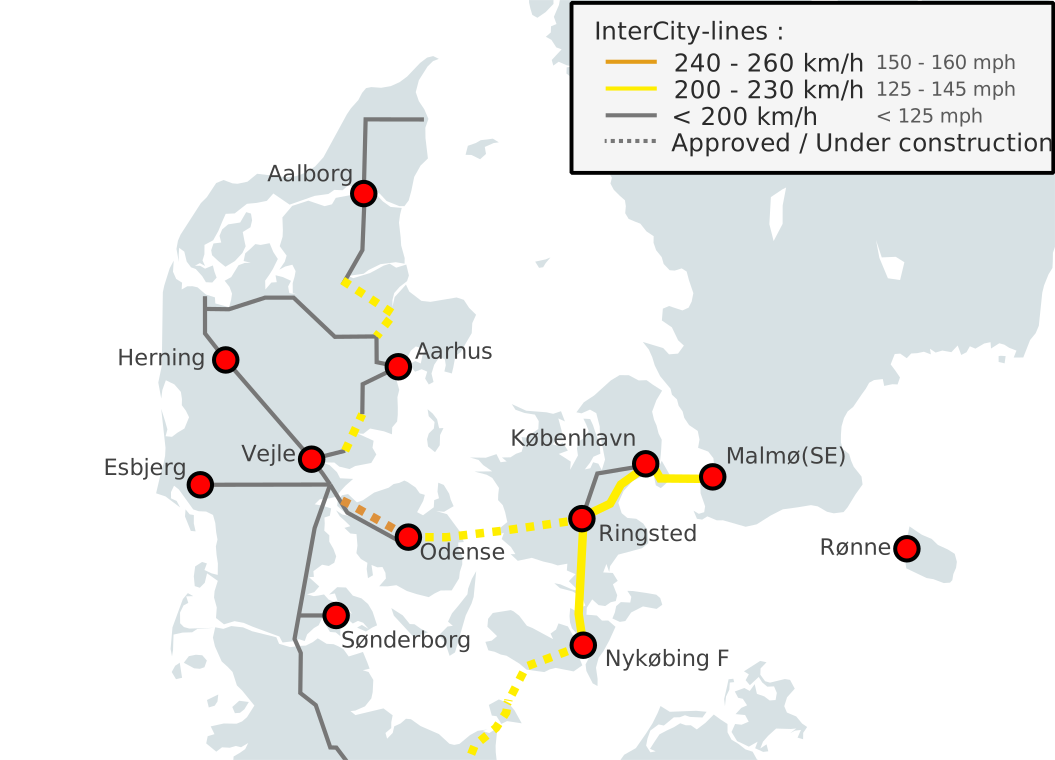
The first high-speed railway in Denmark was the Copenhagen–Ringsted Line, completed in late 2018 and opened in 2019. Further high-speed lines are currently under planning.
Since HSR in Denmark reaches no more than 200 km/h, it can also be described as higher-speed rail.
As a part of a long-term green plan for transportation in Denmark in December 2008, the government at the time presented a high-speed strategy for the inter-city train traffic, called The Hour Model (Danish: Timemodellen). The strategy contains bringing down the travel time on the three links that connect the four largest cities of Denmark (Copenhagen-Odense-Aarhus-Aalborg) to one hour, thereby decreasing the total travel time between Copenhagen and Aalborg from approximately 4½ hours to 3 hours. The first part of the Hour Model, the new high-speed line between Copenhagen and Ringsted, opened in 2019.
After realization of the first three stages of the Hour Model, it can be expanded to Esbjerg and Herning.
On 1 March 2013, the government published their proposal for fulfilling the Hour Model, as well as an electrification of the main lines. The proposal includes creation of a DKK 27.5 billion fund, Togfonden DK (Danish: Train Fund DK), based on taxes from oil activities in the North Sea. The funding was supported by Enhedslisten and Dansk Folkeparti in a political agreement on 17 September 2013, when the potential outcome where adjusted to DKK 28.5 billion.
On 14 January 2014, the parties behind the funding published an agreement for spending the fund, where from DKK 14.8 billion will be spent for realizing the Hour Model.
Completed projects
Øresund Fixed Link
The Øresund Fixed Link has 200 km/h as permitted and used speed (by X 2000 only) on the bridge and the Peberholm island, since year 2000. This stretch has Swedish signalling system, considered easier to install and giving higher speed.
Intercity Express
From 2007 to 2017 ICE TD high speed trains extended the German Intercity Express service into Denmark. Routes served were Berlin-Hamburg-Copenhagen and Berlin-Hamburg-Aarhus. The trains could reach high speed only on the Berlin-Hamburg section, and would continue on regular railway lines into Denmark.
Approved projects

Hour Model
First stage: Copenhagen to Odense
Railways in Denmark use a system for cab signalling which is unique, but is based on the system in Switzerland. The system allows 180 km/h maximum speed in Denmark (200 in Switzerland). 5 km of the Øresund Line closest to the border uses Swedish signalling, and 200 km/h is allowed here (only SJ X2 trains reach this speed here), as the only railway in Denmark.
In order to allow modernization of the Danish railway network, Banedanmark are rolling out European Rail Traffic Management System (ERTMS) Level 2 on all national rail lines between 2018 and 2030, a project called the Signalling Programme. The project was tendered out in four contracts:
- National rail lines east of Little Belt Bridge, won by Alstom
- National rail lines west of Little Belt Bridge, won by Thales-BBR consortium
- S-train signalling system (CBTC), won by Siemens
- On-board equipment, won by Alstom
Electrification
Most of the InterCity train traffic in Denmark is currently operated using the diesel powered IC3 stock. Only the main line between Malmö (Sweden) and Flensburg (Germany)/Esbjerg via Copenhagen, Odense and Kolding, as well as the spur between Tinglev and Sønderborg, the line between Copenhagen and Helsingør and the line between Ringsted and Næstved (part of the Fehmarn Hinterlands projects) are electrified. To replace the IC3 stock, operator DSB ordered 83 IC4 high-speed diesel trains (200 km/h operating speed) at AnsaldoBreda. Electrification of the main lines is appointed the solution to the future InterCity traffic.
On 7 February 2012 a large majority in the Danish parliament reached a political agreement on electrifying the main line between Lunderskov and Esbjerg and produce a feasibility study for electrifying several other main lines. In the Finance Act of Denmark 2013, electrification of the railway between Køge North and Næstved are financed.
On 1 March 2013, DKK 8.7 billion was reserved for electrifying the main lines Fredericia – Frederikshavn, Roskilde – Kalundborg and Vejle – Struer.
In May 2015, an estimated DKK 2.8 billion deal was made.
New electric trainsets
In June 2021, DSB signed a contract with Alstom over the delivery of approximately 150, but at least 100, electric multiple unit trainsets of the type Alstom Coradia Stream. They will be delivered starting 2027 and have a top speed of 200 km/h.
The Talgo 230 cars that DSB have bought are also limited to 200 km/h.
Proposed lines
Beside the Hour Model, additional high-speed rail lines in Denmark are discussed as a part of fixed link projects.
Fixed link across Kattegat
Main article: Kattegat Bridge
The strategic analysis of new transport connections between Copenhagen and Aarhus included a third alternative for decreasing the travel time between the two cities: a new fixed link across Kattegat. This requires a new high-speed rail line between Roskilde and Aarhus via Kalundborg and Samsø. This solution will lower the travel time between Copenhagen and Aarhus to one hour, but not affect the travel time between Odense and Aarhus.
Since 2008 a new fixed link across Kattegat has been discussed widely in Denmark, as a visionary expansion of the overall infrastructure in Denmark, and several analysis (both official and by lobbyists) have been published.
Second Øresund Fixed Link
Main article: HH Tunnel
As connection to a second fixed link across Øresund between Elsinore and Helsingborg, wanted by the Swedish Government, a new high-speed rail line might be constructed. Most studies are describing a new transport corridor around Copenhagen (Ring 5), while some transport researchers are suggesting a new high-speed rail line between Elsinore and Copenhagen along the current motorway.
The development project Scandinavian 8 Million City has proposed a 360 km/h high speed rail line from Oslo via Gothenburg to Copenhagen, which is supported by the mayors of the three cities. The governments do not support the idea in the short or medium term, as they are assumed to pay for this more than €10 billion project.
Other upgrades
The lines to Esbjerg and to the border at Flensburg are planned to be upgraded to 200 km/h most of their routes before 2030, mainly based on installation of ERTMS.
References
References
- Danish Government. (December 2008). "Sustainable transportation - better infrastructure". [[Danish Ministry of Transport]].
- Banedanmark. "Copenhagen-Ringsted". [[Banedanmark]].
- Danish Ministry of Transport. (1 March 2013). "DKK 27.5 billion to a faster and more environmentally friendly railway in Denmark". [[Danish Ministry of Transport]].
- Danish Ministry of Taxation. (1 March 2013). "The overhaul of the North Sea gives DKK 27.5 billion in a new fund". [[Danish Ministry of Taxation]].
- Danish Ministry of Taxation. (17 September 2013). "The Government, Enhedslisten and Dansk Folkepart agrees on harmonisation of the taxation in the North Sea". [[Danish Ministry of Taxation]].
- Danish Ministry of Transport. (14 January 2014). "Agreement on TogfondenDK – Now the danes get a better, greener and faster railway". [[Danish Ministry of Transport]].
- "Banedanmarks Anlægsplan 2030". Banedanmark.
- (2023-10-01). "Fjernbanen Om fjernbanens nye signalsystem". Banedanmark.
- Banedanmark. "Upgrading Aarhus-Hobro". [[Banedanmark]].
- Danish Ministry of Transport. (1 March 2013). "Hour Model". [[Danish Ministry of Transport]].
- Danish Ministry of Transport. (1 March 2013). "Train Fund DK: Investments". [[Danish Ministry of Transport]].
- Danish Transport Authority. (March 2011). "Connections between West and East Denmark". [[Danish Ministry of Transport]].
- (14 December 2022). "Ny regering skrotter omdiskuteret bro-plan: Ingen tog under eller over Vejle Fjord". Vejle Amts Folkeblad.
- (30 September 2019). "Regeringen sætter 147 millioner af til vestfynsk jernbane - TV 2". nyheder.tv2.dk.
- (2 October 2019). "Ny bane Hovedgård - Hasselager {{!}} Banedanmark". Banedanmark.
- (23 January 2023). "Har kostet 135 millioner at forberede: Nu er der ikke længere flertal for togprojekt". Teknologiens Mediehus.
- "Flere Femern-arbejder i gang allerede i år {{!}} Femern Belt Development".
- Banedanmark. "Fehmarn Belt - Danish railway hinterland". [[Banedanmark]].
- Danish Ministry of Transport. (19 March 2013). "Agreement on a new Storstrøm Bridge in the bag". [[Danish Ministry of Transport]].
- "Storstrøm Bridge".
- (September 2023). "Fordelene ved Femern-forbindelsen".
- Banedanmark. "Nye signaler på fjernbanen og S-banen". [[Banedanmark]].
- Banedanmark. (31 January 2012). "Contracts for rail signals of the future are finalized". [[Banedanmark]].
- Banedanmark. (5 August 2011). "Banedanmark and Siemens sign deal for new signalling system on the whole S-train network". [[Banedanmark]].
- Banedanmark. (14 March 2012). "Danish trains get new signalling system". [[Banedanmark]].
- Tarp, David. (16 November 2011). "Majority will head start electrification". Berlingske.
- Danish Ministry of Transport. (7 February 2012). "Wide agreement on electrification of the railway etc.". [[Danish Ministry of Transport]].
- Danish Ministry of Transport. (12 February 2013). "Finance Act 2013". [[Danish Ministry of Transport]].
- Danish Ministry of Transport. (1 March 2013). "Electrification of the railway". [[Danish Ministry of Transport]].
- http://cphpost.dk/general/danishgerman-consortium-wins-huge-rail-electrification-bid.html {{Bare URL inline. (August 2025)
- "Press".
- "Kontrakten om fremtidens tog underskrevet".
- "Coradia Stream {{!}} Fremtidens Tog".
- "Finansudvalget 2022-23 (2. samling)". Folketinget.
- Marfelt, Birgitte. (11 November 2011). "Swedish Government wants two tunnels between Elsinore and Helsingborg". Ingeniøren.
- Nielsen, Otto Anker. (April 2017). "Perspectives for large traffic facilities in the transport corridors, presently as well as further into the future". DTU Transport.
- The Scandinavian 8 Million City. (13 March 2013). "Press announcement: Mayors demand common Scandinavian view".
This article was imported from Wikipedia and is available under the Creative Commons Attribution-ShareAlike 4.0 License. Content has been adapted to SurfDoc format. Original contributors can be found on the article history page.
Ask Mako anything about High-speed rail in Denmark — get instant answers, deeper analysis, and related topics.
Research with MakoFree with your Surf account
Create a free account to save articles, ask Mako questions, and organize your research.
Sign up freeThis content may have been generated or modified by AI. CloudSurf Software LLC is not responsible for the accuracy, completeness, or reliability of AI-generated content. Always verify important information from primary sources.
Report