From Surf Wiki (app.surf) — the open knowledge base
High-altitude platform station
Aircraft that provides common satellite services

Aircraft that provides common satellite services
A high-altitude platform station (HAPS, which can also mean high-altitude pseudo-satellite or high-altitude platform systems), also known as atmospheric satellite, is a long endurance, high altitude aircraft able to offer observation or communication services similarly to artificial satellites. Mostly unmanned aerial vehicles (UAVs), they remain aloft through atmospheric lift, either aerodynamic like airplanes, or aerostatic like airships or balloons. High-altitude long endurance (HALE) military drones can fly above 60,000 ft (18,000 m) over 32 hours, while civil HAPS are radio stations at an altitude of 20 to 50 km above waypoints, for weeks.
High-altitude, long endurance flight has been studied since at least 1983, and demonstrator programs since 1994. Hydrogen and solar power have been proposed as alternatives to conventional engines. Above commercial air transport and wind turbulence, at high altitudes, drag as well as lift are reduced. HAPS could be used for weather monitoring, as a radio relay, for oceanography or earth imaging, for border security, maritime patrol and anti-piracy operations, disaster response, or agricultural observation.
While reconnaissance aircraft have been capable of reaching high altitudes since the 1950s, their endurance is limited. One of the few operational HALE aircraft is the Northrop Grumman RQ-4 Global Hawk. There are many solar powered, lightweight prototypes like the NASA Pathfinder/Helios, or the Airbus Zephyr that can fly for 64 days; few are as advanced as these. Conventional aviation fuels have been used in prototypes since 1970 and can fly for 60 hours like the Boeing Condor. Hydrogen aircraft can fly even longer, a week or longer, like the AeroVironment Global Observer.
Stratospheric airships are often presented as a competing technology. However few prototypes have been built and none are operational. Among balloons specifically, the most well known high-endurance project was Google Loon, using helium-filled high-altitude balloons to reach the stratosphere. Loon was ended in 2021.
Definitions
; High-altitude long endurance (HALE) : High-altitude, long-endurance (HALE) aircraft are non-weaponized military drones capable of flying at 60,000 feet over 32 hours, like the USAF RQ-4 Global Hawk or its variants used for ISR.
; High-altitude platform station (HAPS) : defined by the International Telecommunication Union (ITU) as "a station on an object at an altitude of 20 to 50 km and at a specified, nominal, fixed point relative to the Earth" in its ITU Radio Regulations (RR). HAPS can also be the abbreviation for high-altitude pseudo-satellite.
Studies
In 1983, Lockheed produced A Preliminary Study of solar powered aircraft and Associated Power Trains for the NASA, as long endurance flight could be compared to suborbital spacecraft. In 1984 was published the Design of Long Endurance Unmanned Airplanes Incorporating Solar and fuel cell propulsion report. In 1989, the Design and experimental results for a high-altitude, long-endurance airfoil report proposed applications as a radio relay, for weather monitoring or cruise missile targeting.
The NASA ERAST Program (Environmental Research Aircraft and Sensor Technology) was started in September 1994 to study high-altitude UAVs, and was terminated in 2003. In July 1996, the USAF Strikestar 2025 report forecast HALE UAVs maintaining air occupation with 24 hours flights. The Defense Airborne Reconnaissance Office made demonstrations of long-endurance UAV craft. In September 1996, Israel Aircraft Industries detailed the design of a HALE UAV.
In 2002, Preliminary reliability design of a solar-powered high-altitude very long endurance unmanned air vehicle was published. The European Union CAPECON project aimed to develop HALE vehicles, while the Polish Academy of Sciences proposed its PW-114 concept that would fly at 20 km for 40 hours. Luminati Aerospace proposed its Substrata solar-powered aircraft that would fly in formation like migratory geese to reduce the power required for the trailing aircraft by 79%, allowing smaller airframes to remain aloft indefinitely up to a latitude of 50°.
Design

; Power : Power is required for continuous operation, limiting endurance by the need for refueling. Persistent solar-powered aircraft need to store daylight energy for the night, in electric batteries, or in fuel cells.
; Altitude selection : Drag is reduced in the tropopause thin air, well above the 40 – 160 knots high winds and air traffic of the high troposphere between 20,000 to 35,000 ft. Flying in the tropopause at 65,000 ft is above clouds and turbulence with winds below 5 kn, and above FAA-regulated Class A airspace ending at 60,000 feet.
; Comparison to satellites : A lower altitude covers more effectively a small region, implies a lower telecommunications link budget (a 34 dB advantage over a LEO, 66 dB over GEO), a lower power consumption, and a smaller round-trip delay. A satellite in the vacuum of space orbits due to its high speed generating a centrifugal force matching the gravity. Changing a satellite orbit requires expending its extremely limited fuel supply.
Applications
Atmospheric satellites could be used for weather monitoring, as a radio relay, for oceanography or earth imaging like an orbital satellite for a fraction of the cost. Other uses include border security, maritime patrol and anti-piracy operations, disaster response, or agricultural observation. They could bring internet connectivity to the 5 billion people lacking it, either with 11,000 airplane UAVs or with balloons like Google's Project Loon.
; Radiocommunication services : HAPS can deliver radio connectivity to users, as an altitude above 12500 m enable line-of-sight propagation of at least {{#expr:12500^.5*3.57round-1}} km. HAPS could deliver bandwidth and capacity similar to a broadband wireless access network, like WiMAX, over a coverage area similar to that of a satellite. Military communications can be improved in remote areas like in Afghanistan, where mountainous terrain interferes with communications signals.
; Surveillance and intelligence : The Northrop Grumman RQ-4 Global Hawk UAV is used by the US Air Force for surveillance and security. It carries a radar, optical, and infrared imagers; and is able to transmit its data in realtime.
; Real-time monitoring : An area could be monitored for flood detection, seismic monitoring, remote sensing and disaster management.
; Weather and environmental monitoring : For environment and weather monitoring, high-altitude balloons can deploy scientific equipment to measure environmental changes or to keep track of weather. In partnership with The National Oceanic and Atmospheric Administration (NOAA), NASA has started using Global Hawk UAVs to study Earth's atmosphere.
; Rocket launch : More than 90% of atmospheric matter is below the high-altitude platform, reducing atmospheric drag for starting rockets: "As a rough estimate, a rocket that reaches an altitude of 20 km when launched from the ground will reach 100 km if launched at an altitude of 20 km from a balloon." Mass drivers have been proposed for launching to orbit.
Airplanes
Reconnaissance aircraft like the late 1950s Lockheed U-2 could fly above 70,000 feet and the 1964 SR-71 above 80,000 feet. The twin-turbofan powered Myasishchev M-55 reached an altitude of 21,360 m (70,080 ft) in 1993, a variant of the M-17 first flown in 1982, which reached 21,830 m (71,620 ft) in 1990.
Operational
; Grob G 520 Egrett : The manned Grob G 520 first flew on 24 June 1987 and was certified in 1991. Powered by a Honeywell TPE331 turboprop, it is 33 m wide, reached 16,329 m (53,574 ft), and can stay airborne for 13 hours.
; Northrop Grumman RQ-4 Global Hawk : The Northrop Grumman RQ-4 Global Hawk first flew on 28 February 1998 and was put into USAF service in 2001. The 131 ft (40 m) wide, 48 ft (14.5 m) long RQ-4 is powered by a single Rolls-Royce F137 turbofan, weighs up to 32,250 lb (14.6 t) at takeoff, and carries a 3,000 lb (1,360 kg) payload up to 60,000 ft (18,300 m) over more than 34 hours. It can be used as a radio relay and can carry electro-optical, infrared, synthetic aperture radar (SAR), and high and low band SIGINT sensors. It is the basis for the US Navy's MQ-4C Triton.
Prototypes
Solar powered
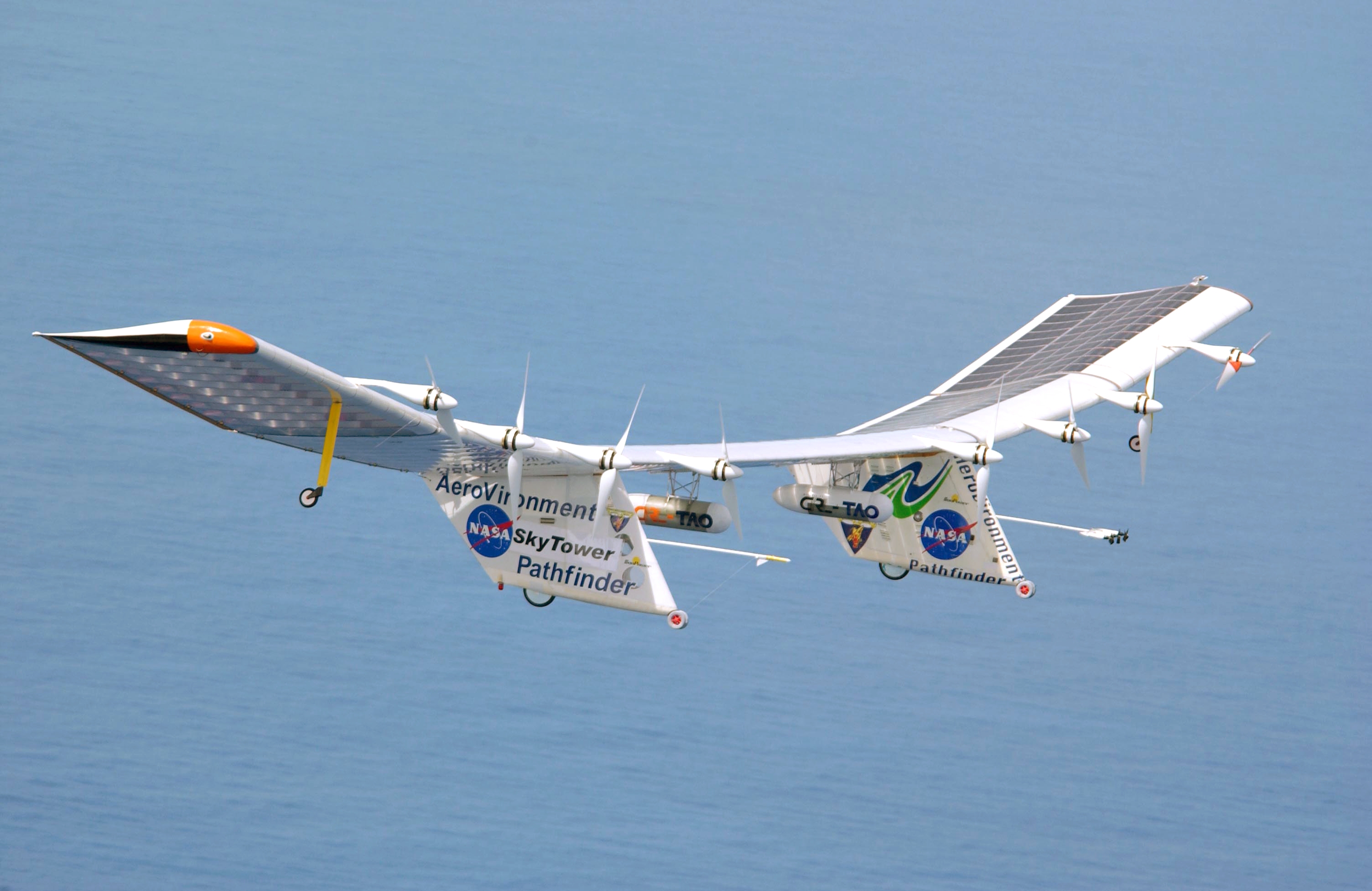
; AeroVironment/NASA Pathfinder : The HALSOL prototype, a 185 kg (410 lb), 30 m (98.4 ft) wide flying wing propelled by eight electric motors, first flew in June 1983. It joined the NASA ERAST Program in late 1993 as the Pathfinder, and with solar cells covering the entire wing added later, it reached 50,500 feet on September 11, 1995 and then 71,530 feet in 1997. The Pathfinder Plus had four sections of the Pathfinder wing out of five attached to a longer center section, increasing span to 121 feet, it flew in 1998 and reached 80,201 feet on August 6 of that year.

; AeroVironment/NASA Centurion/Helios Prototype : Flying in late 1998, the Centurion had a redesigned high-altitude airfoil and span increased to 206 feet, 14 motors, four underwing pods to carry batteries, systems and landing gear. It broke up in flight in 2003.
; Airbus Zephyr : The Zephyr were originally designed by QinetiQ, a commercial offshoot of the UK Ministry of Defence. The UAVs are powered by solar cells, recharging batteries in daylight to stay aloft at night. The earliest model flew in December 2005. In March 2013, the project was sold to Airbus Defence and Space. The latest Zephyr 8/S model weighs 75 kg, has a wingspan of 25 m, and reached 76,100 ft.
; Solar Impulse : The first Solar Impulse manned demonstrator made its first flight on 3 December 2009, and flew an entire diurnal solar cycle in a July 2010 26-hour flight. The 71.9 m (236 ft) wide, 2.3 tonnes (5,100 lb) Solar Impulse 2 first flew on 2 June 2014, it could reach 12,000 m (39,000 ft) and its longest flight was from Nagoya, Japan to Kalaeloa, Hawaii over 117 h 52 min on 28 June 2015.
; Titan Aerospace Solara : Founded in 2012 in New Mexico, Titan Aerospace was developing large solar-powered, high-altitude atmospheric satellites similar to the AeroVironment Global Observer or QinetiQ Zephyr. Google bought Titan Aerospace in April 2014, managed to fly a prototype in May 2015 but it crashed within minutes and Titan Aerospace was shut down by early 2017.
_비행_(196).jpeg)
; KARI EAV : The Korea Aerospace Research Institute (KARI) began developing its Electrical Aerial Vehicle (EAV) in 2010, after subscale demonstrators, its latest 20 m wide EAV-3 weighs 66 kg and is designed to fly for months; it flew up to 14.2 km in August 2015, during 53 hours and up to 22 km in August 2020.
; Astigan A3 : UK mapping agency Ordnance Survey (OS), a subsidiary of the Department for Business, Energy & Industrial Strategy, is developing the A3, a 38 m (125 ft) wingspan, 149 kg (330 lb) twin-boom solar-powered HAPS designed to stay aloft at 67,000 ft for 90 days carrying a 25 kg payload. In March 2021, the project was ended as no strategic partner was found.
; Facebook Aquila : The Facebook Aquila UAV was a carbon fiber, solar-powered flying wing UAV spanning 132 ft and weighing 935 lb, designed to stay aloft at FL650 for 90 days. UAVs would use Laser communication between them and to ground stations. On June 28, 2016, it took its first flight, during ninety minutes and reaching 2150 feet, but a twenty-foot section of the righthand wing broke off during final approach. It made another low-altitude test flights in 2017.
; China Aerospace Science and Technology Corporation : CASTC flew a 147 ft-span solar-powered UAV to FL650 in a 15 hours test flight in July 2017.
; Lavochkin LA-252 : Russia's Lavochkin design bureau is flight-testing the LA-252, an 82 ft-span, 255 lb solar-powered UAV designed to stay aloft 100 days in the stratosphere.
; Mira Aerospace ApusDuo : A joint venture between Abu Dhabi-based Bayanat AI and American UAV manufacturer UAVOS, Mira Aerospace's ApusDuo HAPS has completed over 100 test flights across 3 continents, building off technologies first developed in 2014. With a wingspan of 14 m, the unmanned ApusDuo 14 aircraft utilizes a flexible tandem wing design with high-efficiency solar cells to fly continuously for months at altitudes up to 19000 m, carrying payloads up to 6 kg. During a test flight in Rwanda in October 2023, Mira Aerospace became the first company to successfully deliver 5G connectivity from a fixed-wing HAPS autonomous aircraft in the stratosphere.
; Aurora Odysseus : Aurora Flight Sciences announced its Odysseus in November 2018. It was designed to stay above 65,000 ft up to three months at latitudes up to 20°. Its first flight was indefinitely delayed by July 2019.
; AeroVironment HAPSMobile : AeroVironment will design and development solar-powered UAV prototypes for $65 million for HAPSMobile, a joint venture 95% funded and owned by Japanese telco SoftBank. Resembling the 1999 Helios, the 256 ft span flying wing with 10 electric-driven propellers would provide 4G LTE and 5G direct to devices over a 200 km (125 mi) diameter area On 21–22 September 2020, the HAPSMobile Hawk30 (rebranded as Sunglider) flew 20 hours and reached an altitude of 62,500 ft, testing the long-distance LTE communications developed with Loon for standard LTE smartphones and wireless broadband communications.
; BAE Systems PHASA-35 : Designed by Prismatic Ltd., now BAE Systems, the 35 m (115 ft)-wingspan BAE Systems PHASA-35 made its maiden flight in February 2020 from the Woomera Test Range in South Australia; it should fly its 15 kg payload at around 70,000 ft for days or weeks. By December 2024, it had flown for 24h and reached more than 66,000 ft from Spaceport America in New Mexico, targeting operational activity by 2026.
; Swift Engineering SULE : The Swift Engineering's Swift Ultra Long Endurance SULE completed its maiden flight partnership with NASA's Ames Research Center in July 2020. On Sep. 29-30, 2024, it reached 55,904 ft in a 24-hour flight. It took off from and landed at Spaceport America in New Mexico.
; HAL CATS Infinity : CATS Infinity is being developed by HAL, NAL and NewSpace Research. Its scaled down model first flew in 2022. In February 2024, the 23 kg scaled down prototype with a 12 m wingspan reached 3000 m from Chitradurga Aeronautical Test Range during eight and a half hours, development completion was then expected for 2027. In May 2024, the scaled down prototype flight tests reached 26,000 ft during 27 hours from Chitradurga. The subscale prototype has a goal of a 7-day flight at an altitude of 20 km cruising at 100 km/h. The full-scale, 450 kg CATS Infinity target is a ninety-day endurance at high altitudes, with a 35 kg payload. The Indian Navy is also interested in this project.
; Kea Atmos Mk1 : The Kea Atmos Mk1 solar-powered stratospheric HAPS was designed and manufactured by Kea Aerospace in New Zealand. The maiden test flight was in February 2023 and the first stratospheric flight was on February 8, 2025. It has a wingspan of 12.5 meters and weighs less than 40 kg. The Kea Atmos Mk1 is designed to take 2 kg payloads to the stratosphere on dawn to dusk single day missions and is working with a range of international payload customers. Kea Aerospace is currently designing the Kea Atmos Mk2 to take 6 kg of payload to the stratosphere on multi-month length missions.
| Model | First flight | Span | Weight | Payload | Altitude | Endurance |
|---|---|---|---|---|---|---|
| (dd-hh:mm) | Status | |||||
| AeroVironment Pathfinder | 1993-T4 | 98.4 ft (29.5 m) | 560 lb (252 kg) | 100 lb (45 kg) | 71,530 feet | 00-12:00 |
| AeroVironment Pathfinder plus | 1998 | 121 ft (36.3 m) | 700 lb (315 kg) | 150 lb (67,5 kg) | 80,201 feet | |
| AeroVironment Helios | 1999-09-08 | 247 feet | 2,048 lb (929 kg) | 726 lb (329 kg) | 96,863 feet | goal: 1-00:00 |
| Airbus Zephyr | 2005-12 | 25 m | 75 kg | 5 kg | 76,100 ft | 64-00:00 |
| Titan Aerospace Solara | 2015-05-01 | 160 ft | 70 lb | 520 ft | 00-00:04 | |
| KARI EAV-3 | 2015-08 | 20 m | 66 kg | 22000 m | 02-05:00 | |
| UK OS Astigan A3 | 2016 | 125 ft (38 m) | 330 lb (149 kg) | 25 kg | goal: 67,000 ft | goal: 90-00:00 |
| Facebook Aquila | 2016-06-28 | 132 ft | 935 lb | 2150 feet | 00-01:30 | |
| CASTC | 2017-07 | 147 ft | 65000 ft | 00-15:00 | ||
| Lavochkin LA-252 | 2017-T4 | 82 ft | 255 lb | goal: stratosphere | goal: 100-00:00 | |
| Mira Aerospace's ApusDuo | 2018-10 | 14 m | 43 kg | 3.6 kg | 16686 m | 00-10:30 |
| AeroVironment HAPSMobile | 2019-09-11 | 256 ft | 62,500 ft | 00-20:00 | ||
| BAE Systems PHASA-35 | 2020-02 | 115 ft (35 m) | 150 kg | 15 kg | 66,000 ft+ | 03-00:00 |
| Swift Engineering SULE | 2020-07 | 72 foot | 180 lb | 15 lb | 55,904 feet | 01-00:00 |
| HAL CATS Infinity | 2022-10-19 | 12 m | 23 kg | 26,000 ft | 01-03:00 |
Hydrocarbon fueled
; USAF Compass Dwell and Compass Cope : The USAF Compass Dwell UAV program saw the flight of the LTV XQM-93 in February 1970, based on a turboprop-powered Schweizer SGS 2-32 sailplane and designed to fly 24 hours and to reach 50,000 ft (15,240 m); and the Martin Marietta Model 845 in April 1972, based on a piston engine-powered Schweizer SGS 1-34 sailplane, designed to reach 40,000 feet (12,000 m) and capable to fly 28 hours. The following Compass Cope program saw the Boeing YQM-94 B-Gull first flight on 28 July 1973: powered by a General Electric J97 turbojet, it was designed to fly 30 hours up to 70,000 ft (21,340 m), and managed to fly during 17.4 hours and up to 55,000 feet (16,800 m); the competing Ryan YQM-98 R-Tern was powered by a Garrett ATF3 turbofan, first flew on 17 August 1974 and was designed to fly during 30 hours.
; Boeing Condor : The Boeing Condor first flew on October 9, 1988, it reached 67,028 ft (20,430 m) and stayed aloft for nearly 60 hours; powered by two 175 hp piston engines, the 200 feet wide UAV had a 20,300 lb gross weight and was designed to reach 73,000 ft (22,250 m) and to fly for more than a week.
; Aurora Perseus and Theseus : Built by Aurora Flight Sciences for what would become the NASA ERAST Program, the Perseus Proof-Of-Concept UAV first flew in November 1991 followed by Perseus A on 21 December 1993, which reached over 50,000 feet. Designed to fly at 62,000 ft (18.9 km) and up to 24 hours, Perseus B first flew on 7 October 1994 and reached 60,280 feet on June 27, 1998. Its pusher propeller is powered by a Rotax 914 piston engine boosted by a three-stage turbocharger flat-rated to 105 hp to 60,000 feet. It has a 2,500 lb maximum weight, is able to carry a 260 lb payload and its 71.5 feet wing has a high 26:1 aspect ratio. A larger follow-on powered by two Rotax 912 piston engines, the Theseus first flew on May 24, 1996. Designed to fly during 50 hours up to 65,000 ft (20,000 m), the 5,500 (2.5 t) maximum weight UAV was 140 ft (42.7 m) wide and could carry a 340 kg (750 lb) payload.
; Grob Strato 2C : Designed to fly at 24,000 m (78,700 ft) and for up to 48 hours, the manned Grob Strato 2C first flew on 31 March 1995 and reached 18,552 m (60,897 ft). The 56.5 m (185 ft) wide aircraft was powered by two 300 kW (400 hp) piston engines turbocharged by a PW127 turboprop as the gas generator.
.jpg)
; General Atomics ALTUS : Part of the NASA ERAST Program, the high-altitude UAV General Atomics ALTUS I & II were civil variants of the Gnat 750 (which also spawned the USAF Predator A) which had a 48 hours endurance, with a longer wingspan at 55.3 ft. Powered by a 100 hp turbocharged Rotax 912 piston engine, The 2,130 lb MTOW testbed could carry up to 330 lb of scientific instruments. The Altus II first flew on May 1, 1996, had an endurance over 26 hours, and reached a maximum density altitude of 57,300 feet on March 5, 1999. They led to the larger, turboprop-powered General Atomics Altair.
; Scaled Composites Proteus : The manned Scaled Composites Proteus operates at altitudes of 19.8 km (65,000 ft), while carrying a 1,100 kg payload. Powered by two Williams FJ44 turbofans, it had tandem wings with a 17 m (55 ft) front wing and a wider 24 m (78 ft) wide back wing for a maximum takeoff weight of 6.6 t (14,500 lb), could cruise at 450 km/h and stay 22 hours at {{#expr:3700/4round0}} km of its base.
; Virgin Atlantic GlobalFlyer : The manned GlobalFlyer, built by Scaled Composites, was designed to fly around the world. Powered by a single Williams FJ44, the 114 ft (35 m) wide aircraft can weigh up to 22,100 lb (10 t). Having a 50,700 ft (15,450 m) ceiling, it flew for 76 hours and 45 minutes in February 2006.
; Aurora Flight Sciences Orion : The initial Boeing/Aurora Flight Sciences Orion platform would cruise at 65,000 ft for 100 hours, powered by liquid hydrogen feeding piston engines; its takeoff weight of 7,000 lbs (3.2 tons) allowing 400 lbs (180 kg) payloads.
; Shenyang Aircraft Corporation Divine Eagle : The Divine Eagle, produced by Shenyang Aircraft Corporation, is a large turbofan-powered UAV developed since 2012 and possibly in service by 2018. The twin boom, twin tail aircraft has a canard wing and wind tunnel test were up to a ceiling of 25 km and Mach 0.8.
Hydrogen fueled
; AeroVironment Global Observer : Fueled by liquid hydrogen and designed to fly at up to 65,000 feet for up to 7 days, the AeroVironment Global Observer first flew on 5 August 2010. After a crash in April 2011, the Pentagon shelved the project.
; Boeing Phantom Eye : An evolution of the Boeing Condor developed by Boeing Phantom Works, the Boeing Phantom Eye first flew in June 2012. In August 2016, the Phantom Eye demonstrator was transferred to the Air Force Flight Test Museum.
; Stratospheric Platforms : UK Stratospheric Platforms, created in 2014, went public on 19 October 2020; after flight trials of a 4G/5G relay on a Grob G 520 at 45,000 ft, the start-up is developing a hydrogen-fuel cell-powered HAPS UAV built by Scaled Composites, with a wingspan of 60 m, that would fly at 60,000 ft for nine-days with a payload of 140 kg.
Airships
Unmanned stratospheric airships are designed to operate at very high 60,000 to 75,000 feet (18.3 to 22.9 km) altitudes during weeks, months or years. Subjected to ultraviolet damage, ozone corrosion and challenging station keeping, they can be solar-powered with energy storage for the night.
The first stratospheric powered airship flight took place in 1969, reaching 70000 ft for 2 hours with a 5 lb payload. By August 2002, US company Worldwide Aeros was building a stratospheric demonstrator for the Korea Aerospace Research Institute, as a part the South Korean HAA development program. By April 2004, stratospheric airships were being developed in USA, UK, Canada, Korea and Japan. In May 2004, the Japan Aerospace Exploration Agency shown its test airship in Taiki, Hokkaido, a part of its Stratosphere Platform Project.
; SwRI HiSentinel : On December 4, 2005, a team led by Southwest Research Institute (SwRI), sponsored by the Army Space and Missile Defense Command (ASMDC), successfully demonstrated powered flight of the HiSentinel stratospheric airship at an altitude of 74000 ft.
; Integrated Sensor Is Structure : The USAF Integrated Sensor Is Structure (ISIS) airship would have stayed for up to ten years at 70,000 ft, providing a persistent early warning against cruise missiles at up to 600 km or enemy combatants at up to 300 km.
; Lockheed-Martin HAA : The United States Department of Defense Missile Defense Agency contracted Lockheed Martin to build an unmanned High-Altitude Airship (HAA) for its Ballistic Missile Defense System. In January 2006, Lockheed won a $149M Contract to build it and demonstrate its technical feasibility and military utility. It would operate above 60000 ft in a quasi-geostationary position to deliver persistent orbital station keeping as a surveillance aircraft platform, telecommunications relay, or a weather observer. Launch was originally proposed in 2008, the production aircraft would be 500 ft long and 150 ft in diameter. Powered by solar cells, it would stay in the air for up to one month and was intended to survey a 600 mi diameter of land.
; Lockheed-Martin HALE-D : On July 27, 2011, the "High Altitude Long Endurance-Demonstrator" (HALE-D) subscale demonstrator was launched on a test flight. HALE-D had a 500,000 ft3 volume, was 240 ft long and 70 ft wide, had 15 kW solar cells charging 40 kWh Li-ion batteries and 2 kW electric motors to cruise at 20 kn TAS at 60,000 ft with a 50 lb payload during 15 days. At 32000 ft a problem with the helium levels prevented it and the flight was terminated. It descended and crashed in a Pittsburgh area forest. Two days after, it was destroyed by a fire before its recovery.
; Lindstrand HALE airship : Lindstrand Technologies designed a Helium-filled non-rigid airship covered with solar cells. The 14 t aircraft could carry a 500 kg payload during 3 to 5 years as helium loss would be minimal at high altitudes. For energy storage, a 180kW electrolyser would fill H2 and O2 tanks, to be converted back to water by a 150kW fuel cell. An 80 kW motor would allow a 24 m/s maximum speed.

; Thales Alenia Stratobus : Thales Alenia Space develops the Stratobus unmanned, solar-powered stratospheric airship, 377 ft long and weighting 15,000 lb including a 550 lb payload, it is designed for a five-year mission with annual servicing and a prototype was planned for late 2020.
; H-Aero : H-Aero LTA-based launch systems for Mars exploration, with development taking place via terrestrial high-altitude platforms. The first systems were tested by 2021.
; Stratoship SZ-155 : The SZ-155 was designed and manufactured by Stratoship in Australia. The SZ-155 flew two low altitude test flights in 2022 and 2024 before reaching the stratosphere on its first high altitude flight on May 5th, 2025. It flew for 11 hours and 12 minutes in total, and spent over 8 hours in the stratosphere. The SZ-155 is 25 meters long and was designed for flights of up to 7 days endurance. It can carry up to 10kg of payload to the stratosphere. Stratoship is currently designing a future model for multi-month flights.
Balloons
Main article: Geostationary balloon satellite
A geostationary balloon satellite (GBS) flies in the stratosphere (60,000 to above sea level) at a fixed point over the Earth's surface. At that altitude the air has 1/10 of its density is at sea level. A GBS could be used to provide broadband Internet access over a large area. One prior project was the Google's Project Loon, which envisioned using helium-filled high-altitude balloons.
Rotorcraft
; Boeing A160 Hummingbird : The Boeing A160 Hummingbird is a rotorcraft produced by Boeing. First flown in 2002, the program had goals of a 24-hour endurance, and 30,000 ft (9,100 m) altitude, but was abandoned in December 2012.
References
References
- Pomerleau, Mark. (2015-05-27). "Future of unmanned capabilities: MALE vs HALE". [[Government Executive]].
- "[[ITU Radio Regulations]]".
- D.W. Hall. (December 1983). "A Preliminary Study of Solar Powered Aircraft and Associated Power Trains". NASA Langley Research Centre.
- C.L. Nickol. (January 1, 2007). "High Altitude Long Endurance Air Vehicle Analysis of Alternatives and Technology Requirements Development". [[NASA]].
- (February 1989). "Design and experimental results for a high-altitude, long-endurance airfoil". [[American Institute of Aeronautics and Astronautics.
- Greg Goebel. (1 March 2010). "The NASA ERAST HALE UAV Program". vectorsite.net.
- B.W. Carmichael. (August 1996). "Strikestar 2025". The U.S. Air-force.
- S. Tsach et al. ([[Israel Aircraft Industries. (September 1996). "HALE UAV for intelligence missions". [[International Council of the Aeronautical Sciences.
- (2004). "High altitude long endurance unmanned aerial vehicle of a new generation – a design challenge for a low cost, reliable and high performance aircraft".
- Mark Huber. (August 2, 2018). "Luminati: Perpetual Solar-powered Flight Possible". AIN online.
- T. C. Tozer. (June 2001). "High-altitude platforms for wireless communications". Electronics & Communication Engineering Journal.
- Dillow, Clay. (August 23, 2013). "The drone that may never have to land". Fortune (CNN).
- (2001). "Advantages of HAPS: (ii) Compared with Satellite Services". SkyLARC Technologies.
- "High Altitude Airship". [[Lockheed Martin]].
- John Pike. "RQ-4A Global Hawk (Tier II+ HAE UAV)". Federation of American Scientists.
- Tong Qingxi. (1990). "The airborne Remote Sensing technical system of the Chinese Academy of Sciences". The Joint Center for Remote Sensing of [[Chinese Academy of Sciences.
- (January 17, 2009). "NASA Recruits Unmanned Aircraft for Earth Science". [[Space.com]].
- Nobuyuki Yajima. (2004). "Scientific ballooning: technology and applications of exploration balloons floating in the stratosphere and the atmospheres of other planets". Springer.
- Gerard K. O'Neill. (1981). "2081: a hopeful view of the human future". Simon and Schuster.
- (Feb 20, 2007). "HALE UAVs Come of Age".
- (February 28, 2018). "Northrop Grumman Celebrates 20th Anniversary of Global Hawk's First Flight". Northrop Grumman.
- (October 2014). "RQ-4 Global Hawk". USAF.
- (Sep 13, 2013). "Northrop Grumman Unmanned Aircraft Systems Achieve 100,000 Flight Hours". Faircount Media Group.
- Greg Goebel. (1 Feb 2022). "The Prehistory of Endurance UAVs". airvectors.net.
- (February 28, 2014). "NASA Armstrong Fact Sheet: Helios Prototype". NASA.
- Amos, Jonathan. (24 June 2003). "Strato-plane looks forward". BBC News.
- Craig Hoyle. (11 July 2006). "Energetic Qinetiq". flightglobal.
- (25 September 2013). "First flight of Astrium's Zephyr solar HAPS". [[Airbus]].
- (15 October 2021). "Airbus Zephyr breaks more aviation records during flight testing".
- (March 4, 2014). "Facebook In Talks To Acquire Drone Maker Titan Aerospace". TechCrunch.
- (14 April 2014). "Google buys solar-powered drone maker Titan Aerospace". BBC.
- Stephen Pope. (January 19, 2017). "Google Shuts Down Vern Raburn's Titan Aerospace". [[Flying magazine]].
- "Electrical Aerial Vehicle (EAV)". KARI.
- Tony Osborne. (Feb 18, 2019). "The Week In Technology, Feb. 18-22, 2019". Aviation Week & Space Technology.
- Tony Osborne. (March 30, 2021). "Cartographic Agency Shuts Down Astigan HAPS Project". Aviation Week & Space Technology.
- Rory Cellan-Jones. (21 July 2016). "Facebook's drones - made in Britain". BBC.
- (April 13, 2016). "Facebook's Aquila Drone Creates a Laser-net In the Sky".
- "Aviation Investigation - DCA16CA197". NTSB.
- (16 December 2016). "Reviewing Aquila's first full-scale test flight". Engineering at Meta.
- "Mira Aerospace".
- (October 27, 2023). "Mira Aerospace delivers world's first 5G connectivity from stratosphere". Mira Aerospace.
- Garrett Reim. (14 Nov 2018). "Aurora Flight Science's long-endurance drone to make first flight in spring 2019". Flightglobal.
- Graham Warwick. (Nov 22, 2018). "Anatomy Of Aurora Flight Sciences' Odysseus". Aviation Week & Space Technology.
- Pat Host. (9 July 2019). "Aurora indefinitely delays first flight of Odysseus ultra-long-endurance UAV". Jane's.
- Graham Warwick. (Jan 12, 2018). "AeroVironment's Stratospheric Satellites Persistence Pays Off".
- Graham Warwick. (Apr 29, 2019). "The Week In Technology, April 29-May 3, 2019". Aviation Week & Space Technology.
- Garrett Reim. (8 October 2020). "HAPSMobile Sunglider reaches 63,000ft, demos broadband transmission". Flightglobal.
- Dan Thisdell. (17 February 2020). "BAE joins high-altitude race with maiden PHASA-35 flight". Flightglobal.
- Craig Hoyle. (19 December 2024). "BAE details latest test success with high-flying PHASA-35". Flight Global.
- Swift Engineering. (July 20, 2020). "American made Swift High Altitude Long Endurance UAS Completes Landmark Flight".
- Swift Engineering. (November 2024). "Swift Engineering SULE High-Altitude, Long-Endurance Platform Reaches Stratosphere at 56,000 Feet in 24-Hour-Plus Flight".
- Kim Stevens. (November 21, 2024). "Swift Engineering SULE High-Altitude, Long-Endurance Platform Reaches Stratosphere at 56,000 Feet in 24-Hour-Plus Flight". State Aviation Journal.
- (2024-02-10). "Meet HAPS: India's very own UAV that can fly 20 km high and float for months".
- Joshi, Sameer. (2024-05-15). "The @India_iDEX supported, NewSpace Research & Technologies’s #NRT solar powered scaled #HAPS platform set a new benchmark of 27 hours...".
- Philip, Snehesh Alex. (2023-12-23). "India closer to new drone power as indigenous solar-powered pseudo-satellite flies for over 21 hrs".
- "Condor Unmanned Aerial Vehicle". Boeing.
- (Feb 28, 2014). "Fact Sheet: Perseus B Remotely Piloted Aircraft". NASA Armstrong.
- (Aug 7, 2017). "Fact Sheet: Altus II". [[NASA Armstrong]].
- (Aug 7, 2017). "Fact Sheet: Proteus High-Altitude Aircraft". [[NASA]] Armstrong.
- Sean O'Connor. (14 November 2018). "Divine Eagle UAV spotted at China's Malan airbase". IHS Jane's Defence Weekly.
- (Feb 6, 2015). "China Flies Its Largest Ever Drone: The Divine Eagle". Popular Science.
- (August 16, 2010). "AeroVironment's stratospheric global observer unmanned aircraft system makes first flight". AeroVironment.
- Stephen Trimble. (7 February 2014). "AeroVironment teams with Lockheed Martin on Global Observer". Flightglobal.
- "Phantom Eye". Boeing.
- (Aug 25, 2016). "Air Force Flight Test Museum taking in more NASA history with Phantom Eye, LLRV". Edwards Air Force Base.
- Tim Robinson. (23 October 2020). "Hydrogen-powered UAV to fly 'beast' of the world's biggest airborne 5G antenna". [[Royal Aeronautical Society]].
- Peter Lobner. (9 January 2023). "Modern Airships – Part 1".
- (15 February 2023). "Stratospheric Airships". Aerostar.
- (30 August 2002). "Aeros Completes 50 M Envelope For South Korea High-Altitude Airship Program". Worldwide Aeros Corp.
- (1 April 2004). "Airships: Making a Comeback". Aviation Today.
- (December 3, 2004). "Expectations soar for our huge new airship". [[Japan Aerospace Exploration Agency]].
- (17 November 2005). "Stratospheric airship reaches near-space altitude during demonstration flight". Southwest Research Institute News.
- "High Altitude Airship (HAA)". [[Lockheed Martin]].
- (Jan 16, 2006). "Lockheed Wins $149.2M Contract for High Altitude Airship". [[Defense Industry Daily]].
- (July 27, 2011). "Lockheed Martin, U.S. Army Demonstrate HALE-D During Abbreviated Flight". Lockheed Martin.
- "High Altitude Airship (HAA)". [[GlobalSecurity.org]].
- Jim Mackinnon. (July 27, 2011). "Lockheed Martin's prototype blimp crashes during maiden voyage". [[Akron Beacon Journal]].
- (July 27, 2011). "Lockheed Martin High Altitude Airship's Maiden Voyage Aborted". [[Lighter-Than-Air Society]].
- Jim Mackinnon. (August 2, 2011). "Lockheed Martin's prototype airship burns". Akron Beacon Journal.
- John Pattinson, Lindstrand Technologies. "HALE Airship - Manufacture, Flight and Operation".
- Singer, Cs. (June 2012). "Ultralight Solar Powered Hybrid Research Drone". Concepts and Approaches for Mars Exploration.
- (11 February 2021). "Flugzeug, Hubschrauber und Luftschiff in einem: Baden-Badener Konstrukteur entwickelt neues Fluggerät". [[Badische Neueste Nachrichten]].
- (June 2011). "A low cost alternative for satellites- tethered ultra-high altitude balloons". IEEE.
- FDC/aerofilter. (October 28, 2005). "FDC/aerofilter selected by Boeing Phantom Works for the A160 Hummingbird".
This article was imported from Wikipedia and is available under the Creative Commons Attribution-ShareAlike 4.0 License. Content has been adapted to SurfDoc format. Original contributors can be found on the article history page.
Ask Mako anything about High-altitude platform station — get instant answers, deeper analysis, and related topics.
Research with MakoFree with your Surf account
Create a free account to save articles, ask Mako questions, and organize your research.
Sign up freeThis content may have been generated or modified by AI. CloudSurf Software LLC is not responsible for the accuracy, completeness, or reliability of AI-generated content. Always verify important information from primary sources.
Report