From Surf Wiki (app.surf) — the open knowledge base
Heavy crude oil
Highly viscous liquid fossil fuel
Highly viscous liquid fossil fuel
Heavy crude oil (or extra heavy crude oil) is highly viscous oil that cannot easily flow from production wells under normal reservoir conditions. It is referred to as "heavy" because its density or specific gravity is higher than that of light crude oil. Heavy crude oil has been defined as any liquid petroleum with an API gravity less than 20°. Physical properties that differ between heavy crude oils and lighter grades include higher viscosity and specific gravity, as well as higher molecular weight hydrocarbon composition. In 2010, the World Energy Council (WEC) defined extra heavy oil as crude oil having a gravity of less than 10° and a reservoir viscosity of more than 10,000 centipoises. When reservoir viscosity measurements are not available, extra heavy oil is considered by the WEC to have a lower limit of 4° API; in other words, oil with a density greater than 1000 kg/m3 (or a specific gravity greater than 1) and a reservoir viscosity of more than 10,000 centipoises. Heavy oils and asphalt are dense nonaqueous phase liquids (DNAPLs). They have a low solubility and a viscosity greater than, and density higher than, water. Large spills of DNAPL will quickly penetrate the full depth of a water body and accumulate at the bottom.
Reserves
According to the World Resources Institute, concentrations of remarkable quantities of heavy oil and oil sands are found in Canada and Venezuela.{{cite report | archive-date=2013-07-22 | access-date=2013-04-29 | archive-url=https://web.archive.org/web/20130722055858/http://www.wri.org/publication/content/10339 | url-status=dead
|archive-url = https://web.archive.org/web/20080505051708/http://www.eia.doe.gov/emeu/finance/usi%26to/upstream/venezuela.html |archive-date = 2008-05-05
Extraction
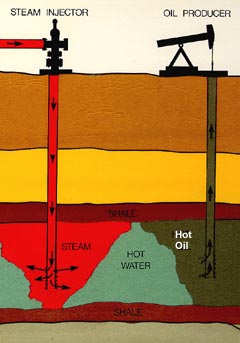
Production of heavy oil is becoming more common in many countries, with 2008 production led by Canada and Venezuela. Methods for extraction include cold heavy oil production with sand, steam-assisted gravity drainage, steam injection, vapor extraction, toe-to-heel air injection, and open-pit mining for extremely sandy and oil-rich deposits.
Production, transportation, and refining of heavy crude oil present special challenges compared to light crude oil. Generally, a diluent is added at regular distances in a pipeline carrying heavy crude to facilitate its flow. Dilbit (diluted bitumen) is a means of transporting highly viscous hydrocarbons. Per the Alberta Oil Sands Bitumen Valuation Methodology, "Dilbit Blends" means "Blends made from heavy crudes and/or bitumens and a diluent usually condensate, for the purpose of meeting pipeline viscosity and density specifications, where the density of the diluent included in the blend is less than 800 kg/m3."
Environmental impact
With current production and transportation methods, heavy crudes have more severe environmental impacts than light ones. With more difficult production comes the employment of a variety of enhanced oil recovery techniques, including steam flooding and tighter well spacing, often as close as one well per acre. Heavy crude oils also carry contaminants. For example, Orinoco extra heavy oil contains 4.5% sulfur as well as vanadium and nickel.
|archive-url = https://web.archive.org/web/20070402100135/http://www.worldenergy.org/wec-geis/publications/default/tech_papers/17th_congress/3_1_04.asp |archive-date = 2007-04-02
With present technology, the extraction and refining of heavy oils and oil sands generates as much as three times the total CO2 emissions when compared with conventional oil, primarily driven by the extra energy consumption of the extraction process (which may include burning natural gas to heat and pressurize the reservoir to stimulate flow). Current research into better production methods seek to reduce this environmental impact.
In a 2009 report, the National Toxics Network, citing data provided by the Carbon Dioxide Information Analysis Center of the government of the United States and the Canadian Association of Petroleum Producers, stated that emissions of CO2 per unit of energy produced were ~84% of those for coal (0.078/0.093) - higher than CO2 emissions of conventional oil.
Environmental Research Web has reported that "because of the energy needed for extraction and processing, petroleum from Canadian oil sands has higher life cycle emission" compared with conventional fossil fuels; "up to 25% more."
Economics
Heavy crude oils provide an interesting situation for the economics of petroleum development. The resources of heavy oil in the world are more than twice those of conventional light crude oil. In October 2009, the United States Geological Survey updated the Orinoco deposits recoverable value to 513 Goilbbl, making this area one of the world's largest recoverable oil deposits. However, recovery rates for heavy oil are often limited from 5-30% of oil in place. The chemical makeup is often the defining variable in recovery rates. New technology utilized for the recovery of heavy oil is constantly increasing recovery rates.
On one hand, due to increased refining costs and high sulfur content for some sources, heavy crudes are often priced at a discount to lighter ones. The increased viscosity and density also makes production more difficult (see reservoir engineering). On the other hand, large quantities of heavy crudes have been discovered in the Americas, including Canada, Venezuela and California. The relatively shallow depth of heavy oil fields—often less than 3000 ft—can contribute to lower production costs; however, these are offset by the difficulties of production and transport that render conventional production methods ineffective. Specialized techniques are being developed for exploration and production of heavy oil.
Properties
Heavy oil can be found in shallow, young reservoirs, with rocks from the Pleistocene, Pliocene, and Miocene (younger than 25 million years). In some cases, it can also be found in older Cretaceous, Mississippian, and Devonian reservoirs.
Heavy oil is asphaltic and contains asphaltenes and resins. Its density and viscosity are the result of the high ratio of aromatics and naphthenes to linear alkanes and high levels of NSOs (nitrogen, sulfur, oxygen and heavy metals). Heavy oil has a higher percentage of compounds with over 60 carbon atoms and hence a high boiling point and molecular weight. For example, the viscosity of Orinoco extra-heavy crude oil lies in the range 1,000 to 5,000 cP (1 to 5 Pa·s), while Canadian extra-heavy crude has a viscosity in the range 5000 to 10,000 cP (5 to 10 Pa·s), about the same as molasses, and higher (up to 100,000 cP or 100 Pa·s for the most viscous commercially exploitable deposits). A definition from the Chevron Phillips Chemical company is as follows:
The "heaviness" of heavy oil is primarily the result of a relatively high proportion of a mixed bag of complex, high molecular weight, non-paraffinic compounds and a low proportion of volatile, low molecular weight compounds. Heavy oils typically contain **very little paraffin** and may or may not contain high levels of asphaltenes.
Heavy crude oils are generally categorized in two ways:
- Those that have over 1% sulfur (high sulfur crude oils), with aromatics and asphaltenes. These are mostly found in North America (Canada (Alberta, Saskatchewan), United States (California), Mexico), South America (Venezuela, Colombia, and Ecuador) and the Middle East (Kuwait, Saudi Arabia).
- Those that have less than 1% sulfur (low sulfur crude oils), with aromatics, naphthenes, and resins; these are mostly found in Western Africa (Chad), Central Africa (Angola), and East Africa (Madagascar).
References
References
- (2006). "Insights Into Non-Thermal Recovery of Heavy Oil".
- Dusseault, M.B.. (12–14 June 2001). "Comparing Venezuelan and Canadian Heavy Oil and Tar Sands". Canadian International Petroleum Conference.
- WEC. (2007). "Survey of Energy Resources 2007: Natural Bitumen - Definitions". World Energy Council.
- (2010). "Survey of energy resources". [[World Energy Council]].
- (1997). "Integrated Study of a Heavy Oil Reservoir in the Orinoco Belt: A Field Case Simulation". SPE Reservoir Simulation Symposium.
- (2003). "Intensive Use of Groundwater: Challenges and Opportunities". CRC Press.
- (2008). "Groundwater Early Warning Monitoring Strategy A Methodological Guide".
- Dusseault, M. B.. (12–14 June 2001). "Comparing Venezuelan and Canadian heavy oil and tar sands". Proceedings of Petroleum Society's Canadian International Conference.
- ''The Leading Edge'', Special Section - Heavy Oil. Vol. 27, No. 8. September, 2008. [[Society of Exploration Geophysicists]].
- (Dec 2008). "Alberta Oil Sands Bitumen Valuation Methodology". [[Canadian Association of Petroleum Producers]].
- Bret Schulte. (4 April 2003). "Oil Spill Spotlights Keystone XL Issue: Is Canadian Crude Worse?". National Geographic News.
- J.R. Century. ''Tar Sands: Key geologic risks and opportunities.'' ''The Leading Edge'', Vol. 27, No. 9, Pg. 1202-1204. September 2008.
- "The Heavy Oil Power Deal. A Dark Cloud over East Timor's Bright Future".
- "Blog Archives – Physics World".
- "Energy Internet".
- [http://www.cpchem.com/enu/docs_drilling/heavyoils.pdf "What causes heavy oil if they don't have asphaltene or paraffin problems?"] {{Webarchive. link. (2008-05-27 - [[Chevron Phillips]] Chemical)
- (August 2003). "Heavy Oil and Natural Bitumen--Strategic Petroleum Resources - "Definitions."".
- "Bitumen". Canadian Encyclopedia.
- {{harv. Meyer. Atanasi. 2003
This article was imported from Wikipedia and is available under the Creative Commons Attribution-ShareAlike 4.0 License. Content has been adapted to SurfDoc format. Original contributors can be found on the article history page.
Ask Mako anything about Heavy crude oil — get instant answers, deeper analysis, and related topics.
Research with MakoFree with your Surf account
Create a free account to save articles, ask Mako questions, and organize your research.
Sign up freeThis content may have been generated or modified by AI. CloudSurf Software LLC is not responsible for the accuracy, completeness, or reliability of AI-generated content. Always verify important information from primary sources.
Report