From Surf Wiki (app.surf) — the open knowledge base
Haweswater Reservoir
Reservoir in Cumbria, England
Reservoir in Cumbria, England
| Field | Value |
|---|---|
| name | Haweswater Reservoir |
| image | Haweswater_from_Harter_Fell_3.jpg |
| caption | Reservoir seen from Harter Fell, Mardale |
| alt | A large lake deep in a valley, pictured from high above |
| location | Lake District, Cumbria |
| coords | |
| type | reservoir, natural lake |
| pushpin_map | United Kingdom Lake District#United Kingdom Eden |
| pushpin_map_caption | Location in the Lake District National Park##Location in Eden, Cumbria |
| inflow | Mardale Beck, Riggindale Beck |
| outflow | Haweswater Beck |
| basin_countries | England |
| length | 6.7 km |
| width | 900 m |
| area | 3.9 km2 |
| depth | 23.4 m |
| max-depth | 57 m |
| volume | 84 e9L |
| residence_time | 500 days |
| elevation | 246 m |
| islands | 1 |
| reference |
| max-depth = 57 m
Haweswater is a reservoir in the valley of Mardale, Cumbria in the Lake District, England. The man-made reservoir, which was created by damming the original natural lake, was completed by 1935. It raised the water level in the valley by 29 m.
The valley was dammed by Manchester Corporation, after it had obtained permission from the UK Parliament through the passing of the Manchester Corporation Act 1919 (9 & 10 Geo. 5. c. cxix). The local act of Parliament was for the supply of drinking water to Manchester. However, the decision caused public outcry because the farming villages of Measand and Mardale Green would be lost when Mardale was flooded.
Construction work on the dam began in 1929. Haweswater was completely flooded by 1935. The reservoir is now owned and managed by United Utilities. It supplies about 25% of North West England's water supply.
Toponymy
Haweswater is derived from Old Norse or Old English. 'Hafr's lake' refers to the personal Norse name 'Hafr' or in Old English 'Hæfer'; 'water' or 'wæter' is the dominant term for 'lake' in old English.
Geology
Haweswater is the location of a caldera volcano succession.
History
Haweswater was originally a natural lake about 4 km long. A tongue of land at Measand divided the lake almost in two. The upper and lower reaches of the lake were known as High Water and Low Water.
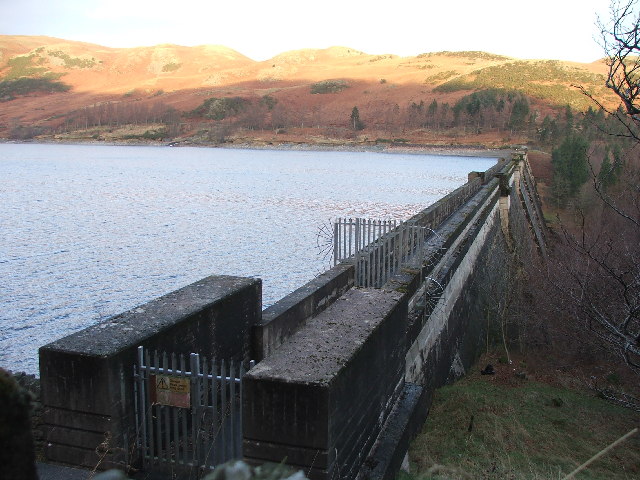
In 1929 work started to build the dam wall across the valley floor. At the time of construction, its design was considered to be at the forefront of civil engineering technology because it was the world's first hollow buttress dam. The wall would be created from 44 separate buttressed units joined by flexible joints.
When the dam was completed by 1935, it measured 470 m long and 27.5 m high. A 1.4 m wide parapet runs atop the length of the dam. Building supplies were brought to the site from the adjoining valleys of Heltondale and Swindale. A purpose-built 5.5 mi concrete road was constructed between the work site and Shap for the transportation of building materials.
When the valley was flooded, the dam raised the water level by 29 m. This created a reservoir 6 km long and up to 600 m across at its widest point. It holds up to 84 e9L of water.
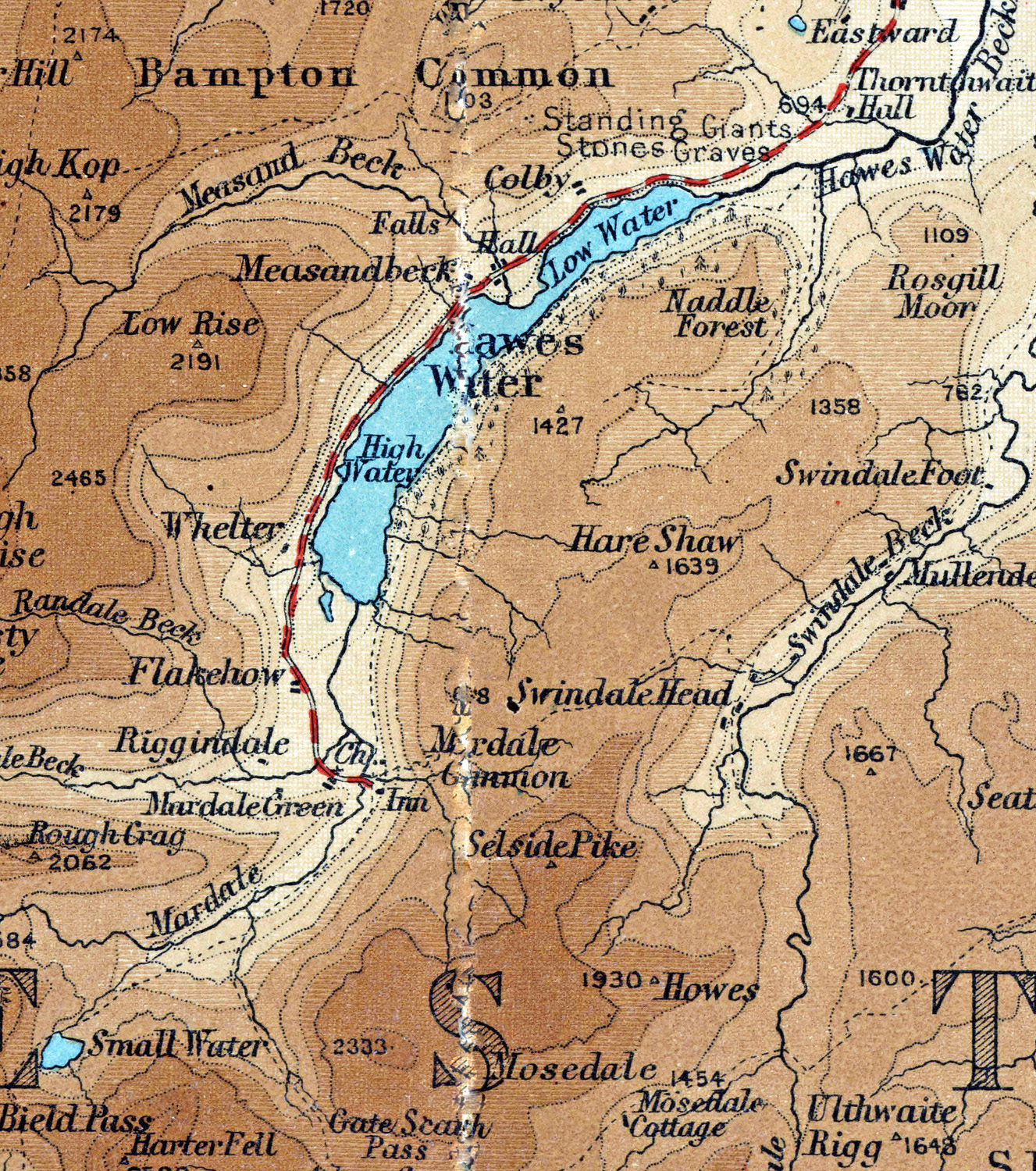

All the farms and dwellings of the villages of Mardale Green and Measand were demolished while the dam wall was being built, as well as the centuries-old Dun Bull Inn at Mardale Green. The village church was dismantled and the stone used in constructing the dam; all the bodies in the churchyard were exhumed and re-buried at Shap.When the water in the reservoir is low, the remains of the submerged village of Mardale Green can still be seen, including stone walls and the village bridge.
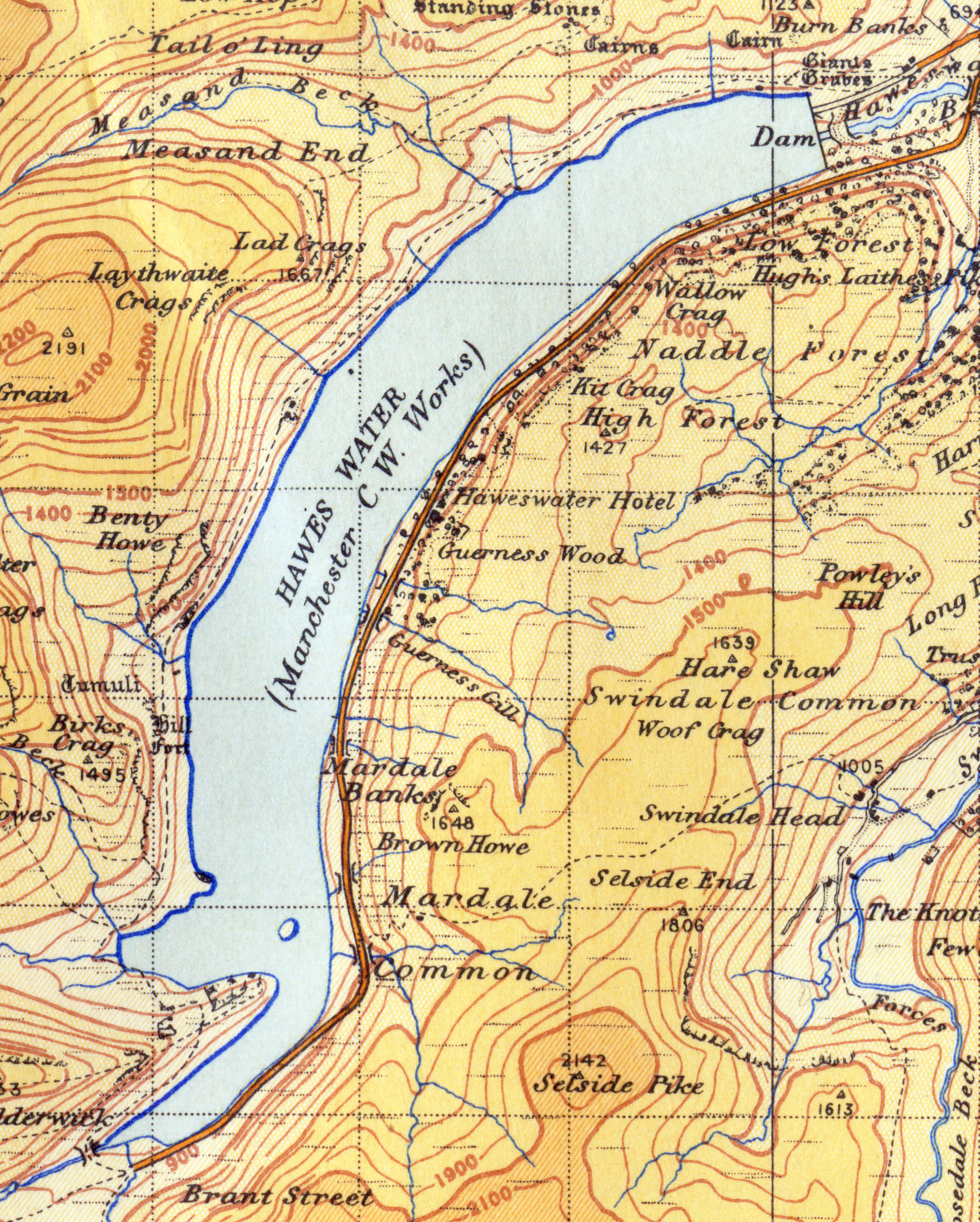
Manchester Corporation built a new road along the eastern side of the lake to replace the flooded highway lower in the valley, and the Haweswater Hotel was constructed midway down the length of the reservoir as a replacement for the Dun Bull. The road continues to the western end of Haweswater, to a car park, a popular starting point for a path to the surrounding fells of Harter Fell, Branstree and High Street.
Wildlife
Fish
A species of schelly, from the Salmon family which is endemic to four lakes in the Lake District, reside in Haweswater They are believed to have lived there since the last Ice Age. However, the population in Haweswater is in decline. Cormorants have been culled to protect the endangered fish. However, analysis of reservoir management data over a 30-year period (1961–1991) has revealed that the decline of the schelly population is also associated with increased water abstraction and reduced water levels.
RSPB
The Royal Society for the Protection of Birds (RSPB) first became involved at Haweswater because of the presence of golden eagles – the first to return to England in over 170 years. The organisation currently leases two farms in the area and has rights to their associated common land.
Until 2015, Haweswater was the only place in England where a golden eagle was resident. A pair of eagles first nested in the valley of Riggindale in 1969, and the male and female of the pairing changed several times over the years, during which 16 chicks were produced. The last female bird disappeared in April 2004, leaving the male alone. There was an RSPB viewpoint in the valley for people wishing to see the eagle. The last sighting was in November 2015, and it was reported in 2016 that the 20-year-old bird might have died of natural causes.
Since 2012, the RSPB has leased two farms from the landowner United Utilities. The aim is to combine the improvement of wildlife habitats and water quality, with running a viable sheep farm. Moorland and woodland habitats are being improved for birds as well as the rare small mountain ringlet butterfly. Measures include grip blocking, where the water level of drainage ditches is raised to encourage re-vegetation and reduce erosion, heather replanting, and juniper woodland planting (especially in the ghylls).
The RSPB have established the largest native tree and plant nursery in the Lake District. Seed is collected from the existing plants and trees on-site, grown in the nursery and planted to restore the landscape.
Literary references
Hawes Water is described in Anthony Trollope's novel Can You Forgive Her? (1864).
Lake District writer and fell walker Alfred Wainwright had this to say on the construction of the Haweswater Dam in his 1955 book A Pictorial Guide to the Lakeland Fells:
Haweswater is a 2002 novel by British writer Sarah Hall, set in Mardale at the time of the building of the dam and flooding of the valley. It won the 2003 Commonwealth Writers' Prize for a First book. The novel was released in the United States as a paperback original in October 2006, by Harper Perennial.
The RSPB's site manager at Haweswater, Lee Schofield, published Wild Fell: Fighting for Nature on a Lake District Hill Farm (2022), a personal account of the charity's work at the site.
References
References
- McNamara, Jane. "Table of lake facts". [[Environment Agency]] of England and Wales.
- Whaley, Diana. (2006). "A dictionary of Lake District place-names". English Place-Name Society.
- Brenchley, P. J.. (10 January 2006). "The Geology of England and Wales". Geological Society of London.
- (18 July 2018). "Lake District village ruins revealed by water shortage". BBC News.
- Ford, M.. (2024). "''Coregonus stigmaticus''".
- "Haweswater". [[RSPB]] website.
- Aldred, Jessica. (2016). "England's last Golden Eagle feared dead".
- "RSPB turns to farming". Westmorland Gazette.
- (2012). "New deal for nature and water".
- [[Anthony Trollope]]. (1864–65). "Can You Forgive Her?". Chapman and Hall (via Project Gutenberg).
- Wainwright, A. (2005). "A pictorial guide to the Lakeland fells". Frances Lincoln.
- (14 June 2002). "Village of the dammed". The Guardian.
- "Commonwealth Writers' Prize Regional Winners 1987–2007". Commonwealth Foundation.
This article was imported from Wikipedia and is available under the Creative Commons Attribution-ShareAlike 4.0 License. Content has been adapted to SurfDoc format. Original contributors can be found on the article history page.
Ask Mako anything about Haweswater Reservoir — get instant answers, deeper analysis, and related topics.
Research with MakoFree with your Surf account
Create a free account to save articles, ask Mako questions, and organize your research.
Sign up freeThis content may have been generated or modified by AI. CloudSurf Software LLC is not responsible for the accuracy, completeness, or reliability of AI-generated content. Always verify important information from primary sources.
Report