From Surf Wiki (app.surf) — the open knowledge base
Haversian canal
Series of microscopic tubes in the cortical bone
Series of microscopic tubes in the cortical bone
| Field | Value |
|---|---|
| Name | Haversian canal |
| Image | Transverse section of bone en.svg |
| Caption | Diagram of compact bone from a transverse section of a typical long bone's cortex. |
| Width | 300 |
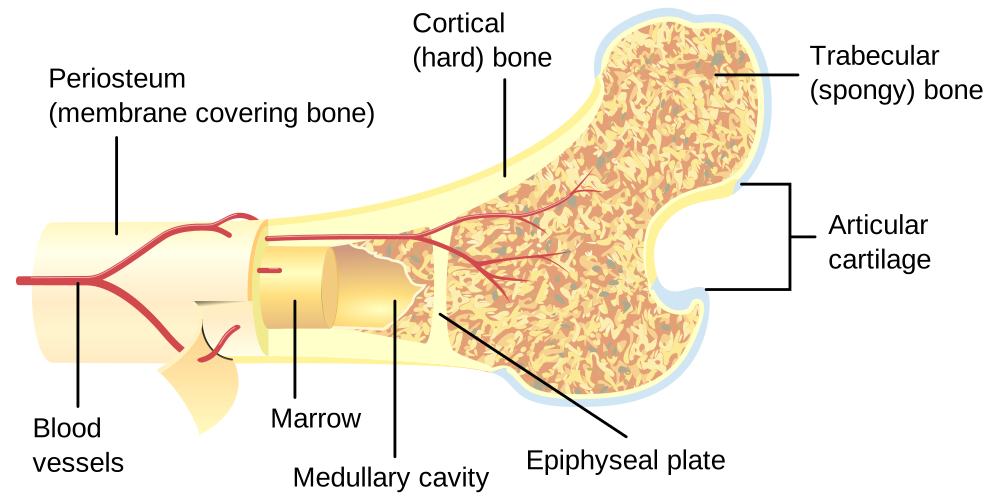
Haversian canals (sometimes canals of Havers, osteonic canals or central canals) are a series of microscopic tubes in the outermost region of bone called cortical bone. They allow blood vessels and nerves to travel through them to supply the osteocytes.
Structure
Each Haversian canal generally contains one or two capillaries and many nerve fibres. The channels are formed by concentric layers called lamellae, which are approximately 50 μm in diameter. The Haversian canals surround blood vessels and nerve cells throughout bones and communicate with osteocytes (contained in spaces within the dense bone matrix called lacunae) through connections called canaliculi. This unique arrangement is conducive to mineral salt deposits and storage which gives bone tissue its strength. Active transport is used to move most substances between the blood vessels and the osteocytes.
Haversian canals are contained within osteons, which are typically arranged along the long axis of the bone in parallel to the surface. The canals and the surrounding lamellae (8-15) form the functional unit, called a Haversian system, or osteon.
Clinical significance
Fracture
Blood vessels in the Haversian canals are likely to be damaged by bone fracture. This can cause haematoma.
Rheumatoid arthritis
Haversian canals may be wider in patients with rheumatoid arthritis. They are also more likely to contain osteoclasts that break down bone structure. These differences are studied with light microscopy.
History
Haversian canals were first described (and probably discovered) by British physician Clopton Havers, after whom they are named. He described them in his 1691 work Osteologica Nova.
In different animals
Human bones are densely vascularized as in many other mammals. Even though some authors tried to identify a correlation between endothermy and secondary Haversian reconstruction, this feature is absent in many living mammals (e.g. monotremes, Talpa, flying foxes, Herpestes, Dasypus) and birds (Aratinga, Morococcyx, Nyctidromus, Momotus, Chloroceryle) while others possess only scattered Haversian systems (e.g. artiodactyls, Didelphis, Anas, Gallus, turkey, helmeted guineafowl). Scattered Haversian canals are also found in ectotherms like cryptodira turtles. Among extinct groups, dense Haversian vascularization is only present in stem-birds (dinosaurs) and stem-mammals (therapsids) while scattered Haversian systems can be found in ichthyosaurs, phytosaurs, basal stem-mammals (e.g. Ophiacodon), Limnoscelis, and temnospondyls. When endosteal Haversian systems are considered, the phylogenetic distribution becomes even broader.
Notes
References
Additional images
File:Osso por Descalcificação – HE – 40x.JPG|Bone by decalcification (40x): File:Osso por Descalcificação2 – HE – 100x.JPG|Bone by decalcification (100x):
References
- (2011-01-01). "5.18 - Mechanobiology of Bone". Academic Press.
- (2005-01-01). "Chapter 4 - BONE BIOLOGY & VARIATION". Academic Press.
- Aeberli, D.. (2014-01-01). "Skeleton, Inflammatory Diseases of". Elsevier.
- (2017-01-01). "Vascularised bone transfer: History, blood supply and contemporary problems". Journal of Plastic, Reconstructive & Aesthetic Surgery.
- Havers, Clopton. (1729). "Osteologia Nova: Or, Some New Observations of the Bones, and the Parts Belonging to Them; with the Manner of Their Accretion and Nutrition: Communicated to the Royal Society in Several Discourses ... To which is Added, a Fifth Discourse, of the Cartilages. The Second Edition. By Clopton Havers ..". W. Innys.
- Bouvier, Marianne. (1977). "Dinosaur Haversian Bone and Endothermy". Evolution.
- Enlow, Donald H.. (1969). "Biology of the Reptilia". Academic Press.
This article was imported from Wikipedia and is available under the Creative Commons Attribution-ShareAlike 4.0 License. Content has been adapted to SurfDoc format. Original contributors can be found on the article history page.
Ask Mako anything about Haversian canal — get instant answers, deeper analysis, and related topics.
Research with MakoFree with your Surf account
Create a free account to save articles, ask Mako questions, and organize your research.
Sign up freeThis content may have been generated or modified by AI. CloudSurf Software LLC is not responsible for the accuracy, completeness, or reliability of AI-generated content. Always verify important information from primary sources.
Report