From Surf Wiki (app.surf) — the open knowledge base
Hasselt
Capital of Limburg province, Belgium
Capital of Limburg province, Belgium
| Field | Value | |||
|---|---|---|---|---|
| name | Hasselt | |||
| type | city | |||
| picture | {{multiple image | |||
| border | infobox | perrow = 1/2/2/2 | total_width = 300px | caption_align = center |
| image1 | Panorama Hasselt- stadscentrum met Sint Quintinuskathedraal en Blauwe Boulevard.jpg | |||
| caption1 | City center with St. Quentin's Cathedral in the bottom left | |||
| image2 | Grote Markt Hasselt.jpg | |||
| caption2 | Grote Markt | |||
| image3 | Hasselt Het Sweert 2.JPG | |||
| caption3 | timber-framed house *Het Sweert* | |||
| image4 | Stadhuis Hasselt.jpg | |||
| caption4 | Old City Hall | |||
| image5 | Stadshuis Hasselt.jpg | |||
| caption5 | New City Hall | |||
| map | Map Belgium Hasselt 2025.svg | |||
| map-legend | Location of Hasselt in Limburg | |||
| arms | Wapen van Hasselt.svg | |||
| flag | Hasselt (B) vlag.svg | |||
| province | Limburg | |||
| arrondissement | Hasselt | |||
| nis | 71072 | |||
| mayor | Steven Vandeput (N-VA) | |||
| majority | Open VLD/N-VA, CD&V, Vooruit | |||
| postal-codes | 3500, 3501, 3510, 3511, 3512, 3720, 3721, 3722, 3723, 3724 | |||
| telephone-area | 011 - 012 | |||
| web | [www.hasselt.be](http://www.hasselt.be/) | |||
| coordinates | ||||
| footnotes | [[File:Hasselt 2017.svg | 120px | center]] |
|picture-legend = |map-legend = Location of Hasselt in Limburg |postal-codes = 3500, 3501, 3510, 3511, 3512, 3720, 3721, 3722, 3723, 3724 |telephone-area = 011 - 012 Hasselt (, , ) is the capital and largest city of the province of Limburg in the Flemish Region of Belgium.
As of 1 January 2025, Hasselt had a total population of 90,249. The old town of Hasselt is surrounded by a number of satellite hamlets including Kiewit, Runkst, Banneuxwijk, Godsheide and Rapertingen. Further away are several sub-municipalities which were once within other municipalities, including Guigoven, Kermt, Kortessem, Kuringen, Sint-Lambrechts-Herk, Spalbeek, Stevoort, Stokrooie, Wimmertingen, Vliermaal, Vliermaalroot, and Wintershoven.
Geographically, Hasselt is located between the Campine region, north of the Demer river, and the Hesbaye region, to the south. Both the Demer river and the Albert Canal run through the municipality.
In terms of economic regions, Hasselt is within the transnational Meuse-Rhine Euroregion, connecting neighbouring regions in Wallonia, the Netherlands and Germany.
History
Hasselt was founded in approximately the 7th century on the Helbeek, a tributary of the Demer river. During the Middle Ages it became one of the free cities of the county of Loon (which had borders approximately the same as the current province of Limburg). It was first named in a document in 1165. In 1232 Arnold IV, Count of Loon gave the city the same freedoms as those enjoyed in Liège. Hasselt became the biggest city in present-day Limburg thanks to its favourable setting, and the proximity of the count's castle at Herkenrode in Kuringen. In 1366 the county of Loon came under the direct rule of the Prince-Bishopric of Liège and remained so until the annexation by France in 1794.
During the First French Empire, the city of Maastricht became the capital of the French Department of the Lower Meuse. This comprised not only the area of the modern province of Limburg in Belgium, but also what is now the province of Limburg in the Netherlands. After the defeat of Napoleon in 1815, all of what is now Belgium became part of the United Kingdom of the Netherlands. During this time, it was King William I who re-named the Lower Meuse department after the medieval Duchy of Limburg. This Duchy was in fact named after Limbourg on the Vesdre river, now in the Liège province of Belgium, which had never encompassed Hasselt or Maastricht. Belgium split from the Netherlands in 1830, but the status of Limburg was only resolved nine years later in 1839, with the division of Limburg into Belgian and Dutch parts. Hasselt became the provisional capital of the Belgian province of Limburg. In ecclesiastical terms, Belgian Limburg became an independent entity from the Diocese of Liège only in 1967, and Hasselt became the seat of the new Diocese of Hasselt.
In 1977, Hasselt merged with several surrounding municipalities attaching the current sub-municipalities of Kermt, Kuringen, Sint-Lambrechts-Herk, Stevoort and Wimmertingen.
Since the beginning of the 21st century, many urban renewal projects have taken place in the city, including the construction of the Two Towers (TT) neighborhood. From 1 January 2025, the neighboring village of Kortessem will merge into Hasselt, becoming a new sub-municipality.
Etymology
The name Hasselt is derived from the Germanic word Hasaluth which refers to the common hazel.
Town centre
The centre is mostly car-free and contains a number of historical buildings. Among the oldest buildings in the town centre are the St. Quentin's Cathedral (11th to 18th centuries) and the Refuge of Herkenrode Abbey, the city's oldest civic building (1542). The Grote Markt (Grand Market) and the nearby streets are lined with restaurants brasseries, cafes and taverns.
The Demerstraat and the Koning Albertstraat are the most important shopping streets, while the Kapelstraat and Hoogstraat house upscale shops and brands. Another major religious building besides the cathedral is the Virga Jesse Basilica. The churches must cede domination of the skyline of the city to the modern twin towers of the TT-wijk (TT Quarter), however. In 2003, the renovation of this complex, now including a shopping mall and a hotel, gave the centre a new boost. In 2004, Hasselt was the first city to receive the title "most sociable city in Flanders".
Demographics
In 1977, the merger of Hasselt with several surrounding municipalities added 22.309 inhabitants at the time to its own population of 40.446 inhabitants. As of 1 October 2024, Hasselt had a total population of 81.708 (40.070 men and 41.638 women).
Languages
- Dutch in Hasselt is often spoken with a distinctive Limburgish accent and vocabulary, which should not be confused with the Limburgish language.
- Limburgish (or Limburgian) is the overlapping term for the tonal dialects spoken in the Belgian and Dutch provinces of Limburg. The Hasselt dialect is only one of many variants of Limburgish. Limburgish is a language, and not the same as the regional variation of Dutch spoken in Dutch Limburg and Belgian Limburg.[[File:Sint Quintinuskathedraal.jpg|thumb|[[St. Quentin's Cathedral]]]] Since Limburgish is still the mother tongue of many inhabitants, Limburgish grammar, vocabulary and pronunciation can however have a significant impact on the way locals speak Dutch in public life.
- French was historically spoken by some of the city population within living memory.
Religion
Hasselt is the main seat of the Catholic diocese of Hasselt, which covers the entire Belgian province of Limburg. The main church is St. Quentin's Cathedral. Hasselt also consists of about 30 parishes. Next to the Catholic Church, Hasselt houses both a Moroccan and Turkish mosque as both communities are established in the city and the surrounding municipalities. There was a Jewish community in Hasselt for centuries, but most of their Jews were deported and murdered during the war. The synagogue was destroyed together with its contents, including ceremonial objects and Torah scrolls. The cemetery is now maintained by the local authorities. A Hebrew inscription on a local war monument memorializes the murdered Jews of Hasselt.
Main sights


- Gothic St. Quentin's Cathedral, seat of the Roman Catholic Diocese of Hasselt
- Virga Jesse Basilica, late-baroque and early-neoclassical architecture
- Herkenrode Abbey, Cistercian monastery
- Beguinage of Hasselt
- Grote Markt, including the timber-framed house Het Sweert
- Havermarkt, including the Old Post Office, the Old Courthouse, and the Augustinian Abbey
- Several buildings in the style of Mosan Renaissance architecture, among them the former Grauwzustersklooster (Abbey of the Grey Sisters of the Third Order)
- Several buildings in the style of eclectic architecture, among them the Old Post Office and the Old Provincial Government Building
- Neoclassical Old City Hall
- Refuge of Herkenrode Abbey, the city's oldest civic building
- Old Prison, now housing Hasselt University
- Oud Kerkhof, historic cemetery
- New City Hall, christened 't Scheep (The Ship)
- New Courthouse
- Art Museum Z33 in the Beguinage
- National Jenever Museum
- City Museum of Hasselt
- Fashion Museum in the former Grauwzustersklooster
- Cultuurcentrum Hasselt
- Japanese gardens, the largest in Europe
- Kiewit Nature Park
- Kiewit Airfield (recreational)
Events
- The Virga Jesse festival, featuring a Procession of the historic wooden statue of infant Jesus with Mary, is celebrated every seven years, it will be in August 2024.
- The yearly Jenever Festival celebrates the history of Jenever in Hasselt.
- Hasselt celebrates Carnival, but at a slightly different date than most places.
- The suburb Kiewit is the location of the yearly Pukkelpop (Pimple Pop) festival, one of Europe's largest alternative music festivals with over a hundred concerts. Rimpelrock (Wrinkle Rock), a festival with music for an older audience, is held at the same location one week prior.
- As in most Belgian cities, there is an annual Kermesse on a date associated with the local church's patron saint - in this case Saint Lambert -, which takes place in September.
- The Junior Eurovision Song Contest 2005 was held in Hasselt.
- The Grand Prix van Hasselt is a cyclo-cross race held in November which is part of the BPost Bank Trophy.
- Gaz de France Stars was a WTA Tour tennis tournament held in Hasselt from 2004 to 2006.
- The European Darts Championship was held in the city's Trixxo Arena three times from 2015-2017.
Gastronomy
Hasselt brands itself as the "Capital of Taste", owing to its local distilleries of Jenever, the Hasselt Jenever Festival, Hasselt speculaas, and chocolate production.
Hasseltse Jenever (Hasselt gin)

Hasselt is famous for its gin, locally known as Jenever. Even though the spirit is produced across the entire country of Belgium, Hasselt Jenever became famous when the city escaped the 1601 ban on the sale and production of the beverage imposed by Albert VII, Archduke of Austria and Isabella Clara Eugenia, both Archduke and Archduchess of the Habsburg Netherlands, because it belonged to the Prince-Bishopric of Liège. Dutch troops stationed in the city from 1675 to 1681 ensured that Hasselt Jenever, more than any other Belgian jenever, carried aromas of herbs and berries.

At the end of the 19th century, dire living conditions among the working population and cheap Jenever prepared from sugar beet molasses led to the annual consumption of 9.5 litres of Jenever (50% vol) per inhabitant of Belgium. Jenever production was the most important industry in Limburg in the 19th century with most distilleries being located in Hasselt. However, increase in excise duty, competition from cheap industrial alcohol, the confiscation of copper stills by the Germans during World War I, and the Vandervelde law against alcohol abuse caused most distilleries in Hasselt to disappear or to be taken over by larger competitors.
By the early 21st century, Hasselt only housed two distilleries (known as 'stokerij' in Dutch): the National Jenever Museum and Stokerij Wissels, which was later bought by the larger Stokerij Fryns, based in Ghent, which resumed Jenever production on the former Wissels grounds under the Fryns name. Today, three Jenever distilleries operate in Hasselt: the National Jenever Museum, Stokerij Fryns, and Stokerij Vanderlinden, founded in 2017.

Hasselt Jenever Festival
Every year during the third weekend of October, the two-day Hasselt Jenever Festival takes place. It includes, among other elements, musical, dance, and street theatre performances, the Borrelmanneke fountain on Maastricherstraat being transformed from a water fountain into a Jenever fountain for the day and a Waiters' Race through the city center.
Hasselt speculaas

Hasselt speculaas is a type of speculaas originating from and only produced in Hasselt. It differs from the type of speculaas eaten in the rest of Belgium in its greater thickness, its smaller reliance on spices - which gives it a milder taste -, and in its structure, with a crispy crust and soft, doughy insides.
Speculaas was baked in Hasselt as early as the 14th century. According to tradition, Hasselt speculaas was eaten with chilled Jenever. The early 19th century saw the introduction of the Spéculation de Hasselt - the Hasselt speculaas -, which was soon exported to Brussels and to Liège, among others. Until the Second World War, Hasselt speculaas was only baked around Saint Nicholas Day, since then it has been sold throughout the entire year.
Branding
Since the early 2000s, Hasselt has been known within Flanders for its distinctive and sometimes outspoken branding as a city. In 2002, former mayor, Steve Stevaert, introduced the catchphrase "Hasselt Capital of Taste" (Dutch: Hasselt Hoofdstad van de Smaak), creating a well-known brand image across the Flemish region to promote its touristic attractions, stores and local industries.
After 15 years the city decided to rebrand to "Hasselt has it" (Dutch: Hasselt heeft het). However, the city's old branding remained in use by its citizens and beyond. Five years later, due to this brand recognition, the city decided to reverse to the original catchphrase in spoken communication, and use "Hasselt Smaakmaker Spraakmaker" in written communication and visuals.
In 2023, a dating platform had selected Hasselt as the Belgian city with the most eligible singles. The city developed a tourism campaign based on this claim, showing diverse couples throughout the city within promotional videos and posters, while also strategically highlighting the claims of the dating platform. The campaign saw the use of a new catchphrase "Hasselt tastes like more" (Dutch: Hasselt smaakt naar meer), building further on their earlier catchphrase "Hasselt Capital of Taste".
Economy
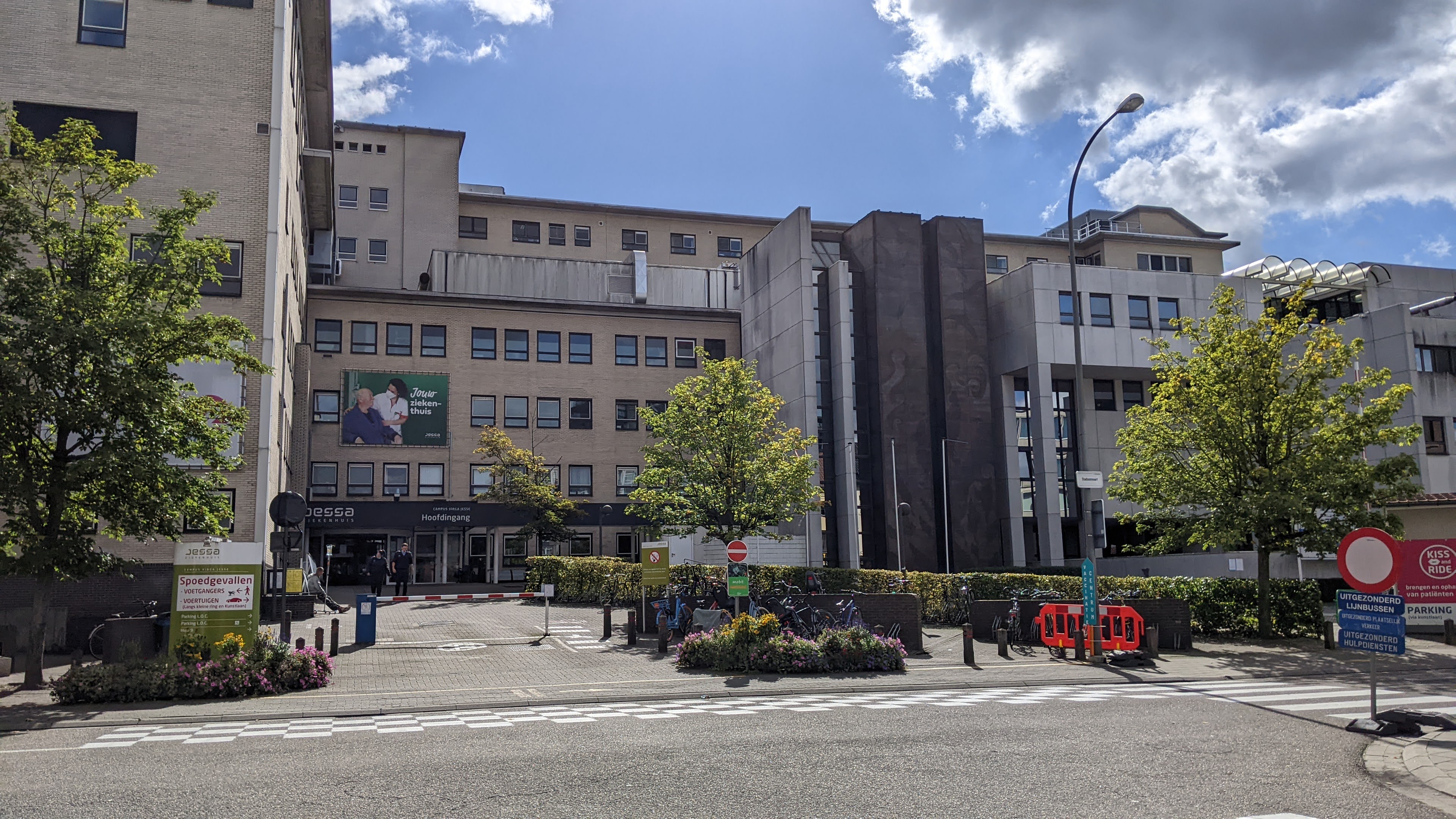
With 3,000 employees, the Jessa Hospital in Hasselt is the city's biggest employer with two health care campuses and one logistical campus. Cegeka Group, a European provider of IT solutions, services, and consultancy is also one of the city's largest employers, generating a turnover of €744 million. The city also provides an ecosystem for start-ups, scale-ups, and major companies through its Corda Campus, surrounded by government organizations and research institutions. Currently, 5,000 people work in 250 companies over a land area of 9 acres, formerly being occupied by Philips. By 2030, an investment of €150 million at the site is planned to generate employment for 7,500 people in 350 companies on an area of 14 acres.
Inventions
The Compact Cassette and Cassette Recorder were invented by a team of Belgian and Dutch engineers, led by the Lou Ottens, at Philips' Hasselt site in 1963. In 1983, a team of engineers developed one of the first compact disc (CD) devices at Philips Hasselt.
Transport
Road
Hasselt lies at the junction of important traffic arteries from several directions. The most important motorways are the European route E313 (Antwerp-Liège) and the European route E314 (Brussels-Aachen). The old town of Hasselt is enclosed by 2 ring roads. The outer ring road serves to keep traffic out of the city center and main residential areas. The inner ring road, the Green Boulevard, serves to keep traffic out of the commercial center, which is almost entirely a pedestrian area. There are also important traffic arteries to Tongeren, Sint-Truiden, Genk, and Diest.
Nearby airports
The city lies within approximately an hour's drive from the airports of Brussels, Liège, Antwerp, Charleroi, Eindhoven, Maastricht, Cologne/Bonn, and Düsseldorf. Within a three-hour radius, the major hubs of Paris, Amsterdam and Frankfurt can be reached. Some of these airports have direct public transport links via either train or intercity bus lines, like Flixbus.
Kiewit Airfield
The suburb of Kiewit, Hasselt is home to Belgium's oldest existing airfield, being also one of the oldest in the world. Kiewit Airfield opened in 1909, just six years after the Wright brothers' first flight. In October 1910, the first Belgian air show took place here.
Currently it is a recreational airfield with a single grass runway of 600m length with mixed activity of airplanes and gliders.
Bus
Hasselt introduced a zero-fare policy for all public buses in 1997. By 2006, the usage of public transport had increased by 800–900% compared to pre-zero-fare numbers. In 2013, bus subsidies were reduced, resulting in the reintroduction of fares (60 cents per ride).
| access-date = 21 February 2002}} The city's official website records passenger growth as follows:
| Year | Passengers | Percentage |
|---|---|---|
| 1996 | 360 000 | 100% |
| 1997 | 1,498,088 | 428% |
| 1998 | 2,837,975 | 810% |
| 1999 | 2,840,924 | 811% |
| 2000 | 3,178,548 | 908% |
| 2001 | 3,706,638 | 1059% |
| 2002 | 3,640,270 | 1040% |
| 2003 | 3,895,886 | 1113% |
| 2004 | 4,259,008 | 1217% |
| 2005 | 4,257,408 | 1216% |
| 2006 | 4,614,844 | 1319% |
A Belgian website describes Hasselt identity cards as becoming "like gold in value", because of free bus travel.
In 2013, Hasselt cancelled free public transportation due to financial reasons. The operator increased its claim towards the city, which the city could not pay. Now persons up to the age of 19 travel for free.
Rail
Hasselt railway station, run by NMBS, is located near the city centre, outside the innermost ring road. InterCity trains link the city to major Belgian centres such as Brussels, Antwerp, Liège, and Leuven, as well as to Brussels Airport.
Reopening of rail line 20 Hasselt - Maastricht
In February 2007, a plan was launched for the construction of an international light rail connection between Hasselt and Maastricht (Hasselt – Maastricht tramway). Agreements between the relevant governments were reached in June 2008 and December 2011. The line was planned to reduce the current travel time of 61 minutes by bus to only 36 minutes. Construction should have started in 2014, with the line expected to go into service in 2017. The construction eventually was delayed several times due to problems with the Wilhelminabrug in Maastricht, concerns about the profitability and the numbers of passengers making use of the planned line as well as opposition from the Hasselt city council regarding the planned route through the city. The Flemish government eventually stopped the project, with various Dutch governments reporting to have spent more than €20 million without any major construction happening. The line has now been proposed to be replaced by a so-called electric trambus system. However, concerns were raised too as the new alternative might not fulfill the cross-border high-quality public transport needs of the Dutch and Belgian provinces of Limburg.
Since end 2024, the reopening of rail line 20 between Hasselt and Maastricht is being reconsidered within Flanders, after the Dutch Government unveiled plans to demolish a vital railway bridge over the Meuse river in Maastricht.
Climate
Education

Hasselt has two university colleges: University College PXL and University Colleges Leuven-Limburg (UCLL). These offer courses in healthcare, social work, art, commercial sciences, and teacher training, among others.
Hasselt University, established in 1971, operates campuses in the city and in the neighbouring town of Diepenbeek and, as of 2023, has more than 7,000 students and 1,700 academic, administrative, and technical staff. The university houses 7 faculties, 4 research institutes, 3 research centres, and 3 doctoral schools. In the Times Higher Education ranking of the world's best universities under 50, Hasselt University is ranked 35th out of 605.

Sports
Hasselt is home to Limburg United, one of the Belgium's top professional basketball teams. The team plays its home games at Sporthal Alverberg. The city's largest football club is Sporting Hasselt, which plays its home games at Stedelijk Sportstadion Hasselt. The city's rugby club is RC Hasselt.
Notable people


Born in Hasselt
- Hendrik van Veldeke, writer of romance, lyric, and hagiography; first vernacular writer in the Low Countries (c. 1140–c. 1190)
- Francis Rombouts, Mayor of New York City from 1679 to 1680
- Jean-Joseph Thonissen, professor at law and former Belgian Minister of State (1817–1891)
- Louis Willems, doctor and one of the pioneers of bacteriology and immunology (1822–1907)
- Adrien de Gerlache, officer of the Belgian Navy and leader of the Belgian Antarctic Expedition (1866–1934)
- Joannes Henricus Paulus Bellefroid, legal scholar and professor, Flemish activist (1869 - 1959)
- Willy Claes, politician and former Secretary General of NATO (b. 1938)
- Guy Bleus, artist (b. 1950)
- Dana Winner, singer (b. 1965)
- Stef Driesen, Antwerp-based artist (b. 1966)
- Luc Nilis, footballer (b. 1967)
- Axelle Red, singer-songwriter (b. 1968)
- Regi Penxten, artist, producer (b. 1976)
- Hannelore Knuts, Actress and fashion model (b. 1977)
- Anthony Kumpen, racing driver (b. 1978)
- Bram Castro, footballer (b. 1982)
- Daniel Guijo-Velasco, footballer (b. 1984)
- Brecht Evens, Paris-based graphic novelist and illustrator (b. 1986)
- Matteo Simoni (b. 1987)
- Laurens Vanthoor, racing driver (b. 1991)
- Casper de Norre, footballer (b. 1997)
- Max Verstappen, four-time Formula One World Drivers' Champion (b. 1997)
- Dries Vanthoor, racing driver (b. 1998)
Lived in Hasselt
- Valentinus Paquay, Roman Catholic priest and member of the Order of Friars Minor (1828 - 1905)
- Luuk Gruwez, poet (b. 1953)
- Steve Stevaert, politician (1954–2015)
- Charlotte Adigéry, singer, musician (b. 1990)
Twin and partner cities
- : Detmold (since 1976)
- : Sittard-Geleen (since 1980)
- : Itami, Hyogo (since 1985)
- : Mountain View, California (since 1987)
- EUR Hasselt is a member city of Eurotowns network
References
References
- [https://web.archive.org/web/20240911140701/https://www.vlaanderen.be/lokaal-bestuur/samenwerking-fusies-regiovorming-en-verzelfstandiging/lopende-fusietrajecten-2019-2024 Lopende fusietrajecten 2019-2024], Vlaanderen
- P.A.F. van Veen & N. van der Sijs. ''Etymologisch woordenboek: de herkomst van onze woorden'' Van Dale Lexicografie, 1989
- NWS, VRT. (2022-06-14). "Universiteit Hasselt helpt lokale handelaars vernieuwen".
- (25 August 2022). "Lagere huurprijzen voor winkels remmen leegstand (zachtjes) af".
- Melaerts, Lauranne. (2019-07-15). "Citytrip in eigen land: deze Belgische steden zijn geweldig om te bezoeken".
- (2017-05-26). "Escapadas en coche (o en tren) desde Bruselas que no te puedes perder".
- NWS, VRT. (2022-09-07). "Brewmine Tap is de eerste stadsbrouwerij in Hasselt sinds 1965".
- "Globaal bevolkingscijfers per gemeente".
- Peters, Jörg. (2006). "The dialect of Hasselt". Journal of the International Phonetic Association.
- (2007). "Limburgismen in het handschrift-Borgloon". Tijdschrift voor Nederlandse Taal- en Letterkunde.
- Times, The Brussels. "Hidden Belgium: The Jenever Museum".
- "Hasselt Town Hall's Virga Jesse link". Hasselt.be.
- (15 February 2010). "Hasselt Town Hall's Carnival link". Hasselt.be.
- "Hasselt Town Hall's Kermis page". Hasselt.be.
- [https://www.britannica.com/place/Hasselt Hasselt] [[Encyclopædia Britannica]], 06.02.2012
- [https://www.visithasselt.be/en/hasselt-specialities-taste-touch-of-hasselt Hasselt specialities: taste a touch of Hasselt] Visit Hasselt, 12.06.2023
- [https://www.visithasselt.be/en/hasselt-tastes Hasselt tastes] Visit Hasselt, 24.10.2023
- [https://www.visitlimburg.be/en/breweries-and-distilleries Breweries and distilleries] Visit Limburg, accessed 15.01.2024
- [https://www.fryns.com/over-ons/ Familiebedrijf sinds 1887] Fryns, accessed 15.01.2024
- [https://www.visithasselt.be/nl/jeneverfeesten Jeneverfesten] Visit Hasselt, accessed 15.01.2014
- [https://www.visithasselt.be/nl/blog/bak-je-eigen-hasseltse-speculaas Bak je eigen Hasseltse speculaas] Visit Hasselt, 21.11.2023
- [https://web.archive.org/web/20210202050948/https://www.visithasselt.be/nl/hasseltse-speculaas Hasseltse Speculaas] Visit Hasselt, 10.12.2020
- (2013-03-30). "De smaken van Hasselt - Stad Hasselt".
- (23 June 2017). "Nieuw stadslogo kostte 115.000 euro: "Hasselt heeft het"". Het Belang van Limburg.
- Jacobs, Dirk. (30 November 2022). "Hasselt heeft heimwee naar 'Hoofdstad van de Smaak': "We willen dat gevoel terug"".
- NWS, VRT. (2023-05-12). "Stad Hasselt lanceert opvallende filmpjes voor nieuwe toeristische campagne "Hasselt smaakt naar meer"".
- Vandenreyt, Caroline. (12 May 2023). "Gedurfde campagne van Stad Hasselt: "Hier vind je de knapste vrijgezellen van het land"".
- (14 December 2023). "Bierkaartjes in 400 cafés moeten toeristen in Hasselt aan een lief helpen".
- (13 July 2019). "Jessa Ziekenhuis en stad werken samen parkeerplan uit".
- (9 May 2022). "De groeimotor van Cegeka op toerental: 744 miljoen omzet na 30 jaar".
- (4 March 2022). "Corda Campus in Hasselt wil fors uitbreiden".
- Rothman, Lily. "Rewound: On its 50th birthday, the cassette tape is still rolling".
- (30 August 2013). "Gouden jubileum muziekcassette". NOS.
- (2 September 2013). "Compact Cassette supremo Lou Ottens talks to El Reg".
- Meesters, Joos. (26 January 2019). "Geheime Hasseltse uitvinding beleeft na halve eeuw tweede jeugd: De cassette laat zich niet kisten".
- maw. (23 October 2017). "48 jaar Philips Hasselt: van cassette-recorder tot competentiecentrum voor cd-technologie".
- C. van Goeverden, P. Rietveld, J. Koelemeijer, P. Peeters: [http://www.istiee.org/te/papers/N32/02%20van%20goeverden%20_5-25_.pdf 'Subsidies in public transport'] {{Webarchive. link. (16 September 2008 ''European Transport'' 32 (2006): 5–25)
- "Hasselt cancels free public transport after 16 years (Belgium)". eltis.org.
- "Stad HASSELT :: 10 jaar gratis openbaar vervoer".
- "Pagina niet gevonden - Gva.be".
- "Sneltramlijn 1: Hasselt - Maastricht - Waar staan we nu? - Mobiliteitsvisie 2020 - de Lijn".
- NWS, VRT. (2021-04-23). "Sneltram Hasselt-Maastricht zal tot aan station van Hasselt rijden, verzekert Vlaams minister Lydia Peeters".
- (June 2022). "Belgium pulls the plug on cross-border tram to the Netherlands, to the dismay of the Dutch".
- (8 June 2022). "Studie sneltram versus trambus zaait nog meer twijfels".
- van Diepen, Timmie. (2024-03-14). "ANALYSE. Rijdt na de tram nu ook de trambus zich vast?". Het Belang van Limburg.
- van Diepen, Timmie. (2024-11-27). "Politiek roert zich in strijd tegen sloop van spoorbrug in Maastricht". Het Belang van Limburg.
- "Het klimaat in uw gemeente: Hoeselt (nis 73032)". KMI.
- [https://www.uhasselt.be/en/about-hasselt-university/facts-and-figures Facts and figures] UHasselt, accessed 15.01.2024
- Brandworks.be. "WRT {{!}} Dries Vanthoor".
- Cornelissen, Marc. (13 June 2024). "Dries Vanthoor het snelst in de kwalificaties voor de 24 Uur van Le Mans". Het Belang van Limburg.
- "Eurotowns – The future's city network in Europe (2019)".
This article was imported from Wikipedia and is available under the Creative Commons Attribution-ShareAlike 4.0 License. Content has been adapted to SurfDoc format. Original contributors can be found on the article history page.
Ask Mako anything about Hasselt — get instant answers, deeper analysis, and related topics.
Research with MakoFree with your Surf account
Create a free account to save articles, ask Mako questions, and organize your research.
Sign up freeThis content may have been generated or modified by AI. CloudSurf Software LLC is not responsible for the accuracy, completeness, or reliability of AI-generated content. Always verify important information from primary sources.
Report