From Surf Wiki (app.surf) — the open knowledge base
Harriton House
Historic house in Pennsylvania, United States
Historic house in Pennsylvania, United States
| Field | Value |
|---|---|
| name | Bryn Mawr |
| image | Harriton House, 25 Mar 2025, front.png |
| caption | Harriton House in March 2025 |
| location | 500 Harriton Road, Bryn Mawr, Pennsylvania |
| coordinates | |
| locmapin | Pennsylvania#USA |
| built | 1704 |
| added | July 2, 1973 |
| area | 13.8 acre |
| refnum | 73001643 |
| designated_other1_name | Pennsylvania state historical marker |
| designated_other1_abbr | PHMC |
| designated_other1_date | June 12, 1963 |
| designated_other1_link | List of Pennsylvania state historical markers |
| designated_other1_color | navy |
| designated_other1_textcolor | #ffc94b |
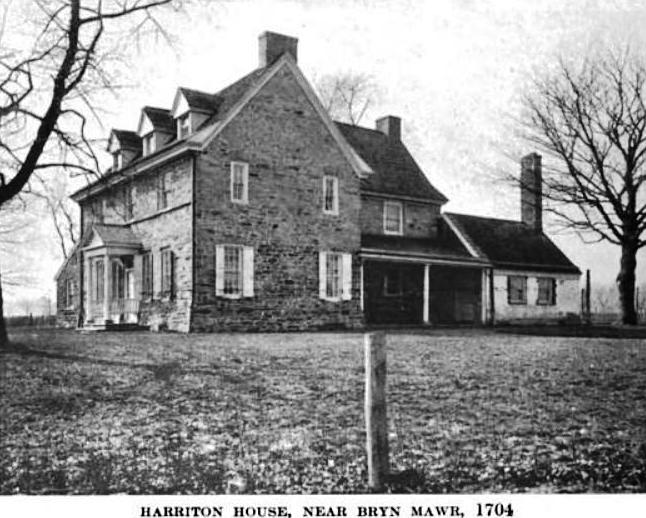
Harriton House, originally known as Bryn Mawr, is an historic house which is located on the Philadelphia Main Line, and was most famously the residence of Founding Father Charles Thomson, the secretary of the Continental Congress.
It was added to the National Register of Historic Places in 1973.
History and architectural features
Originally built in 1704 by Rowland Ellis, a Welsh Quaker, it was called Bryn Mawr, meaning high hill. The modern town of Bryn Mawr is named after the house, and the National Register of Historic Places has it listed under the original name.
It was originally designed as a T-shaped, two-story fieldstone dwelling with a gable roof. The original front section is approximately thirty-seven feet wide and twenty-two feet deep and the rear extension is approximately eighteen feet wide and twenty-three feet deep. A one-story brick kitchen was added to the end of the rear extension. The house was renovated in 1911 and major additions were made in 1926.
It was added to the National Register of Historic Places in 1973.
Harriton Association
The Harriton Association was started in 1962 by a group of people who were concerned that the house and its surrounding grounds, which were privately owned at the time, would be subdivided and developed. The creation of the group was spearheaded by W. Dallas "Bob" Saybolt, a Philadelphia furniture manufacturer (Saybolt & Cleland Inc.) who served as the first president of the Harriton Association. The association removed the 1926 additions and restored the house to look as it did when Charles Thomson lived there. Those renovations were completed in time for the 1976 United States Bicentennial.
The association operates Harriton House as a museum and cultural resource. Tours are given from Wednesday through Saturday, and special events are held at the house throughout the year.
References
References
- {{NRISref
- "PHMC Historical Markers". Pennsylvania Historical & Museum Commission.
- George Vaux. (May 1972). "National Register of Historic Places Registration: Pennsylvania SP Bryn Mawr". National Archives and Records Administration.
- George E. Thomas. (July 1985). "National Register of Historic Places Registration: Pennsylvania SP Harriton". National Archives and Records Administration.
This article was imported from Wikipedia and is available under the Creative Commons Attribution-ShareAlike 4.0 License. Content has been adapted to SurfDoc format. Original contributors can be found on the article history page.
Ask Mako anything about Harriton House — get instant answers, deeper analysis, and related topics.
Research with MakoFree with your Surf account
Create a free account to save articles, ask Mako questions, and organize your research.
Sign up freeThis content may have been generated or modified by AI. CloudSurf Software LLC is not responsible for the accuracy, completeness, or reliability of AI-generated content. Always verify important information from primary sources.
Report