From Surf Wiki (app.surf) — the open knowledge base
Hardystonite
Sorosilicate mineral
Sorosilicate mineral
| Field | Value |
|---|---|
| name | Hardystonite |
| category | Sorosilicates |
| image | Hardystonite-Clinohedrite-Calcite-170573.jpg |
| imagesize | 260px |
| caption | Hardystonite is fluorescing blue in this Franklin Furnace specimen. Red is calcite, and green is willemite (size: 7.0 × 6.0 × 3.2 cm) |
| formula | Ca2ZnSi2O7 |
| IMAsymbol | Hdy |
| strunz | 9.BB.10 |
| dana | 55.4.2.2 |
| system | Tetragonal |
| class | Scalenohedral (2m) |
| H-M symbol: ( 2m) | |
| symmetry | *P*21m |
| unit cell | a = 7.8287(16) Å |
| c = 5.0140(2) Å; Z = 2 | |
| color | Light brownish white, pale greyish-white, very pale pink |
| habit | Massive granular |
| cleavage | [001] good, [100] and [110] fair |
| tenacity | Brittle |
| mohs | 3–4 |
| luster | Vitreous, resinous, greasy, dull |
| diaphaneity | Transparent to translucent |
| gravity | 3.396–3.443 |
| opticalprop | Uniaxial (−) |
| refractive | nω = 1.672 nε = 1.661 |
| fluorescence | Purple to violet blue in short wave ultraviolet light |
| alteration | Hydrothermal alteration to clinohedrite |
| references |
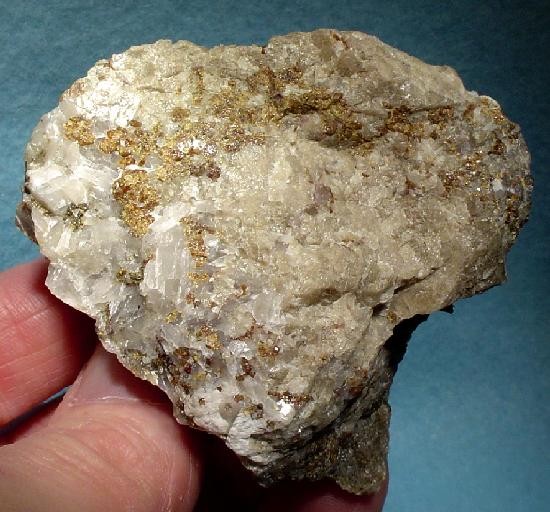
H-M symbol: ( 2m) c = 5.0140(2) Å; Z = 2 | length fast/slow = Hardystonite is a rare calcium zinc silicate mineral first described from the Franklin, New Jersey, U.S. zinc deposits. Like many of the famous Franklin minerals, hardystonite responds to short wave ultraviolet (254 nm wavelength) light, emitting a fluorescence from dark purple to bright violet blue. In daylight, it is white to gray to light pink in color, sometimes with a vitreous or greasy luster. It is very rarely found as well formed crystals, and these are usually rectangular in appearance and rock-locked.
Hardystonite has a chemical composition of Ca2ZnSi2O7. It is frequently found with willemite (fluoresces green), calcite (fluoresces red), and clinohedrite (fluoresces orange). Hardystonite can be found altered to clinohedrite CaZn(SiO4)·H2O through direct hydrothermal alteration. Other minerals often associated with hardystonite are franklinite, diopside, andradite garnet, and esperite (fluoresces yellow).
It was first described in 1899 by J.E. Wolff, when the New Jersey Zinc Company mines were located in what was called Franklin Furnace, in Hardyston Township, New Jersey.
References
References
- Warr, L.N.. (2021). "IMA–CNMNC approved mineral symbols". Mineralogical Magazine.
- http://www.mindat.org/min-1818.html Mindat
- http://www.webmineral.com/data/Hardystonite.shtml Webmineral data
- [http://rruff.geo.arizona.edu/doclib/hom/hardystonite.pdf Handbook of Mineralogy]
- Q58144929. Palache, Charles
- Dunn, Pete J. Franklin and Sterling Hill, New Jersey: the world's most magnificent mineral deposits. Dr. Pete J. Dunn, 2004.
This article was imported from Wikipedia and is available under the Creative Commons Attribution-ShareAlike 4.0 License. Content has been adapted to SurfDoc format. Original contributors can be found on the article history page.
Ask Mako anything about Hardystonite — get instant answers, deeper analysis, and related topics.
Research with MakoFree with your Surf account
Create a free account to save articles, ask Mako questions, and organize your research.
Sign up freeThis content may have been generated or modified by AI. CloudSurf Software LLC is not responsible for the accuracy, completeness, or reliability of AI-generated content. Always verify important information from primary sources.
Report