From Surf Wiki (app.surf) — the open knowledge base
Hansom cab
Horse-drawn vehicle for hire
Horse-drawn vehicle for hire
The hansom cab is a two-wheeled horse-drawn vehicle designed as a carriage for hire in London. First patented in 1834 by Joseph Hansom of England, and named the Hansom Safety Cab, it was designed to have a low centre of gravity to improve stability when maneuvering London's crowded streets, while light enough to be pulled by a single horse. The concept was substantially redesigned in 1836 by John Chapman, whose improved design was later widely copied, though retaining the "hansom" name. The hansom cab became the most common vehicle for hire, and was exported across Europe, to other British colonies, and to the US. It is easily recognized by the high seat of the driver behind the passenger compartment.
Design

The vehicle seats two passengers while the driver sits on a seat behind the vehicle. Passengers can give instructions to the driver, or pay, through a hatch in the roof. The driver could operate a lever to release the doors so that passengers could alight. In some designs, the driver could operate a device that balanced the cab and reduced strain on the horse. The passengers were protected from the elements by folding wooden doors that enclosed their feet and legs and thus protected their clothes from splashing mud. Later versions also had an up-and-over glass window above the doors to complete the enclosure of the passengers. Additionally, a curved fender mounted forward of the doors protected passengers from stones thrown up by the hooves of the horse.
Variations
Other vehicles similar to the Hansom cab include the American light trade cart for deliveries such as bread, the bow-fronted hansom which was fully enclosed and entered through a side door, and the Brougham Hansom which was entered from the rear and driven from a seat on the fore-part of the roof.
Hansom-cab (Sevilla).jpg|A bow-fronted hansom Parlour's hansom.png|Parlour's hansom Michelin 1909 Hansom cab wheel5192.JPG|Pneumatic wheels used on later hansom cabs (1909)
Historical context

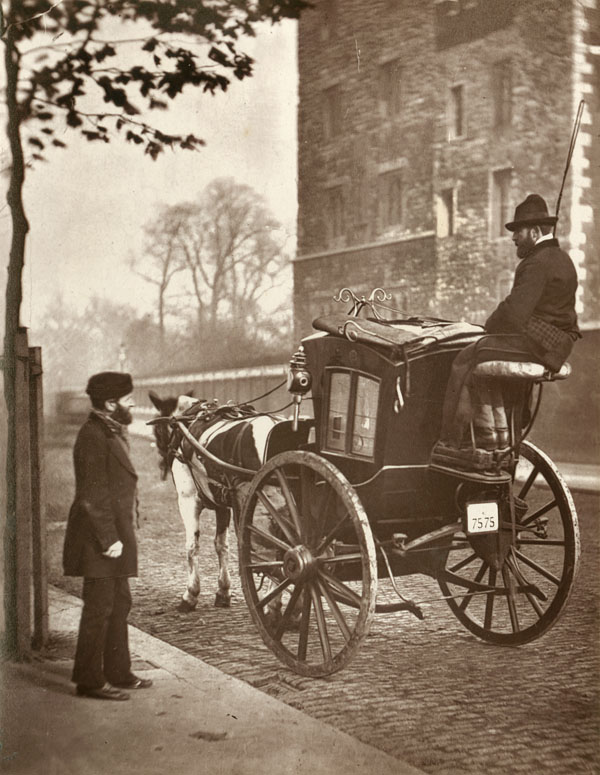
The hansom cab was designed and patented in 1834 by Joseph Hansom, an architect from York, England. The vehicle was developed and tested by Hansom in Hinckley. Originally called the Hansom safety cab, it was designed to combine speed with safety, with a low centre of gravity for safe cornering. Joseph Hansom's two-wheeled "safety cab" proved too heavy and was not commercially successful. In the original design, the driver sat on the front center of the roof. The wheels were 7'6" tall, as tall as the roof of the vehicle, and there were two stub axles.
In 1836, John Chapman, secretary of the Safety Cabriolet and Two‑Wheeled Carriage Company, redesigned the vehicle, putting the driver on a high seat to the rear of the roof, reducing the size of the wheels, and using a dropped axle design—later versions had straight axles directly under the passenger seat. Chapman and investor Gillett patented their design in 1836, though the vehicles continued to be called "hansoms". An account by Chapman's son was published in 1882 in Notes and Queries, and emphasized that the cab then in general use was "in all essential features" his father's invention.
United Kingdom
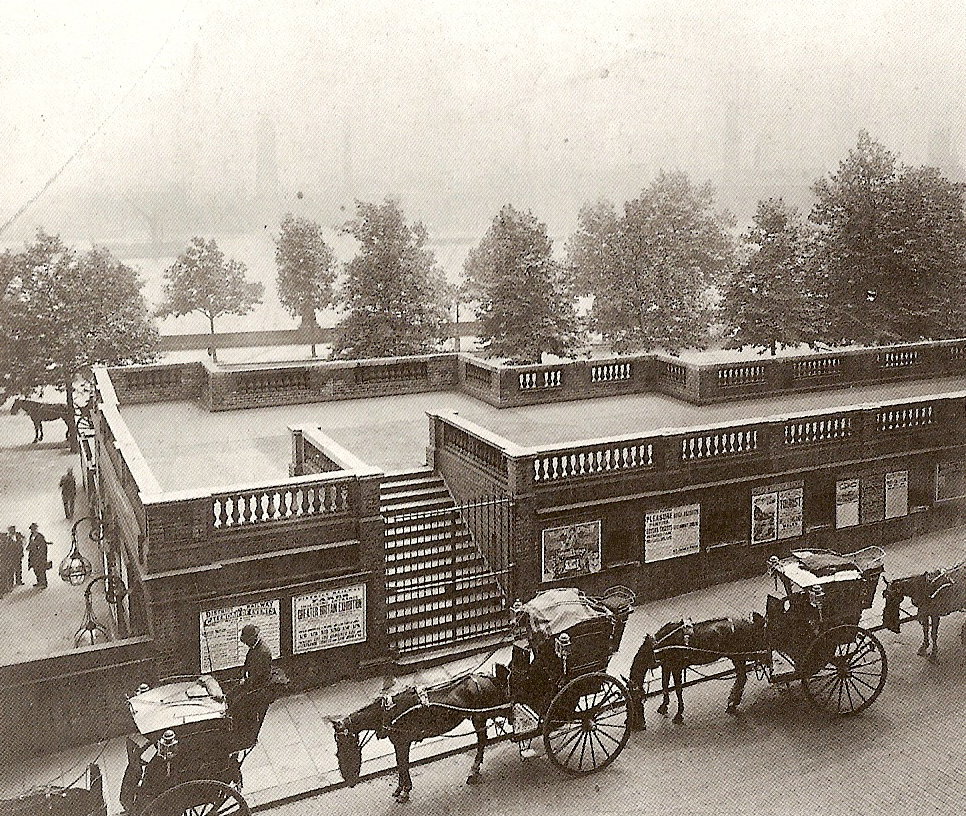
Two English peers who owned cab companies, Lord Shrewsbury and Lord Lonsdale, raised the standards of all Hansom cabs in London when they purchased upgraded cabs made by Forder, complete with brass fittings, quiet-running rubber tires, and luxuriously fitted interiors. Their horses were thoroughbreds in polished harnesses. These flashier Hansoms were sometimes referred to as "Gondolas of London" or "gondolas of the streets".
The cabs were widely used in the United Kingdom until 1908 when Taximeter Cars (petrol cabs) started to be introduced and were rapidly accepted; by the early 1920s horse-drawn cabs had largely been superseded by motor vehicles. The last licence for a horse-drawn cab in London was relinquished in 1947.
United States
The Hansom Cab Company

The Hansom Cab Company was established in May 1869 to provide transportation in New York City and Brooklyn. The business was located at 133 Water Street, Brooklyn; Duncan, Sherman & Company handled the books of subscription (initial offers of stock to capitalize a new company). The enterprise was organized by Ed W. Brandon who became its president. Two orders for a fleet of cabs were sent to carriage makers in New York City. Fares were to be charged either by distance or time: $0.30 for a single person per mile, or portion thereof, and $0.40 for two people. By time, $0.75 for one person for an hour or portion thereof, $1.00 for two persons.
Modern usage
Hansom cabs remain in active use as props in period dramas, especially those set in Victorian or Edwardian eras. Film production companies can rent replicas or restored original vehicles.
A restored hansom cab once owned by Alfred Gwynne Vanderbilt is on display at the Remington Carriage Museum in Cardston, Alberta, Canada. There is another surviving example, owned and operated by the Sherlock Holmes Museum in London; in common with other horse-drawn vehicles it is not permitted to enter any of the Royal Parks. Hinckley and Bosworth Borough Council, Leicestershire, also have a restored Hansom cab. The Smithsonian Institution's National Museum of American History has a hansom cab made by D.P. Nichols of New York (circa 1900) in its collections.
In popular culture
- The 1886 novel The Mystery of a Hansom Cab by Fergus Hume is a detective story about a murder set in a hansom cab in post-Victorian gold rush Australia. The book became an international bestseller, selling over one million copies, and has been adapted for film and television six times.
References
References
- Drozdz, Gregory. (1990). "Cab and Coach".
- (May 27, 1869). "The Hansom Cab Company". [[New York Times]].
- "Remington Carriage Museum website". Remingtoncarriagemuseum.com.
- "Correspondence between the Sherlock Holmes Museum and James Purnell MP, The Secretary of State for Culture Media and Sport".
- "Hansom cab, 1900". The Smithsonian Institution.
- Berkebile, Donald H.. (1978). "Carriage Terminology: An Historical Dictionary". Smithsonian Institution Scholarly Press.
- Terry, F. C. Birkbeck. (23 September 1882). "The Invention of Hansom Cabs". [[Notes and Queries]].
- {{cite DNB
- Harris, Penelope. (2010). "The Architectural Achievement of Joseph Aloysius Hansom (1803-1882), Designer of the Hansom Cab, Birmingham Town Hall, and Churches of the Catholic Revival". [[Edwin Mellen Press]].
- "The Hansom Cab was designed, patented and tested in Hinckley".
- "The life of Joseph Aloysius Hansom (1803-1882)".
- Hume, Fergus. "The Mystery of a Hansom Cab".
- (18 September 1954). "Early Thriller as Serial". ABC.
- Smith, D.J.M.. (1988). "A Dictionary of Horse Drawn Vehicles". J. A. Allen & Co. Ltd..
- Walrond, Sallie. (1992). "Looking at Carriages".
- Walrond, Sallie. (1979). "The Encyclopaedia of Driving". Country Life Books.
This article was imported from Wikipedia and is available under the Creative Commons Attribution-ShareAlike 4.0 License. Content has been adapted to SurfDoc format. Original contributors can be found on the article history page.
Ask Mako anything about Hansom cab — get instant answers, deeper analysis, and related topics.
Research with MakoFree with your Surf account
Create a free account to save articles, ask Mako questions, and organize your research.
Sign up freeThis content may have been generated or modified by AI. CloudSurf Software LLC is not responsible for the accuracy, completeness, or reliability of AI-generated content. Always verify important information from primary sources.
Report