From Surf Wiki (app.surf) — the open knowledge base
Hair iron
Hair styling tool with heating element

Hair styling tool with heating element
A hair iron or hair tong is a tool used to change the arrangement of the hair using heat. There are three general kinds: curling irons, used to make the hair curl; straightening irons, commonly called straighteners or flat irons, used to straighten the hair; and crimping irons, used to create crimps of the desired size in the hair.
Most models have electric heating; cordless curling irons or flat irons typically use butane, and some flat irons use batteries that can last up to 30 minutes for straightening. Overuse of these tools can cause severe damage to hair.
Types of hair irons
Curling iron
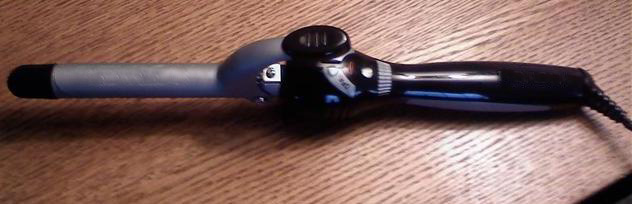

Curling irons, also known as curling tongs, create waves or curls in hair using a variety of different methods. There are many different types of modern curling irons, which can vary by diameter, material, and shape of barrel and the type of handle. The barrel's diameter can be anywhere from .5 in to 2 in. Smaller barrels typically create spiral curls or ringlets, and larger barrels are used to give shape and volume to a hairstyle.
Curling irons are typically made of ceramic, metal, Teflon, titanium, tourmaline. The barrel's shape can either be a cone, reverse cone, or cylinder, and the iron can have brush attachments or double and triple barrels.
The curling iron can also have either a clipless, Marcel, or spring-loaded handle. Spring-loaded handles are the most popular and use a spring to work the barrel's clamp. When using a Marcel handle, one applies pressure to the clamp. Clipless wands have no clamp: the user simply wraps hair around a rod. Most clipless curling irons come with a Kevlar glove to avoid burns.
Straightening irons
Main article: Hair straightening
Straightening irons, straighteners, or flat irons work by breaking down the positive hydrogen bonds found in the hair's cortex, which cause hair to open, bend and become curly. Once the bonds are broken, hair is prevented from holding its original, natural form, though the hydrogen bonds can re-form if exposed to moisture. Straightening irons use mainly ceramic material for their plates. Low-end straighteners use a single layer of ceramic coating on the plates, whereas high-end straighteners use multiple layers or even 100% ceramic material. Some straightening irons are fitted with an automatic shut off feature to prevent fire accidents.
Early hair straightening systems relied on harsh chemicals that tended to damage the hair. In the 1870s, the French hairdresser Marcel Grateau introduced heated metal hair care implements such as hot combs to straighten hair. Madame C.J. Walker used combs with wider teeth and popularized their use together with her system of chemical scalp preparation and straightening lotions. Her mentor Annie Malone is sometimes said to have patented the hot comb. Heated metal implements slide more easily through the hair, reducing damage and dryness. Women in the 1960s sometimes used clothing irons to straighten their hair.
In 1909, Isaac K. Shero patented the first hair straightener composed of two flat irons that are heated and pressed together.
Ceramic and electrical straighteners were introduced later, allowing adjustment of heat settings and straightener size. A ceramic hair straightener brush was patented in 2013. Sharon Rabi released the first straightening brush in 2015 under the DAFNI brand name. The ceramic straightening brush has a larger surface area than a traditional flat iron.
Crimping irons
Main article: Hair crimping
Crimping irons or crimpers work by crimping hair in sawtooth style. The look is similar to the crimps left after taking out small braids. Crimping irons come in different sizes with different sized ridges on the paddles. Larger ridges produce larger crimps in the hair and smaller ridges produce smaller crimps. Crimped hair was very popular in the 1980s and 1990s.
References
References
- "How To Avoid Hair Damage from Blow Dryers, Flat Irons, and Curling Irons". [[WebMD]].
- Read, Melissa B.. (June 2004). "Designing a Better Hair Straightener". [[MIT]].
- (2013-11-15). "Madam Walker, the First Black American Woman to Be a Self-Made Millionaire {{!}} The African Americans: Many Rivers to Cross". The African Americans: Many Rivers to Cross.
- "Annie Malone: First African American Millionairess (Educator, Entrepreneur & Philanthropist)".
- Byrd, Ayana D.. (2014). "Hair Story: Untangling the Roots of Black Hair in America". St. Martin's Press.
- "Hair-straightener".
- "Hair straightening brush".
- (23 May 2021). "Ceramic vs Titanium Flat Iron: Which Is Better for Your Hair?".
- "Crimping iron". The Free Dictionary By Farlex.
- "[https://www.allure.com/story/crimping-hair-trend The Crimped Hair Trend of the '80s Is Back]"
This article was imported from Wikipedia and is available under the Creative Commons Attribution-ShareAlike 4.0 License. Content has been adapted to SurfDoc format. Original contributors can be found on the article history page.
Ask Mako anything about Hair iron — get instant answers, deeper analysis, and related topics.
Research with MakoFree with your Surf account
Create a free account to save articles, ask Mako questions, and organize your research.
Sign up freeThis content may have been generated or modified by AI. CloudSurf Software LLC is not responsible for the accuracy, completeness, or reliability of AI-generated content. Always verify important information from primary sources.
Report