From Surf Wiki (app.surf) — the open knowledge base
Hackney carriage
British car for hire
British car for hire
| Field | Value |
|---|---|
| short_title | Hackney Coaches, etc. Act 1694 |
| type | Act |
| parliament | Parliament of England |
| long_title | An Act for the licensing and regulating Hackney-Coaches and Stage-Coaches. |
| year | 1694 |
| citation | [5 & 6 Will. & Mar.](5-6-will-mar) c. 22 |
| royal_assent | 25 April 1694 |
| repeal_date | 15 July 1867 |
| repealing_legislation | Statute Law Revision Act 1867 |
| status | Repealed |
| original_text | https://www.british-history.ac.uk/statutes-realm/vol6/pp502-505 |
| collapsed | yes |
A hackney or hackney carriage (also called a cab, black cab, hack or taxi) is a carriage or car for hire. A symbol of London and Britain, the black taxi is a common sight on the streets of London. The hackney carriages carry a roof sign TAXI that can be illuminated to indicate their availability for passengers.
In the UK, the name hackney carriage today refers to a taxicab licensed by Transport for London, local authority (non-metropolitan district councils, unitary authorities) or the Department of the Environment depending on region of the country. Some hackney carriages have also been exported for use in other countries.
Etymology
The origin of the word hackney in connection with horses and carriages is uncertain. The origin is often attributed to the London borough of Hackney, whose name likely originated in Old English meaning 'Haka's Island'. Some favour an alternative etymology stemming from the French word **—a horse of medium size, easy to ride, and often a hired horse. The earliest hackney coaches were worn and shabby second-hand coaches from the nobility. Between the condition of the vehicles and the overuse of the street horses, it led to the term hackneyed to indicate something which is worn out. Hack is a shortened form of hackney and appears by the start of the eighteenth century; the word has also applied to the driver, and to the horse.
In modern usage, the term "hackney carriage" remains primarily a term of regulation and not of contemporary speech—whereas "taxi" and "cab" are common parlance. The British carried their practices with them throughout the British Empire and established regulations for public hire transport in many countries. In the 1820s, horses and carriages were imported from England to British Colonial Singapore and, with the passing of the Hackney Carriage Act of 1867, a Hackney Carriage Department was established to regulate public transportation; in 1892 jinrikisha regulation was incorporated into the department. In 1847, Sydney passed a law to regulate hackney carriages in the city and its vicinity. Boston's Hackney Carriage Unit was established in 1854 and still uses the term hackney carriage in their contemporary licensing regulations for taxis, sight-seeing vehicles, horse drawn carriages, and pedicabs within the city. In 1879 British India, the Hackney-Carriage Act was passed to regulate and control hackney carriages.
History==
Hackney coach | use_new_UK-LEG = | UK-LEG_title = | use_new_UK-LEG = | UK-LEG_title = | use_new_UK-LEG = | UK-LEG_title = | use_new_UK-LEG = | UK-LEG_title =
| use_new_UK-LEG = | UK-LEG_title = | use_new_UK-LEG = | UK-LEG_title = London Hackney Carriage Act 1831 | use_new_UK-LEG = | UK-LEG_title = London Hackney Carriages Act 1843 | use_new_UK-LEG = | UK-LEG_title = London Cab Act 1968 | use_new_UK-LEG = | UK-LEG_title = London Cab Act 1973
Horse-drawn era
The widespread use of private coaches by the English aristocracy began to be seen in the 1580s; within fifty years hackney coaches were regularly to be seen on the streets of London. The first documented hackney coaches operated in London in the early 1600s. In the 1620s there was a proliferation of coaches for hire in the metropolis, so much so that they were seen as a danger to pedestrians in the narrow streets of the city, and in 1635 an Order in Council was issued limiting the number allowed. Two years later a system for licensing hackney coachmen was established (overseen by the Master of the Horse).
"An Ordinance for the Regulation of Hackney-Coachmen in London and the places adjacent" was approved by Parliament in 1654, to remedy what it described as the "many Inconveniences [that] do daily arise by reason of the late increase and great irregularity of Hackney Coaches and Hackney Coachmen in London, Westminster and the places thereabouts". The first hackney-carriage licences date from a 1662 act of Parliament, the London and Westminster Streets Act 1662 (14 Cha. 2. c. 2) establishing the Commissioners of Scotland Yard to regulate them. Licences applied literally to horse-drawn carriages, later modernised as hansom cabs (1834), that operated as vehicles for hire. The 1662 act limited the licences to 400; when it expired in 1679, extra licences were created until the Hackney Coaches, etc. Act 1694 (5 & 6 Will. & Mar. c. 22) imposed a limit of 700. The limit was increased to 800 in 1715, 1,000 in 1770 and 1,100 in 1802, before being abolished in 1832. The 1694 act established the Hackney Coach Commissioners to oversee the regulation of fares, licences and other matters; in 1831 their work was taken over by the Stamp Office and in 1869 responsibility for licensing was passed on to the Metropolitan Police. In the 18th and 19th centuries, private carriages were commonly sold off for use as hackney carriages, often displaying painted-over traces of the previous owner's coat of arms on the doors.
There was a distinction between a general hackney carriage and a hackney coach, which was specifically a hireable vehicle with four wheels, two horses and six seats: four on the inside for the passengers and two on the outside (one for a servant and the other for the driver, who was popularly termed the Jarvey (also spelled jarvie)). For many years only coaches, to this specification, could be licensed for hire; but in 1814 the licensing of up to 200 hackney chariots was permitted, which carried a maximum of three passengers inside and one servant outside (such was the popularity of these new faster carriages that the number of licences was doubled the following year).
Shortly afterwards even lighter carriages began to be licensed: the two-wheel, single-horse cabriolets or 'cabs', which were licensed to carry no more than two passengers. Then, in 1834, the hansom cab was patented by Joseph Hansom: a jaunty single-horse, two-wheel carriage with a distinctive appearance, designed to carry passengers safely in an urban environment. The hansom cab quickly established itself as the standard two-wheel hackney carriage and remained in use into the 20th century.
In 1836, the Clarence was introduced to London's streets: a type of small four-wheel enclosed carriage drawn by one or two horses. These became known as 'growlers' because of the sound they made on the cobbled streets. Much slower than a hansom cab, they nevertheless had room for up to four passengers (plus one servant) and space on the roof for luggage. As such they remained in use as the standard form of four-wheeled hackney carriage until replaced by motorised taxi cabs in the early 20th century.
In the 1857 edition of Thom's Irish Almanac and Official Directory, a table was included of agreed mileage fares which hackney carriages and cabriolets were permitted to charge their passengers for journeys within a radius of ten statute miles of the General Post Office in Dublin city centre. Fares were divided into two fare types; that of Fare 1 - "Not returning with Employer", and Fare 2 - "Returning with Employer, the delay not to exceed 30 minutes".
A small, usually two-wheeled, one-horse hackney vehicle called a noddy once plied the roads in Ireland and Scotland. The French had a small hackney coach called a fiacre.
Motorisation
Electric hackney carriages appeared before the introduction of the internal combustion engine to vehicles for hire in 1897. In fact there was even London Electrical Cab Company: the cabs were informally called Berseys after the manager who designed them, Walter Bersey. Another nickname was Hummingbirds from the sound that they made. In August 1897, 25 were introduced, and by 1898, there were 50 more. During the early 20th century, cars generally replaced horse-drawn models. In 1910, the number of motor cabs on London streets outnumbered horse-drawn growlers and hansoms for the first time. At the time of the outbreak of World War I, the ratio was seven to one in favour of motorized cabs. The last horse-drawn hackney carriage ceased service in London in 1947.
UK regulations define a hackney carriage as a taxicab allowed to ply the streets looking for passengers to pick up, as opposed to private hire vehicles (sometimes called minicabs), which may pick up only passengers who have previously booked or who visit the taxi operator's office. In 1999, the first of a series of fuel cell powered taxis were tried out in London. The "Millennium Cab" built by ZeTek gained television coverage and great interest when driven in the Sheraton Hotel ballroom in New York by Judd Hirsch, the star of the television series Taxi. ZeTek built three cabs but ceased activities in 2001.
Continuing horse-drawn cab services
Horse-drawn hackney services continue to operate in parts of the UK, for example in Cockington, Torquay. The town of Windsor, Berkshire, is the last remaining UK town with a continuous lineage of horse-drawn hackney carriages, operated run by Windsor Carriages, the licence having been passed down from driver to driver since the 1830's. The original hackney licence is in place, allowing for passenger travel under the same law that was originally passed in 1662. The city of Bath has an occasional horse-drawn hackney, principally for tourists, but still carrying hackney plates.
Driver qualification
In London, hackney-carriage drivers have to pass a test called The Knowledge to demonstrate that they have an intimate knowledge of the geography of London streets, important buildings, etc. Elsewhere in the UK, councils have their own regulations. Some merely require a driver to pass a DBS disclosure and have a reasonably clean driving licence, while others use their own local versions of London's The Knowledge test.
Black cabs

Though there has never been law requiring London's taxis to be black, they were, since the end of the Second World War, sold in a standard colour of black. This, in the 1970s gave rise within the minicab trade to the nickname 'black cab' and it has become common currency. However, before the Second World War, London's cabs were seen in a variety of colours. They are produced in a variety of colours, sometimes in advertising brand liveries (see below). Fifty golden cabs were produced for the Queen's Golden Jubilee celebrations in 2002.
Vehicle design
In Edwardian times, Renault and Unic, but also smaller players like Charron and Darracq were to be found. Fiat was also a presence, with their importer d'Arcy Baker running a fleet of 400 cars of the brand. In the 1920s, Beardmore cabs were introduced and became for a while the most popular. They were nicknamed 'the Rolls-Royce of cabs' for their comfort and robustness. Maxwell Monson introduced Citroën cabs, which were cheaper, but crude in comparison to the Beardmore. In 1930 dealers Mann and Overton struck a deal with the Austin to bring a modified version of the Austin 12/4 car to the London taxi market. This established Austin as dominant until the end of the 1970s and Mann and Overton until 2012. The Austin FX4, launched in 1958, which stayed in production until 1997 under successive manufacturers is perhaps the most iconic and recognised of all hackney carriages and set the basic styling parameters of its successors.
Morrises cabs were also seen, in small numbers, but after the Second World War, produced the Oxford, made by Wolseleys.
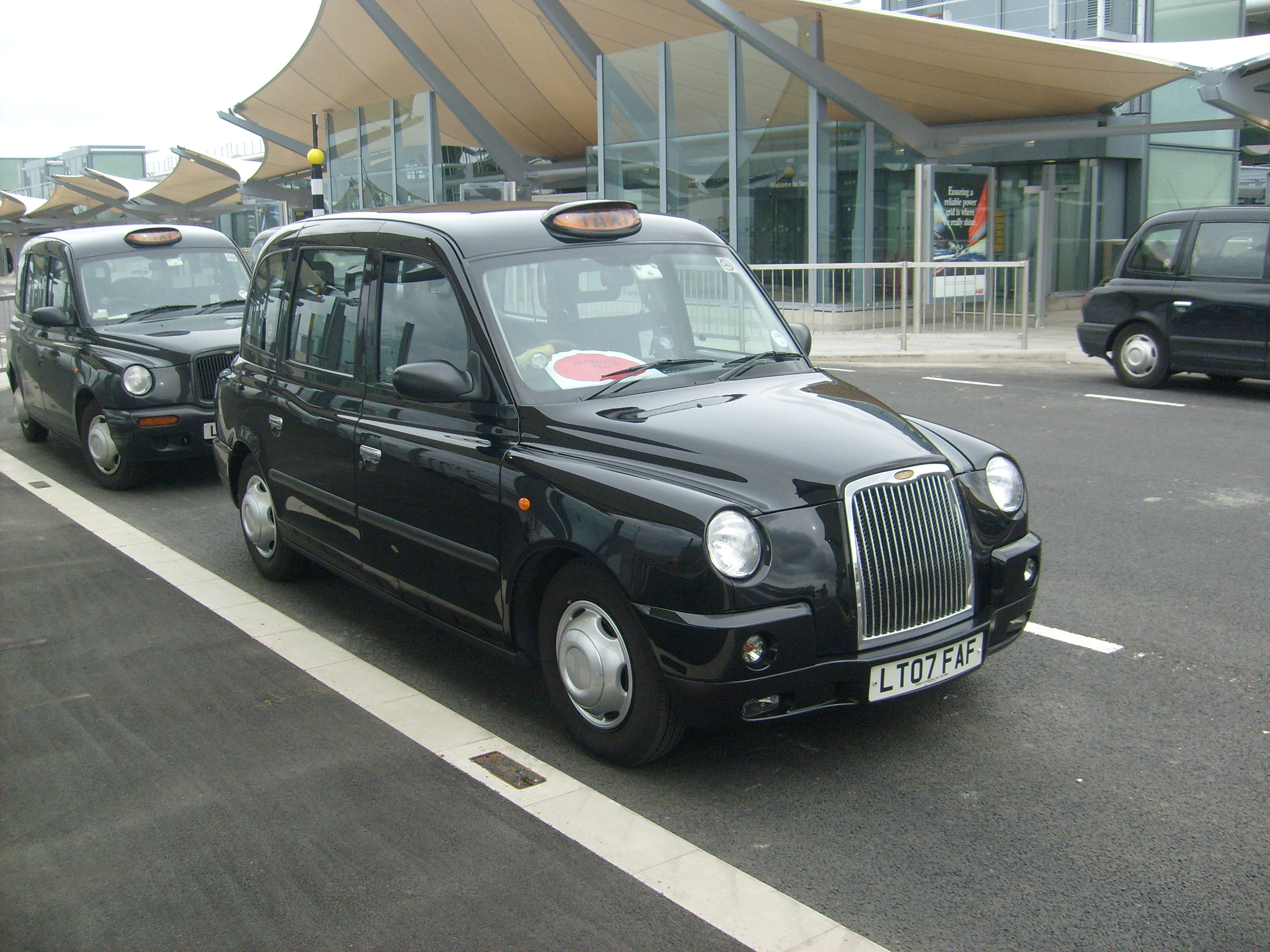
Outside of London, the regulations governing the hackney cab trade are different. Four-door saloon cars have been highly popular as hackney carriages, but with disability regulations growing in strength and some councils offering free licensing for disabled-friendly vehicles, many operators are now opting for wheelchair-adapted taxis such as the LEVC TX of London Electric Vehicle Company (LEVC). London taxis have broad rear doors that open very wide (or slide), and an electrically controlled ramp that is extended for access.
Other models of specialist taxis include the Peugeot E7 and rivals from Fiat, Ford, Volkswagen, and Mercedes-Benz. These vehicles normally allow six or seven passengers, although some models can accommodate eight. Some of these minibus taxis include a front passenger seat next to the driver, while others reserve this space solely for luggage.
London taxis must have a turning circle not greater than 8.535 m. One reason for this is the configuration of the famed Savoy Hotel: the hotel entrance's small roundabout meant that vehicles needed the small turning circle to navigate it. That requirement became the legally required turning circles for all London cabs, while the custom of a passenger's sitting on the right, behind the driver, provided a reason for the right-hand traffic in Savoy Court, allowing hotel patrons to board and alight from the driver's side.
The design standards for London taxis are set out in the Conditions of Fitness, which are now published by Transport for London. The first edition was published in May 1906, by the Public Carriage Office, which was then part of the Metropolitan Police. These regulations set out the conditions under which a taxi may operate and have been updated over the years to keep pace with motor car development and legislation. Changes include regulating the taximeter (made compulsory in 1907), advertisements and the turning circle of 8.535 m. Until the beginning of the 1980s, London Taxis were not allowed to carry any advertisements.
The London Taxis fleet has been fully accessible since 1 January 2000, following the introduction of the first accessible taxi in 1987. On 14 December 2010, Mayor of London Boris Johnson released an air quality strategy paper encouraging phasing out of the oldest of the LT cabs, and proposing a £1m fund to encourage taxi owners to upgrade to low-emission vehicles. Since 2018, all newly registered taxis in London must be zero emission, and more than half of the 14,700 fleet is zero emission capable.
As part of the Transported by Design programme of activities, on 15 October 2015, after two months of public voting, the black cab was elected by Londoners as their favourite transport design icon.
In 2017, the LEVC TX was introduced – a purpose built hackney carriage, built as a plug-in hybrid range-extender electric vehicle. By April 2022, over 5,000 TX's had been sold in London, around a third of London's taxi fleet. In October 2019 the first fully electric cab since the Bersey in 1897, the Dynamo Taxi, was launched with a 187-mile range and with the bodywork based on Nissan's NV200 platform.

In October 2011 the company Eyetease Ltd. introduced digital screens on the roofs of London taxis for dynamically changing location-specific advertising.
Variety of models
There have been different makes and types of hackney cab through the years, including:
- Mann & Overton – including Carbodies, The London Taxi Company and currently London EV Company
- Unic sold in London from 1906 to 1930s
- Austin London Taxicab
- Austin FX3
- Austin/Carbodies/LTI FX4 and Fairway
- LTI TX1, TXII and TX4
- LEVC TX (plug-in hybrid range-extender)
- Mercedes-Benz
- Vito W639
- Morris
- Nuffield Oxford Taxi
- London General Cab Co.
- Citroën
- Beardmore
- Beardmore Marks I to VII
- Metrocab (originally formed by Metro Cammell Weymann)
- MCW/Reliant/Hooper Metrocab
- Dynamo Motor Company
- Dynamo Taxi(Nissan NV200 based)
Notable private owners
Oil millionaire Nubar Gulbenkian owned an Austin FX3 Brougham Sedanca taxi, with custom coachwork by FLM Panelcraft Ltd as he was quoted "because it turns on a sixpence whatever that is." Gulbenkian had two such taxis built, the second of which was built on an FX4 chassis and was sold at auction by Bonhams for $39,600 in 2015. Other celebrities are known to have used hackney carriages both for their anonymity and their ruggedness and manoeuvrability in London traffic. Users included Prince Philip, whose cab was converted to run on liquefied petroleum gas, author and actor Stephen Fry, and the Sheriffs of the City of London. A black cab was used in the band Oasis's video for the song "Don't Look Back in Anger." Black cabs were used as recording studios for indie band performances and other performances in the Black Cab Sessions internet project.
Ghosthunting With... featured a black cab owned by host of the show, Yvette Fielding. Bez of the Happy Mondays owns one, shown on the UK edition of Pimp My Ride. Noel Edmonds used a black cab to commute from his home to the Deal or No Deal studios in Bristol. He placed a dressed mannequin in the back so that he could use special bus/taxi lanes, and so that people would not attempt to hail his cab.
The official car of the Governor of the Falkland Islands between 1976 and 2010 was a London taxi.
In other countries

Between 2003 and 1 August 2009 the London taxi model TXII could be purchased in the United States. Today there are approximately 250 TXIIs in the US, operating as taxis in San Francisco, Dallas, Long Beach, Houston, New Orleans, Las Vegas, Newport, Rhode Island, Wilmington, North Carolina and Portland, Oregon. There are also a few operating in Ottawa, Ontario, Canada. The largest London taxi rental fleet in North America is in Wilmington, owned by The British Taxi Company. There are London cabs in Saudi Arabia, Romania, South Africa, Lebanon, Egypt, Bahrain and Cyprus, and in Israel, where a Chinese-made version of LTI's model TX4 built by Geely Automobile is available. In February 2010, a number of TX4s started operating in Pristina, Kosovo, and are known as London Taxi.

Singapore has used London-style cabs since 1992; starting with the "Fairway". The flag-down fares for the London Taxis are the same as for other taxis. SMRT Corporation, the sole operator, had by March 2013 replaced its fleet of 15 ageing multi-coloured (gold, pink, etc.) taxis with new white ones. They are the only wheelchair-accessible taxis in Singapore, and were brought back following an outcry after the removal of the service.

By 2011 a thousand of a Chinese-made version of LTI's latest model, TX4, had been ordered by Baku Taxi Company. The plan is part of a program originally announced by Azerbaijan's Ministry of Transportation to introduce London cabs to the capital, Baku. The move was part of a £16 million agreement between the London Taxi Company and Baku Taxi Company.

Although the LEVC TX is more expensive and exceeds the Japanese size classifications to gain the tax advantages Japanese livery drivers enjoy with the similarly designed but smaller Toyota JPN Taxi, Geely has attempted to break into the Japanese market. Alternatively, while the Toyota JPN Taxi does not meet the passenger capacity or turning radius Conditions of Fitness required by Transport for London, it does meet the emissions and accessibility requirements that may make it an ideal option for cities outside of London without the seating requirements or as a private hire vehicle while still evoking the familiar black cab profile.
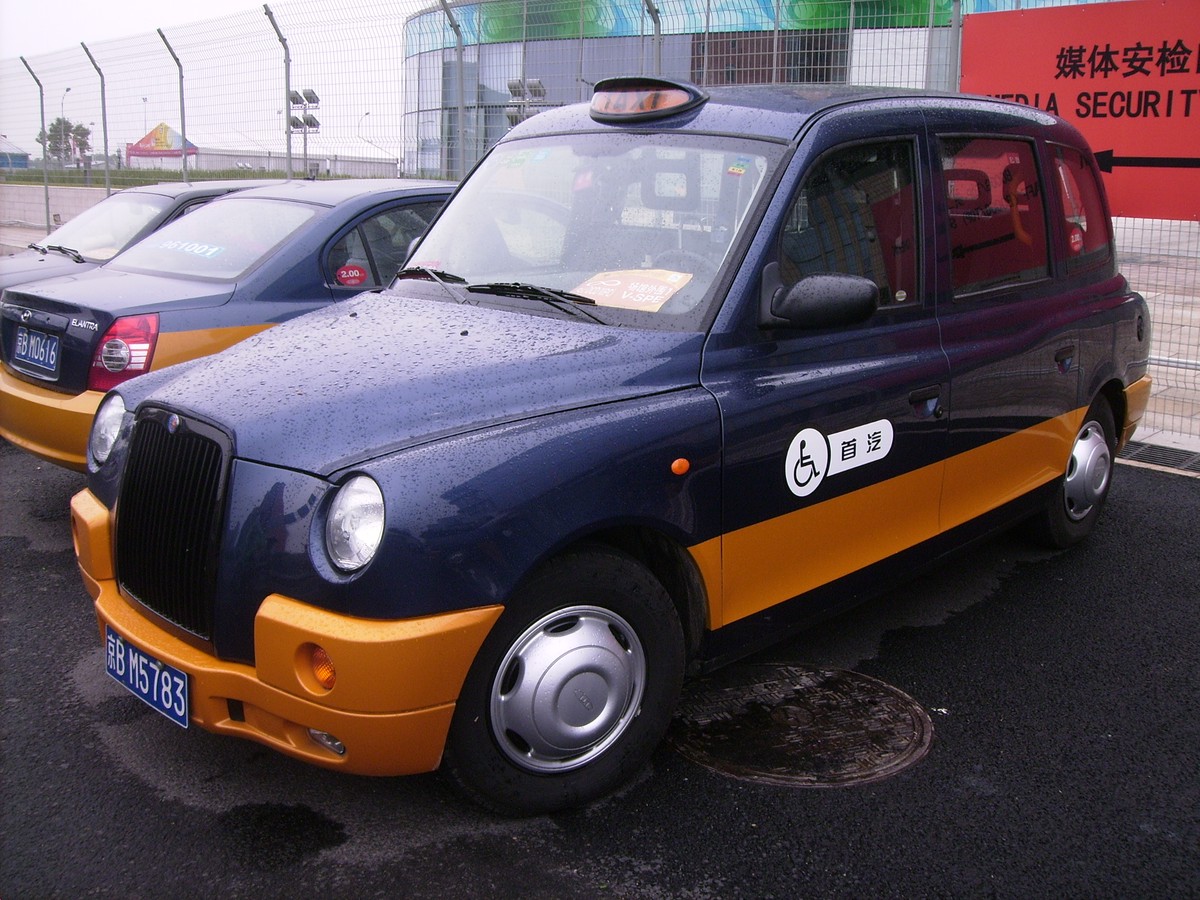
During the 2008 Olympic Games, there were about 100 hackney carriages operating in Beijing.
United Kingdom law
Laws about the definition, licensing and operation of hackney carriages have a long history. The most significant pieces of legislation by region are:
- In England and Wales: the Town Police Clauses Act 1847, and the Local Government (Miscellaneous Provisions) Act 1976. In Wales, responsibility for licensing is now devolved to the Senedd. In September 2017, a consultation started about the future of such licensing.
- In London: the Metropolitan Public Carriage Act 1869 and the London Cab Order 1934.
- In Scotland: the Civic Government (Scotland) Act 1982.
- In Northern Ireland: the Taxis Act (Northern Ireland) 2008
Notes
References
References
- "Definition of "hackney"". Onlinedictionary.datasegment.com.
- "We know where we're going: London's women black cab drivers". Financial Times.
- "London taxis, black cabs and minicabs". Visit London.
- [https://www.london.gov.uk/about-us/about-us/london-assembly/london-assembly-publications/where-guv "Where to, Guv?"], London Assembly Transport Committee report into the Public Carriage Office, November 2005
- (13 January 2025). "Jinrikisha Station begins operations".
- Rimmer, Peter J.. (1990). "The Underside of Malaysian History : Pullers, Prostitutes, Plantation Workers". Singapore University Press.
- "Hackney Carriages Sydney Act 1847 No 21a".
- "Hackney Carriage Unit".
- "Hackney Carriage Act, 1879".
- (1884). "A History of Taxes and Taxation in England: volume III". Longmans, Green & co..
- [http://www.british-history.ac.uk/report.aspx?compid=56562 An Ordinance for the Regulation of Hackney-Coachmen in London and the places adjacent, June 1654], british-history.ac.uk; accessed 26 May 2017.
- (1819). "William and Mary, 1694: An Act for the lycenseing and regulateing Hackney-Coaches and Stage-Coaches [Chapter XXII Rot. Parl. pt. 5. nu. 2.]". Great Britain Record Commission.
- (December 1857). "The Omnibuses of London". R. Newton.
- (1948). "The English Carriage". Batchworth Press.
- 28649833
- Busch, Noel F. (1947) "Life's Reports: Restful Days in Dublin" " ''Life Magazine'' 15 September 1947 [https://books.google.com/books?id=M0IEAAAAMBAJ&pg=PA9 page 9], includes a photograph of a growler.
- (1857). "Thom's Irish Almanac and Official Directory of the United Kingdom for the year 1857". Alexander Thom and Sons, Printers and Publishers, 87, Abbey-Street.
- "Taxi History – London Vintage Taxi Association". lvta.co.uk.
- Lord Montagu of Beaulieu. (5 June 1982). "London's Taxis". IPC Business Press Ltd..
- Drozdz, Gregory. (1990). "Cab and Coach".
- "Cockington Carriages plan for the future – Cockington Court".
- "Fairway History".
- [https://www.legislation.gov.uk/ukpga/1985/67/pdfs/ukpga_19850067_en.pdf?section-41-3-a Transport Act 1985] – Legislation.gov.uk
- "London Taxi History".
- (1940). "Taxi". BBC.
- [https://news.bbc.co.uk/2/hi/uk_news/england/1871142.stm ''Golden times for black cabs''], bbc.co.uk, 13 March 2002
- (2021). "London Wheelchair Taxis with Ramps". Wheelchair Travel.
- "Why does traffic entering and leaving the Savoy Hotel in London drive on the right?". Guardian News and Media Limited.
- (17 September 2019). "Construction and Licensing of Motor Taxis for Use in London: Conditions of Fitness, as updated 17 September 2019". [[Transport for London]]: Public Carriage Office.
- "London Taxis – Monday 16 January 1989 – Hansard – UK Parliament".
- Mashburn, Rick. (18 April 2004). "Rolling Along in London". The New York Times.
- (13 December 2011). "Taxicab History".
- "Emissions standards for taxis".
- (6 December 2023). "More than half of London's black taxis are zero emission capable".
- "Transported by Design".
- "London's transport 'Design Icons' announced".
- (4 August 2015). "Transported By Design: Vote for your favourite part of London transport".
- (31 Jul 2019). "2,500th LEVC TX taxi rolls off production line".
- (27 April 2022). "LEVC Celebrates Sale of 5000th TX Electric Taxi in London".
- "Electric London black cab launches with 187-mile range {{!}} Autocar".
- (23 October 2019). "First 100% electric black cab for 120 years launches in London".
- (11 October 2011). "The video screen coming to a cab near you". London Evening Standard.
- "Taxicab Make And Model History". London-taxi.co.uk.
- (3 December 2012). "London Black-Cab Crisis Opens Road to Mercedes Minivans". Bloomberg.
- The sixpence was the smallest coin in circulation, so the phrase was a [[hyperbole]] meaning that it had a tight turning radius.
- "Bonhams The millionaire Paul Mellon wants to buy Gulbenkian's FX3, but Gulbenkian would not sell, but did allow Mellon to have replica built. This was also constructed by FLM Panelcraft, but on an FX4 chassis and was fitted with an American Ford 6-cylinder engine and automatic gearbox, as Mellon kept it in the USA: The ex-Nubar Gulbenkian,1960 AUSTIN FX4 BROUGHAM SEDANCA Chassis no. FX4AT033U010".
- "Prince Philip's taxi". Royal.gov.uk.
- [http://www.stephenfry.com/blog/2008/10/10/stephen-fry-in-america ''Stephen Fry in America''], stephenfry.com, 10 October 2008.
- (30 November 2018). "Noel Edmonds dodged traffic by illegally driving a taxi in Bristol". motor1.com.
- "Rex Hunt, Governor of the Falkland Islands". Imperial War Museum.
- (18 January 2016). "United Nations Resolution 1244".
- Ben-Gedalyahu, Dubi. (18 August 2009). "Eldan to sell Chinese 'London taxi'". [[Globes (newspaper).
- Meidment, Neil. "Manganese Bronze seals biggest London taxi order". Reuters.
- Jaglom, Ben. "Manganese takes black cab to Azerbaijan".
- "1,000 London taxis for Azerbaijan".
- "British firm wins £16m Azerbaijan order for its Chinese built taxis".
- (17 January 2020). "LEVC TX Electrified London Black Cab Lands In Japan, Targets Toyota's JPN Taxi". Carscoops.
- (29 January 2019). "The Toyota JPN Taxi: Changing the Asian landscape, can it change the UK's?". Taxi Point.
- Butcher, Louise. (2018). "Taxi and private hire vehicle licensing in England. House of Commons Briefing Paper CBP 2005".
- Moore, Henry Charles. (1902). "Omnibuses and Cabs : Their Origin and History". [[Chapman & Hall]].
This article was imported from Wikipedia and is available under the Creative Commons Attribution-ShareAlike 4.0 License. Content has been adapted to SurfDoc format. Original contributors can be found on the article history page.
Ask Mako anything about Hackney carriage — get instant answers, deeper analysis, and related topics.
Research with MakoFree with your Surf account
Create a free account to save articles, ask Mako questions, and organize your research.
Sign up freeThis content may have been generated or modified by AI. CloudSurf Software LLC is not responsible for the accuracy, completeness, or reliability of AI-generated content. Always verify important information from primary sources.
Report