From Surf Wiki (app.surf) — the open knowledge base
H-IIB
Expendable launch system
Expendable launch system
| Field | Value | |
|---|---|---|
| name | H-IIB | |
| image | H-ⅡBロケット8号機.jpg | |
| caption | H-IIB Flight 8 at the launch pad in September 2019 | |
| function | Medium-lift launch vehicle | |
| manufacturer | Mitsubishi Heavy Industries | |
| country-origin | Japan | |
| cpl | ||
| height | 56.6 m | |
| mass | 531000 kg | |
| stages | 2 | |
| family | H-II family | |
| derived_from | H-IIA | |
| derivatives | H3 | |
| comparable | {{flatlist | |
| capacities | ||
| location | LEO | |
| kilos | 19000 kg | |
| location | ISS (carrying the HTV) | |
| kilos | 16500 kg | |
| location | GTO | |
| kilos | 8000 kg | |
| status | Retired | |
| sites | Tanegashima, LA-Y2 | |
| first | 10 September 2009 | |
| last | 20 May 2020 | |
| launches | 9 | |
| success | 9 | |
| payloads | H-II Transfer Vehicle | |
| stagedata | {{Infobox rocket/stage | |
| type | booster | |
| name | SRB-A3 | |
| number | 4 | |
| length | 15.1 m | |
| diameter | 2.5 m | |
| empty | ||
| gross | 76,500 kg each | |
| propmass | 66,000 kg each | |
| solid | yes | |
| thrust | 2305 kN each | |
| total | 9220 kN | |
| SI | 283.6 isp | |
| burntime | 116 seconds | |
| fuel | HTPB | |
| stageno | First | |
| type | stage | |
| length | 38 m | |
| diameter | 5.2 m | |
| empty | ||
| gross | 202000 kg | |
| propmass | 177800 kg | |
| engines | 2 × LE-7A | |
| thrust | 2196 kN | |
| SI | 440 isp | |
| burntime | 352 seconds | |
| fuel | LH2 / LOX | |
| stageno | Second | |
| type | stage | |
| length | 11 m | |
| diameter | 4 m | |
| empty | ||
| gross | 20000 kg | |
| propmass | 16600 kg | |
| engines | 1 × LE-5B | |
| thrust | 137 kN | |
| SI | 448 isp | |
| burntime | 499 seconds | |
| fuel | LH2 / LOX |
|country-origin = Japan |cpl-year =
- Ariane 5
- Atlas V
- Falcon 9
- Proton-M
The H-IIB (H2B) was a Japanese expendable launch system jointly developed by JAXA and Mitsubishi Heavy Industries. It was used exclusively to launch the H-II Transfer Vehicle (HTV, or Kōnotori) cargo spacecraft to the International Space Station.
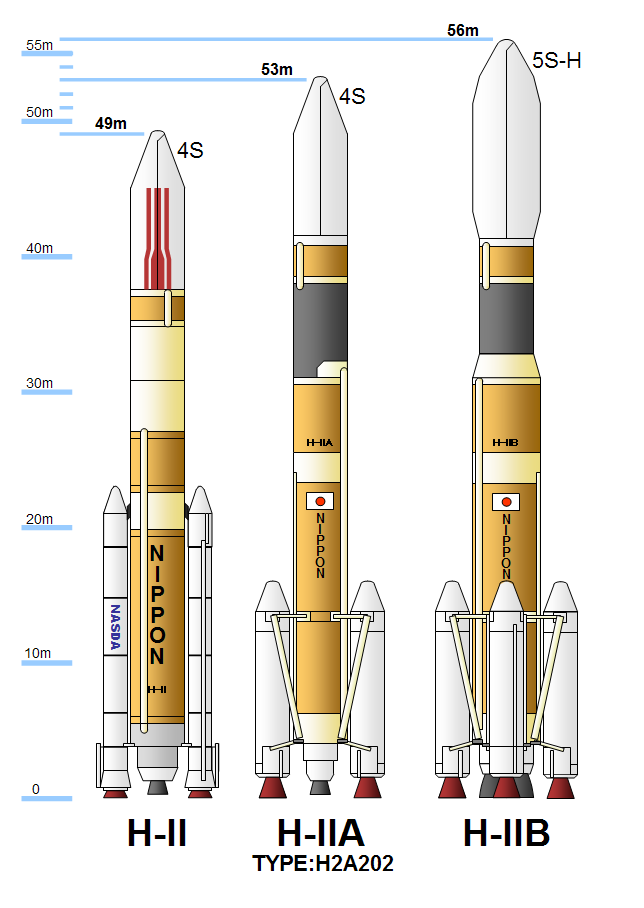
The H-IIB was a two-stage rocket powered by liquid hydrogen and liquid oxygen (hydrolox) engines, with four strap-on solid rocket boosters, and was launched from the Tanegashima Space Center in southern Japan. It could deliver up to 8000 kg to geostationary transfer orbit (GTO), compared with 4000 – for its predecessor, the H-IIA. Its performance to low Earth orbit (LEO) was sufficient to carry the 16500 kg HTV.
The H-IIB made its debut in September 2009 and flew nine times through May 2020, all successfully.
Development
The H-IIB was a space launch vehicle jointly designed, manufactured and operated by JAXA and Mitsubishi Heavy Industries to launch the H-II Transfer Vehicle. The system was designed to adopt methods and components that have already been verified by flights on the H-IIA, so that manufacturing the new launch vehicle would be more cost-effective, with less risk, in a shorter period of time. JAXA was in charge of preliminary design, readiness of the ground facility, and the development of new technologies for the H-IIB, in which the private sector has limited competencies, while the Mitsubishi Heavy Industries was responsible for manufacturing. JAXA successfully conducted eight firing tests of the new cluster design with the simulated first-stage propulsion system, called Battleship Firing Tests, since March 2008, at MHI's Tashiro Test Facility in Ōdate, Akita Prefecture.
Before launch, two Captive Firing Tests were conducted on the H-IIB. The first test, which consisted of firing the first stage for ten seconds, was originally scheduled to occur at 02:30 UTC on 27 March 2009, however it was cancelled after the launch pad's coolant system failed to activate. This was later discovered to have been due to a manual supply valve not being open. The test was rescheduled for 1 April 2009, but then postponed again due to a leak in a pipe associated with the launch facility's fire suppression system. The test was rescheduled for 2 April 2009, when it was successfully conducted at 05:00 UTC. Following this, the second test, which involved a 150-second burn of the first stage, was scheduled for 20 April. This was successfully conducted at 04:00 UTC on 22 April 2009, following a two-day delay due to unfavorable weather conditions. A ground test, using a battleship mockup of the rocket was subsequently conducted on 11 July 2009.
By 2009, the development program of the H-IIB had cost approximately 27 billion yen.
Vehicle description
The H-IIB launch vehicle was a two-stage rocket. The first stage used liquid oxygen and liquid hydrogen as propellants and had four strap-on solid rocket boosters (SRB-A3) powered by polybutadiene. The first stage was powered by two LE-7A engines, instead of one for the H-IIA. In addition, the first-stage body of the H-IIB was 5.2 m in diameter compared with 4 m for the H-IIA. The total length of the first stage was extended by 1 m from that of H-IIA. As a result, the H-IIB first stage held 70% more propellant than that of the H-IIA. The second stage was powered by a single LE-5B engine, which was also propelled by a hydrogen/oxygen fuel and oxidizer.
Launch history
Main article: List of H-II and H3 launches
The first launch of the H-IIB occurred on 10 September 2009 at 17:01:46 UTC. It successfully launched the HTV-1, which was on a mission to resupply the International Space Station (ISS).
| Flight | Date of Launch (UTC) | Payload | Remarks | Result | TF1 | F2 | F3 | F4 | F5 | F6 | F7 | F8 | F9 |
|---|---|---|---|---|---|---|---|---|---|---|---|---|---|
| 10 September 2009 | |||||||||||||
| 17:01:46 | HTV-1 | H-IIB flight test | |||||||||||
| HTV demonstration flight | |||||||||||||
| 22 January 2011 | |||||||||||||
| 05:37:57 | Kounotori 2 | ||||||||||||
| 21 July 2012 | |||||||||||||
| 02:06:18 | Kounotori 3 | ||||||||||||
| 3 August 2013 | |||||||||||||
| 19:48:46 | Kounotori 4 | ||||||||||||
| 19 August 2015 | |||||||||||||
| 11:50:49 | Kounotori 5 | ||||||||||||
| 9 December 2016 | |||||||||||||
| 13:26:47 | Kounotori 6 | ||||||||||||
| 22 September 2018 | |||||||||||||
| 17:52:27 | Kounotori 7 | ||||||||||||
| 24 September 2019 | |||||||||||||
| 16:05:05 | Kounotori 8 | ||||||||||||
| 20 May 2020 | |||||||||||||
| 17:31:00 | Kounotori 9 | Final flight of H-IIB | |||||||||||
| Final flight of HTV |
References
References
- (16 August 2017). "Surplus Missile Motors: Sale Price Drives Potential Effects on DOD and Commercial Launch Providers".
- (2009). "Development Plan for Future Mission from HTV System". Transactions of the Japan Society for Aeronautical and Space Sciences, Space Technology Japan.
- "About H-IIB Launch Vehicle". JAXA.
- Krebs, Gunter. "H-2B". Gunter's Space Page.
- (2007-07-15). "A new stage in Japanese space transportation". JAXA.
- (2009-03-27). "Postponement of the First Captive Firing Test (CFT) of the First Stage Flight Model Tank for the H-IIB Launch Vehicle". JAXA.
- (2009-03-30). "The First Captive Firing Test for the First Stage Flight Model Tank for the H-IIB Launch Vehicle". JAXA.
- (2009-04-01). "Suspension of the First Captive Firing Test (CFT) of the First Stage Flight Model Tank for the H-IIB Launch Vehicle". JAXA.
- (2009-04-01). "The First Captive Firing Test for the First Stage Flight Model Tank for the H-IIB Launch Vehicle". JAXA.
- (2009-04-02). "Result of the First Captive Firing Test for the First Stage Flight Model Tank of the H-IIB Launch Vehicle". JAXA.
- (2009-04-17). "The Second Captive Firing Test for the First Stage Flight Model Tank for the H-IIB Launch Vehicle". JAXA.
- (2009-04-22). "Result of the Second Captive Firing Test for the First Stage Flight Model Tank of the H-IIB Launch Vehicle". JAXA.
- (2009-04-19). "Postponement of the Second Captive Firing Test (CFT) of the First Stage Flight Model Tank for the H-IIB Launch Vehicle". JAXA.
- (2009-07-11). "Results of the H-IIB Launch Vehicle Ground Test Vehicle (GTV) Test". JAXA.
- [http://robot.watch.impress.co.jp/docs/news/20090710_301383.html JAXA、H-IIBロケットの地上総合試験(GTV)について説明], Robot Watch, 2009-7-10
- (2009-07-15). "H-IIB". Japanese Aerospace Exploration Agency.
- (2009-08-10). "Japan's space freighter in orbit". BBC.
This article was imported from Wikipedia and is available under the Creative Commons Attribution-ShareAlike 4.0 License. Content has been adapted to SurfDoc format. Original contributors can be found on the article history page.
Ask Mako anything about H-IIB — get instant answers, deeper analysis, and related topics.
Research with MakoFree with your Surf account
Create a free account to save articles, ask Mako questions, and organize your research.
Sign up freeThis content may have been generated or modified by AI. CloudSurf Software LLC is not responsible for the accuracy, completeness, or reliability of AI-generated content. Always verify important information from primary sources.
Report