From Surf Wiki (app.surf) — the open knowledge base
Gulf of Aqaba
Large gulf at the northern tip of the Red Sea

Large gulf at the northern tip of the Red Sea
| Field | Value | |
|---|---|---|
| name | Gulf of Aqaba | |
| native_name | ||
| other_name | Gulf of Eilat | |
| image | Gulf of Suez map.jpg | |
| caption | The Sinai Peninsula with the Gulf of Aqaba to the east and the Gulf of Suez to the west | |
| location | West Asia | |
| coords | pushpin_map=Egypt | |
| type | Gulf | |
| inflow | Red Sea | |
| basin_countries | Egypt, Israel, Jordan, and Saudi Arabia | |
| length | 160 km | |
| width | 24 km | |
| area | 239 km2 | |
| max-depth | 1850 m | |
| cities | Aqaba, Eilat, Taba, Haql, Sharm El Sheikh |
| max-depth = 1850 m
The Gulf of Aqaba () or Gulf of Eilat () is a large gulf at the northern tip of the Red Sea, southeast of the Sinai Peninsula, and west of the Arabian Peninsula. Its coastline is divided among four countries: Egypt, Israel, Jordan, and Saudi Arabia.
Name
The name Aqaba is potentially as old as 150 A.D., as evidenced by the plotting of a Mt. Acabe ('Ακάβη όρος) in Ptolemy's Geography, with the mountain shown directly across from the mouth of the Gulf of Aqaba, on the western coast of the Red Sea, probably somewhere in the vicinity of modern Hurghada, Egypt, and ancient Mons Claudianus. Both these names could also themselves be derived cognate forms of the word Aqaba, the former by morphological drift, the latter as a translation into Latin, wherein "Claudianus" also suggests limping or stumbling, a perfect semantic overlap for the literal Arabic meaning of "Aqaba" (عقبة), as an "obstacle," "stumbling block," or "spine."
Thus, the Gulf of Aqaba may've in turn gotten its name from the older region around Mt. Acabe (not necessarily a single identifiable mountain), construed as the rough spine of highland that must be crossed.
Geography
The gulf is east of the Sinai Peninsula and west of the Arabian Peninsula. With the Gulf of Suez to the west, it extends from the northern portion of the Red Sea. It reaches a maximum depth of 1850 m in its central area: the Gulf of Suez is significantly wider but less than 100 m deep.
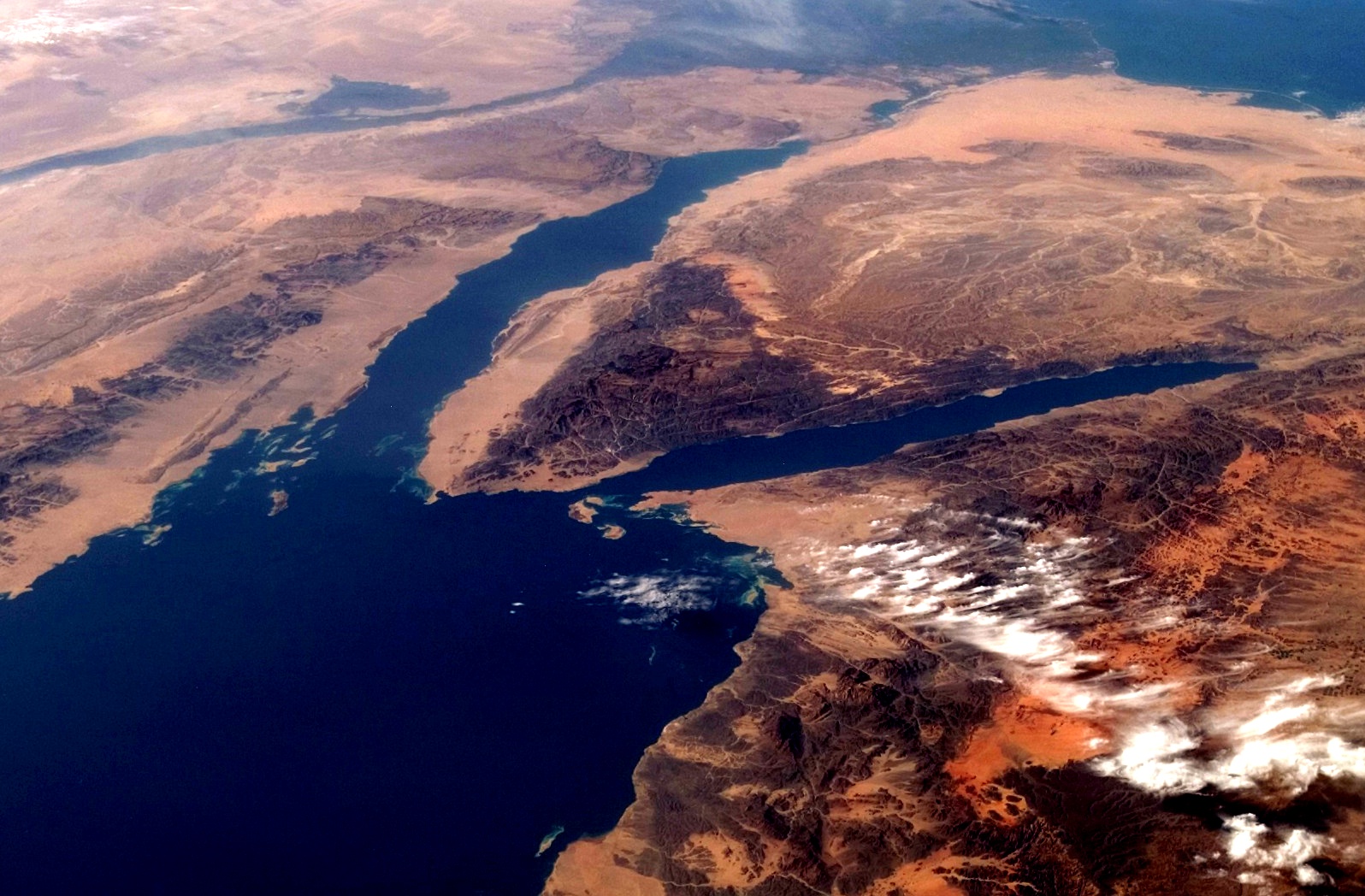

The gulf measures 24 km at its widest point and stretches some 160 km north from the Straits of Tiran to where Israel meets Egypt and Jordan.
Like the coastal waters of the Red Sea, the gulf is one of the world's premier sites for diving. The area is especially rich in coral and other marine biodiversity and has both accidental shipwrecks and vessels deliberately sunk in an effort to provide a habitat for marine organisms and bolster the local dive tourism industry.
Cities and Commercial Significance
At this northern end of the gulf are three important cities: Taba in Egypt, Eilat in Israel, and Aqaba in Jordan. As the only point of access to the Red Sea for Israel and Jordan, the gulf has held and continues to hold commercial and strategic importance, especially. In the case of the Israel, these few kilometers' access to the gulf were included in the original (never implemented) 1947 UN Palestine Partition Plan and became crucially important for trade during times of hostility with its neighbors (e.g. when Egypt closed access to the Suez Canal), while Jordan's 26 km shoreline on the gulf is the only part of Jordan's borders preventing it from being completely landlocked. The Gulf is also home to popular resorts for tourists seeking to enjoy the warm climate.
Further south, Haql is the largest Saudi Arabian city on the gulf. On Sinai, Sharm el-Sheikh and Dahab are the major centres.
The largest population center is Aqaba, with a population of 148,398 (2015), followed by Eilat with a population of 50,724 (2020).
Extent
The International Hydrographic Organization defines the southern limit of the gulf as "A line running from Ràs al Fasma Southwesterly to Requin Island () through Tiran Island to the Southwest point thereof and thence Westward on a parallel (27°54'N) to the coast of the Sinaï Peninsula".
Geology
The gulf is one of two gulfs created by the Sinai Peninsula's bifurcation of the northern Red Sea, the Gulf of Suez lying to the west of the peninsula and the Gulf of Aqaba to its east. Geologically, the gulf forms the southern end of the Dead Sea Transform. It contains three small pull-apart basins, the Elat Deep, Aragonese Deep and Dakar Deep, formed between four left lateral strike-slip fault segments. Movement on one of these faults caused the 1995 Gulf of Aqaba earthquake.
Ecology
History
Trade across the Red Sea between Thebes' port of Elim and Elath at the head of the gulf is documented as early as the Fourth Dynasty of Egypt. Expeditions crossing the Red Sea and heading south to Punt are mentioned in the fifth, the sixth, the eleventh, the twelfth and the eighteenth dynasties of Egypt, when Hatshepsut built a fleet to support the trade and journeyed south to Punt in a six-month voyage. Thebes used Nubian gold or Nub from her conquests south into Kush to facilitate the purchase of frankincense, myrrh, bitumen, natron, juniper oil, linen, and copper amulets for the mummification industry at Karnak. Egyptian settlements near Timna at the head of the gulf date to the Eighteenth dynasty of Egypt.
At the northern edge, the ancient city of Ayla (in present-day Aqaba) was a commercial hub for the Nabateans. The Romans built the Via Traiana Nova, which joined the King's Highway at Aqaba and connected Africa to Asia and the Levant and Red Sea shipping.
Aqaba was a major Ottoman port, connected to Damascus and Medina by the Hejaz railway. During World War I, the Battle of Aqaba was the key battle that ended a 500-year Ottoman rule over the region of Syria.
Fauna
In general, the fauna in the Red Sea represents the fauna in the waters of the Indian Ocean, except that many species cannot penetrate it due to salinity and temperature limitations and some are only found in the southern part of the Red Sea. A large part of the species in the Red Sea are endemic and the proportion of several groups reaches about 30%. It is possible that some of them developed during the Tethys Sea period. The endemic species are more suitable to the conditions in the Red Sea and the Gulf of Aqaba and therefore thrive there more than the oceanic species.
Tourism
The gulf is one of the most popular diving destinations in the world. About 250,000 dives are performed annually in Eilat's 11 km coastline, and diving represents 10% of the tourism income of this area.
The Landscape of Wadi Rum to the east of the northern edge of the gulf is a popular destination. Other destinations are the ruins of the iron-age civilization of Ayla in the city of Aqaba, the site of the World War I Battle of Aqaba, led by Lawrence of Arabia.
Whales, orcas, dolphins, dugongs, and whale sharks live in the gulf as well.
File:The Underwater Observatory in Eilat.jpg|Coral World Underwater Observatory at Eilat File:Hilton hotel taba egypt.jpg|Taba beach File:Sea goldies swimming next to a coral, the Red Sea, Gulf of Eilat, Israel..jpg|Red Sea coral and marine fish File:Gulf of Eilat.jpg|A resort near Eilat's Coral Beach
References
References
- (1843). "Geographia". Karl Friedrich August Nobbe.
- (1879). "A Latin Dictionary". Clarendon Press.
- (1953). "Limits of Oceans and Seas, 3rd edition". International Hydrographic Organization.
- (August 1999). "Active Faulting in the Gulf of Aqaba: New Knowledge from the Mw 7.3 Earthquake of 22 November 1995". [[Seismological Society of America]].
- [[:he:מדריך ישראל. מדריך ישראל]], סיני וחבל עזה, [[:he:הוצאת כתר. הוצאת כתר]] ו[[:he:משרד הביטחון – ההוצאה לאור. משרד הביטחון – ההוצאה לאור]], 1979, עמ' 124–126, 165–157, 239-185
- (1998). "Artificial Reefs and Dive Tourism in Eilat, Israel". Ambio.
- Sciara di N.G., Smeenk C., Rudolph P., Addink M., Baldwin R., Cesario A., Costa M., Feingold D., Fumagalli M., Kerem D., Goffman O., Elasar M., Scheinin A., Hadar N.. 2014. Summary review of cetaceans of the Red Sea.
- "Dugongs in the Red Sea and Gulf of Aden". unep.ch.
This article was imported from Wikipedia and is available under the Creative Commons Attribution-ShareAlike 4.0 License. Content has been adapted to SurfDoc format. Original contributors can be found on the article history page.
Ask Mako anything about Gulf of Aqaba — get instant answers, deeper analysis, and related topics.
Research with MakoFree with your Surf account
Create a free account to save articles, ask Mako questions, and organize your research.
Sign up freeThis content may have been generated or modified by AI. CloudSurf Software LLC is not responsible for the accuracy, completeness, or reliability of AI-generated content. Always verify important information from primary sources.
Report