From Surf Wiki (app.surf) — the open knowledge base
Group of 77
Coalition of developing countries

Coalition of developing countries
| Field | Value |
|---|---|
| name | Group of 77 |
| named_after | Number of founding Member States |
| logo | Group of 77 Logo.svg |
| logo_size | 150px |
| abbreviation | G77 |
| formation | |
| founding_location | Geneva, Switzerland |
| type | Intergovernmental |
| purpose | To provide a forum for developing nations to promote their economic interests |
| headquarters | United Nations Headquarters |
| methods | Collective bargaining, lobbying, reports and studies |
| fields | International politics |
| membership | 134 member states |
| leader_title | Chair of the Group of 77 |
| leader_name | Uruguay |
| affiliations | United Nations |
| website | [G77.org](https://www.g77.org/) |
The Group of 77 (G77) at the United Nations (UN) is a coalition of developing countries, designed to promote its members' collective economic interests and create an enhanced joint negotiating capacity in the United Nations. The group consists of a diverse set of states with a common South-South ideology. There were 77 founding members of the organization headquartered in Geneva, but it has since expanded to 134 member countries. Iraq holds its chairmanship for 2025, succeeding Uganda.
The group was founded on 15 June 1964, by 77 non-aligned nations in the "Joint Declaration of the Seventy-Seven Countries" issued at the United Nations Conference on Trade and Development (UNCTAD). The first major meeting was in Algiers in 1967, where the Charter of Algiers was adopted and the basis for permanent institutional structures was begun under the leadership of Raúl Prebisch who had previously worked at ECLA. There are Chapters of the Group of 77 in Geneva (UN), Rome (FAO), Vienna (UNIDO), Paris (UNESCO), Nairobi (UNEP) and the Group of 24 in Washington, D.C. (International Monetary Fund and World Bank).
Policies
The group was credited with a common stance against apartheid and for supporting global disarmament. It has been supportive of the New International Economic Order.
Regarding environmental matters, the G77's position is that the developed countries bear historical responsibility for greenhouse gas emissions, pointing also to the disparity in per capita emissions between the developing and developed countries. As a result, the G77 often resists binding commitments to reduce its emissions. The G77 has been subject to criticism for its lacklustre support, or outright opposition, to pro-environmental initiatives, which the group considers secondary to economic development and poverty eradication initiatives. In turn, the G77 has criticized the wealthier nations for their insufficient attention to poverty eradication, including at the 1992 United Nations Conference on Environment and Development in Rio de Janeiro, Brazil.
Members
As of 2023, the group comprises all of the UN member states (along with the UN observer State of Palestine), excluding the following countries:
- Members of the Council of Europe, except for Azerbaijan.
- Members of the Commonwealth of Independent States Free Trade Area, except for Tajikistan.
- Members of the Organisation for Economic Co-operation and Development, except for all its (four) Latin American members.
- Two microstates in Oceania: Palau and Tuvalu.
Current founding members
Source:
- Afghanistan
- Algeria
- Argentina
- Bangladesh
- Benin
- Bolivia
- Brazil
- Burkina Faso
- Burundi
- Cambodia
- Cameroon
- Central African Republic
- Chad
- Chile
- Colombia
- Republic of the Congo
- Democratic Republic of the Congo
- Costa Rica
- Dominican Republic
- Ecuador
- Egypt
- El Salvador
- Ethiopia
- Gabon
- Ghana
- Guatemala
- Guinea
- Haiti
- Honduras
- India
- Indonesia
- Iran
- Iraq
- Jamaica
- Jordan
- Kenya
- Kuwait
- Laos
- Lebanon
- Liberia
- Libya
- Madagascar
- Malaysia
- Mali
- Mauritania
- Mexico
- Morocco
- Myanmar
- Nepal
- Nicaragua
- Niger
- Nigeria
- Pakistan
- Panama
- Paraguay
- Peru
- Philippines
- Rwanda
- Saudi Arabia
- Senegal
- Sierra Leone
- Somalia
- Sri Lanka
- Sudan
- Syria
- Tanzania
- Thailand
- Togo
- Trinidad and Tobago
- Tunisia
- Uganda
- Uruguay
- Venezuela
- Vietnam
- Yemen
Other current members
- Angola
- Antigua and Barbuda
- Azerbaijan
- Bahamas
- Bahrain
- Barbados
- Belize
- Bhutan
- Botswana
- Brunei Darussalam Brunei Darussalam
- Cape Verde Cabo Verde
- China
- Comoros
- Côte d'Ivoire Côte D'Ivoire
- Cuba
- Djibouti
- Dominica
- Equatorial Guinea
- Eritrea
- Eswatini
- Fiji
- Gambia The Gambia
- Grenada
- Guinea-Bissau
- Guyana
- Kiribati
- Lesotho
- Malawi
- Maldives
- Marshall Islands
- Mauritius
- Federated States of Micronesia Federated States of Micronesia
- Mongolia
- Mozambique
- Namibia
- Nauru
- North Korea
- Oman
- State of Palestine
- Papua New Guinea
- Qatar
- Saint Kitts and Nevis
- Saint Lucia
- Saint Vincent and the Grenadines
- Samoa
- São Tomé and Príncipe
- Seychelles
- Singapore
- Solomon Islands
- South Africa
- South Sudan
- Suriname
- Tajikistan
- Timor-Leste
- Tonga
- Turkmenistan
- United Arab Emirates
- Vanuatu
- Zambia
- Zimbabwe
Former members
- Mexico was a founding member but left the Group after joining the OECD in 1994.
- New Zealand signed the original "Joint Declaration of the Developing Countries" in October 1963 but pulled out of the group before the formation of the G77 in 1964 (it joined the OECD in 1973).
- South Korea was a founding member but left the Group after joining the OECD in 1996.
- Socialist Federal Republic of Yugoslavia was a founding member; by the late 1990s, it was still listed on the membership list, but it was noted that it "cannot participate in the activities of G77." It was removed from the list in late 2003. It had presided over the group from 1985 to 1986.
- Bosnia and Herzegovina was the only former Yugoslavian state to be listed as a member on the G77 official website in 2007; it was removed from the member list in February 2020.
- Cyprus was a founding member but was no longer listed on the official membership list after it acceded to the European Union in 2004. A document from 1975 states that Cyprus is not a member.
- South Vietnam was a founding member, while North Vietnam never joined separately.
- South Yemen joined separately from founding member North Yemen sometime between 1967 and 1975.
- Malta was admitted to the Group in 1976 but was no longer listed on the official membership list after it acceded to the European Union in 2004.
- Palau joined the Group in 2002 but withdrew in 2004, having decided that it could best pursue its environmental interests through the Alliance of Small Island States.
- Romania was classed as a Latin American country for the purposes of the G77, having joined in 1976. The G77 was divided into geographical regions, and because there was technically no European area, Romania was placed under the umbrella of Latin America. Romania left the G77 following its accession to the European Union.
China
The Group of 77 lists China as one of its members. The Chinese government provides consistent political support to the G77 and has made financial contributions to the Group since 1994, but it does not consider itself to be a member. As a result, official statements of the G77 are delivered in the name of The Group of 77 and China or G77+China.
Presiding countries
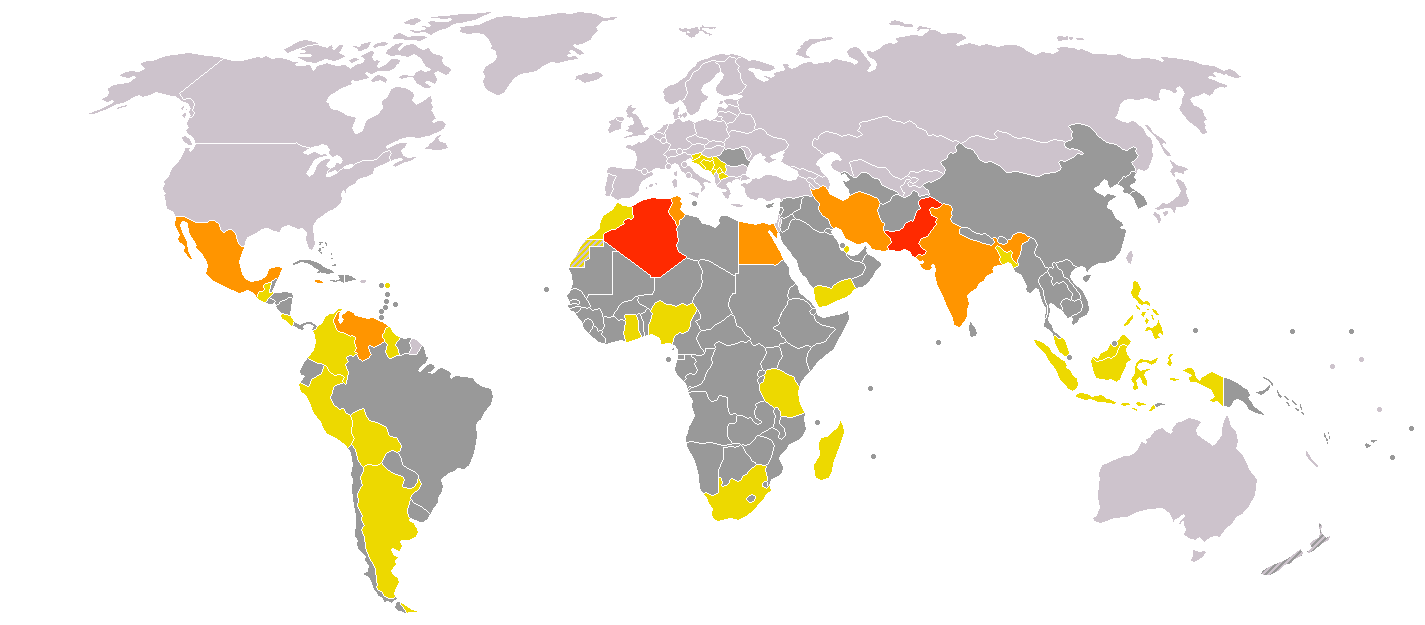
The following is the chain of succession of the chairmanship of the G77:
| Presiding country | Year |
|---|---|
| India | 1970–71 |
| Peru | 1971–72 |
| Egypt | 1972–73 |
| Iran | 1973–74 |
| Mexico | 1974–75 |
| Madagascar | 1975–76 |
| Pakistan | 1976–77 |
| Jamaica | 1977–78 |
| Tunisia | 1978–79 |
| India | 1979–80 |
| Venezuela | 1980–81 |
| Algeria | 1981–82 |
| Bangladesh | 1982–83 |
| Mexico | 1983–84 |
| Egypt | 1984–85 |
| Yugoslavia | 1985–86 |
| Guatemala | 1987 |
| Tunisia | 1988 |
| Malaysia | 1989 |
| Bolivia | 1990 |
| Ghana | 1991 |
| Pakistan | 1992 |
| Colombia | 1993 |
| Algeria | 1994 |
| Philippines | 1995 |
| Costa Rica | 1996 |
| Tanzania | 1997 |
| Indonesia | 1998 |
| Guyana | 1999 |
| Nigeria | 2000 |
| Iran | 2001 |
| Venezuela | 2002 |
| Morocco | 2003 |
| Qatar | 2004 |
| Jamaica | 2005 |
| South Africa | 2006 |
| Pakistan | 2007 |
| Antigua and Barbuda | 2008 |
| Sudan | 2009 |
| Yemen | 2010 |
| Argentina | 2011 |
| Algeria | 2012 |
| Fiji | 2013 |
| Bolivia | 2014 |
| South Africa | 2015 |
| Thailand | 2016 |
| Ecuador | 2017 |
| Egypt | 2018 |
| State of Palestine | 2019 |
| Guyana | 2020 |
| Guinea | 2021 |
| Pakistan | 2022 |
| Cuba | 2023 |
| Uganda | 2024 |
| Iraq | 2025 |
| Uruguay | 2026 |
Group of 24
Main article: Group of 24

The Group of 24 (G-24) is a chapter of the G-77 that was established in 1971 to coordinate the positions of developing countries on international monetary and development finance issues and to ensure that their interests were adequately represented in negotiations on international monetary matters. Every member of the G-24 is also a member of the G77.
Notes
References
References
- (2024). "Group of 77 (G-77)". [[Union of International Associations]].
- (2023). "China's Relations with Africa: a New Era of Strategic Engagement". [[Columbia University Press]].
- Lees, Nicholas. (2023). "The endurance of the G77 in international relations: South–South ideology and voting at the United Nations 1970–2015". Japanese Journal of Political Science.
- "About the Group of 77".
- (October 1986). "El desarrollo económico de la América Latina y algunos de sus principales problemas". Desarrollo Económico.
- Satpathy. (2005). "Environment Management". Excel Books India.
- (2010). "Research Handbook on International Environmental Law". Edward Elgar Publishing.
- Lewis, Joanna I.. (2020). "Greening East Asia: The Rise of the Eco-Developmental State". [[University of Washington Press]].
- Satpathy, Ipseeta. (2005). "Environment Management". Excel Books India.
- (15 June 1964). "Joint Declaration of the Seventy-seven Developing Countries Made at the Conclusion of the United Nations Conference on Trade and Development".
- "About G77 - G77 3rd South Summit".
- (17 September 2023). "G77 + China aprueba la reincorporación de México – DW – 17/09/2023".
- "Prospects for the 7th Special Session of the UN General Assembly".
- "A/RES/52/250".
- "The Group of 77 - Member States".
- "The Group of 77 - Member States".
- "The Group of 77 - Member States".
- (August 29, 2019). "1989". Cambridge University Press.
- (February 11, 2020). "Alternative Globalizations: Eastern Europe and the Postcolonial World". Indiana University Press.
- (November 7, 1995). "State, Society and the UN System: Changing Perspectives on Multilateralism". United Nations University Press.
- Badie, B.. (August 21, 2012). "Diplomacy of Connivance". Springer.
- "The Member States of the Group of 77".
- (July 2016). "七十七国集团(Group of 77, G77)". [[Ministry of Foreign Affairs of the People's Republic of China]].
- (10 July 2017). "Statement on behalf of the Group of 77 and China by HE Mr. Horacio Sevilla Borja, Permanent Representative of the Republic of Ecuador to the United Nations, at the opening session of the 4th Prepcom established by General Assembly resolution 69/292: Development of an international legally binding instrument under UNCLOS on the conservation and sustainable use of marine biological diversity of areas beyond national jurisdiction (New York)".
- "Presiding Countries of the Group of 77 in New York".
This article was imported from Wikipedia and is available under the Creative Commons Attribution-ShareAlike 4.0 License. Content has been adapted to SurfDoc format. Original contributors can be found on the article history page.
Ask Mako anything about Group of 77 — get instant answers, deeper analysis, and related topics.
Research with MakoFree with your Surf account
Create a free account to save articles, ask Mako questions, and organize your research.
Sign up freeThis content may have been generated or modified by AI. CloudSurf Software LLC is not responsible for the accuracy, completeness, or reliability of AI-generated content. Always verify important information from primary sources.
Report