From Surf Wiki (app.surf) — the open knowledge base
Ground-effect train
Type of train
Type of train
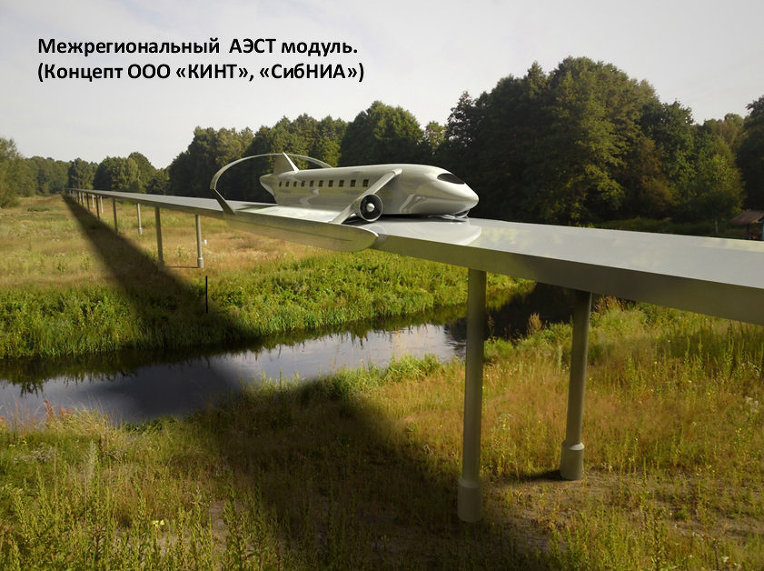
A ground-effect train is a conceptualized alternative to a magnetic levitation (maglev) train. In both cases the objective is to prevent the vehicle from making contact with the ground. Whereas a maglev train accomplishes this through the use of magnetism, a ground-effect train uses an air cushion; either in the manner of a hovercraft (as in hovertrains) or using the wing–in–ground-effect design.
Details
The advantages of a ground-effect train over a maglev are lower cost due to simpler construction. Disadvantages include either constant input of energy to keep the train hovering (in the case of hovercraft-like vehicles) or the necessity to keep the vehicle moving for it to remain off the ground (in the case of wing–in–ground-effect vehicles). Furthermore, these vehicles may be drastically affected by wind, air turbulence, and weather. Whereas the magnetic levitation train can be built to operate in a vacuum to minimise air resistance, the ground-effect train must operate in an atmosphere in order for the air cushion to exist.
Development work has been undertaken in several countries since the middle 20th century. No ground-effect train has entered regular commercial service.
Yusuke Sugahara and his team of researchers at Tohoku University, in Sendai, Japan have developed the Aero-Train that uses wings attached to a fuselage to fly inches off the ground. Dubbed a ground-effect vehicle the train is designed to be completely powered by wind and solar energymaking this a true zero-carbon transportation system.
References
- Bastien, Stéphane, and Laframboise, M. Jacques (translation/adaptation) Aérotrain - The Aerotrain Story. Retrieved 7 January 2011.
- Joseph George Ground Effect Vehicle, Physics-edu (private) website. . Retrieved 7 January 2011.
- Kikuchi Satoshi (Inst. Of Fluid Sci., Tohoku Univ.), Watanabe Hideo (Inst. Of Fluid Sci., Tohoku Univ.), Ota Fukuo (Inst. Of Fluid Sci., Tohoku Univ.), Kawahara Susumu (Inst. Of Fluid Sci., Tohoku Univ.), Kohama Yasuaki (Inst. Of Fluid Sci., Tohoku Univ.). Dynamic Stability Control of Ground Effect Train, Nihon Kikai Gakkai Nenji Taikai Koen Ronbunshu, Japan, 2000, Vol.4, pp. 297–298, Journal Code:X0587B. (Japanese)
- Shonner website Rohr Industries Aérotrain - The Rohr Aerotrain Tracked Air-Cushion Vehicle (TACV), Shonner.com website. Retrieved 7 January 2011.
- Sleath, M. News In Science: Flying Trains, ABC Science website. Retrieved 7 January 2011.
References
This article was imported from Wikipedia and is available under the Creative Commons Attribution-ShareAlike 4.0 License. Content has been adapted to SurfDoc format. Original contributors can be found on the article history page.
Ask Mako anything about Ground-effect train — get instant answers, deeper analysis, and related topics.
Research with MakoFree with your Surf account
Create a free account to save articles, ask Mako questions, and organize your research.
Sign up freeThis content may have been generated or modified by AI. CloudSurf Software LLC is not responsible for the accuracy, completeness, or reliability of AI-generated content. Always verify important information from primary sources.
Report