From Surf Wiki (app.surf) — the open knowledge base
Gridiron (cooking)
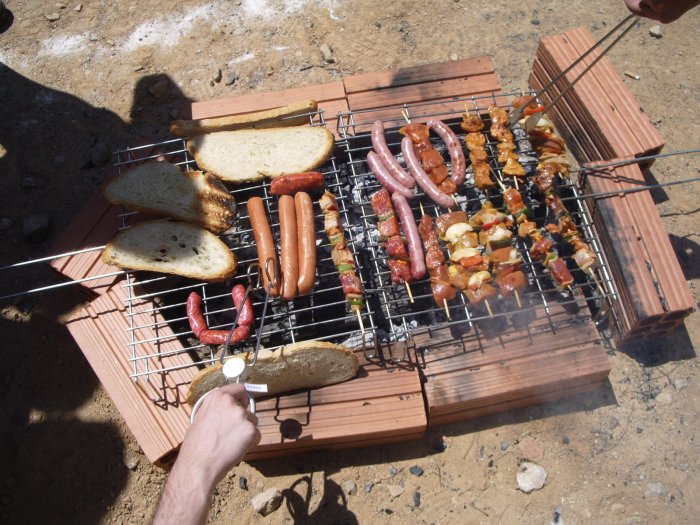
Metal grate for grilling over a fire

Metal grate for grilling over a fire
A gridiron is a metal grate with parallel bars typically used for grilling foods. Some designs involve two such grates hinged to fold together, securely holding food while grilling over an open flame.
Development

Early examples of the gridiron were found in Pompeii. The Latin term is craticula, a diminutive form of "crates". This referred to their cross-hatched design, which appeared similar to a wicker basket, or crate. This is also used as the base for the word graticule, passing through French.
In Mishnaic Hebrew, used by Jews in the 2nd-century CE, the word for gridiron is eskalah (), a word borrowed from , with a slight corruption in pronunciation. Skewers with meat could be laid over the gridiron, or else meat laid directly over the gridiron.
Manufacture in US
There were numerous iron gridirons manufactured and patented in the U.S. in the 1800s. These iron legged devices were used in a fireplace placed over the fire to cook food. Over time, gridirons have been developed specifically to accommodate the type of food being prepared and the cooking method being used. A combination hinged gridiron and spider was developed and patented in 1836 by Amasa and George Sizer of Meriden, Connecticut. A steel wire gridiron was developed and patented as early as 1889 in New Haven, Connecticut, by William C. Perkins, of the New Haven Wire Goods Co., who received a U.S. Patent #408,136 for a hinged gridiron that would hold the meat in place while broiling. A commercial hinged broiler or gridiron was designed for use in the Bridge & Beach, Co., 1898 vertical cast iron stove. This hinged broiler was manufactured by Luigi Pieragostini, also of the New Haven Wire Goods Co., and patented in 1939; U.S. Patent #2,148,879.
Today, hinged gridirons are used extensively to deep fry or broil fast food in restaurants throughout the world. Hot dog gridirons are also available for camping and outdoor cooking.
Cultural references
A gridiron is essential to Chapter 28 of David Copperfield, where David, the Micawbers, and Traddles improvise a meal on one. Charles Dickens mentions gridirons again as a suitable and practical gift that a blacksmith can make in his book Great Expectations, where he refers to their use for cooking sprats.
In response to the block game strategies of some college football teams in 1880 and 1881, in 1882 lines perpendicular to the sidelines and spaced 5-yards apart were placed on the field. Since the field now resembled the cooking utensil the nickname started appearing and was well established by 1895.
In Christian iconography, Saint Lawrence is commonly depicted with a gridiron, as traditional accounts hold that he was martyred by being placed on one over hot coals.
References
Bibliography
References
- Daremberg & Saglio, [https://penelope.uchicago.edu/Thayer/E/Roman/Texts/secondary/DARSAG/Craticula.html "Craticula"], Dictionnaire des Antiquités Grecques et Romaines, Librairie Hachette et Cie., Paris, 1877–1919
- [http://mw1.merriam-webster.com/dictionary/graticule "graticule"] {{Webarchive. link. (2007-10-10 , Merriam-Webster)
- [[Mishnah]] (''[[Avodah Zarah]]'' 5:12)
- (2006). "Dictionary of the Targumim, the Talmud Babli and Yerushalmi, and the Midrashic Literature". Hendrickson Publishers.
- "U.S. Patent #78".
- "U.S. Patent #408,136".
- https://patentimages.storage.googleapis.com/c7/9b/d6/1926a2ab6e148f/US2148879.pdf {{Bare URL PDF. (March 2022)
- (15 September 1895). "In Football Armor These". Los Angeles Herald.
- ""St. Lawrence, Deacon Martyr," said to have been martyred by being put on a gridiron. St. Lawrence Orthodox Christian Church".
This article was imported from Wikipedia and is available under the Creative Commons Attribution-ShareAlike 4.0 License. Content has been adapted to SurfDoc format. Original contributors can be found on the article history page.
Ask Mako anything about Gridiron (cooking) — get instant answers, deeper analysis, and related topics.
Research with MakoFree with your Surf account
Create a free account to save articles, ask Mako questions, and organize your research.
Sign up freeThis content may have been generated or modified by AI. CloudSurf Software LLC is not responsible for the accuracy, completeness, or reliability of AI-generated content. Always verify important information from primary sources.
Report