From Surf Wiki (app.surf) — the open knowledge base
Greater Israel
Zionist ideologically irredentist term
Zionist ideologically irredentist term
"Greater Israel" () is an expression with several different biblical and political meanings over time. It is often used, in an irredentist fashion, to refer to the historic or desired borders of the State of Israel.
Territorial claims of Israeli Nationalist or Zionist movements have varied, depending on the time period and different groups of proponents such as Labor Zionist, Revisionist Zionist, or Religious Zionist groups. There are two different primary uses of the term Greater Israel – one referring more narrowly to the area internationally recognized as part of the State of Israel along with the Golan Heights, West Bank, and Gaza Strip; and a second definition referring to the much larger region stretching from the river Nile to the Euphrates.{{cite web|url=https://theweek.com/world-news/what-is-the-greater-israel-movement|date=18 October 2024|accessdate=29 January 2025|website=The Week|title=What is the 'Greater Israel' movement?
History
Early Zionism
Theodore Herzl, one of the founders of Zionism, was influenced by the Tanakh in his thinking on the borders for a Jewish State in Palestine. In the words of professor of history H.S. Haddad: "Herzl's idea of the geographical extent of the Jewish state was derived from the biblical romance of the Davidic Kingdom."
William Hechler, an English Christian Zionist, also influenced Herzl's thinking on the matter, and Theodore Herzl recorded in his diary that:
Hechler unfolded his Palestine map in our [train] compartment and instructed me by the hour. The northern frontier is to be the mountains facing Cappadocia, the southern, the Suez Canal. Our slogan shall be: "The Palestine of David and Solomon."Marvin Lowenthal's translation of The Diaries of Theodore Herzl (New York: Dial Press, 1956), p. 124 [citation copied from Haddad 1974]
The Land of Israel in Jewish history and religion
The Land of Israel () is the traditional Jewish name for an area of the Southern Levant. Related biblical, religious and historical English terms include the Land of Canaan, the Promised Land, the Holy Land, and Palestine. The definitions of the limits of this territory vary between passages in the Hebrew Bible, with specific mentions in Genesis 15, Exodus 23, Numbers 34 and Ezekiel 47. Nine times elsewhere in the Bible, the settled land is referred as "from Dan to Beersheba", and three times it is referred as "from the entrance of Hamath unto the brook of Egypt" (1 Kings 8:65, 1 Chronicles 13:5 and 2 Chronicles 7:8).
The Bible contains three geographical definitions of the Land of Israel:
- The first definition () seems to define the land that was given to all of the children of Abram (Abraham), including Ishmael, Zimran, Jokshan, Midian, etc. It describes a large territory, "from the brook of Egypt to the Euphrates".
- A narrower definition ( and ) refers to the land that was divided between the original Twelve tribes of Israel after they were delivered from Egypt.
- A wider definition (, ) indicating the territory that will be given to the children of Israel slowly throughout the years, as explained in and ).
These biblical limits for the land differ from the borders of established historical Israelite and later Jewish kingdoms, including the United Kingdom of Israel, the two kingdoms of Israel (Samaria) and Judah, the Hasmonean Kingdom, and the Herodian kingdom. At their heights, these realms ruled lands with similar but not identical boundaries.
Judaism defines the land as where Jewish religious law prevailed and excludes territory where it was not applied. It holds that the area is a God-given inheritance of the Jewish people based on the Torah, particularly the books of Genesis, Exodus, Numbers and Deuteronomy, as well as Joshua and the later Prophets. According to the Book of Genesis, the land was first promised by God to Abram's descendants; the text is explicit that this is a covenant between God and Abram for his descendants. Abram's name was later changed to Abraham, with the promise refined to pass through his son Isaac and to the Israelites, descendants of Jacob, Abraham's grandson.
Professor of history H.S. Haddad writes that "Although there are different delineations of the boundaries of the Promised Land in the Bible, the locus of Eretz Israel is clear and constant. Whether it is defined as "from Dan to Beersheba" and "from the desert to the sea" or, more often, from the Nile to the Euphrates, Jerusalem is the centre around which these circles of varying size are drawn."
Kingdom of Israel
Main article: History of ancient Israel and Judah, Kingdom of Israel (united monarchy), Kingdom of Israel (northern kingdom), Kingdom of Judah
- The Kingdom of Israel (united monarchy) (1047–931 BCE), was the kingdom established by the Israelites and uniting them under a single king.
- The Kingdom of Israel (northern kingdom) (930–c.720 BCE), was the kingdom of northern Israel after the breakup of the united monarchy of the Kingdom of Israel.
- The Kingdom of Judah (930–587 BCE), was the southern Jewish kingdom after the breakup of the united monarchy of the Kingdom of Israel.
Second Temple period
Main article: Second Temple period, Return to Zion
Return to Zion (, he, ) is an event recorded in Ezra–Nehemiah of the Hebrew Bible, in which the Jews of the Kingdom of Judah—subjugated by the Neo-Babylonian Empire—were freed from the Babylonian captivity following the Persian conquest of Babylon. In 539 BCE, the Persian king Cyrus the Great issued the Edict of Cyrus allowing the Jews to return to Jerusalem and the Land of Judah, which was made into a self-governing Jewish province known as Yehud under the new Persian Achaemenid Empire.
The Second Temple period or post-exilic period in Jewish history denotes the approximately 600 years (516 BCE–70 CE) during which the Second Temple stood in the city of Jerusalem. It began with the return to Zion and subsequent reconstruction of the Temple in Jerusalem, and ended with the First Jewish–Roman War and the Roman siege of Jerusalem.
Palestine under British rule 1917–1948
Main article: British Mandatory Palestine
Balfour Declaration
Main article: Balfour Declaration
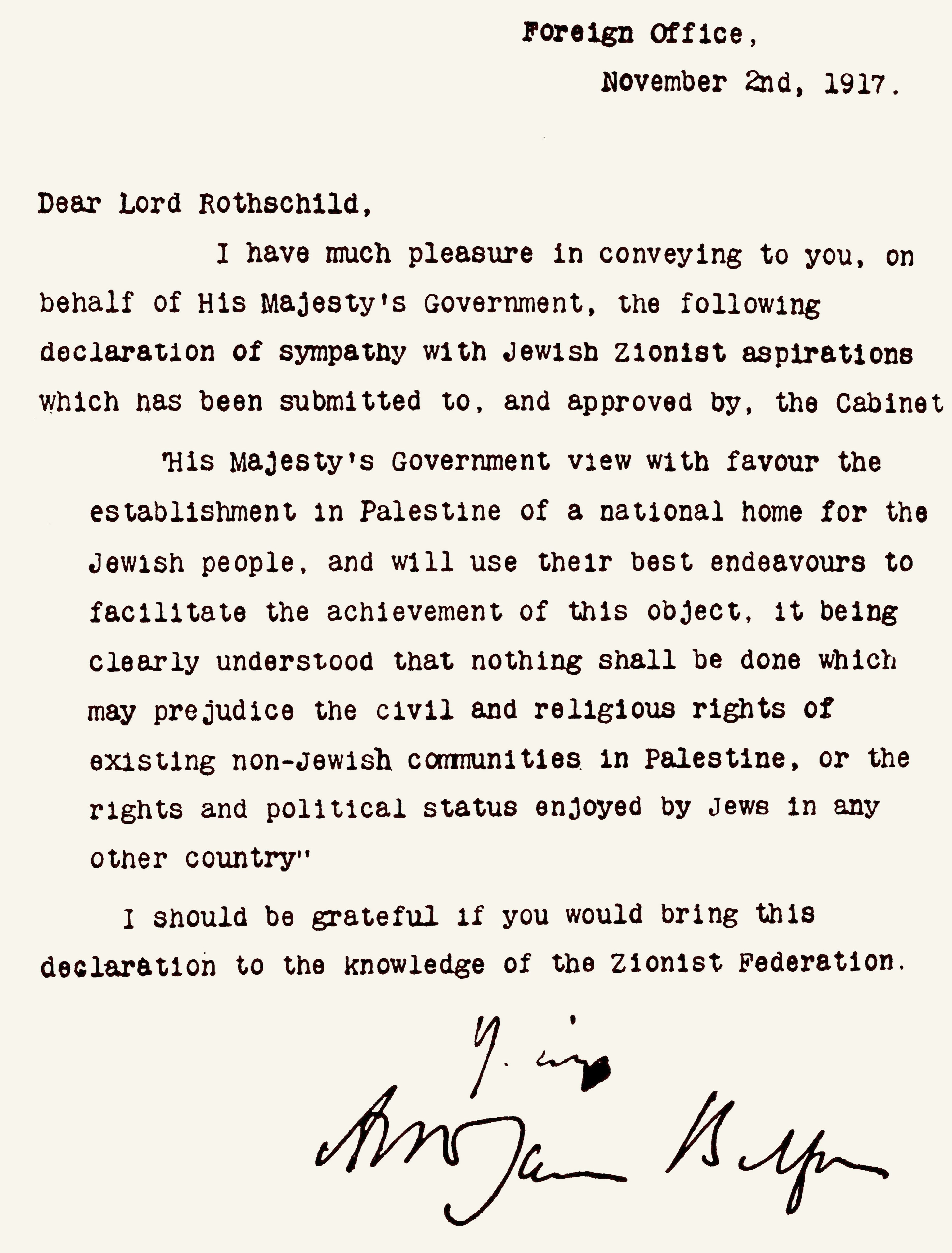
The 1917 Balfour Declaration]]
The Balfour Declaration was a public statement issued by the British Government in 1917 during the First World War announcing that it "viewed with favour" the establishment of a "national home for the Jewish people" in Palestine, then an Ottoman region with a small minority Jewish population. The declaration was contained in a letter dated 2November 1917 from the United Kingdom's Foreign Secretary Arthur Balfour to Lord Rothschild, a leader of the British Jewish community, for transmission to the Zionist Federation of Great Britain and Ireland. The text of the declaration was published in the press on 9November 1917.
On the military front in Palestine, the Sinai and Palestine campaign was part of the Middle Eastern theatre of World War I, taking place between January 1915 and October 1918. It brought Palestine under British control that ended with the Armistice of Mudros in 1918, leading to the cession of Ottoman Syria that included most of western Palestine.
During British Mandate for Palestine
Main article: Mandate for Palestine
Early Revisionist Zionist groups such as Betar and Irgun Zvai-Leumi regarded the territory of the Mandate for Palestine, including Transjordan, as Greater Israel.
In 1937, the Peel Commission recommended partition of Mandatory Palestine. In a letter to his son later that year, David Ben-Gurion stated that partition would be acceptable but as a first step. Ben-Gurion wrote that The same sentiment was recorded by Ben-Gurion on other occasions, such as at a meeting of the Jewish Agency executive in June 1938, as well as by Chaim Weizmann. Ben Gurion said:
Of the Peel Commission's partition plan Zionist leader Chaim Weizmann stated "I know that God promised Palestine to the children of Israel, but I do not know what boundaries He set. I believe they were wider than the ones now proposed and may have included Transjordan."
During early period of the State of Israel
Joel Greenberg writing in The New York Times notes: "At Israel's founding in 1948, the Labor Zionist leadership, which went on to govern Israel in its first three decades of independence, accepted a pragmatic partition of what had been British Palestine into independent Jewish and Arab states. The opposition Revisionist Zionists, who evolved into today's Likud party, sought Eretz Yisrael Ha-Shlema—Greater Israel, or literally, the Whole Land of Israel (shalem, meaning complete)." The capture of the West Bank and Gaza Strip from Jordan and Egypt during the Six-Day War in 1967 led to the growth of the non-parliamentary Movement for Greater Israel and the construction of Israeli settlements. The 1977 elections, which brought Likud to power also had considerable impact on acceptance and rejection of the term. Greenberg notes: THE seed was sown in 1977, when Menachem Begin of Likud brought his party to power for the first time in a stunning election victory over Labor. A decade before, in the 1967 war, Israeli troops had in effect undone the partition accepted in 1948 by overrunning the West Bank and Gaza Strip. Ever since, Mr. Begin had preached undying loyalty to what he called Judea and Samaria (the West Bank lands) and promoted Jewish settlement there. But he did not annex the West Bank and Gaza to Israel after he took office, reflecting a recognition that absorbing the Palestinians could turn Israel into a bi-national state instead of a Jewish one.
Yitzhak Shamir was a dedicated proponent of Greater Israel and as Israeli Prime Minister gave the settler movement funding and Israeli governmental legitimisation.
Movement for Greater Israel and Gush Emunim
Main article: Movement for Greater Israel, Gush Emunim
The Movement for Greater Israel (, HaTenu'a Lema'an Eretz Yisrael HaSheleima), also known as the Land of Israel Movement, was a political organisation in Israel during the 1960s and 1970s which subscribed to an ideology of Greater Israel. The organization was formed in July 1967, a month after Israel captured the Gaza Strip, the Sinai Peninsula, the West Bank, and the Golan Heights in the Six-Day War. It called on the Israeli government to keep the captured areas and to settle them with Jewish populations. Despite the decrease in support of a Jewish homeland stretching from "the River of Egypt to ... the River Euphrates" among the Religious Zionists, Gush Emunim persisted in that belief in the 1970s and 1980s.
Today
Today the term "Greater Israel" is generally used among Israelis to refer to the territory of the State of Israel and the area internationally recognized as the Palestinian territories, which together form the combined territory of the former Mandatory Palestine minus Trans-Jordan (modern-day Jordan), which was already separated from Palestine by the British in the early 1920s. However, because of ambiguity and controversy surrounding the term, those areas are instead often referred to as the Land of Israel. Some Israelis still interpret "Greater Israel" to include the Golan Heights and Sinai Peninsula, or even as a promise of dominion over the entire area from the Nile River (in modern Egypt) to the Euphrates River (which flows through today's Turkey, Syria, and Iraq). In the present day, the Hardal section of the Religious Zionist movement has brought back claims of a Jewish homeland extending from "the River of Egypt to ... the River Euphrates".
In the 2000s, the annexation of the West Bank and Gaza Strip was part of the platform of the mainstream Israeli Likud party, and of some other, often more extreme Israeli political parties. On September 14, 2008, Israeli Prime Minister Ehud Olmert, formerly of Likud, remarked that "Greater Israel is over. There is no such thing. Anyone who talks that way is deluding themselves", making this statement just two days before privately reaching out to the Palestinian President with a comprehensive plan that ultimately never was implemented.
Meir Kahane, an ultra-nationalist Knesset member, who founded the American Jewish Defense League and the banned Israeli Kach party, worked towards Greater Israel and other Religious Zionist goals. Kach, Tehiya, and the National Religious Party are parties which supported the idea of a Greater Israel.
In March 2023, the Israeli Finance Minister Bezalel Smotrich, leader of the far-right National Religious Party–Religious Zionism, spoke at a Paris memorial behind a podium featuring a 'Greater Israel' map including Trans-Jordan. This speech has led to tensions with Jordan, while his spokesperson attributed the symbol's presence to the organizers of the event, which was dedicated to a man connected to the Irgun (see above for Irgun emblem). In response to the diplomatic controversy, Israel's Foreign Ministry stated that Israel adheres to the 1994 peace treaty and respects Jordan's sovereignty.
In August 2025, Israeli prime minister Benjamin Netanyahu said in an interview with i24NEWS that he was on a "historic and spiritual mission" and that he is "very" attached to the vision of Greater Israel, which includes Palestinian areas and possibly also places that are part of Jordan, Egypt, Syria, and Lebanon. He stated that the generation of his parents was responsible for establishing the state, and it is now his duty, as well as that of his generation, to guarantee the survival of this state (Greater Israel). In response to Netanyahu's statements, the foreign ministers from Arab and Muslim nations denounced his assertion regarding "Greater Israel" as a blatant infringement of international law. The nations that expressed this condemnation included Saudi Arabia, Algeria, Bahrain, Bangladesh, Chad, Comoros, Djibouti, Egypt, Gambia, Indonesia, Iraq, Jordan, Kuwait, Lebanon, Libya, Maldives, Mauritania, Morocco, Nigeria, Oman, Pakistan, Palestine, Qatar, Senegal, Sierra Leone, Somalia, Sudan, Syria, Turkey, the United Arab Emirates, and Yemen.
Proposed inclusion of areas beyond the borders of the Mandate
Israeli Finance Minister Bezalel Smotrich has suggested that Israel is destined to expand to include Jordan, and even beyond, to parts of Syria, Lebanon, Jordan, Egypt and even Iraq. In a documentary film by Arte in 2024, Smotrich said “it is written that the future of Jerusalem is to expand to Damascus.” This view has support in some parts of Israeli society. Israel’s incursions into Jordan and Syria has intensified international concerns that some actors in Israel are pursuing expansion into other countries.
In 2024 Daniella Weiss said "We know from the Bible that the real borders of Greater Israel are the Euphrates and the Nile".
In academia
Hillel Weiss, a professor at Bar-Ilan University, has promoted the "necessity" of rebuilding the Temple and of Jewish rule over Greater Israel. Francesca Albanese and Amos Goldberg have said that an aim towards a Greater Israel is a factor during the Gaza genocide. According to Yoav Di-Capua, one of the beliefs of the Hardal movement is "the obligation to retrieve the biblical land of Israel in its entirety as a pre-requisite for collective redemption which heralds the arrival of the Messiah".
Controversies
It has been suggested that the blue strips of the Israeli flag represent the Nile and Euphrates as the boundaries of Eretz Isra'el as promised to the Jews by God according to religious scripture. This claim was at a time made by Yasser Arafat, Iran and Hamas. However, Danny Rubinstein points out that "Arafat ... added, in interviews that he gave in the past, that the two blue stripes on the Israeli flag represent the Nile and the Euphrates. ... No Israeli, even those who demonstrate understanding for Palestinian distress, will accept the ... nonsense about the blue stripes on the flag, which was designed according to the colours of the traditional tallit (prayer shawl) ..."
The 10 agorot controversy was a conspiracy theory put forth by Palestine Liberation Organization chairman Yasser Arafat at a specially convened session of the UN Security Council in Geneva on 25 May 1990. At the session, Arafat claimed that the obverse design of an Israeli ten agorot coin contained a map of Greater Israel.
According to Nadav Shelef, a minority of Religious Zionist groups supported a Jewish homeland extending from "the River of Egypt to ... the River Euphrates" in 1925, whereas modern-day such groups changed the claims to present-day Israel, the Golan Heights, Gaza Strip, and West Bank by 2005. However, the Hardal section of the Religious Zionist groups still supports "the River of Egypt to ... the River Euphrates" claims.
References
Sources
References
- {{harvnb. Shelef. 2018
- Haddad, H. S. (1974). The Biblical Bases of Zionist Colonialism. Journal of Palestine Studies, 3(4), 97–113. https://doi.org/10.2307/2535451
- Rachel Havelock, [https://books.google.com/books?id=5tCIiwLQr2MC&pg=PA210 ''River Jordan: The Mythology of a Dividing Line,''] University of Chicago Press, 2011 p.210.
- "Exodus 6:4 I also established my covenant with them to give them the land of Canaan, where they resided as foreigners". Bible.cc.
- "Gen 15:18–21; NIV; - On that day the LORD made a covenant". Bible Gateway.
- Haddad, H. S. (1974). The Biblical Bases of Zionist Colonialism. Journal of Palestine Studies, 3(4), 97–113. https://doi.org/10.2307/2535451
- Pappé, Ilan. (1994). "The Making of the Arab–Israeli Conflict, 1947–1951". I.B.Tauris.
- [http://www.palestineremembered.com/download/B-G%20LetterTranslation.pdf Letter from David Ben-Gurion to his son Amos, written 5 October 1937], Obtained from the Ben-Gurion Archives in Hebrew, and translated into English by the [[Institute of Palestine Studies]], Beirut
- Morris, Benny. (2011). "Righteous Victims: A History of the Zionist-Arab Conflict, 1881-1998". Knopf Doubleday Publishing Group.
- Finkelstein, Norman. (2005). "Beyond Chutzpah: On the Misuse of Anti-semitism and the Abuse of History". University of California Press.
- Masalha, Nur. (1992). ["Expulsion of the Palestinians: The Concept of "Transfer" in Zionist Political Thought, 1882-1948"](https://archive.org/details/expulsionofpales00masa/page/107}}; and
{{citation). Inst for Palestine Studies. - Masalha, Nur. (1992). "Expulsion of the Palestinians: The Concept of "Transfer" in Zionist Political Thought, 1882-1948". Inst. for Palestine Studies.
- Howard M. Sachar History of Israel from the rise of Zionism to our Time pp. 207-208
- Lewis, G. (2009). Balfour and Weizmann: The Zionist, the Zealot and the Emergence of Israel. United Kingdom: Bloomsbury Publishing
- Chaim Weizmann, ''Trial and Error: The Autobiography of Chaim Weizmann'' (1949), Volume 2
- Greenberg, Joel. (22 November 1998). "The World: Pursuing Peace; Netanyahu and His Party Turn Away from 'Greater Israel'". The New York Times.
- Mordechai Bar-On (2004) ''A Never-Ending Conflict: A Guide to Israeli Military History'' Greenwood Publishing Group, {{ISBN. 0-275-98158-4 p 219
- {{harvnb. Shelef. 2018
- (8 Jan 2024). "Greater Israel—From the Euphrates to the Nile". The Times of Israel.
- {{harvnb. Shelef. 2018
- "Likud - Platform". www.knesset.gov.il.
- [https://www.haaretz.com/hasen/spages/1020929.html Ha'aretz 14 September 2008] ''Olmert: There's no such thing as 'Greater Israel' any more''. By Barak Ravid. "Prime Minister Ehud Olmert on Sunday reiterated his position that the vision of Israel holding onto the West Bank and Gaza Strip as part of its sovereign territory was finished."
- Adams, Paul. (2025-02-24). "The two-state solution map that promised to solve Middle East crisis".
- (2011). "The SAGE Encyclopedia of Terrorism, Second Edition". SAGE Publications.
- (2010). "Politics of Terrorism A Survey". Taylor & Francis.
- (2012). "The Triumph of Israel's Radical Right". Oxford University Press.
- (2004). "Encyclopedia of Modern Worldwide Extremists and Extremist Groups". Greenwood Press.
- Yishai, Yael. "Israeli Annexation of East Jerusalem and the Golan Heights: Factors and Processes." Middle Eastern Studies, vol. 21, no. 1, 1985, pp. 45–60. JSTOR, http://www.jstor.org/stable/4283045. Accessed 27 Mar. 2023.
- (22 December 2002). "National Religious Party: Greater Israel, Religious Status Quo".
- Lazaroff, Tovah. (March 20, 2023). "Smotrich violated Israel-Jordan peace treaty with expanded Israel map - Amman". Jerusalem Post.
- Schwaeber-Issan, Cookie. (24 March 2023). "Why does Finance Minister Bezalel Smotrich think he can bring about the Greater Israel dream?".
- Samuels. (March 20, 2023). "Israeli Ambassador to Jordan Summoned After Top Minister Showcases Map of 'Greater Israel'". [[Haaretz]].
- (13 August 2025). "Netanyahu says he backs 'Greater Israel', which includes parts of Jordan and Egypt".
- (12 August 2025). "Netanyahu says he’s on a ‘historic and spiritual mission,’ also feels a connection to vision of Greater Israel".
- "Netanyahu says he’s on a ‘historic and spiritual mission,’ also feels a connection to vision of Greater Israel".
- "Arab, Islamic foreign ministers condemn Netanyahu’s ‘Greater Israel’ remark".
- (2024-10-10). "Smotrich calls for 'bit by bit' Israeli expansion to Damascus". The New Arab.
- (2025-06-10). "Israel: Extremists in Power".
- Muaddi, Qassam. (2024-12-17). "Inside 'Greater Israel': myths and truths behind the long-time Zionist fantasy".
- (2025). "Turning Palestine into a ''Terra Nullius'' : On Amalek and "Miracles"". Journal of Genocide Research.
- ''Haaretz'' "Weiss versa" by Avi Garfunkel, 30 January 2004
- "Website Disabled".
- Brown, Matt. (4 May 2007). "Rabbis call for re-establishment of Jewish court".
- (1 October 2024). "Report of the Special Rapporteur on the situation of human rights in the Palestinian territories occupied since 1967, Francesca Albanese: Genocide as colonial erasure". [[United Nations Special Rapporteur on the occupied Palestinian territories]].
- Goldberg, Amos. (15 October 2024). "The Problematic Return of Intent". [[Journal of Genocide Research]].
- (2024). "Genocidal Mirroring in Israel/Palestine". Journal of Genocide Research.
- Genesis 15.18: "The Lord made a covenant with Abram, saying unto thy seed have I given this land from the river of Egypt [the Nile] unto the great river, the River Euphrates."
- [https://web.archive.org/web/20011015064546/http://www.geocities.com/Heartland/9766/arafat.htm Playboy Interview: Yasir Arafat], ''[[Playboy]]'', September 1988.
- Raczka, Witt. (2015-11-30). "Unholy Land: In Search of Hope in Israel/Palestine". Rowman & Littlefield.
- [[Danny Rubinstein. Rubinstein, Danny]]. [https://www.haaretz.com/inflammatory-legends-1.140253 Inflammatory legends], ''[[Haaretz]]'', November 15, 2004.
- Yasir Arafat: A Political Biography: A Political Biography, Barry Rubin. Page 241
- Pipes, Daniel. (1998). "The Hidden Hand: Middle East Fears of Conspiracy". St Martin's Press.
- Rowley, Gwyn. (April 1991). "The Areal Extent of Israel: Passions, Prejudices and Realities". GeoJournal.
- {{harvnb. Shelef. 2018
This article was imported from Wikipedia and is available under the Creative Commons Attribution-ShareAlike 4.0 License. Content has been adapted to SurfDoc format. Original contributors can be found on the article history page.
Ask Mako anything about Greater Israel — get instant answers, deeper analysis, and related topics.
Research with MakoFree with your Surf account
Create a free account to save articles, ask Mako questions, and organize your research.
Sign up freeThis content may have been generated or modified by AI. CloudSurf Software LLC is not responsible for the accuracy, completeness, or reliability of AI-generated content. Always verify important information from primary sources.
Report