From Surf Wiki (app.surf) — the open knowledge base
Grand Hotel, Birmingham
Grade II* listed hotel in Birmingham, England
Grade II* listed hotel in Birmingham, England
| Field | Value |
|---|---|
| name | Grand Hotel |
| status | Open |
| image | Grand Hotel Colmore Road.jpg |
| caption | The Grand Hotel in 1894 |
| nrhp | {{Designation list |
| embed | yes |
| designation1 | UK Grade II* |
| designation1_date | 4 May 2004 |
| designation1_number | 1391246 |
| building_type | Hotel |
| architectural_style | French Renaissance |
| ren_cost | £45 million |
| owner | Hortons' Estate Ltd |
| address | 43 Colmore Row |
| location_town | Birmingham |
| location_country | England |
| coordinates | |
| start_date | 1875 |
| opened_date | |
| renovation_date | October 2012— May 2021 |
| height | 30 m |
| floor_count | 10 |
| architect | Thomson Plevins |
| ren_architect | Berman Guedes Stretton |
| ren_firm | Midland Conservation Ltd |
| ren_str_engineer | Arup |
| website | |
| affiliation | Starwood Capital Group |
| number_of_rooms | 185 (Proposed) |
| number_of_restaurants | 1 |
| number_of_bars | 2 |
| facilities | Sunken rooftop garden terrace |
Martin & Chamberlain (Extension & Grosvenor Suites, 1893–95)
The Grand Hotel is a Grade II* listed Victorian five star hotel in the city centre of Birmingham, England. The hotel occupies the greater part of a block bounded by Colmore Row, Church Street, Barwick Street and Livery Street and overlooks St Philip's Cathedral and churchyard. Designed by architect Thomson Plevins, construction began in 1875 and the hotel opened in 1879. Extensions and extensive interior renovations were undertaken by prominent Birmingham architecture firm Martin & Chamberlain from 1890 to 1895. Interior renovations included the building of the Grosvenor Room with Louis XIV style decoration.
The hotel closed in 2002 and due to the risk of crumbling stonework where it remained under scaffolding and protective covers for ten years. In 2012 planning permission was granted for plans to restore the building into a luxury hotel. Works to the exterior began in October 2012 and completed in 2021. The hotel reopened in May 2021 with 185 bedrooms, two new bars and a restaurant, a gymnasium, meeting rooms, collaboration areas, and event spaces.
History
Before the 1870s, St Philip's churchyard was surrounded with Georgian terraces. However, as a result of the Second Birmingham Improvement Act of 1861, the buildings were to be cleared for the redevelopment of Colmore Row. As the leases on the buildings on Colmore Row began to end in the late 1860s, demolition began. Barwick Street was constructed in 1870 and several plots of land bounded by Colmore Row, Church Street, Barwick Street and Livery Street were acquired to create the site of the hotel. Isaac Horton, a major Birmingham land and property owner and his architect and builder, Thomson Plevins, were very active in the acquisition of the land and developing it in line with the 1861 Act. Plevins issued three separate contracts for the Colmore Row range of the hotel and construction work started in 1875 on the corner of Church Street. The hotel opened on 1 February 1879, with 100 rooms and a further 60 unfinished at the time of opening. Other facilities included a restaurant with an entrance fronting Church Street, two coffee rooms and stock rooms. The stock rooms were an exhibition space where businessmen could demonstrate their new products and were built as the hotel aimed to attract most of its clients from commercial visitors from out of town. The hotel was let to Arthur Field, a hotel operator from Newcastle upon Tyne. In 1880 the hotel was extended, when the corner of Church Street and Barwick Street was built.
The hotel's heyday was in the early 20th century, when it played host to royalty, politicians and film stars as well as staging many dinners, concerts and dances in the Grosvenor Suites. King George VI, Winston Churchill, Neville Chamberlain, Charlie Chaplin, James Cagney and Joe Louis attended functions or stayed in the hotel at this time. Despite its previous success, as the century continued, the hotel ran into financial difficulties and closed in 1969. Hickmet Hotels took lease of the hotel in 1972, and even after a £500,000 refurbishment, trading conditions proved difficult, and they fell into receivership in 1976.
Grand Metropolitan Hotels took over the lease in 1977 and undertook a £1.5 million refurbishment. In 1978, architects Harper Sperring undertook a modernisation of the interior and the exterior of the hotel. A major repair job was undertaken on the exterior stonework on Colmore Row and Church Street which comprised applying a resin sealant coat, followed by a thick cement layer and then over painting. In 1982 the lease was passed to Queens' Moat Hotels; with little investment and maintenance during the 1980s and 1990s, the hotel again fell into decline. In August 2002, the hotel closed due to financial difficulties. The exterior of the building began to deteriorate because of poor quality stonework; scaffolding was erected for public safety. In 2003, plans were put forward by the owners to demolish the building as the maintenance costs were becoming too high. The Victorian Society countered these plans by putting forward an application to spot-list the building to save it from demolition. In May 2004, the building was designated with a Grade II* listing protecting it from demolition.
In 2012, a planning application was put forward and accepted to restore the hotel. Owners Hortons' Estate proposed a £30 million scheme to the restore the hotel's façade, the Grosvenor Suites, and the grand staircase, and to re-model the inside to create a 152-bedroom, 8-suite, luxury hotel and move the main entrance to Church Street. Works to the exterior began in October 2012 and the hotel reopened in May 2021.
Architecture

The Grand Hotel is one of the largest Victorian buildings in central Birmingham and forms part of the informal square around St Philip's Cathedral. The materials used on the north side of Colmore Row are predominantly stone with some brick and terracotta. The Colmore Estate insisted on the use of stone to add status, grandeur and dignity to the north side of Colmore Row. It has been stated that the north side of Colmore Row presents the best ensemble of Mid-Victorian palazzo splendour in Birmingham.
The building, by Thomson Plevins, is principally of French Renaissance style, a style first used on a large hotel at the Great Western Hotel, Paddington by Philip Hardwick in 1851. The Colmore Row frontage is of 22 bays and symmetrical and built from ashlar and brick with stone dressings and hipped slate roofs with lead dressings. The Church Street façade is of 7 bays and decoratively similar to the Colmore Row front.
The interior was redesigned by Martin & Chamberlain in 1890–91, and in 1893–95 the firm built an eight-storey red brick and terracotta block fronting onto Barwick Street. Within this block an elaborately decorated ballroom was built, named the Grosvenor Room. It is 100 ft long and 32 ft high.
During the restoration in 2014, a course of red sandstone blocks was discovered on the Colmore Row and Church Street façades above the windows across the first four floors. The building is predominantly painted limestone and the specification of works required re-painting of all stonework. However the aesthetic impact of the red sandstone courses was deemed positive enough to be left exposed.
Renovation
After the hotel closed in August 2002, the building fell into disrepair and the poor quality stonework on the building's façade began to crumble. After some of the stonework fell onto the pavement in Colmore Row, the building was surrounded with scaffolding and protective covers to protect the public. Escalating maintenance costs led to the proposal by the owners to demolish the building in 2003. The proposal was dropped when the building was listed as a Grade II* listed building in 2004. The building then continued to lay vacant (except for the shops fronting Colmore Row) as the cost of repairing and restoring the building was deemed as too high or not even feasible due to the poor state of the exterior stonework.
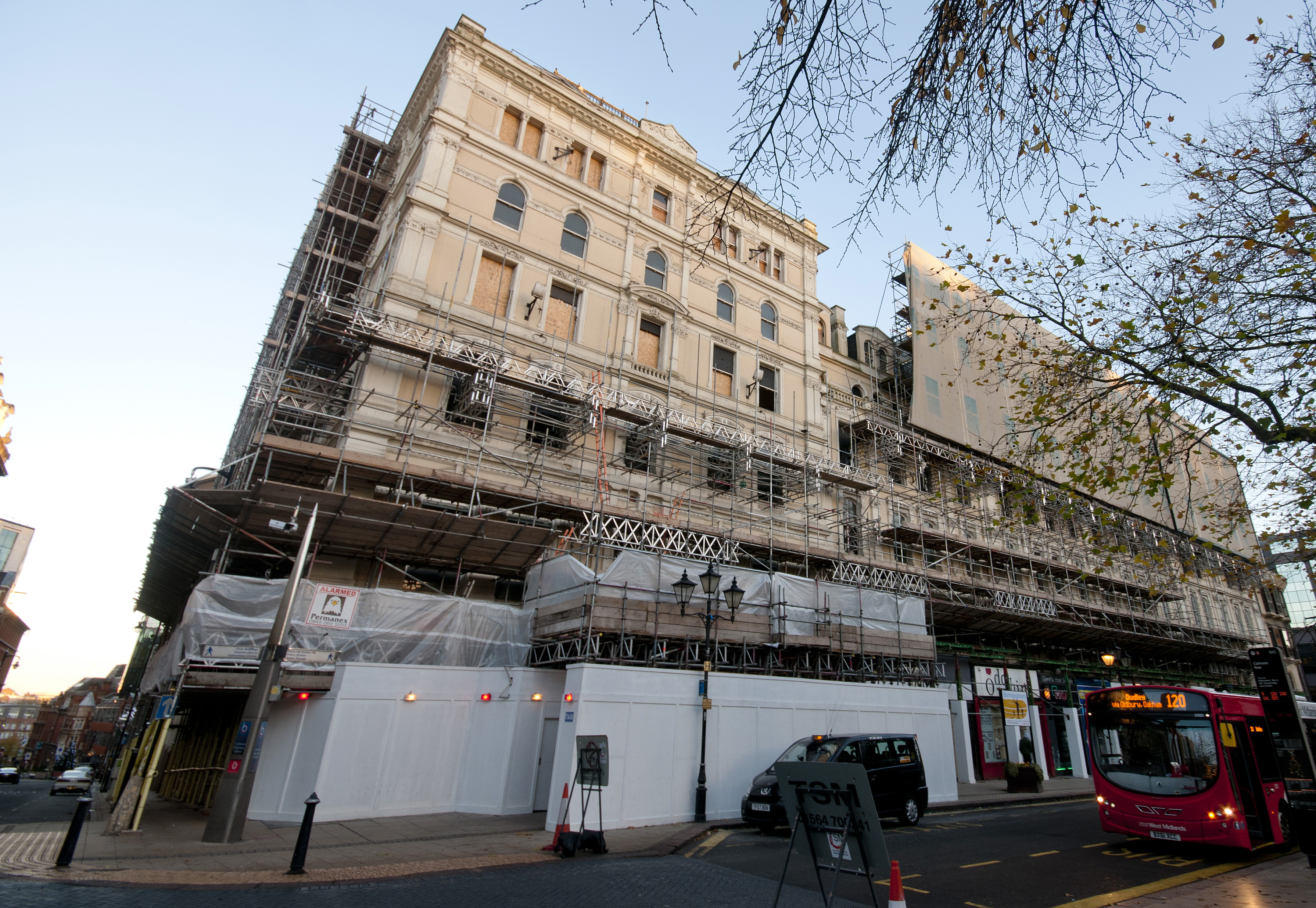
In the summer of 2011, Arup Façade Engineering and Linford Group were appointed by Hortons' Estate at a cost of £1.5 million to find a solution to restore the façade. It was discovered that some of the stone was unsuitable for construction in the first place and was laid incorrectly. The restoration team formed a repair strategy and worked on a trial area on Church Street. The strategy comprised stripping all paint and render back to solid stone, replacing all failed stone and repainting with modern paint that allows water vapour to permeate through it.
After the successful trial, £30 million proposals were drawn up and went on public consultation in January 2012 followed by a planning application in February 2012. Other elements include the creation of a terrace in the central courtyard, a hotel bar and restaurant accessed from Colmore Row, a standalone bar on the corner of Church Street and Barwick Street, a new main entrance on Church Street, and refurbished shops on Colmore Row based on a harmonised design and colour scheme. The stonework façades on Colmore Row and Church Street, the Grosvenor Suites and the grand staircase were restored.
The project team for the project was Hortons' Estate Ltd and architect Berman Guedes Stretton. On 26 April 2012, the planning application received unanimous backing from city councillors. The project began in October 2012 with a projected finishing date of summer 2014. However, due to problems during the tendering process for the interior building contract, no interior works were started. In October 2014 it was reported that an extra £4 million would be invested by the owners with £2.5 million spent on further façade refurbishment and a new roof and £1.5 million spent on refurbishing 10 shops fronting Colmore Row and 10,000 sq ft of office space within the building. A deal on the interior works with building contractors and a hotel operator was yet to be agreed.
The project was awarded a £6 million grant in November 2015 from Birmingham City Council and the GBSLEP, of which £4 million would be repayable subject to commercial success of the hotel. The grant made the aspiration to return the building to hotel use financially viable with the owners reporting that talks were taking place with two hotel operators. In January 2020, it was announced by Starwood Capital Group that the hotel would open in summer 2020, following an extensive £45 million refurbishment. The restoration includes new penthouse suites, a sunken rooftop garden terrace, two new bars and a restaurant, a gymnasium, meeting rooms, collaboration areas, and event spaces.
In media
During January 2012 the BBC drama Dancing on the Edge written and directed by Stephen Poliakoff used the Grosvenor Room as the filming location for the Imperial Ballroom. The Imperial Ballroom was used for a scene in Episode 4 of The Game in 2014.
The hotel features in Kit de Waal's novel The Trick to Time (2018).
Notes
References
References
- {{NHLE
- Elkes, Neil. (30 March 2012). "Birmingham Grand Hotel restoration backed by city councillors". [[Birmingham Post]].
- "Inspectors Listing Advice Print for Grand Hotel". [[English Heritage]].
- "Spot-listing Application for Grand Hotel". [[The Victorian Society]].
- (5 October 1895). "Additions to the Grand Hotel". The Builder.
- (19 July 1900). "Death of [[William Martin (architect)". Birmingham Post.
- (13 October 2011). "New Hope for Future of Birmingham's Grand Hotel". [[Birmingham Post]].
- Thorne, Alun. (5 January 2012). "£30m plan to restore Birmingham's Grand Hotel to former glories". [[Birmingham Post]].
- O'Brien, Cillian. (2 May 2012). "£30m Grand Hotel restoration approved". [[Birmingham Post]].
- (3 December 2012). "Facade contract placed".
- (21 June 2013). "Birmingham’s Grand Hotel restored to former glory". [[Birmingham Post]].
- (14 March 2014). "Rebirth of Birmingham's Grand Hotel on hold after tendering blow". [[Birmingham Post]].
- Brown, Graeme. (12 October 2014). "Extra £4 million pumped into Grand Hotel restoration". Birmingham Post.
- (16 February 2012). "Hustle and Dancing on the Edge put Birmingham locations in the spotlight". [[Birmingham Post]].
This article was imported from Wikipedia and is available under the Creative Commons Attribution-ShareAlike 4.0 License. Content has been adapted to SurfDoc format. Original contributors can be found on the article history page.
Ask Mako anything about Grand Hotel, Birmingham — get instant answers, deeper analysis, and related topics.
Research with MakoFree with your Surf account
Create a free account to save articles, ask Mako questions, and organize your research.
Sign up freeThis content may have been generated or modified by AI. CloudSurf Software LLC is not responsible for the accuracy, completeness, or reliability of AI-generated content. Always verify important information from primary sources.
Report