From Surf Wiki (app.surf) — the open knowledge base
Grading of the tumors of the central nervous system
| Field | Value | |
|---|---|---|
| name | Infobox/doc | |
| above | Grading of the tumors of the | |
| CNS | ||
| abovestyle | background:lightgrey; | |
| image | [[File:AFIP00405522M-GLIOBLASTOMA ARISING IN ASTROCYTOMA.jpg | 200px]] |
| caption | **Glioblastoma arising in an astrocytoma**. This spinal cord exhibits both a lightly staining microcystic astrocytoma as well as a darkly staining glioblastoma. | |
| headerstyle | background:lightgrey; | |
| belowstyle | background:lightgrey; | |
| below | Medicine WikiProject/Neurology task force |
CNS
The concept of grading of the tumors of the central nervous system, agreeing for such the regulation of the "progressiveness" of these neoplasias (from benign and localized tumors to malignant and infiltrating tumors), dates back to 1926 and was introduced by P. Bailey and H. Cushing, Bailey P, Cushing H (1926).
A classification of the tumors of the glioma group on a histogenic basis with a correlated study of prognosis.
J B Lippincott Co. Philadelphia. in the elaboration of what turned out the first systematic classification of gliomas. Tonn J-C, Westphal M, Rutka JT, Grossman SA (2006).
Neuro-Oncology of CNS Tumors
Springer Science & Business, . In the following, the grading systems present in the current literature are introduced. Then, through a table, the more relevant are compared.
ICD-O scale
The first edition of the International Classification of Diseases (ICD) dates back to 1893. The current review (ICD-10) dates back to 1994, came into use in the U.S. in 2015, and is revised yearly, being very comprehensive. In 1976 the World Health Organization (WHO) published the first edition of the International Classification of Diseases for Oncology (ICD-O), which is now at the third edition (ICD-O-3, 2000). In this last edition, the Arabic numeral after the character "/" indicates the "behavior" of the neoplasia, with the following meaning:Vicari P (2007).
Principi di codifica delle neoplasie.
Reggio Emilia dicembre 2007. Accessed on 2009-08-12.
- /0 benign neoplasia
- /1 uncertain neoplasia (benign or malignant)
- /2 neoplasia in situ
- /3 primary infiltrative malignant neoplasia
- /6 secondary malignant neoplasia
- /9 malignant neoplasia, uncertain if primitive or secondary
For the concepts of benign and malignant neoplasia see Tumor and Cancer. For primary and secondary neoplasias see Metastasis.
A brain tumor composed of benign cells, but located in a vital area (as the brain is), can be considered to be life-threatening — although the tumor and its cells would not be classified as malignant.
Kernohan grading
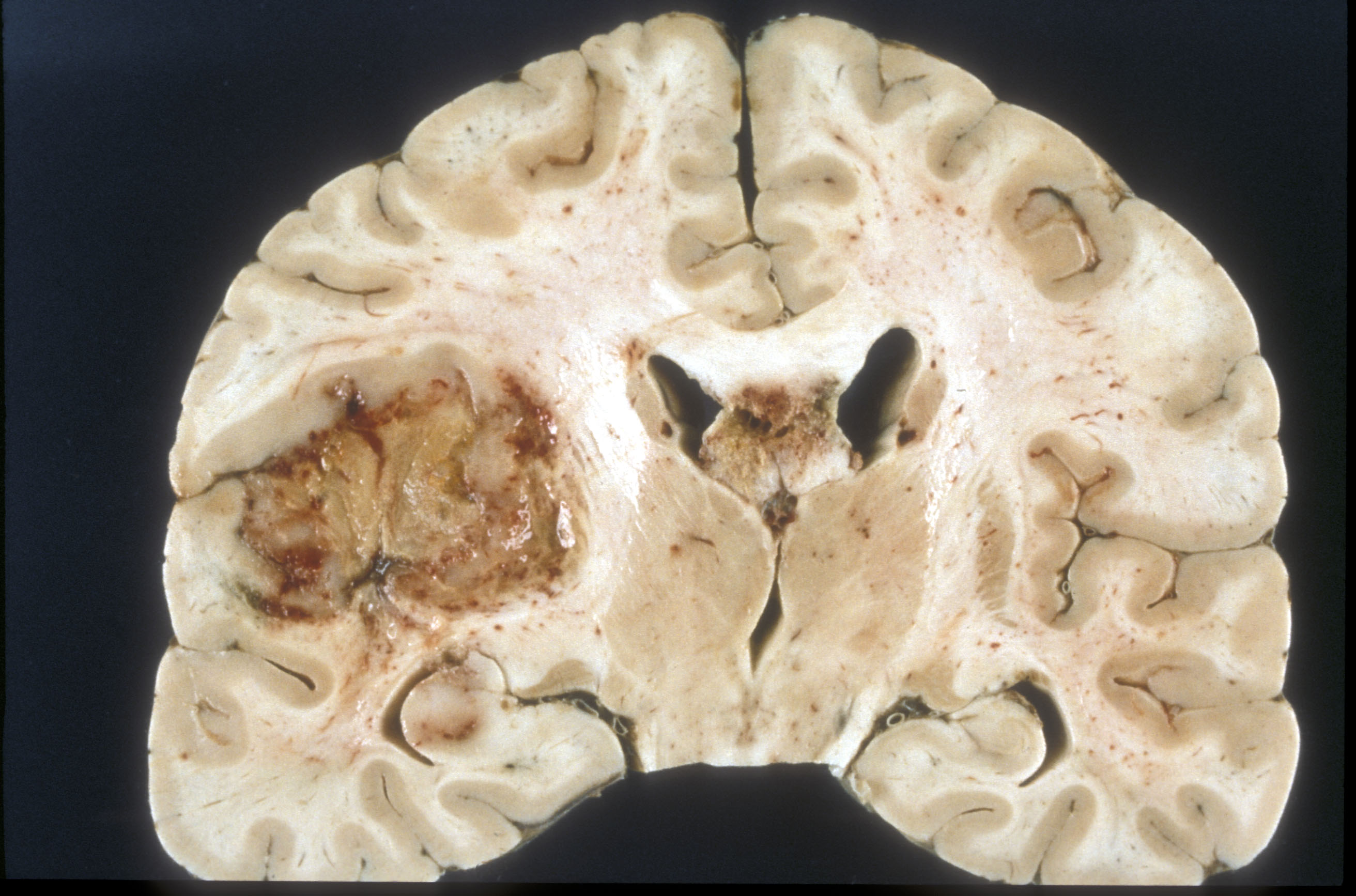
The Kernohan grading system Kernohan JW, Mabon RF, Svien HJ, Adson AW (1949).
A Semplified classification of gliomas.
Proc. Staff: Meet. Mayo Clin. 24: 71-75. defines progressive malignancy of astrocytomas as follows:
- Grade 1 tumors are benign astrocytomas.
- Grade 2 tumors are low-grade astrocytomas.
- Grade 3 tumors are anaplastic astrocytomas.
- Grade 4 tumors are glioblastomas.
St Anne-Mayo grading
The St Anne-Mayo grading system Daumas-Duport C, Scheithauer B, O'Fallon J, Kelly P (1988).
Grading of astrocytomas. A simple and reproducible method.
Cancer 62: 2152-2165. Kim TS, Halliday AL, Hedley W, Convery K (1991).
Correlates of survival and the Daumas-Duport grading system for astrocytomas.
J Neurosurg 74: 27-37. also is used to grade astrocytomas; however, this system uses four morphologic criteria to assign a grade:
a) nuclear atypia,
b) mitosis,
c) endothelial proliferation-'piled-up' endothelial cells. NOT hypervascularity
d) necrosis.
The St. Anne-Mayo grade has four categories of tumors:
- Grade 1 tumors do not meet any of the criteria.
- Grade 2 tumors meet one criterion, usually nuclear atypia.
- Grade 3 tumors meet two criteria, usually nuclear atypia and mitosis.
- Grade 4 tumors meet three or four of the criteria.
WHO grading
The World Health Organization (WHO) grading system Centers for Disease Control and Prevention (2004).
Atlanta, Georgia: Department of Health and Human Services, Centers for Disease Control and Prevention. Kleihues P, Burger PC, Scheithauer BW (1993).
Histological Typing of Tumours of Central Nervous System. World Health Organization International Histological Classification of Tumours.
2nd ed. Springer Verlag: Berlin Heidelberg. Kleihues P, Kiessling M, Scheithauer BW (1987).
The new WHO classification of brain tumours.
Brain Pathol. 3: 255-268. is contained in the volume Histological Typing of Tumours of the Central Nervous System, whose first edition dates back to 1979 (now up to the 5th edition, published online in 2021). The WHO grade has four categories of tumors:
- Grade 1 tumors are slow-growing, nonmalignant, and associated with long-term survival.
- Grade 2 tumors are relatively slow-growing but sometimes recur as higher grade tumors. They can be nonmalignant or malignant.
- Grade 3 tumors are malignant and often recur as higher grade tumors.
- Grade 4 tumors reproduce rapidly and are very aggressive malignant tumors.
Roman numerals (I – IV) were used until the 5th edition (2021) of the WHO classification of CNS tumors.
From the histological point of view the WHO system is based on the same criteria as the St Anne-Mayo system.Grier JT, Batchelor T (2006).
*Low-Grade Gliomas in Adults *
Oncologist. 2006 Jun;11(6):681-93. Buckner JC, Brown PD, O'Neill BP, Meyer FB, Wetmore CJ, Uhm JH (2007).
Central nervous system tumors.
Mayo Clin Proc. 2007 Oct;82(10):1271-86.
Comparison of the grading systems
In the following table the various grading systems are compared (the IDC-O scale is not comprised because it is not considered a real grading system):Tatter SB (2005).
The new WHO Classification of Tumors affecting the Central Nervous System .
Accessed on 2009-08-12.Gudinavičienė I (2004).
*Impact of morphology and biology on the prognosis of patiens with gliomas. *
Medicina Vol. 40, No. 2. Kleihues P, Cavenee WK, eds. (2000).
Pathology and genetics of tumours of the nervous system. World Health Organization classification of tumours.
Lyon, France: IARC Press .
| Nome WHO | WHO *grade* | Kernohan *grade* | St Anne/Mayo *grade* | St Anne/Mayo criteria |
|---|---|---|---|---|
| Pilocytic astrocytoma | 1 | - | 1 | 0 criterion |
| Astrocytoma, IDH-mutant, grade 2 | 2 | 1/2 | 2 | 1 criterion (a) |
| Astrocytoma, IDH-mutant, grade 3 | 3 | 3 | 3 | 2 criteria (a+b) |
| Glioblastoma, IDH-wildtype | 4 | 4 | 4 | 3-4 criteria (a+b[+/-c]+d) |
References
Bibliography
- Kleihues P, Cavenee WK, eds. (2000). Pathology and genetics of tumours of the nervous system. World Health Organization classification of tumours. Lyon, France: IARC Press .
- Louis DN, Ohgaki H, Wiestler OD, Cavenee WK (eds) (2007). World Health Organization Classification of Tumours of the Central Nervous System. IARC, Lyon .
References
- (2017-03-06). "Vestibular Schwannoma (Acoustic Neuroma) & Neurofibromatosis {{!}} NIDCD".
- "Grading Brain Tumors {{!}} SEER Training".
- Acta Neuropathol. 2007 Aug;114(2):97-109. Epub 2007 Jul 6. The 2007 WHO classification of tumours of the central nervous system. Louis DN, Ohgaki H, Wiestler OD, Cavenee WK, Burger PC, Jouvet A, Scheithauer BW, Kleihues P. Source Department of Pathology, Massachusetts General Hospital and Harvard Medical School, Boston, MA 02114, USA.
This article was imported from Wikipedia and is available under the Creative Commons Attribution-ShareAlike 4.0 License. Content has been adapted to SurfDoc format. Original contributors can be found on the article history page.
Ask Mako anything about Grading of the tumors of the central nervous system — get instant answers, deeper analysis, and related topics.
Research with MakoFree with your Surf account
Create a free account to save articles, ask Mako questions, and organize your research.
Sign up freeThis content may have been generated or modified by AI. CloudSurf Software LLC is not responsible for the accuracy, completeness, or reliability of AI-generated content. Always verify important information from primary sources.
Report