From Surf Wiki (app.surf) — the open knowledge base
Gradation (art)
Art technique of slowly transitioning between color hues, shades, or textures
Art technique of slowly transitioning between color hues, shades, or textures
In the visual arts, gradation is the technique of gradually transitioning from one hue to another, or from one shade to another, or one texture to another. Space, distance, atmosphere, volume, and curved or rounded forms are some of the visual effects created with gradation.

Artists use a variety of methods to create gradation, depending upon the art medium, and the precise desired effect. Blending, shading, hatching and crosshatching are common methods. A fading effect can be created with pastels by using a torchon.
Gradation in photography
Gradation can also be useful in composing photographs. The early decades of the development of photography involved much effort and experimentation aimed at improving gradation detail in photographs. Different materials were tested in producing lithographs and early photographs, with steady improvement in producing detailed gradation. In 1878, one photographer wrote:
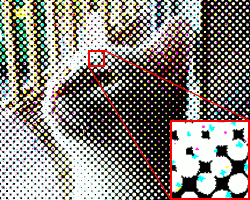
A major innovation was the development of halftone photography in the late 19th century. Halftone photography involves creating a reproduction of an original photograph by taking an image of it using a Photomechnical transfer camera (PMT), with a halftone screen as an intermediary tool to create gradation in the final reproduction. Halftone screens are a plate or film, made up of a continuous pattern of small dots, and when used in a photomechanical transfer camera, the halftone screen serves as an image filter. The invention of halftone photography was an important milestone, allowing photographs to be reproduced for mass publication in newspapers and magazines.
Analog photography is limited by the materials and equipment used by the photographer to capture gradation. These constraints are eliminated in digital photography, where software can be used to manipulate photograph images to create gradation.

References
References
- Martin, Judy. (1992). "The Encyclopedia of Pastel Techniques". Running Press.
- Martin, Judy. (1992). "The Encyclopedia of Pastel Techniques". Running Press.
- J. Waterhouse, Capt.. (2007). "The British Journal of Photography". Oxford University.
- (2010). "Way Beyond Monochrome 2e: Advanced Techniques for Traditional Black & White ...". Focal Press.
This article was imported from Wikipedia and is available under the Creative Commons Attribution-ShareAlike 4.0 License. Content has been adapted to SurfDoc format. Original contributors can be found on the article history page.
Ask Mako anything about Gradation (art) — get instant answers, deeper analysis, and related topics.
Research with MakoFree with your Surf account
Create a free account to save articles, ask Mako questions, and organize your research.
Sign up freeThis content may have been generated or modified by AI. CloudSurf Software LLC is not responsible for the accuracy, completeness, or reliability of AI-generated content. Always verify important information from primary sources.
Report