From Surf Wiki (app.surf) — the open knowledge base
Government of India
none
none
Prime Minister of India (Narendra Modi) (de facto)
The Government of India (hi, legally the Union Government or the Union of India or the Central Government) is the national authority of the Republic of India. The government is led by the president of India (currently ) who as head of state holds formal executive power, and thus (following parliamentary elections) appoints, as head of government, the prime minister, as well as other ministers. The government has been formed by The prime minister and ministers are members of parliament; they also belong to the Union Council of Ministers, the peak decision-making committee of which is the Indian cabinet.
The government's formal seat is at Parliament House in New Delhi. It has three primary branches: the legislature, the executive, and the judiciary. The Constitution of India vests legislative power in the bicameral Parliament of India, executive power (through the President) in the Union Council of Ministers, and judicial power in the Supreme Court of India, with the president as head of state. It is a derivation of the British Westminster system, and has a federal structure.
The Union Council of Ministers is responsible to the lower house of parliament, as is the Cabinet in accordance with the principles of responsible government. As is the case in most parliamentary systems, the government is dependent on Parliament to legislate, and general elections are held every five years to elect a new Lok Sabha. The most recent election was in 2024.
After an election, the president generally selects as Prime Minister the leader of the party or alliance most likely to command the confidence of the majority of the Lok Sabha. In the event that the prime minister is not a member of either house of parliament upon appointment, they are given six months to be elected or appointed to parliament.
History
British colonial rule: (1857–1947)
Main article: British Raj
The first seeds of elected responsible government were sown during British colonial rule in India in particular by the Indian Councils Act 1909, commonly known as the Morley-Minto reforms. The Act introduced elections to the Imperial Legislative Council (then the unicameral Legislature for British India). Before that, governance was carried by an all-European Legislative Council and Viceroy's Executive Council. As such, no Indians were represented in high levels of government before 1909.
India's current bicameral Parliament has its roots in the Government of India Act 1919, commonly known as the Montagu-Chelmsford reforms, which introduced a greatly expanded Imperial Legislative Council. It comprised a lower house, the Central Legislative Assembly, with 145 members (of which 104 were elected and 41 nominated); and an upper house, the Council of State, with 60 members (of which 34 were elected and 26 nominated).
The next structural modification to the governance of British India, the Government of India Act 1935 (the longest ever Act of Parliament of the United Kingdom until this record was surpassed by the Greater London Authority Act 1999) was aimed at subsidiarity and devolution of powers away from London: it sought to do this by establishing provincial governments and the creation of civil service institutions. However, it was unpopular amongst Indians and is considered a failure as it did not give Indians self-rule and permanent dominion status (the form of government followed in Canada, Australia and New Zealand) as was previously promised.
Dominion: (1947–1950)
Main article: Dominion of India
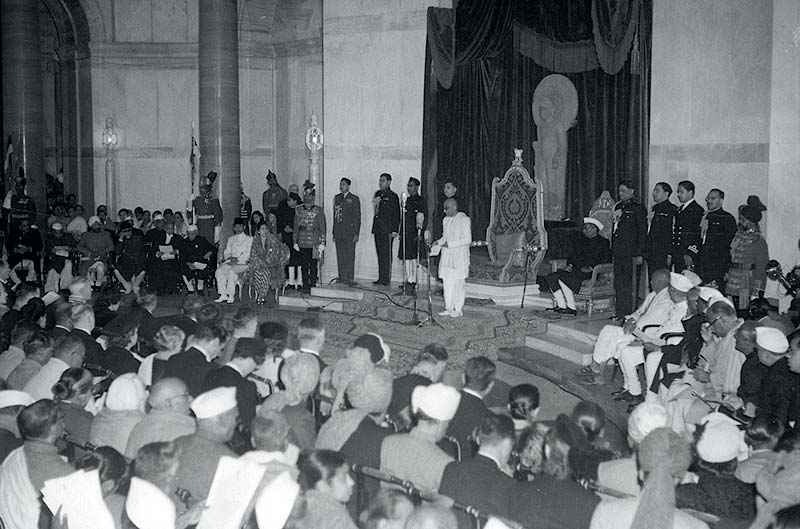
Between midnight on 15 August 1947 and 26 January 1950, India was an independent, self-governing dominion of the Commonwealth of Nations, a constitutional monarchy with a Prime Minister and a Governor-General as the viceregal representative of the head of state, George VI. Its unicameral legislature, the Constituent Assembly, was tasked with drafting the country's constitution.
Republic: (1950–present)
The Constitution of India came into effect on 26 January 1950, making India a republic with a president as head of state, replacing the monarch and his viceregal representative, the governor-general. It was based in large part on the Government of India Act 1935, which was itself based on the uncodified constitution of the United Kingdom. It also drew notable inspirations from the constitutions of several other Commonwealth dominions and the French, Soviet, Japanese, German and American constitutions.
India today prides itself in being the world's largest democracy, and the 4th largest economy in the world. Even though much remains to be done, especially in regard to eradicating poverty and securing effective structures of governance, India's achievements since independence in sustaining freedom and democracy have been singular among the world's new nations.
Nomenclature
The full name of the country is the Republic of India. India and Bharat are equally official short names for the Republic of India in the Constitution, and both names appears on legal banknotes, in treaties and in legal cases. The terms "Union government", "central government" and "hi" are often used officially and unofficially to refer to the government of India. The term New Delhi is commonly used as a metonym for the Union government, as the seat of the central government is in New Delhi.
Basic structure
The Government of India is modelled after the Westminster system. The Union government is mainly composed of the executive, the legislature, and the judiciary, and powers are vested by the constitution in the council of ministers, parliament, and the supreme court, respectively. The president of India is the head of state and the commander-in-chief of the Indian Armed Forces, while the elected prime minister acts as the head of the executive and is responsible for running the Union government. Parliament is bicameral in nature, with the Lok Sabha being the lower house, and the Rajya Sabha the upper house. The judiciary systematically contains an apex supreme court, 25 high courts, and hundreds of district courts, all subordinate to the supreme court.
The basic civil and criminal laws governing the citizens of India are set down in major parliamentary legislation, such as the civil procedure code, the penal code, and the criminal procedure code. Similar to the Union government, individual state governments each consist of executive, legislative and judiciary branches. The legal system as applicable to the Union and individual state governments is based on the English common law and Statutory Law.
Legislature
Main article: Parliament of India
The powers of the legislature in India are exercised by the Parliament, a bicameral legislature consisting of the Rajya Sabha and the Lok Sabha. Of the two houses of parliament, the Rajya Sabha (or the 'Council of States') is considered to be the upper house and consists of members appointed by the president and elected by the state and territorial legislatures. The Lok Sabha (or the 'House of the People') is considered the lower house.
The parliament does not have complete control and sovereignty, as its laws are subject to judicial review by the Supreme Court. However, it does exercise some control over the executive. The members of the Council of Ministers, including the prime minister, are either chosen from parliament or elected there within six months of assuming office. The council as a whole is responsible to the Lok Sabha. The Lok Sabha is a temporary house and can be dissolved only when the party in power loses the support of the majority of the house. The Rajya Sabha is a permanent house and can never be dissolved. The members of the Rajya Sabha are elected for a six-year term.
Executive
The executive of government has authority and responsibility to implement laws enacted by the legislature, and for the daily administration of the state through the civil service (the bureaucracy). The separation of various types of government power, its constraint and its sharing among the separate branches of government is central to the democratic idea of the separation of powers.
President
Main article: President of India
The executive power is vested mainly in the president of India, as per Article 53(1) of the constitution. The president has all constitutional powers and exercises them directly or through subordinate officers as per the aforesaid Article 53(1). The president is to act following aid and advice tendered by the prime minister, who leads the Council of Ministers as described in Article 74 of the Constitution.
The council of ministers remains in power during the 'pleasure' of the president. However, in practice, the council of ministers must retain the support of the Lok Sabha. If a president were to dismiss the council of ministers on her or his own initiative (ie, without advice to do so from the prime minister), it might trigger a constitutional crisis. Thus, in practice, the Council of Ministers cannot be dismissed as long as it holds the support of a majority in the Lok Sabha.
The president is formally responsible for appointing many high level government officials in India. These high officials include the governors of the 28 states; the chief justice of India; other judges of the supreme court and high courts (on the advice of other judges); the attorney general; the comptroller and auditor general; the chief election commissioner and other election commissioners; the chairperson and members of the Union Public Service Commission; the officers of the All India Services (IAS, IFoS and IPS) and Central Civil Services in group 'A'; officers of the Indian Armed Forces; and ambassadors and high commissioners to other countries; among many others. Such appointments are made 'on advice': that is, on the recommendation of ministers
The president, as the head of state, also receives the credentials of ambassadors from other countries, while the prime minister, as head of government, receives credentials of high commissioners from other members of the Commonwealth, in line with historical tradition.
The president is the de jure commander-in-chief of the Indian Armed Forces.
The president can pardon or reduce the sentence of a convicted person once, particularly in cases involving the punishment of death. Decisions involving pardons and certain other matters are made independently of the advice of the prime minister or the opinion of the Lok Sabha majority. In most other cases, however, the president exercises any executive power only on the advice of the prime minister.
Vice president
Main article: Vice President of India
The vice president is the second-highest constitutional position in India after the president. The vice president represents the nation in the absence of the president and takes charge as acting president in the case of resignation, impeachment or removal of the president. The vice president also has the legislative function of acting as the chairperson of the Rajya Sabha. The vice president is elected indirectly by members of an electoral college consisting of the members of both the houses of parliament.
Prime minister
Main article: Prime Minister of India
The prime minister of India, as addressed in the Constitution of India, is the chief executive of the government and the leader of the majority party that holds a majority in the Lok Sabha. The prime minister leads the executive of the Government of India.
The prime minister is the senior member of the cabinet in the executive government in a parliamentary system. The prime minister selects and can dismiss other members of the cabinet; allocates posts to members within the Government; is the presiding member and chairperson of the cabinet and is responsible for bringing a proposal of legislation. The resignation or death of the prime minister dissolves the cabinet.
The prime minister is appointed by the president to assist the latter in the administration of the affairs of the executive.
Cabinet, ministries and agencies
Main article: Union Council of Ministers, List of central agencies in India
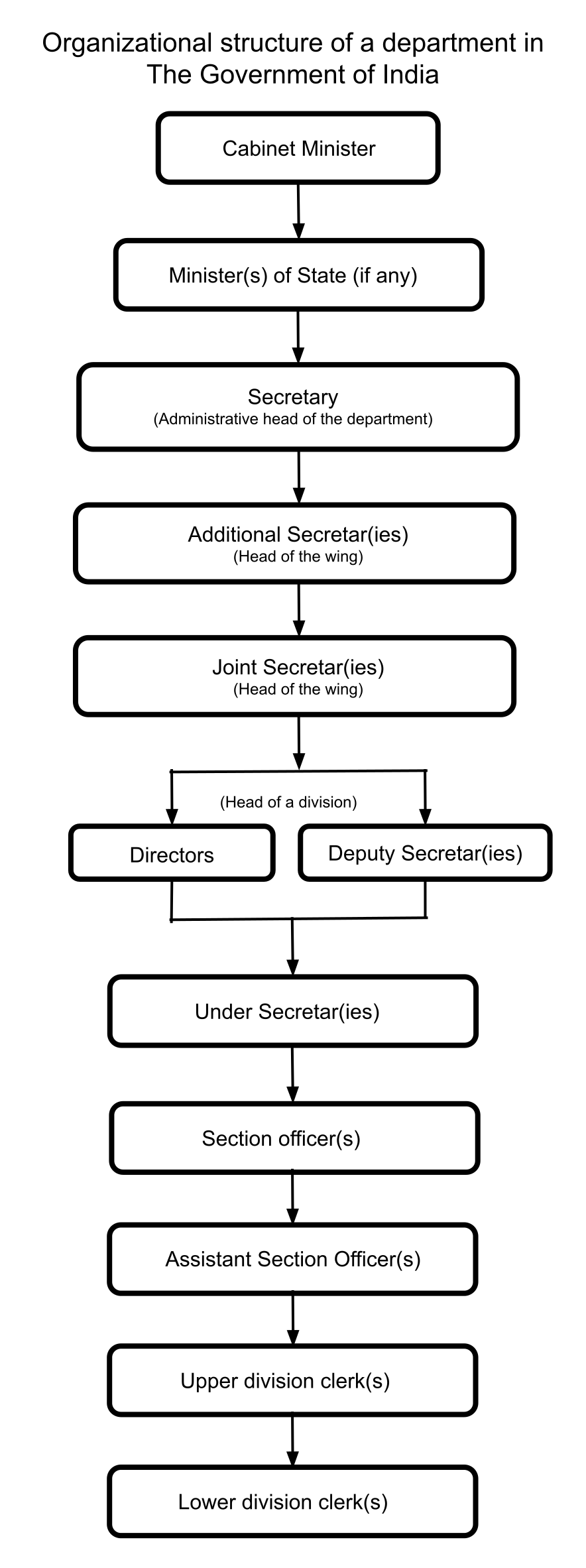
The Union Council of Ministers includes the prime minister, Cabinet Ministers and Ministers of State (MoS). Each minister must be a member of one of the houses of the parliament. The cabinet is headed by the prime minister, and is advised by the cabinet secretary, who also acts as the head of the Indian Administrative Service and other civil services. Other members of the council are either union cabinet ministers, who are heads of various ministries; or ministers of state, who are junior members who report directly to one of the cabinet ministers, often overseeing a specific aspect of government; or ministers of state (independent charges), who do not report to a cabinet minister. As per article 88 of the constitution, every minister shall have the right to speak in, and to take part in the proceedings of, either house, any joint sitting of the houses, and any committee of parliament of which he may be named a member, but shall not be entitled to a vote in the house where he is not a member.
Secretaries
Main article: Secretary to the Government of India
A secretary to the Government of India, a civil servant, generally an Indian Administrative Service (IAS) officer, is the administrative head of the ministry or department, and is the principal adviser to the minister on all matters of policy and administration within the ministry/department. Secretaries to the Government of India rank 23rd on Indian order of precedence. Secretaries at the higher level are assisted by one or many additional secretaries, who are further assisted by joint secretaries. At the middle they are assisted by directors/deputy secretaries and under secretaries. At the lower level, there are section officers, assistant section officers, upper division clerks, lower division clerks and other secretarial staff.
| # | Ministry | Department(s) | 1 | 2 | 3 | 4 | 5 | 6 | 7 | 8 | 9 | 10 | 11 | 12 | 13 | 14 | 15 | 16 | 17 | 18 | 19 | 20 | 21 | 22 | 23 | 24 | 25 | 26 | 27 | 28 | 29 | 30 | 31 | 32 | 33 | 34 | 35 | 36 | 37 | 38 | 39 | 40 | 41 | 42 | 43 | 44 | 45 | 46 | 47 | 48 | 49 | 50 | 51 | 52 | 53 | 54 |
|---|---|---|---|---|---|---|---|---|---|---|---|---|---|---|---|---|---|---|---|---|---|---|---|---|---|---|---|---|---|---|---|---|---|---|---|---|---|---|---|---|---|---|---|---|---|---|---|---|---|---|---|---|---|---|---|---|
| Prime Minister's Office | Department of Atomic Energy | |||||||||||||||||||||||||||||||||||||||||||||||||||||||
| Department of Space | ||||||||||||||||||||||||||||||||||||||||||||||||||||||||
| Ministry of Agriculture and Farmers Welfare | Department of Agriculture and Farmers Welfare | |||||||||||||||||||||||||||||||||||||||||||||||||||||||
| Department of Agricultural Research and Education | ||||||||||||||||||||||||||||||||||||||||||||||||||||||||
| Ministry of Ayush | ||||||||||||||||||||||||||||||||||||||||||||||||||||||||
| Ministry of Chemicals and Fertilizers | Department of Chemicals and Petrochemicals | |||||||||||||||||||||||||||||||||||||||||||||||||||||||
| Department of Fertilizers | ||||||||||||||||||||||||||||||||||||||||||||||||||||||||
| Department of Pharmaceuticals | ||||||||||||||||||||||||||||||||||||||||||||||||||||||||
| Ministry of Civil Aviation | ||||||||||||||||||||||||||||||||||||||||||||||||||||||||
| Ministry of Co-operation | ||||||||||||||||||||||||||||||||||||||||||||||||||||||||
| Ministry of Coal | ||||||||||||||||||||||||||||||||||||||||||||||||||||||||
| Ministry of Commerce and Industry | Department for Promotion of Industry and Internal Trade | |||||||||||||||||||||||||||||||||||||||||||||||||||||||
| Department of Commerce | ||||||||||||||||||||||||||||||||||||||||||||||||||||||||
| Ministry of Communications | Department of Posts | |||||||||||||||||||||||||||||||||||||||||||||||||||||||
| Department of Telecommunications | ||||||||||||||||||||||||||||||||||||||||||||||||||||||||
| Ministry of Consumer Affairs, Food and Public Distribution | Department of Consumer Affairs | |||||||||||||||||||||||||||||||||||||||||||||||||||||||
| Department of Food and Public Distribution | ||||||||||||||||||||||||||||||||||||||||||||||||||||||||
| Ministry of Corporate Affairs | ||||||||||||||||||||||||||||||||||||||||||||||||||||||||
| Ministry of Culture | ||||||||||||||||||||||||||||||||||||||||||||||||||||||||
| Ministry of Defence | Department of Defence | |||||||||||||||||||||||||||||||||||||||||||||||||||||||
| Department of Defence Production | ||||||||||||||||||||||||||||||||||||||||||||||||||||||||
| Department of Defence Research and Development | ||||||||||||||||||||||||||||||||||||||||||||||||||||||||
| Department of Ex-servicemen Welfare | ||||||||||||||||||||||||||||||||||||||||||||||||||||||||
| Department of Military Affairs | ||||||||||||||||||||||||||||||||||||||||||||||||||||||||
| Ministry of Development of North Eastern Region | ||||||||||||||||||||||||||||||||||||||||||||||||||||||||
| Ministry of Earth Sciences | ||||||||||||||||||||||||||||||||||||||||||||||||||||||||
| Ministry of Education | Department of Higher Education | |||||||||||||||||||||||||||||||||||||||||||||||||||||||
| Department of School Education and Literacy | ||||||||||||||||||||||||||||||||||||||||||||||||||||||||
| Ministry of Electronics and Information Technology | ||||||||||||||||||||||||||||||||||||||||||||||||||||||||
| Ministry of Environment, Forest and Climate Change | ||||||||||||||||||||||||||||||||||||||||||||||||||||||||
| Ministry of External Affairs | ||||||||||||||||||||||||||||||||||||||||||||||||||||||||
| Ministry of Finance | Department of Economic Affairs | |||||||||||||||||||||||||||||||||||||||||||||||||||||||
| Department of Expenditure | ||||||||||||||||||||||||||||||||||||||||||||||||||||||||
| Department of Financial Services | ||||||||||||||||||||||||||||||||||||||||||||||||||||||||
| Department of Investment and Public Asset Management | ||||||||||||||||||||||||||||||||||||||||||||||||||||||||
| Department of Public Enterprises | ||||||||||||||||||||||||||||||||||||||||||||||||||||||||
| Department of Revenue | ||||||||||||||||||||||||||||||||||||||||||||||||||||||||
| Ministry of Fisheries, Animal Husbandry and Dairying | Department of Animal Husbandry, Dairying & Fisheries | |||||||||||||||||||||||||||||||||||||||||||||||||||||||
| Ministry of Food Processing Industries | ||||||||||||||||||||||||||||||||||||||||||||||||||||||||
| Ministry of Health and Family Welfare | Department of Family Welfare | |||||||||||||||||||||||||||||||||||||||||||||||||||||||
| Department of Health | ||||||||||||||||||||||||||||||||||||||||||||||||||||||||
| Department of Health Research | ||||||||||||||||||||||||||||||||||||||||||||||||||||||||
| Ministry of Heavy Industries | ||||||||||||||||||||||||||||||||||||||||||||||||||||||||
| Ministry of Home Affairs | Department of Border Management | |||||||||||||||||||||||||||||||||||||||||||||||||||||||
| Department of Home | ||||||||||||||||||||||||||||||||||||||||||||||||||||||||
| Department of Internal Security | ||||||||||||||||||||||||||||||||||||||||||||||||||||||||
| Department of Jammu, Kashmir and Ladakh Affairs | ||||||||||||||||||||||||||||||||||||||||||||||||||||||||
| Department of Official Language | ||||||||||||||||||||||||||||||||||||||||||||||||||||||||
| Department of States | ||||||||||||||||||||||||||||||||||||||||||||||||||||||||
| Ministry of Housing and Urban Affairs | Central Public Works Department | |||||||||||||||||||||||||||||||||||||||||||||||||||||||
| Ministry of Information and Broadcasting | ||||||||||||||||||||||||||||||||||||||||||||||||||||||||
| Ministry of Jal Shakti | ||||||||||||||||||||||||||||||||||||||||||||||||||||||||
| Ministry of Labour and Employment | ||||||||||||||||||||||||||||||||||||||||||||||||||||||||
| Ministry of Law and Justice | Department of Legal Affairs | |||||||||||||||||||||||||||||||||||||||||||||||||||||||
| Department of Justice | ||||||||||||||||||||||||||||||||||||||||||||||||||||||||
| Legislative Department | ||||||||||||||||||||||||||||||||||||||||||||||||||||||||
| Ministry of Micro, Small and Medium Enterprises | ||||||||||||||||||||||||||||||||||||||||||||||||||||||||
| Ministry of Mines | ||||||||||||||||||||||||||||||||||||||||||||||||||||||||
| Ministry of Minority Affairs | ||||||||||||||||||||||||||||||||||||||||||||||||||||||||
| Ministry of New and Renewable Energy | ||||||||||||||||||||||||||||||||||||||||||||||||||||||||
| Ministry of Panchayati Raj | ||||||||||||||||||||||||||||||||||||||||||||||||||||||||
| Ministry of Parliamentary Affairs | ||||||||||||||||||||||||||||||||||||||||||||||||||||||||
| Ministry of Personnel, Public Grievances and Pensions | Department of Administrative Reforms & Public Grievances | |||||||||||||||||||||||||||||||||||||||||||||||||||||||
| Department of Pension and Pensioners' Welfare | ||||||||||||||||||||||||||||||||||||||||||||||||||||||||
| Department of Personnel and Training | ||||||||||||||||||||||||||||||||||||||||||||||||||||||||
| Ministry of Petroleum and Natural Gas | ||||||||||||||||||||||||||||||||||||||||||||||||||||||||
| Ministry of Planning | ||||||||||||||||||||||||||||||||||||||||||||||||||||||||
| Ministry of Ports, Shipping and Waterways | ||||||||||||||||||||||||||||||||||||||||||||||||||||||||
| Ministry of Power | ||||||||||||||||||||||||||||||||||||||||||||||||||||||||
| Ministry of Railways | ||||||||||||||||||||||||||||||||||||||||||||||||||||||||
| Ministry of Road Transport and Highways | ||||||||||||||||||||||||||||||||||||||||||||||||||||||||
| Ministry of Rural Development | Department of Land Resources | |||||||||||||||||||||||||||||||||||||||||||||||||||||||
| Department of Rural Development | ||||||||||||||||||||||||||||||||||||||||||||||||||||||||
| Ministry of Science and Technology | Department of Biotechnology | |||||||||||||||||||||||||||||||||||||||||||||||||||||||
| Department of Scientific and Industrial Research | ||||||||||||||||||||||||||||||||||||||||||||||||||||||||
| Department of Science and Technology | ||||||||||||||||||||||||||||||||||||||||||||||||||||||||
| Ministry of Skill Development and Entrepreneurship | ||||||||||||||||||||||||||||||||||||||||||||||||||||||||
| Ministry of Social Justice and Empowerment | Department of Empowerment of Persons with Disabilities | |||||||||||||||||||||||||||||||||||||||||||||||||||||||
| Department of Social Justice and Empowerment | ||||||||||||||||||||||||||||||||||||||||||||||||||||||||
| Ministry of Statistics and Programme Implementation | ||||||||||||||||||||||||||||||||||||||||||||||||||||||||
| Ministry of Steel | ||||||||||||||||||||||||||||||||||||||||||||||||||||||||
| Ministry of Textiles | ||||||||||||||||||||||||||||||||||||||||||||||||||||||||
| Ministry of Tourism | ||||||||||||||||||||||||||||||||||||||||||||||||||||||||
| Ministry of Tribal Affairs | ||||||||||||||||||||||||||||||||||||||||||||||||||||||||
| Ministry of Women and Child Development | ||||||||||||||||||||||||||||||||||||||||||||||||||||||||
| Ministry of Youth Affairs and Sports | Department of Youth Affairs | |||||||||||||||||||||||||||||||||||||||||||||||||||||||
| Department of Sports |
Civil services
Main article: Civil Services of India
The Civil Services of India are the civil services and the permanent bureaucracy of India. The executive decisions are implemented by the Indian civil servants.
In the parliamentary democracy of India, the ultimate responsibility for running the administration rests with the elected representatives of the people which are the ministers. These ministers are accountable to the legislatures which are also elected by the people based on universal adult suffrage. The ministers are indirectly responsible to the people themselves. But the handful of ministers is not expected to deal personally with the various problems of modern administration. Thus the ministers lay down the policy and it is for the civil servants to enforce it.
Cabinet secretary
Main article: Cabinet Secretary of India
The cabinet secretary (IAST: ) is the top-most executive official and senior-most civil servant of the Government of India. The cabinet secretary is the ex-officio head of the Civil Services Board, the Cabinet Secretariat, the Indian Administrative Service (IAS) and the head of all civil services under the rules of business of the government.
The cabinet secretary is generally the senior-most officer of the Indian Administrative Service. The cabinet secretary ranks 11th on the Indian order of precedence. The cabinet secretary is under the direct charge of the prime minister. Presently, the Cabinet Secretary of India is Rajiv Gauba, IAS.
Judiciary
Main article: Judiciary of India
India's independent union judicial system began under the British, and its concepts and procedures resemble those of Anglo-Saxon countries. The Supreme Court of India consists of the chief justice and 33 associate justices, all appointed by the president on the advice of the Chief Justice of India. The jury trials were abolished in India in the early 1960s, after the famous case KM Nanavati v. the State of Maharashtra, for reasons of being vulnerable to media and public pressure, as well as to being misled.
Unlike its United States counterpart, the Indian justice system consists of a unitary system at both state and union levels. The judiciary consists of the Supreme Court of India, high courts at the state level, and district courts and Sessions Courts at the district level.
Supreme Court
Main article: Supreme Court of India
The Supreme Court of India is situated in New Delhi, the capital region of India.
The Supreme Court is the highest judicial forum and final court of appeal under the Constitution of India, the highest constitutional court, with the power of constitutional review. Consisting of the Chief Justice of India and 33 sanctioned other judges, it has extensive powers in the form of original, appellate and advisory jurisdictions.
As the final court of appeal of the country, it takes up appeals primarily against verdicts of the high courts of various states of the Union and other courts and tribunals. It safeguards fundamental rights of citizens and settles disputes between various governments in the country. As an advisory court, it hears matters which may specifically be referred to it under the constitution by the president. It also may take cognisance of matters on its own (or 'suo moto'), without anyone drawing its attention to them. The law declared by the supreme court becomes binding on all courts within India and also by the union and state governments. Per Article 142, it is the duty of the president to enforce the decrees of the supreme court.
In addition, Article 32 of the constitution gives an extensive original jurisdiction to the supreme court concerning enforcing fundamental rights. It is empowered to issue directions, orders or writs, including writs in the nature of habeas corpus, mandamus, prohibition, quo warranto and certiorari to enforce them. The supreme court has been conferred with power to direct the transfer of any civil or criminal case from one state high court to another state high court, or from a Court subordinate to another state high court and the supreme court. Although the proceedings in the supreme court arise out of the judgment or orders made by the subordinate courts, of late the supreme court has started entertaining matters in which the interest of the public at large is involved. This may be done by any individual or group of persons either by filing a writ petition at the filing counter of the court or by addressing a letter to the Chief Justice of India, highlighting the question of public importance for redress. These are known as public interest litigations.
Elections and voting
Main article: Elections in India, Politics of India
India has a quasi-federal form of government, called "union" or "central" government, with elected officials at the union, state and local levels. At the national level, the head of government, the prime minister, is appointed by the president of India from the party or coalition that has the majority of seats in the Lok Sabha. The members of the Lok Sabha are directly elected for a term of five years by universal adult suffrage through a first-past-the-post voting system. Members of the Rajya Sabha, which represents the states, are elected by the members of State legislative assemblies by proportional representation, except for 12 members who are nominated by the president.
The Election Commission of India conducts national and state elections, while State Election Commissions conduct local government elections.
India is currently the largest democracy in the world, with around 900 million eligible voters, as of 2019.
State and local governments
Main article: State governments of India, Union territory, Local government in India
In India, power is divided between the governments of the union and the states of India, the latter being ruled by the chiefs ministers. The state legislature is bicameral in six states and unicameral in the rest. The lower house is elected with a five-year term, while in the upper house one-third of the members in the house gets elected every two years with six-year terms.
Union territories are administered directly by the union government through an Administrator or Lieutenant Governor, though some have legislatures and elected governments with limited powers.
Local governments function at the basic level. It is the third level of government apart from union and state governments. It consists of panchayats in rural areas and municipalities in urban areas. They are elected directly or indirectly by the people.
Local governments, comprising Panchayati Raj Institutions in rural areas and Urban Local Bodies in urban areas, function under the 73rd and 74th Constitutional Amendments to promote democratic decentralization. Each state also enacts its own legislation to regulate the structure and functioning of local governments.
Finance
Taxation
Main article: Taxation in India
India has a three-tier tax structure, wherein the constitution empowers the union government to levy income tax, tax on capital transactions (wealth tax, inheritance tax), sales tax, service tax, customs and excise duties and the state governments to levy sales tax on intrastate sale of goods, taxon entertainment and professions, excise duties on manufacture of alcohol, stamp duties on transfer of property and collect land revenue (levy on land owned). The local governments are empowered by the state government to levy property tax and charge users for public utilities like water supply, sewage etc. More than half of the revenues of the union and state governments come from taxes, of which 3/4 come from direct taxes. More than a quarter of the union government's tax revenues are shared with the state governments.
The tax reforms, initiated in 1991, have sought to rationalise the tax structure and increase compliance by taking steps in the following directions:
- Reducing the rates of individual and corporate income taxes, excises, and customs and making it more progressive
- Reducing exemptions and concessions
- Simplification of laws and procedures
- Introduction of permanent account number (PAN) to track monetary transactions
- 21 of the 29 states introduced value added tax (VAT) on 1 April 2005 to replace the complex and multiple sales tax system
The non-tax revenues of the central government come from fiscal services, interest receipts, public sector dividends, etc., while the non-tax revenues of the States are grants from the central government, interest receipts, dividends and income from general, economic and social services.
Inter-state share in the union tax pool is decided by the recommendations of the Finance Commission to the president.
Total tax receipts of Centre and State amount to approximately 18% of national GDP. This compares to a figure of 37–45% in the OECD.
Union budget
Main article: Union budget of India
The Finance minister of India usually presents the annual union budget in the parliament on the last working day of February. However, for the F.Y. 2017–18, this tradition had been changed. Now the budget will be presented on the 1st day of February. The budget has to be passed by the Lok Sabha before it can come into effect on 1 April, the start of India's fiscal year. The Union budget is preceded by an economic survey which outlines the broad direction of the budget and the economic performance of the country for the outgoing financial year
India's non-development revenue expenditure had increased nearly five-fold in 2003–04 since 1990–91 and more than tenfold from 1985 to 1986. Interest payments are the single largest item of expenditure and accounted for more than 40% of the total non-development expenditure in the 2003–04 budget. Defence expenditure increased fourfold during the same period and has been increasing to defend from a difficult neighbourhood and external terror threats. In 2025–26, India's defence budget stood at .
Issues
Corruption
Main article: Corruption in India
In 2009, several ministers are accused of corruption and nearly a quarter of the 543 elected members of parliament had been charged with crimes, including murder. Many of the biggest scandals since 2010 have involved high-level government officials, including cabinet ministers and chief ministers, such as the 2010 Commonwealth Games scandal (), the Adarsh Housing Society scandal, the Coal allocation scandal (), the mining scandal in Karnataka and the cash-for-votes scandal.
References
References
- Article 75(3) of [[Constitution of India]]
- "Constitution of India » 300. Suits and proceedings.".
- Article 53 & 75 of [[Constitution of India]].
- Sharma, B. K.. (1 August 2007). "Introduction to the Constitution of India". [[Prentice Hall]].
- Gledhill, Alan. (1970). "The Republic of India: The Development of its Laws and Constitution". [[Greenwood Publishing Group.
- Sharma, Ram. (1 January 1950). "Cabinet Government in India". [[Parliamentary Affairs]].
- Burt, Neuborne. (2003). "The Supreme Court of India". International Journal of Constitutional Law.
- Kumarasingham, Harshan. (2013). "A Political Legacy of the British Empire: Power and the Parliamentary System in Post-Colonial India and Sri Lanka". I.B.Tauris & Co Ltd.
- Article 75(3) of Constitution of India.
- "Indian Councils Act, 1909 Archives".
- "Government of India Act, 1935 Archives".
- (2 August 1935). "Government of India Act, 1935".
- (18 July 1947). "Indian Independence Act, 1947".
- (26 November 2019). "Constitution Day: Borrowed features in the Indian Constitution from other countries".
- Metcalf & Metcalf. (24 September 2012). "A Concise History of Modern India". [[Cambridge University Press]].
- Buckley, A. M.. (2012). "India". ABDO Publishing Company.
- Das, Nairita. (14 June 2012). "Why Raisina Hills, is so important for Indian Politicians?". [[One India]].
- Subramanian, K.. (17 June 2014). "A prime ministerial form of government". [[The Hindu]].
- (8 January 2018). "Government of India, Structure of Government India".
- "Constitution of India's definition of India".
- "Legal services India on Criminal laws in India". Legal Services India.
- Dheeraj Kumar Tiwari. "Structure of Indian Legal System: Original Origin and Development". International Journal of Law and Legal Jurisprudence Studies.
- (29 June 2016). "Cultural Perspectives on Youth Justice: Connecting Theory, Policy and International Practise". Springer.
- "Parliament's actions subject to judicial review: court". The Hindu.
- "Indian Constitution And Parliamentary Government {{!}} Law Teacher".
- Laxmikanth. "Governance in India". Tata McGraw-Hill Education.
- "Our Parliament".
- (29 June 2016). "Cultural Perspectives on Youth Justice: Connecting Theory, Policy and International Practice". Springer.
- Pratiyogita Darpan. (March 2007). "Pratiyogita Darpan". Pratiyogita Darpan.
- Bakshi, Parvinrai Mulwantrai. (2010). "The Constitution of India". Universal Law Pub. Co.
- Oldenburg, Philip. (2010). "India, Pakistan, and Democracy: Solving the Puzzle of Divergent Paths". Taylor & Francis.
- link. (7 January 2016 Pg no. 72.)
- "Important India functions of vicepresident".
- [http://pmindia.gov.in/details9.php Cabinet Ministers (as on 26 May 2014)]. Cabsec.nic.in. Retrieved 6 December 2013. {{webarchive. link. (27 May 2014)
- Tikku, Aloke. (15 January 2016). "Parity between IAS and non-IAS? The IAS will get to decide". [[Hindustan Times]].
- (18 January 2016). "Non-IAS bureaucrats now eligible for secretary-level posts". [[The Asian Age]].
- (30 June 2016). "Need Pay Parity With IAS Officers, Say Officials of 20 Civil Services". [[NDTV]].
- Dastidar, Avishek G. (14 January 2017). "Alleging bias, non-IAS officers petition PM Modi". [[The Indian Express]].
- Laxmikanth, M.. (2014). "Governance in India". McGraw Hill Education.
- "Central Secretariat Manual of Office Procedure – 14th Edition (2015)". [[Ministry of Personnel, Public Grievances and Pensions (India).
- (26 July 1979). "Order of Precedence". President's Secretariat.
- (26 July 1979). "Table of Precedence". President's Secretariat.
- "Table of Precedence". President's Secretariat.
- Maheshwari, S.R.. (2000). "Indian Administration". Orient Blackswan Private Ltd..
- "Rule of law index 2016".
- "History of Supreme Court of India". Supreme Court of India.
- "PIL".
- "The Constitution of India".
- (10 March 2019). "Indian voter population is 900 million".
- (1947). "Division of Powers in the Indian Constitution". The Indian Journal of Political Science.
- (1980). "Local Government and Development in India". International Political Science Review.
- (1975). "The Passing of Bicameralism". The American Journal of Comparative Law.
- "73rd Amendment of Panchayati Raj in India {{!}} Election Commission for UTs {{!}} India".
- "74th Amendment and Municipalities in India {{!}} Election Commission for UTs {{!}} India".
- (2005). "Tax System And Tax Reforms in India". Polis Working Papers.
- (2005). "Indian Economy". S.Chand.
- (25 March 2005). "Indif_real_GDP_per_capitaa says 21 of 29 states to launch new tax". Daily Times.
- "Indian Economy".
- "Union Budget 2017–18".
- [https://www.washingtonpost.com/wp-dyn/content/article/2009/05/13/AR2009051303758.html When the Little Ones Run the Show (quote from the New Delhi based Association for Democratic Reform)] {{Webarchive. link. (15 December 2018 . ''[[The Washington Post]]''. Retrieved 14 May 2009.)
This article was imported from Wikipedia and is available under the Creative Commons Attribution-ShareAlike 4.0 License. Content has been adapted to SurfDoc format. Original contributors can be found on the article history page.
Ask Mako anything about Government of India — get instant answers, deeper analysis, and related topics.
Research with MakoFree with your Surf account
Create a free account to save articles, ask Mako questions, and organize your research.
Sign up freeThis content may have been generated or modified by AI. CloudSurf Software LLC is not responsible for the accuracy, completeness, or reliability of AI-generated content. Always verify important information from primary sources.
Report