From Surf Wiki (app.surf) — the open knowledge base
Government of Colombia
none
none
| Field | Value | ||||||
|---|---|---|---|---|---|---|---|
| government_name | Government of Colombia | ||||||
| image | Logo_gobierno_de_Colombia_(2022-2026).png | ||||||
| caption | Logo since 2022 | ||||||
| country | Colombia Colombia | ||||||
| branch1 | Executive | ||||||
| branch1_label1 | Head of state | ||||||
| branch1_data1 | President of Colombia | ||||||
| (Gustavo Petro) | |||||||
| branch2 | Legislative | ||||||
| legislature | Congress of Colombia | ||||||
| branch4 | Judicial | ||||||
| court | {{Bulleted list | ||||||
| url | |||||||
| main_body | branch1_label2=Vice head of state | branch1_data2=Vice President of Colombia | |||||
| (Francia Márquez) | nativename= | government_form= | document_type=Constitution | document=Colombian Constitution of 1991 | branch1_label3=Cabinet | branch1_data3=Council of Ministers of Colombia | meeting_place=National Capitol of Colombia |
(Gustavo Petro)
| Senate of Colombia | Chamber of Representatives of Colombia | Supreme Court of Justice of Colombia | Council of State (Colombia) | Constitutional Court of Colombia | Superior Council of Judicature (Francia Márquez)|nativename=|government_form=|document_type=Constitution|document=Colombian Constitution of 1991|branch1_label3=Cabinet|branch1_data3=Council of Ministers of Colombia|meeting_place=National Capitol of Colombia}}
The Government of Colombia is a unitary presidential republic with separation of powers into an executive, judicial, and legislative branch. The executive is led by the president, who acts as both the head of state and government, the judiciary includes four high courts which manage different fields of the law, and the national legislature is a bicameral congress composed of the senate and chamber of representatives.
The country is principally divided into 32 departments and one capital district.
Colombia has "control institutions" that mix government and public officials, who work alongside one another. For example, the public's inspector general works closely with the government's controller general, whose job it is to ensure governmental fiscal responsibility. An independent Ombudsman deals with maladministration complaints and functions.--
Executive ==<!--PRE-REWRITE EXECUTIVE SECTION (unsourced):
The executive branch of power in Colombia is headed by the President of the Republic. He is supported by the Vice President of Colombia, the Council of Ministers and Government entities of Colombia| Administrative Departments of Colombia. The government is in charge of creating and developing policies concerning Colombia, while the governors of the Departments of Colombia are elected by popular vote to represent the president and the executive branch of government. Mayors are subordinated to the governors, who are the maximum representatives of the executive branch of government at a municipal level. Mayors are also elected in regional elections, along with the department governors.--
President
Main article: President of Colombia
The president of Colombia is elected by a direct popular vote, with elections held every four years. They are the head of state and government, as well as the commander-in-chief and supreme administrative authority. In 2015, congress limited the presidency to a single four-year term, preventing the president from seeking re-election.
For 150 years, excluding military dictatorships in the 1950s, the president came from either the Liberal Party or Conservative Party, with the country being a two-party system. But, every president following the 2002 election has come from a third party.[[File:Casa-narino-1-fachada.jpg|thumb|[[Casa de Nariño]], the presidential palace in [[Bogotá]], houses the [[President of Colombia]]|left]]
Vice President
Main article: Vice President of Colombia
The Vice President is the second-highest executive office in Colombia. They are elected directly through appearing on a ticket with a presidential candidate. The office was reestablished by the constitution of 1991 after being abolished in 1905.
Council of Ministers
Main article: Council of Ministers of Colombia}}The [Council of Ministers of Colombia, [Council of Ministers]] is the national [Cabinet (government), [government cabinet]] of Colombia, it is composed of the most senior appointed politicians of the executive branch. In addition to the president and vice president, members are the heads of [Ministry (government department), [ministries]] and administrative departments. Its composition has changed throughout history, but the council currently includes 19 ministers{{Cite web
Legislature
Main article: Legislative Branch of Colombia, Congress of Colombia, Elections in Colombia
The legislative branch of Colombia's national government is the bicameral Congress, composed of the Senate and Chamber of Representatives. Its primary duties are lawmaking and legislative regulation, this includes drafting, enacting, interpreting, amending, and repealing laws.
Senate
Chamber of Representatives
Main article: [Colombians abroad]].{{Cite web](colombians-abroad-ref-cite-web)
Judiciary
Main article: Judiciary of Colombia
The judiciary comprises a hierarchical system of courts presided over by judges, magistrates and other adjudicators.
Colombia is a centralized state, thus there is only one jurisdiction (with the exception of special indigenous jurisdictions), which is functionally divided by subject matter into an ordinary, penal, administrative, disciplinary, constitutional and special jurisdictions (military, peace, and indigenous matters).
The judiciary of Colombia interprets and applies the laws of the country to ensure equal justice under law and to provide a mechanism for dispute resolution. The judicial branch of Colombia's national government is composed of four high courts: the Supreme Court of Justice which takes on matters of criminal law, the Council of State which handles administrative law, the Constitutional Court dealing with constitutional law, and the Superior Council of Judicature which manages jurisdictional conflicts and judicial administration. Colombia’s legal system follows civil law.
Supreme Court of Justice of Colombia
Main article: Supreme Court of Justice of Colombia
The Supreme Court of Justice of Colombia handles criminal law, composed of 23 judges appointed to non-renewable 8 year terms by congress from a list of candidates. Justices must be a lawyer who has served a minimum of 10 years in the judiciary, the public ministry, or at an established educational institution and be a natural-born Colombian citizen. The court was created in 1886 and is led by the President of the Supreme Court of Justice. Below the Supreme Court are Judicial District Superior Tribunals and below them, district courts. Prior to the 1991 constitution, it was the highest legal, civil, criminal and constitutional court in Colombia.
Council of State
Main article: Council of State (Colombia)
The Council of State handles administrative law. It was established in 1817 by the first president of Colombia Simón Bolívar.
Constitutional Court
Main article: Constitutional Court of Colombia
The Constitutional Court handles constitutional law and international treaties. It was established by the constitution of 1991, which reorganized the country's high courts.
Superior Council of Judicature
Main article: Superior Council of Judicature
The Superior Council of Judicature handles jurisdictional conflicts and judicial administration; it is headed by a president. The council is composed of two chambers: the administrative chamber and the disciplinary jurisdictional chamber, made up of 6 and 7 judges respectively. It is also the job of the superior council to submit lists of potential justices for the Supreme Court of Justice.
Special jurisdictions
Military tribunals handle infractions by police and active military personnel according to the Military Penal Code. The National Electoral Council is a legal body which has final say on electoral issues. Due to the ongoing Colombian conflict, special legal jurisdictions (the Special Jurisdiction for Peace and Judicial Chambers for Justice and Peace) have been created to try individuals for crimes committed during the conflict.
Subdivisions
Colombia is principally divided into 32 departments and one capital district. There are four other cities (Cartagena, Barranquilla, Santa Marta, and Buenaventura) which also have district status due to their national importance but remain within a department.
Departments
Main article: Departments of Colombia
Each department has a governor and department assembly and are granted limited autonomy. Departments are primarily composed of municipalities, of which there are 1123 in Colombia, each with a mayor and municipal council. Each department has its own department capital.
The most recent changes to departments were made in the 1991 constitution, which created the modern departments of Amazonas, Arauca, Casanare, Guainía, Guaviare, Putumayo, San Andrés y Providencia, Vapués, and Vichada that were previously a part of the "National Territory".
Capital District
The capital city of Bogotá has the same administrative status as a department. It is governed by the Superior Mayor of Bogotá and Bogotá City Council. The council is the supreme authority of the district, autonomous in administrative, budgetary and financial matters. While Bogotá is outside of Cundinamarca Department, it is the department's official capital.
Indigenous territories
Main article: Indigenous territory (Colombia)
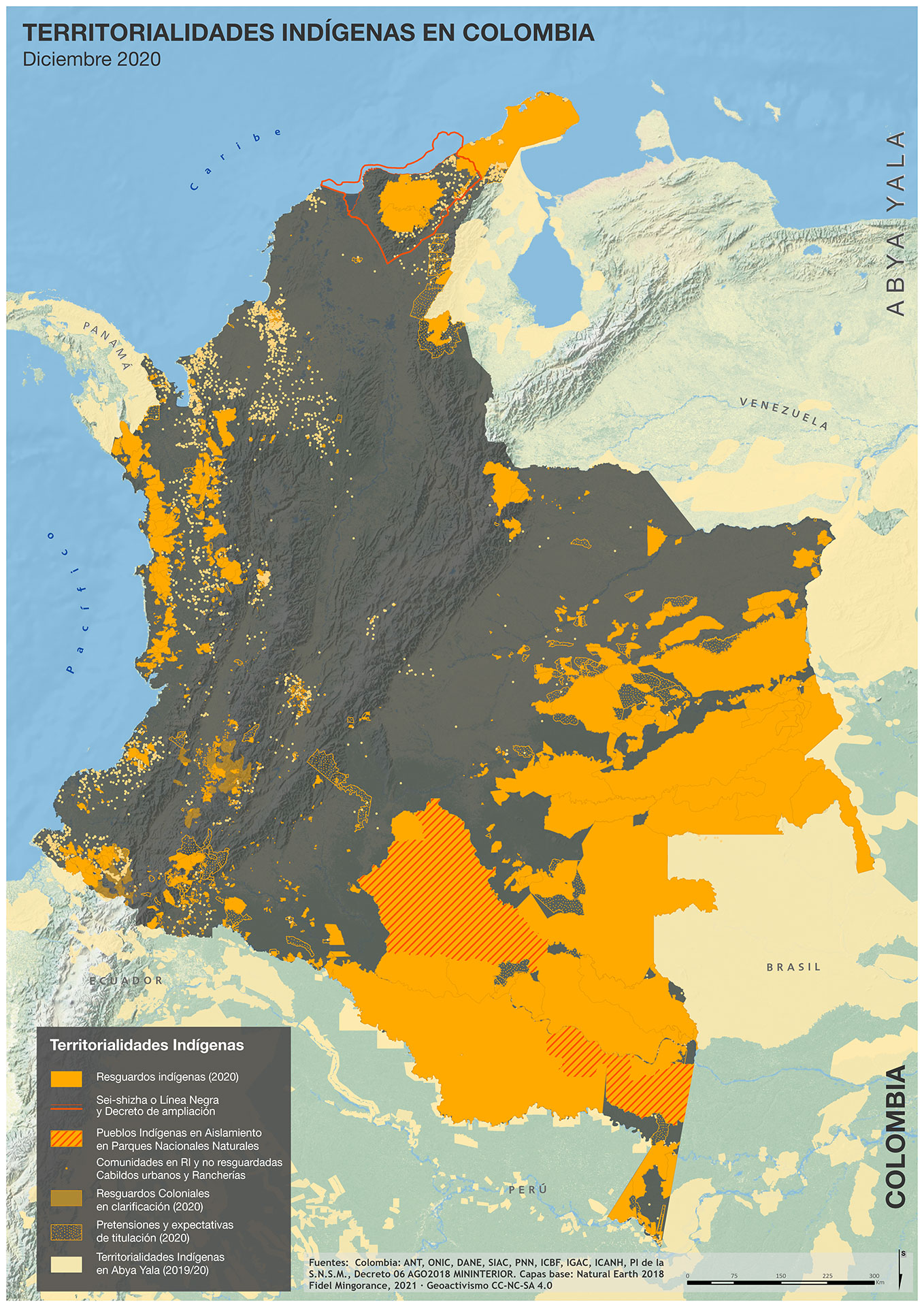
Indigenous territories or indigenous reserves in Colombia are the "constitutional form through which the state recognizes and formalizes the collective ownership of [indigenous] peoples’ ancestral territories"; there are 846 territories recognized by law. The territories total 35,608,579.2 hectares or 31% of the nation as of 2023 according to the National Land Agency.
According to the 2018 census, 64% of the 1.9 million indigenous people of Colombia lived within these territories.
The National Indigenous Territories Commission (CNTI) was created in 1996 through Decree 1397 to ensure full territorial rights to the indigenous people. It is composed of 10 delegates representing indigenous organizations within the territories who consult with and relay issues to the national government.
Elections and voting
Main article: Elections in Colombia
Constitution
Main article: Colombian Constitution of 1991
Foreign relations
Main article: Foreign relations of Colombia
Issues
Corruption
Main article: Corruption in Colombia
Trust
In 2022, 21% of Colombians reported their trust in the national government being high or moderately high, 22% reported high or moderately high trust in their local government, and 20% in civil service.
Climate change
Colombia's government has been recognised as taking a determined approach to reducing its dependence on fossil fuels and contributing to a reversal in global climate change trends.
History
Pre-Columbian era
New Kingdom of Granada
Viceroyalty of New Granada
United Provinces of New Granada
Gran Colombia
Republic of New Granada
Granadine Confederation
United States of Colombia
Republic of Colombia
Budget ==-->
References
References
- Fuentes, Juan-Andrés. "Research Guides: Colombian Legal Research: Basic Legal Structure".
- (4 June 2015). "Colombian lawmakers approve a one-term limit for presidents". EL PAÍS English Edition.
- "Colombia in Detail".
- Villanueva, Juliana. "¿Cuáles son las funciones del vicepresidente? {{!}} Elecciones Colombia".
- "Ley 1444 de 2011 Congreso de la República de Colombia".
- (2022-08-18). "¿Quiénes son los ministros del Gobierno de Gustavo Petro? Este es su gabinete". [[CNN]].
- "Colombia: Government". [[Michigan State University]].
- "Historia".
- "¿Será que en el Congreso 2026 por fin ocuparán la curul raizal en Cámara?".
- (April 2007). "Country Fact Sheet: COLOMBIA".
- "Colombia 1991 (rev. 2013)".
- "Historia".
- [http://www.consejodeestado.gov.co/linea_tiempo.html#/step-3 ''Linea de Tiempo'' (timeline)] {{Webarchive. link. (2016-03-29, Council of State website)
- Roa Roa, Jorge Ernesto. (July 2015). "La independencia de la Corte Constitucional de Colombia y la Acción Pública de Constitucionalidad". Department of Constitutional Law, [[Universidad Externado de Colombia]].
- Nagle, Luz Estella. "Evolution of the Colombian Judiciary and the Constitutional Court". Notre Dame Journal of International & Comparative Law.
- "Wayback Machine".
- Procolombia. (2024-10-15). "Territorial divisions colombia {{!}} Colombia Country Brand".
- "Information about departments of Colombia".
- Barragán, Eliana Paola. "Territorios Nacionales: imágenes, representaciones o ideas".
- "Organización del Distrito Capital". bogota.gov.co.
- "The Indigenous World 2024: Colombia".
- "Partner - Forest Peoples Programme".
- (2023-06-29). "Government at a Glance 2023: Colombia".
- Seabrook, V., [https://news.sky.com/story/the-major-coal-producing-country-that-wants-to-leave-its-fossil-fuels-in-the-ground-13254177 The major coal producing country that wants to leave its fossil fuels in the ground], ''[[Sky News]]'', published on 20 November 2024, accessed on 23 November 2025
This article was imported from Wikipedia and is available under the Creative Commons Attribution-ShareAlike 4.0 License. Content has been adapted to SurfDoc format. Original contributors can be found on the article history page.
Ask Mako anything about Government of Colombia — get instant answers, deeper analysis, and related topics.
Research with MakoFree with your Surf account
Create a free account to save articles, ask Mako questions, and organize your research.
Sign up freeThis content may have been generated or modified by AI. CloudSurf Software LLC is not responsible for the accuracy, completeness, or reliability of AI-generated content. Always verify important information from primary sources.
Report