From Surf Wiki (app.surf) — the open knowledge base
GOES 6
NOAA weather satellite
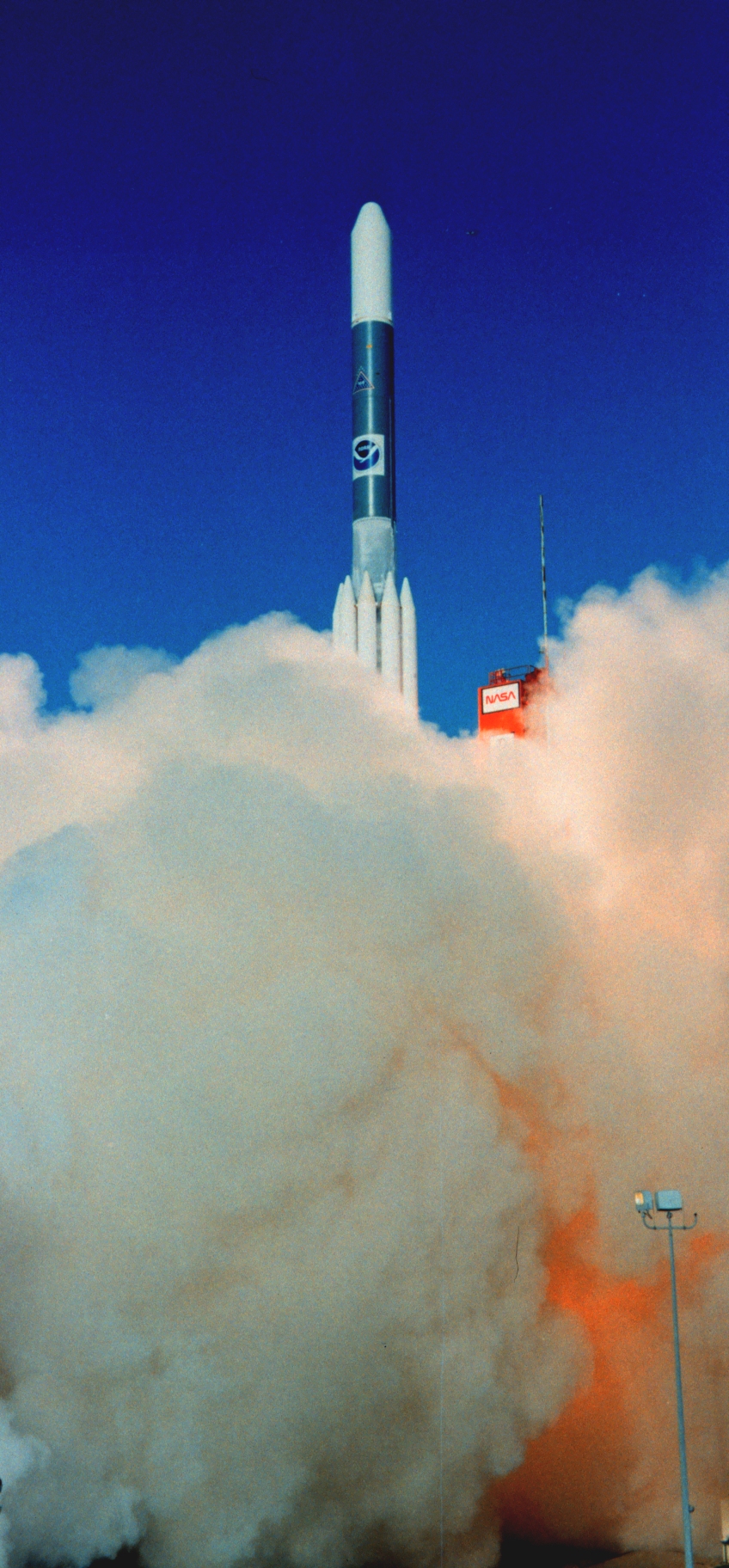
NOAA weather satellite
| Field | Value |
|---|---|
| name | GOES-6 |
| image | GOES 4-5-6-7 illustration.jpg |
| image_caption | Artist's impression of an HS-371 derived GOES satellite |
| mission_type | Weather satellite |
| operator | NOAANASA |
| COSPAR_ID | 1983-041A |
| SATCAT | 14050 |
| mission_duration | 7 years (planned) |
| 6 years (VISSR) | |
| 9 years (achieved) | |
| spacecraft_bus | HS-371 |
| manufacturer | Hughes |
| launch_mass | 660 kg |
| launch_date | UTC |
| launch_rocket | Delta 3914 |
| launch_site | Cape Canaveral LC-17A |
| launch_contractor | McDonnell Douglas |
| disposal_type | Decommissioned |
| deactivated | |
| orbit_reference | Geocentric |
| orbit_regime | Geostationary |
| orbit_semimajor | 42,151.0 km |
| orbit_periapsis | 35,759.4 km |
| orbit_apoapsis | 35,800.9 km |
| orbit_inclination | 14.7° |
| orbit_period | 1,435.1 minutes |
| orbit_longitude | 135° West (1983-1984) |
| 97° West (1984) | |
| 108° West (1984-1987) | |
| 135° West (1987-1992) | |
| orbit_slot | GOES-WEST (1983-1984, 1987-1992) |
| apsis | gee |
6 years (VISSR) 9 years (achieved)
97° West (1984) 108° West (1984-1987) 135° West (1987-1992)
GOES-6, known as GOES-F before becoming operational, was a geostationary weather satellite which was operated by the United States National Oceanic and Atmospheric Administration as part of the Geostationary Operational Environmental Satellite system. Launched in 1983, it was used for weather forecasting in the United States.
GOES-6 was built by Hughes Space and Communications, and was based on the HS-371 satellite bus. At launch it had a mass of 660 kg, with an expected operational lifespan of around seven years.
Launch
GOES-F was launched using a Delta 3914 carrier rocket flying from Launch Complex 17A at the Cape Canaveral Air Force Station. The launch occurred at 22:26 GMT on 28 April 1983.
Orbit
The launch successfully placed GOES-F into a geosynchronous transfer orbit, from which it raised itself to geostationary orbit by means of an onboard Star 27 apogee motor, with insertion occurring on 9 May 1983.
Following insertion into geosynchronous orbit, GOES-6 was positioned at 135° West. In 1984 it was moved, initially to 97° West, and later to 108° West to cover for the failure of the Visible Infrared Spin-Scan Radiometer on GOES-5. After GOES-7 replaced GOES-5 in 1987, GOES-6 was returned to 135° West, where it remained for the rest of its operational life. Its imager had failed on 21 January 1989, leaving GOES-7 as the only operational GOES satellite for over five years, until the launch of GOES-8 in 1994. Following this failure, it remained operational as a relay satellite until it was retired to a graveyard orbit on 19 May 1992.
References
References
- "GOES-6". NASA.
- "GOES-6". US National Space Science Data Center.
- Krebs, Gunter. "GOES 4, 5, 6, G, 7". Gunter's Space Page.
- Wade, Mark. "GOES". Encyclopedia Astronautica.
- McDowell, Jonathan. "Launch Log". Jonathan's Space Page.
- McDowell, Jonathan. "Index". Jonathan's Space Page.
This article was imported from Wikipedia and is available under the Creative Commons Attribution-ShareAlike 4.0 License. Content has been adapted to SurfDoc format. Original contributors can be found on the article history page.
Ask Mako anything about GOES 6 — get instant answers, deeper analysis, and related topics.
Research with MakoFree with your Surf account
Create a free account to save articles, ask Mako questions, and organize your research.
Sign up freeThis content may have been generated or modified by AI. CloudSurf Software LLC is not responsible for the accuracy, completeness, or reliability of AI-generated content. Always verify important information from primary sources.
Report