From Surf Wiki (app.surf) — the open knowledge base
Goans
People native to Goa, India
People native to Goa, India
| Field | Value | |||
|---|---|---|---|---|
| group | Goans | |||
| region1 | India | |||
| region2 | →Goa (2001) | |||
| region3 | Goa | |||
| Maharashtra | ||||
| United Kingdom | ||||
| Portugal | ||||
| Rest of India | ||||
| Rest of the world | ||||
| pop3 | 650,000 (2017) | |||
| 150,000 | ||||
| 149,000 | ||||
| 100,000 | ||||
| 200,000 | ||||
| 600,000 (2000) | ||||
| langs | **Primary:** | |||
| Goan Konkani | ||||
| **Additional:** | ||||
| Marathi (incl. Bombay Mahratti), Hindi–Urdu, Portuguese & English | ||||
| rels | **Global Predominance**: | |||
| [[File:Christian cross.svg | 12px]] Christianity | |||
| **Global Minority:** | ||||
| [[File:Om.svg | 15px]] Hinduism, [[File:Star and Crescent.svg | 15px]] Islam and others | ||
| related | Other Konkani people: | |||
| Bombayites, Bombay East Indians, Basseinites, Mangaloreans Norteiro people & Luso-Indians | ||||
| native_name | gom, | |||
| native_name_lang | knn | |||
| image | {{image array | perrow=4 | width=70 | height=60 |
| image1 | Dr_Jaime_Portrait.jpg | |||
| caption1 | Jaime Valfredo Rangel | |||
| image2 | Leena Dias (née Fernandes).jpg | |||
| caption2 | Leena Fernandes | |||
| image3 | JC Lisboa.jpg | |||
| caption3 | José Lisboa | |||
| image4 | Angela Trindade.jpg | |||
| caption4 | Angela Trindade | |||
| image5 | Frederika Menezes, author from Goa, India.jpg | |||
| caption5 | Frederika Menezes | |||
| image6 | António Fortunato de Figueiredo.jpg | |||
| caption6 | António Figueiredo | |||
| image7 | Vimala Devi Portrait.jpg | |||
| caption7 | Vimala Devi | |||
| image8 | Narana Coissoró.jpg | |||
| caption8 | Narana Coissoró | |||
| image9 | Retrato de António Maria de Bettencourt Rodrigues - Columbano Bordalo Pinheiro.png | |||
| caption9 | António Rodrigues | |||
| image10 | Portrait of Dr. Jack de Sequeira.jpg | |||
| caption10 | Jack de Sequeira | |||
| image11 | Artist Vamona Navelcar, in Goa, India..JPG | |||
| caption11 | Vamona Navelcar | |||
| image12 | António Costa- 2017 - Web Summit - 24778904437 (cropped).jpg | |||
| caption12 | António Costa | |||
| image13 | MCAlbuquerqueColchester1918.jpg | |||
| caption13 | M. C. Albuquerque | |||
| image14 | Sebastao Rodolfo Dalgado.jpg | |||
| caption14 | Sebastião Dalgado | |||
| image15 | Miss World 1966, Dr. Reita Faria in Africa.jpg | |||
| caption15 | Reita Faria | |||
| image16 | Braz Fernandes.jpg | |||
| caption16 | Braz Fernandes | |||
| image17 | Joze-Vaz.jpg | |||
| caption17 | Joseph Vaz | |||
| image18 | Official portrait of Claire Coutinho MP crop 2.jpg | |||
| caption18 | Claire Coutinho | |||
| image19 | Charles Correa.jpg | |||
| caption19 | Charles Correa | |||
| image20 | Raja Ravi Varma, Lady in the Moon Light (1889).jpg | |||
| caption20 | Anjanibai Malpekar | |||
| genealogy | Some notable Goans | |||
| footnotes | Due to mass emigration of people (mainly Goan Catholics) from Goa, as well as mass migration from mainland India, since 1961, the ethnic, religious and cultural demographics of Goa have been severely altered. This exchange of population has made the Goan natives a virtual minority in their homeland. |
Maharashtra United Kingdom Portugal Rest of India Rest of the world 150,000 149,000 100,000 200,000 600,000 (2000) Goan Konkani Additional: Marathi (incl. Bombay Mahratti), Hindi–Urdu, Portuguese & English Global Minority: Bombayites, Bombay East Indians, Basseinites, Mangaloreans Norteiro people & Luso-Indians gom
- Note: This article is for information on the ethnic Goan people (many in diaspora), and not residents living within the state of Goa.
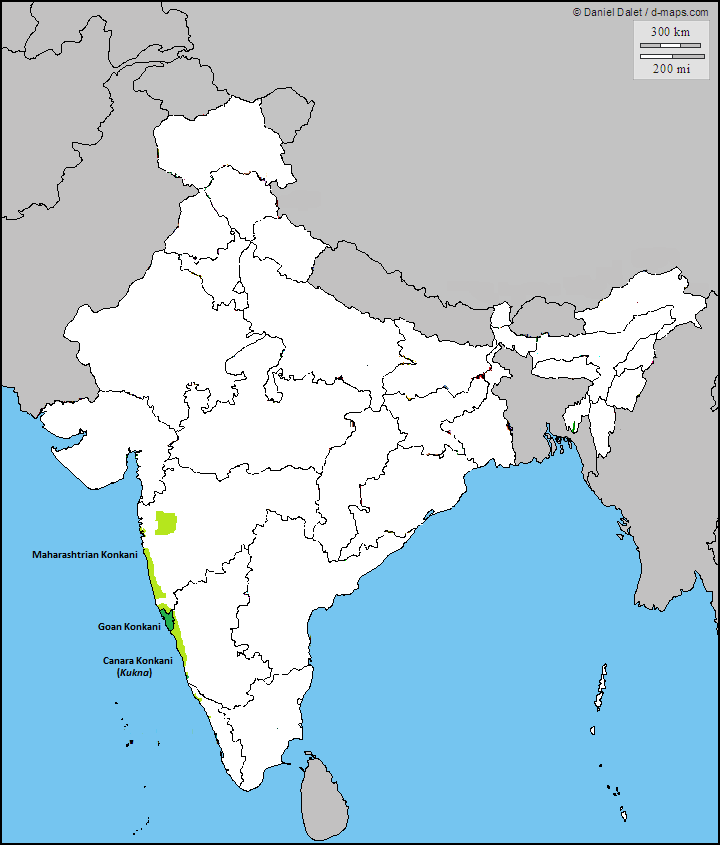
Goans (Romi Konkani: gom, ) is the demonym used to describe the people native to Goa, India, formerly part of Portuguese India (Estado Português da Índia). They form an ethno-linguistic group resulting from the assimilation of Indo-Aryan, Dravidian, Indo-Portuguese, Austro-Asiatic ethnic and/or linguistic ancestries. They speak different dialects of the Konkani language, collectively known as Goan Konkani. "Goanese", although sometimes used, is an incorrect term for Goans.
Language
Goans are generally multilingual, but mainly speak the Konkani language, a Prakrit based language belonging to the Southern group of Indo-Aryan Languages. Various dialects of Konkani spoken by the Goans include Bardezkari, Saxtti, Pednekari and Antruz. The Konkani spoken by the Catholics is notably different from those of the Hindus, since it has a lot of Portuguese influence in its vocabulary.{{cite book
Konkani was suppressed for official documentation use only not for unofficial use under the Portuguese governance, playing a minor part in education of the past generations. All Goans were educated in Portuguese in the past when Goa was an overseas province of Portugal. A small minority of Goans are descendants of the Portuguese (Luso-Indian ethnicity) and speak Portuguese. However, a number of native Christians also used Portuguese as their first language prior to 1961.
Goans use Devanagari (official) and Latin script (liturgical and historical) for education as well as communication (personal, formal and religious). However the entire liturgy of the Catholic church is solely in the Latin script, having been influenced by the Portuguese colonial rule. In the past other scripts such as Goykanadi, Modi, Kannada and Persian were also used, but later fell into disuse owing to many social, political and religious reasons.
Portuguese is still spoken as a first language by a number of Goans, though it is mainly restricted to upper-class Catholic families and the older generation. However, the annual number of Goans learning Portuguese as a second language has been continuously increasing in the 21st century through introduction in schools and the opening of Instituto Camões.
The Marathi language has played a significant role for Hindus near the northern borders of Goa close to Maharashtra and parts of Novas Conquistas (lit. new conquests). This is due to the influx of ethnic Marathi people since the 20th century.
Religion
Ethnic Goans are predominantly Roman Catholics followed by Hindus and a tiny Muslim community.
As per the 1909 statistics, the Catholic population stood at 293,628 out of a total population 365,291 (80.33%).
Within Goa, there has been a steady decline of Christianity as a percentage of the total population due to Goan emigration to other Indian cities (especially Mumbai) and foreign countries,{{cite book
According to the 2011 census, out of the Indian population residing in Goa (1,458,545 persons), 66.1% were Hindu, 25.1% were Christian, 8.32% were Muslim, and 0.1% were Sikh.{{cite news |publication-date = 26 August 2015 |access-date = 6 September 2017 |archive-url = https://web.archive.org/web/20160110201326/http://www.thehindu.com/news/national/religious-communities-census-2011-what-the-numbers-say/article7582284.ece |archive-date = 10 January 2016 |url-status = live
Christianity
The Catholics display Portuguese influence, due to over 451 years of direct rule and interaction with the Portuguese people as an overseas province. Portuguese names are common among the Goan Catholics.{{Cite book |last=Saradesāya |first=Manohararāya |publisher=Sahitya Akademi |url=https://books.google.com/books?id=1YILeUD_oZUC
Hinduism
Goan Hindus refer to themselves as "Konkane" (Devanagari Konkani: कोंकणे), meaning the residents of an area broadly identified as Konkan. Hindus in Goa are divided into many different castes and sub-castes, known as Jatis. They use their village names to identify their clans, some of them use titles. Some are known by the occupation their ancestors have been practising; Nayak, Borkar, Raikar, Keni, Prabhu, Kamat, Lotlikar, Chodankar, Mandrekar, Naik, Bhat, Tari, Gaude are some examples.
Islam
Only a small number of native Muslims remain and are known as Moir, the word is derived from the Portuguese Mouro, which means Moor. Muçulmano was the word later used in Portuguese to identify them, which is still the world used in today's Portuguese.
Geographical distribution
Goans have been migrating all along the Konkan region and across the Anglosphere, Lusosphere and Persian Gulf countries for the last six centuries because of socio-religious and economic reasons. The Indian diaspora have been assimilated with other Konkani people of Maharashtra, Karnataka and Kerala. Goans across the globe refer to the publication, Goan Voice for news about members from their community.
Many overseas Goans have settled in the erstwhile British Empire and the United Kingdom mainly in south-west town of Swindon, Leicester in the East Midlands and in London (especially Wembley and Southall). Many Goans have migrated to the UK on Portuguese passports due to the UK being an EU member country up until the Brexit. According to the Office for National Statistics, as of June 2020, the population of EU Nationals (Indian-born Portuguese citizens) in UK was about 35,000.
Many Goans have also chosen to migrate to the former Portuguese territories (especially Mozambique) and to Portugal itself.
Pre-Portuguese migrations
There are no definitive records of Goan migration prior to the Portuguese conquests in the region corresponding to nowadays Goa. One reason being that the Goan people were not a distinct ethnic group as yet.
Migrations from 1510–1700s (first phase)
The first recorded instances of significant emigrations of Goans could be traced back to the Portuguese conquest of Goa in 1510 and the subsequent flight of the surviving Muslim residents to the territories ruled by the Sultanate of Bijapur. Sizable numbers of Hindus also later fled to Mangalore and Kanara during the 16th–17th centuries due to the increasing Christianization of Goa. They were soon followed by some newly-converted Catholics, who fled the Goa Inquisition.{{cite book
Migrations from 1800s–1950s (second phase)
During the Napoleonic Wars Goa was occupied by the British Raj, and many of their vessels were anchored in the Morumugão harbour. These ships were serviced by native Goans, who then left for British India once the ships had moved on. The Anglo-Portuguese Treaty of 1878 played an important role in speeding the emigration of Goans in the latter half of the 19th Century, since it gave the British the authority to construct the West of India Portuguese Railway, which connected the Velhas Conquistas to the Bombay Presidency. They primarily moved to the cities of Bombay (now Mumbai), Poona (now Pune), Calcutta (now Kolkata) and Karachi. Goans who moved to mainland India were of both, Christian as well as Hindu, origin.
A small number of Goans moved to Burma, to join the already established community in Pegu (now Bago). Another destination, mainly for the Catholic community, was Africa. Most of the emigrants hailed from the province of Bardes, due to their high literacy rate, and the Velhas Conquistas region in general. Immigration into Africa came to end after the Decolonisation of Africa, during the 1950-60s.
In 1880, there were already 29,216 Goans living outside of Goa. By 1954, the number had risen to 180,000.
Migration from 1960s–present (current phase)
After the Annexation of Goa in 1961 by the Republic of India, there has been a steep rise in the number of emigrants of Goan origin. Many had applied and were granted Portuguese passports in order to obtain a European residence. The educated class found it difficult to get jobs within Goa due to the high influx of non-Goans into Goa, and this encouraged many of them to move to the Gulf states.
Until the early 1970s there were substantial populations of Goans in the Middle East, Africa and Europe. There have also, historically, been Goans in former British colonies of Kenya, Uganda, and Tanzania, and Portuguese colonies of Mozambique and Angola. The end of colonial rule brought a subsequent process of Africanisation and a wave of expulsion of South Asians from Uganda (1972) and Malawi (1974) forced the community to migrate elsewhere.
In 2000, it was estimated that there are around 600,000 Goans living outside India.
Professions
Since the Second Phase of migrations, Goans have had a variety of professions. In British India they were personal butlers or physicians to the English and Parsi elite in India. On the Ships and Cruise liners they were sailors, stewards, chefs, musicians and dancers. Many have also been working on oil rigs. Many Goan doctors worked in African colonies of Portugal, as well as being also active in British India.
Notes
References
References
- (September 9, 2017). "Goa's Population Problems". The Times of India.
- (10 February 2021). "Postcard from Goa".
- "Goa Swindon Association: Uniting, supporting Goans in Swindon".
- "Goeses em Portugal".
- "Goan Catholics in Portugal".
- Rajesh Ghadge (2015), The story of Goan Migration.
- Pereira, José. (2000). "Song of Goa: mandos of yearning". Aryan Books International.
- Cabral e Sá, Mário. (1997). "Wind of fire: the music and musicians of Goa". Promilla & Co..
- Pinto, Cecil. (2003-11-07). "Goanese & non-Goans". Goa Publications.
- (April 2003). "Publications". COSPAR Information Bulletin.
- "National Archives of India". National Archives of India.
- Kamat, Krishnanand Kamat. "The origin and development of Konkani language". www.kamat.com.
- (2 June 2014). "1.500 pessoas estudam português em Goa". Revista MACAU.
- Lusa, Agência. "Fundação Oriente quer valorização de língua portuguesa em Goa e apoia 800 alunos".
- "Goa - Universidade de Goa - Camões - Instituto da Cooperação e da Língua".
- Malkarnekar, Gauree. (14 August 2019). "After Karnataka & Maha, UP gives Goa the most migrants". [[Times of India]].
- (1909). "Catholic Encyclopedia". Robert Appleton Company.
- Rajesh Ghadge (2015). ''The story of Goan Migration.''
- Kulakarṇī, A. Rā. (2006). "Explorations in the Deccan history Volume 9 of Monograph series". Pragati Publications in association with Indian Council of Historical Research.
- (1993). "People of India: Goa Volume 21 of People of India, Kumar Suresh Singh Volume 21 of State Series, Kumar Suresh Singh". Anthropological Survey of India.
- S.A, Priberam Informática. "Dicionário Priberam da Língua Portuguesa".
- Sonwalkar, Prasun. "The long read: Britain's Goan flavour".
- Mergulhao, Marcus. (August 22, 2021). "All for tradition: Goans pack coconuts to UK to break them {{!}} Goa News - Times of India".
- (2015). "[[Conquerors: How Portugal Forged the First Global Empire]]". Random House.
- de Souza, Teotónio. (1979). "Medieval Goa". Concept Publishing Company.
- Disney, Anthony. (1996). "The Gulf Route from India to Portugal in the Sixteenth and Seventeenth Centuries". Actas do XII Seminário Internacional de História Indo-Portuguesa.
- Fernandes, Paul. (2017). "Dona Paula's forgotten British cemetery gets a new lease of life". The Times of India.
- Pinto, J. B.. (1962). "J. B. Pinto (1962), Goan Emigration".
- Khan, Haward R.. (1980). "Haward, R. Khan, 1980, 'An Urban Minority: The Goan Christian Community in Karachi'". University of London.
- De Souza, Teotonio R.. (1989). "Essays in Goan history". Concept Publishing Company.
- (1870–1889). "Paco Patriarcal (Patriarchal Archives), Rois de Cristandade : Rois de Ilhas, 1870-1889".
- Pereira, José. (2000). "Song of Goa: mandos of yearning". Aryan Books International.
- Fatima da Silva Gracias. (1994). "Health and Hygiene in Colonial Goa, 1510-1961". Concept Publishing Company.
This article was imported from Wikipedia and is available under the Creative Commons Attribution-ShareAlike 4.0 License. Content has been adapted to SurfDoc format. Original contributors can be found on the article history page.
Ask Mako anything about Goans — get instant answers, deeper analysis, and related topics.
Research with MakoFree with your Surf account
Create a free account to save articles, ask Mako questions, and organize your research.
Sign up freeThis content may have been generated or modified by AI. CloudSurf Software LLC is not responsible for the accuracy, completeness, or reliability of AI-generated content. Always verify important information from primary sources.
Report