From Surf Wiki (app.surf) — the open knowledge base
Glyceride
Chemical esters commonly found in fats and oils
Chemical esters commonly found in fats and oils
a type of chemical substances within the group of lipids
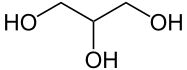
Glycerides, also known as acylglycerols, are esters formed from glycerol and fatty acids, and are generally very hydrophobic.
Glycerol has three hydroxyl functional groups, which can be esterified with one, two, or three fatty acids to form mono-, di-, and triglycerides. These structures vary in their fatty acid alkyl groups as they can contain different carbon numbers, different degrees of unsaturation, and different configurations and positions of olefins.
Soaps are formed from the reaction of glycerides with sodium hydroxide. The product of the reaction is glycerol and salts of fatty acids. Fatty acids in the soap emulsify the oils in dirt, enabling the removal of oily dirt with water.
Partial glycerides are esters of glycerol with fatty acids, where not all the hydroxyl groups are esterified. Since some of their hydroxyl groups are free their molecules are polar. Partial glycerides may be monoglycerides (two hydroxyl groups free) or diglycerides (one hydroxyl group free). Short chain partial glycerides are more strongly polar than long chain partial glycerides, and have excellent solvent properties for many hard-to-solubilize drugs, making them valuable as excipients in improving the formulation of certain pharmaceuticals. The most common forms of acylglycerol are triglycerides, having high caloric value and usually yielding twice as much energy per gram as carbohydrate.
Acylglyceride linkage
An acylglyceride linkage is the covalent bond between the organic acid groups (such as fatty acid) and one of the three hydroxyl groups of glycerol.
References
References
- (2015-07-28). "Differential sensing for the regio- and stereoselective identification and quantitation of glycerides". Proceedings of the National Academy of Sciences.
- (June 2007). "Sasol retains olefins and surfactants unit". Focus on Surfactants.
- Moore, Randy, et al. (1998) ''Botany.'' 2nd Ed. New York: WCB/McGraw Hill. {{ISBN. 978-0-697-28623-9.
This article was imported from Wikipedia and is available under the Creative Commons Attribution-ShareAlike 4.0 License. Content has been adapted to SurfDoc format. Original contributors can be found on the article history page.
Ask Mako anything about Glyceride — get instant answers, deeper analysis, and related topics.
Research with MakoFree with your Surf account
Create a free account to save articles, ask Mako questions, and organize your research.
Sign up freeThis content may have been generated or modified by AI. CloudSurf Software LLC is not responsible for the accuracy, completeness, or reliability of AI-generated content. Always verify important information from primary sources.
Report