From Surf Wiki (app.surf) — the open knowledge base
Gluttony
Over-indulgence and over-consumption, such as of food

Over-indulgence and over-consumption, such as of food
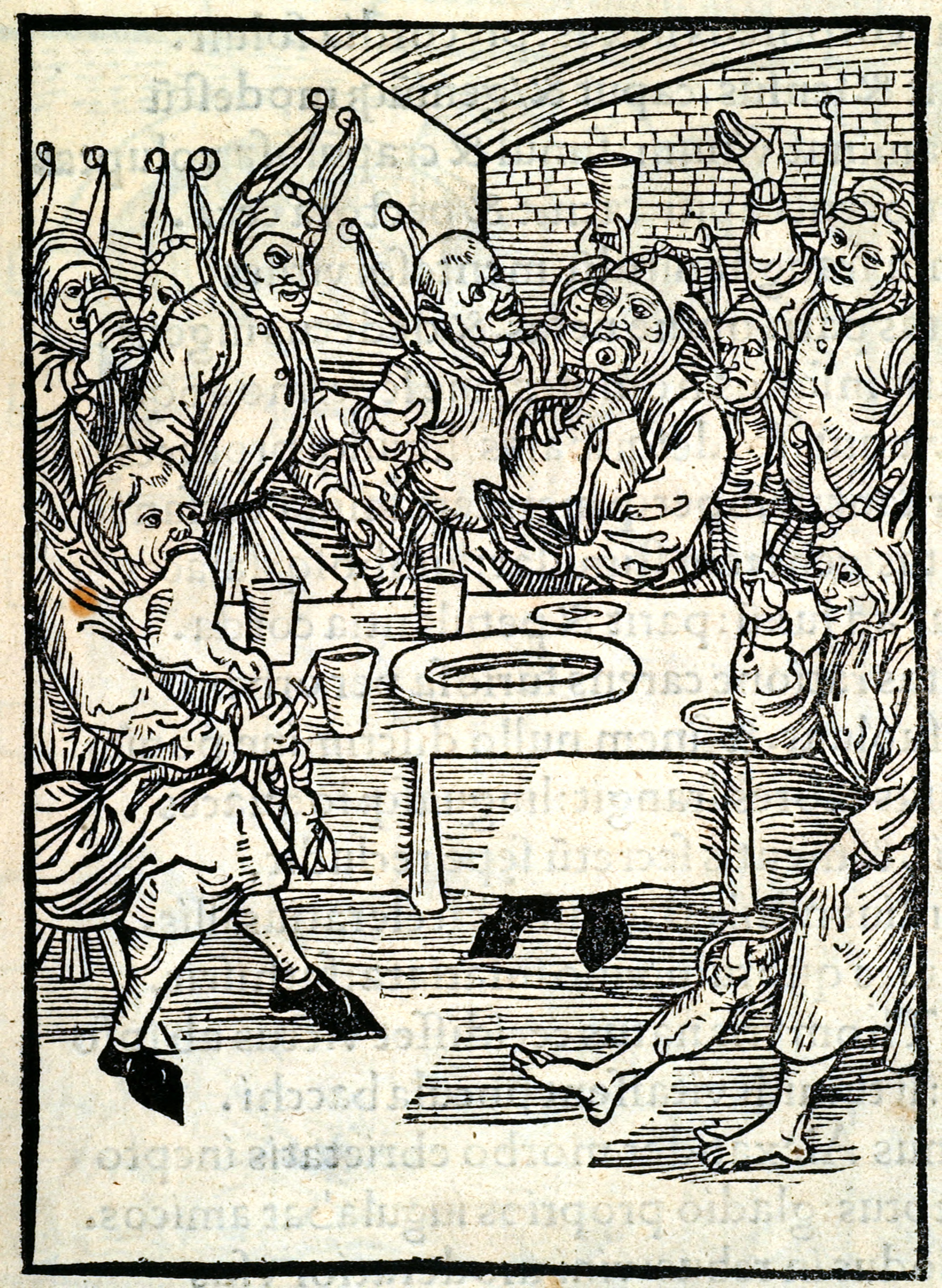
Gluttony (, derived from the Latin gluttire meaning 'to gulp down or swallow') means over-indulgence and over-consumption of anything to the point of waste.
In Christianity, it is considered a sin if the excessive desire for food leads to a lack of control over one's relation with food or harms the body. Some Christian denominations consider gluttony one of the seven deadly sins. The concept of gluttony also has a broader definition within Christianity, where it is categorized into five distinct traits.
Etymology
In Deut 21:20 and Proverbs 23:21, it is זלל. The Gesenius Entry (lower left word) has indications of "squandering" and "profligacy" (waste).
In Matthew 11:19 and Luke 7:34, it is φαγος (phagos transliterated character for character). The LSJ Entry is tiny, and only refers to one external source, Zenobius Paroemiographus 1.73. The word could mean merely 'an eater', since φαγω means 'eat'.
In religion
Judaism
Rambam, for example, prohibits excessive eating and drinking in Hilchot De'ot (e.g., halachot 1:4, 3:2, 5:1). The Chofetz Chaim (Yisrael Meir Kagan) prohibits gluttony on the basis of Leviticus 19:26, in Sefer Ha-Mitzvot Ha-Katzar (Prohibition #106).
Christianity
Church leaders from the ascetic Middle Ages took a more expansive view of gluttony:
St. Gregory the Great
Pope Gregory I (St. Gregory the Great), a doctor of the Church, described the following ways by which one can commit the sin of gluttony:
- Eating before the time of meals in order to satisfy the palate.
- Seeking delicacies and better quality of food to gratify the "vile sense of taste".
- Seeking to stimulate the palate with overly or elaborately prepared food (e.g. with luxurious sauces and seasonings).
- Exceeding the necessary quantity of food.
- Taking food with too much eagerness, even when eating the proper amount, and even if the food is not luxurious.
This fifth way is worse than all others, said St. Gregory, because it shows attachment to pleasure most clearly. To recapitulate, St Gregory the Great said that one may succumb to the sin of gluttony by: 1. Time (when); 2. Quality; 3. Stimulants; 4. Quantity; 5. Eagerness. He asserts that the irregular desire is the sin, not the food: "For it is not the food, but the desire that is in fault".
St. Thomas Aquinas
In his Summa Theologica, St. Thomas Aquinas reiterated the list of five ways to commit gluttony:
- Laute – eating food that is too luxurious, exotic, or costly
- Studiose – eating food that is excessive in quality (too daintily or elaborately prepared)
- Nimis – eating food that is excessive in quantity (too much)
- Praepropere – eating hastily (too soon or at an inappropriate time)
- Ardenter – eating greedily (too eagerly)
St. Aquinas concludes that "gluttony denotes inordinate concupiscence in eating"; the first three ways are related to the food itself, while the last two related to the manner of eating. He says that abstinence from food and drink overcome the sin of gluttony, and the act of abstinence is fasting. (see: Fasting and abstinence in the Roman Catholic Church) In general, fasting is useful to restrain concupiscence of the flesh.
St. Alphonsus Liguori
St. Alphonsus Liguori wrote the following when explaining gluttony:
Pope Innocent XI has condemned the proposition which asserts that it is not a sin to eat or to drink from the sole motive of satisfying the palate. However, it is not a fault to feel pleasure in eating: for it is, generally speaking, impossible to eat without experiencing the delight which food naturally produces. But it is a defect to eat, like beasts, through the sole motive of sensual gratification, and without any reasonable object. Hence, the most delicious meats may be eaten without sin, if the motive be good and worthy of a rational creature; and, in taking the coarsest food through attachment to pleasure, there may be a fault.
Islam
An interpretation of the meaning of a part of a Qur'anic verse is as follows:
and eat and drink but waste not by extravagance, certainly He (Allah) likes not Al‑Musrifoon (those who waste by extravagance)
The Sunnah encourages moderation in eating, and strongly criticizes extravagance.
The Prophet said: The son of Adam does not fill any vessel worse than his stomach. It is sufficient for the son of Adam to eat a few mouthfuls, to keep him going. If he must do that (fill his stomach), then let him fill one third with food, one third with drink and one third with air.” Narrated by al-Tirmidhi (2380); classed as saheeh (truthful) by al-Albaani in al-Silsilah al-Saheehah (2265).
In arts
Callimachus the famous Greek poet states, "All that I have given to my stomach has disappeared, and I have retained all the fodder that I gave to my spirit."
Popular quote "Eat to live, not live to eat" is commonly attributed to Socrates. A quotation from Rhetorica ad Herennium IV.28 : "Esse oportet ut vivas; non vivere ut edas" ('It is necessary to eat in order to live, not to live in order to eat') is credited by the Oxford Dictionary of Proverbs to Cicero.
References
References
- Okholm, Dennis. [https://www.christianitytoday.com/ct/2000/september4/3.62.html "Rx for Gluttony"]. ''[[Christianity Today]]'', Vol. 44, No. 10, September 11, 2000, p.62
- "Strong's Search: H2151". Newjerusalem.org.
- "Hebrew and Chaldee Lexicon by Friedrich Wilhelm Gesenius". Tyndalearchive.com.
- "Strong's Search: G5314". Newjerusalem.org.
- "Henry George Liddell, Robert Scott, A Greek-English Lexicon, φάγος". Perseus.tufts.edu.
- "Hilchot De'ot".
- "ספר המצות הקצר".
- (1875). "Shipley, Orby. A Theory About Sin, London (1875) pg. 268–278". Macmillan.
- Susan E. Hill. (2007). "The Seven Deadly Sins: From Communities to Individuals". BRILL.
- Lori Barcliff Baptista. (2012). "Encyclopedia of Consumption and Waste: The Social Science of Garbage". SAGE Publications.
- St. Gregory the Great. "Morals on the Book of Job". Lectionary Central.
- St. Thomas Aquinas. "The Summa Theologica II-II.Q148.A4". New Advent.
- St. Thomas Aquinas. "The Summa Theologica II-II". New Advent.
- St. Thomas Aquinas. "The Summa Theologica II-II". New Advent.
- (1835). "St. Alphonsus Liguori. ''The True Spouse of Jesus Christ''; trans. from Italian. Dublin (1835), p. 282".
- Jaucourt, Louis, chevalier de. "[http://quod.lib.umich.edu/d/did/did2222.0000.665?view=text;rgn=main Gluttony]." ''The Encyclopedia of Diderot & d'Alembert Collaborative Translation Project''. Translated by Sean Takats. Ann Arbor: Michigan Publishing, University of Michigan Library, 2006. Web.
- George Alexander Kennedy. (2008). "The Art of Rhetoric in the Roman World". Wipf and Stock Publishers.
- M. Tullius Cicero. (1773). "Rhetoricorum". J. Manfré (from Montserrat Abbey Library).
- Giambattista Vico. (1996). "The Art of Rhetoric". Rodopi.
- (2015). "Oxford Dictionary of Proverbs". OUP Oxford.
This article was imported from Wikipedia and is available under the Creative Commons Attribution-ShareAlike 4.0 License. Content has been adapted to SurfDoc format. Original contributors can be found on the article history page.
Ask Mako anything about Gluttony — get instant answers, deeper analysis, and related topics.
Research with MakoFree with your Surf account
Create a free account to save articles, ask Mako questions, and organize your research.
Sign up freeThis content may have been generated or modified by AI. CloudSurf Software LLC is not responsible for the accuracy, completeness, or reliability of AI-generated content. Always verify important information from primary sources.
Report