From Surf Wiki (app.surf) — the open knowledge base
Glaucophane
Inosilicate mineral
Inosilicate mineral
| Field | Value |
|---|---|
| name | Glaucophane |
| category | Inosilicates |
| Sodic amphibole group | |
| image | Glaucophane bleu de Groix.jpg |
| imagesize | 260px |
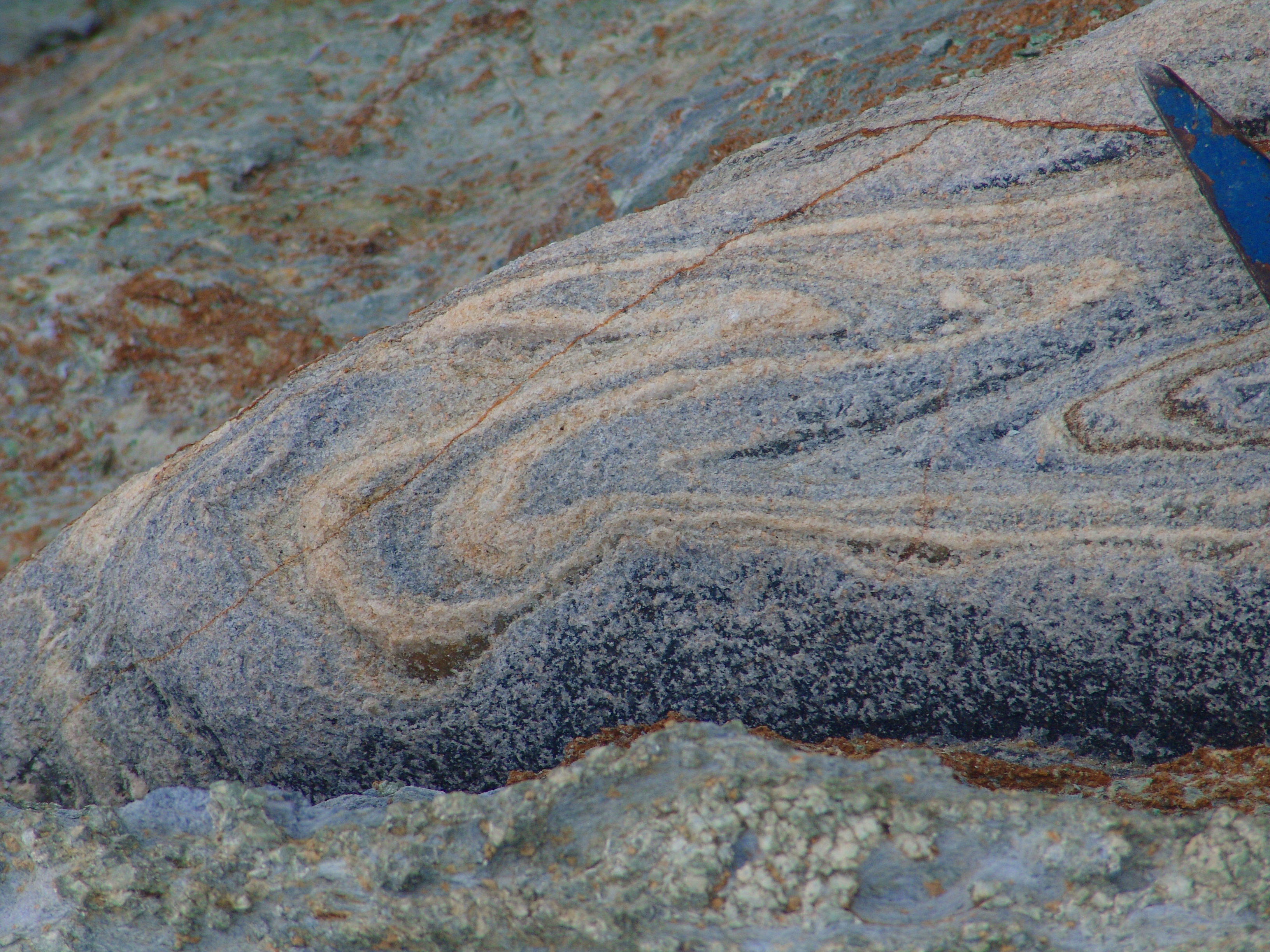
| caption | Glaucophane with fuchsite (white oval) |
| formula | ☐Na2(Mg3Al2)Si8O22(OH)2 |
| IMAsymbol | Gln |
| strunz | 9.DE.25 |
| system | Monoclinic |
| class | Prismatic (2/m) |
| (same H-M symbol) | |
| symmetry | *C2/m* |
| color | Gray, navy blue, lavender-blue |
| habit | slender long prisms, Massive granular to columnar |
| cleavage | Good on [110] and on [001] |
| fracture | Brittle – conchoidal |
| mohs | 6.0–6.5 |
| luster | Vitreous – pearly |
| streak | Grayish blue |
| diaphaneity | Translucent |
| gravity | 3–3.15 |
| opticalprop | Biaxial (−) |
| refractive | nα = 1.606 – 1.637 nβ = 1.615 – 1.650 nγ = 1.627 – 1.655 |
| birefringence | δ = 0.021 |
| pleochroism | Strong |
| dispersion | Strong |
| references |
Sodic amphibole group (same H-M symbol) | length fast/slow =
Glaucophane is a mineral and a mineral group belonging to the sodic amphibole supergroup of the double chain inosilicates, with the chemical formula Na2(Mg3Al2)Si8O22(OH)2.
Glaucophane crystallizes in the monoclinic system.
Name
Glaucophane is named for its typical blue color. In Greek, glaucophane means "blue appearing". As the major mineral component, it is glaucophane's color that gives the "blueschist" metamorphic rock type its name.
Characteristics
The blue color is very diagnostic for this species. Glaucophane, along with the closely related mineral riebeckite, to which it forms a series with, and their intermediate crossite, are the only well known amphiboles that are commonly blue. Glaucophane forms a solid solution series with ferroglaucophane (). Glaucophane is the magnesium-rich endmember and ferroglaucophane is the iron-rich endmember.
Ferroglaucophane is similar to glaucophane but is slightly denser and hence increased specific gravity. The two endmembers are indistinguishable in hand specimens and are strongly pleochroic. Glaucophane's hardness is 5–6 and its specific gravity is approximately 3–3.2.
Occurrence
The blueschist metamorphic facies gets its name from abundant blue minerals glaucophane and lawsonite. Glaucophane generally forms in blueschist metamorphic rocks of gabbroic or basaltic composition that are rich in sodium and have experienced low temperature-high pressure metamorphism such as would occur along a subduction zone.
This material has undergone intense pressure and moderate heat as it was subducted downward toward the mantle. Glaucophane is also found in eclogites that have undergone retrograde metamorphism.
There is also a rare amphibole called holmquistite, chemical formula Li2Mg3Al2Si8O22(OH)2, which occurs only in lithium-rich continental rocks. For many years, holmquistite was mistaken for glaucophane, as the two look identical in thin section.
References
References
- Warr, L.N.. (2021). "IMA–CNMNC approved mineral symbols". Mineralogical Magazine.
- http://rruff.geo.arizona.edu/doclib/hom/glaucophane.pdf Handbook of Mineralogy
- http://webmineral.com/data/Glaucophane.shtml Webmineral
- "Glaucophane: Glaucophane mineral information and data.".
- Burke, Ernst A.J.. "International Mineralogical Association - Commission on New Minerals, Nomenclature and Classification".
This article was imported from Wikipedia and is available under the Creative Commons Attribution-ShareAlike 4.0 License. Content has been adapted to SurfDoc format. Original contributors can be found on the article history page.
Ask Mako anything about Glaucophane — get instant answers, deeper analysis, and related topics.
Research with MakoFree with your Surf account
Create a free account to save articles, ask Mako questions, and organize your research.
Sign up freeThis content may have been generated or modified by AI. CloudSurf Software LLC is not responsible for the accuracy, completeness, or reliability of AI-generated content. Always verify important information from primary sources.
Report