From Surf Wiki (app.surf) — the open knowledge base
Giant anteater
Species of mammal

Species of mammal
~
- Myrmecophaga jubata Linnaeus, 1766
- Falcifer Rehn, 1900
The giant anteater (Myrmecophaga tridactyla) is an insectivorous mammal native to Central and South America. It is the largest of the four living species of anteaters, which are classified with sloths in the order Pilosa. The only extant member of the genus Myrmecophaga, the giant anteater is mostly terrestrial, in contrast to other living anteaters and sloths, which are arboreal or semiarboreal. The species is 182 to in length, with weights of 33 to for males and 27 to for females. It is recognizable by its elongated snout, bushy tail, long foreclaws, and distinctively colored fur.
The giant anteater is found in multiple habitats, including grassland and rainforest. It forages in open areas and rests in more forested habitats. It feeds primarily on ants and termites, using its foreclaws to dig them up and its long, sticky tongue to collect them. Though giant anteaters live in overlapping home ranges, they are mostly solitary except during mother-offspring relationships, aggressive interactions between males, and when mating. Mother anteaters carry their offspring on their backs until weaning them.
The giant anteater is listed as vulnerable by the International Union for Conservation of Nature. It has been extirpated from many parts of its former range. Threats to its survival include habitat destruction, fire, and poaching for fur and bushmeat, although some anteaters inhabit protected areas. With its distinctive appearance and habits, the anteater has been featured in pre-Columbian myths and folktales.
Taxonomy
The giant anteater got its binomial name from Carl Linnaeus in 1758. Its generic name, Myrmecophaga, and specific name, tridactyla, are both Greek, meaning "anteater" and "three fingers", respectively. Myrmecophaga jubata was used as a synonym. Three subspecies have been suggested: M. t. tridactyla (Venezuela and the Guianas south to northern Argentina), M. t. centralis (Central America to northwestern Colombia and northern Ecuador), and M. t. artata (northeastern Colombia and northwestern Venezuela). The giant anteater is grouped with the semiarboreal northern and southern tamanduas in the family Myrmecophagidae. Together with the family Cyclopedidae, whose only extant member is the arboreal silky anteater, the two families comprise the suborder Vermilingua.
Anteaters and sloths belong to the order Pilosa and share the superorder Xenarthra with the Cingulata (whose only extant members are armadillos). The two orders of Xenarthra split 65 million years ago (Mya) during the Late Cretaceous epoch. Anteaters and sloths diverged around 58 Mya, during the Paleocene epoch. The lineages of Cyclopes and other extant anteaters split around 40 Mya in the Eocene epoch, while the last common ancestor of Myrmecophaga and Tamandua existed circa 13 Mya in the Miocene epoch. Through most of their evolutionary history, anteaters were confined to South America, which was formerly an island continent. Following the formation of the Isthmus of Panama about 3 Mya, anteaters of all three extant genera invaded Central America as part of the Great American Interchange.
The following cladogram is based on a genetic study by Delsuc and colleagues (2012).
The fossil record for anteaters is generally sparse. Known fossils include the Pliocene genus Palaeomyrmidon, a close relative to the silky anteater, Protamandua, which is closer to the giant anteater and the tamanduas from the Miocene, and Neotamandua, which is believed to have close affinities to Myrmecophaga. Protamandua was larger than the silky anteater but smaller than a tamandua, while Neotamandua was larger, falling somewhere between a tamandua and a giant anteater. Protamandua did not appear to be specialized for walking or climbing, but it may have had a prehensile tail. Neotamandua, though, is unlikely to have had a prehensile tail, and its feet were similar in form to both the tamanduas and the giant anteater. The species was reclassified as Myrmecophaga caroloameghinoi by S. E. Hirschfeld in 1976.
The giant anteater is the most terrestrial of the living anteater species; specialization for life on the ground appears to be a new trait in anteater evolution. The transition to life on the ground could have been aided by the expansion of open habitats such as savanna in South America and the abundance of native colonial insects, such as termites, that provided a larger potential food source. Both the giant anteater and the southern tamandua are well represented in the fossil record of the late Pleistocene and early Holocene.
Characteristics
The giant anteater can be identified by its large size, long, narrow muzzle, and long, bushy tail. It has a total body length of 182 to. Males weigh 33 to, and females weigh 27 to, making the giant anteater the biggest extant species in its suborder. The head of the giant anteater, at 30 cm long, is particularly elongated, even when compared to other anteaters. Its cylindrical snout takes up most of its head. Its eyes, ears, and mouth are relatively small. The female's two mammary glands are located between the front legs.
.jpg)
Even for an anteater, the neck is especially thick compared to the back of the head, The bold pattern was thought to be disruptive camouflage, but a 2009 study suggests it is warning coloration.
The giant anteater has broad ribs and five toes on each foot. Unlike the front feet, the hind feet have short claws on all five toes and walk plantigrade.
The giant anteater has a low body temperature for a mammal, about 33 C, a few degrees lower than a typical mammalian temperature of 36 to.
Feeding anatomy
The giant anteater has no teeth and is capable of very limited jaw movement. It relies on the rotation of the two halves of its lower jaw, held together by a ligament connecting the rami, to open and close its mouth. This is accomplished by its chewing muscles, which are relatively underdeveloped. Jaw depression creates an oral opening large enough for the slender tongue to flick out. It has a length of around 60 cm
The tongue can only move forwards and backwards due to the tiny mouth and shape of the snout. During feeding, the animal relies on the direction of its head for aim. When fully extended, the tongue reaches 45 cm and can move in and out around 160 times per minute (nearly three times per second). The hyoid apparatus is large, V-shaped, and flexible and supports the tongue as it moves. The buccinator (cheek) muscles loosen and tighten, allowing food in and preventing it from falling out. When retracted, the tongue is held in the oropharynx, preventing it from blocking respiration.
The anteater presses its tongue against its palate to smash the insects for swallowing. Unlike other mammals, giant anteaters swallow almost constantly when feeding. The giant anteater cannot produce stomach acid of its own but digests using the formic acid of its prey.
Distribution and status
The giant anteater is native to Central and South America; its known range stretches from Honduras to Bolivia and northern Argentina, It is largely absent from the Andes
The species is listed as vulnerable by the International Union for Conservation of Nature, due to the number of regional extirpations, and under Appendix II by CITES, tightly restricting international trade in specimens. By 2014, the total population declined more than 30 percent "over the last three generations". In 1994, some 340 giant anteaters died due to wildfires at Emas National Park in Brazil. The animal is particularly vulnerable to fires, as its coat can easily be set ablaze, and it is too slow to escape.
Human-induced threats include collision with vehicles, attacks by dogs, and destruction of habitat. A 2018 study in Brazil found that: (1) roads were more likely to be detrimental to anteaters because of habitat fragmentation rather than vehicle accidents, (2) 18–20% of satisfactory anteater habitat did not reach minimum patch size, (3) 0.1–1% of its range had dangerously high road density, (4) 32–36% of the anteater's distribution represented critical areas for its survival, and (5) more conservation opportunities existed in the north of the country. A 2020 study in the Brazilian Cerrado found that road mortality can cut population growth by 50 percent at the local level.
The giant anteater is commonly hunted in Bolivia, both as a trophy and food. The animal's thick, leathery hide is used to make horse-riding equipment in the Chaco. In Venezuela, it is slain for its claws. Giant anteaters are also killed for their perceived danger, particularly during threat displays. The biggest ecological strengths of the species are its wide range and adaptability. The Amazon, Pantanal, and the Cerrado have various protected areas where the anteater finds refuge. In Argentina, some local governments list it as a national heritage species, affording it official protection.
Behaviour and ecology

Despite its iconic status, the giant anteater is little studied in the wild, and research has been limited to certain areas. The species may use multiple habitats; a 2007 study of giant anteaters in the Brazilian Pantanal found that the animals move and forage in open areas and rest in forests; the latter provide shade when the temperature rises and retain heat when the temperature drops. Anteaters may travel an average of 3700 m per day. Giant anteaters can be either diurnal or nocturnal; a 2006 study in the Pantanal found them to be mostly nocturnal when it is warm but become more active in daylight hours as the temperature drops. Diurnal giant anteaters have been observed at Serra da Canastra. Nocturnality in anteaters may be a response to human disturbances.
Giant anteaters prefer dense brush to sleep in, but when it gets cooler, they may use tall grass. When they need to rest, they carve a shallow cavity in the ground. The animal sleeps curled up with its bushy tail over its body, both to keep it warm and to camouflage it from predators. One anteater was recorded sleeping flat on its side with the tail unfolded on a 17 C morning, possibly to allow its body to absorb the sun's rays for warmth. Giant anteaters sometimes enter water to bathe and even swim across wide rivers.
Spacing

Giant anteater home ranges vary in size depending on the location, ranging from as small as 2.7 km2 in Serra da Canastra National Park, Brazil, to as large as 32.5 km2 in Iberá Natural Reserve, Argentina. Individuals mostly live alone, aside from the young who stay with their mothers. and appear to be able to recognize each other's saliva by scent.
Females are more tolerant of each other than males are and thus are more likely to be found closer together. Males are more likely to engage in agonistic behaviors, which start with the combatants approaching and circling each other while uttering a "harrr" noise. This can escalate into chasing and actual fighting. Combat includes wrestling, slashing with the claws, and bellowing. Males are possibly territorial.
Foraging
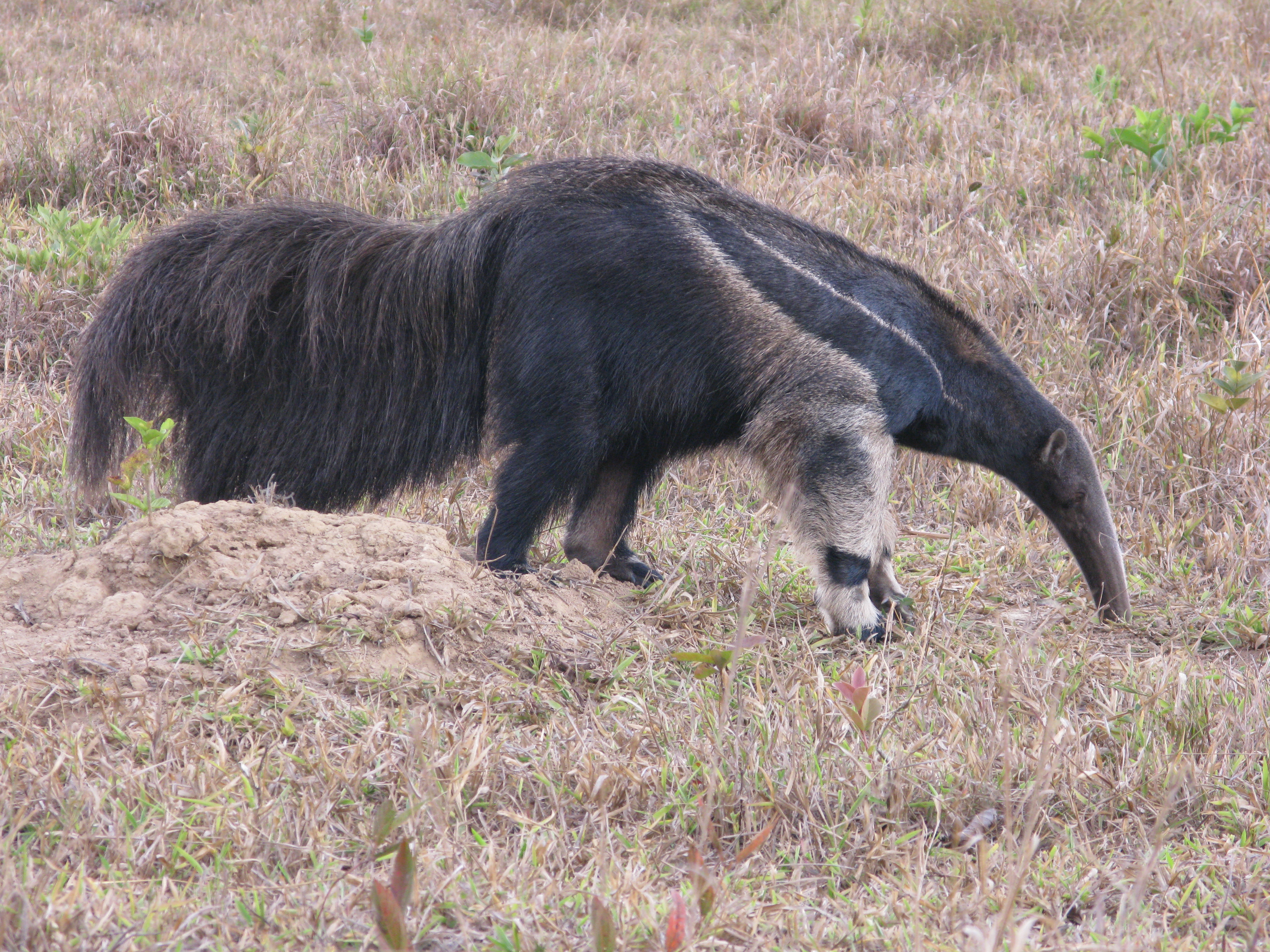
This animal is an insectivore, and feeds mostly on ants or termites (myrmecophagy). In areas that experience regular flooding, like the Pantanal and the Venezuelan-Colombian Llanos, anteaters mainly feed on ants, which are more numerous. Conversely, termites are more numerous in the grasslands of Emas National Park and hence are a more important food source for anteaters there. At Serra da Canastra, during the wet season (October to March), anteaters eat mainly ants, while during the dry season (May to September), they switch to termites.
Anteaters track prey by their scent.
Other prey include the larvae of beetles and western honey bees. Anteaters may target termite mounds with beehives. Captive anteaters are fed mixtures of milk and eggs as well as mealworms and ground beef. To drink, an anteater may dig for water when none at the surface is available, creating waterholes for other animals.
Reproduction and parenting
.jpg)
Giant anteaters mate all year. A male trails an estrous female, who then partially raises her tail. Courting pairs are known to share the same insect nest during feeding. Mating involves the female lying sideways and the male hunching over. A couple may stay together for up to three days and mate multiple times during that period. Giant anteaters have a 170–190 day gestation period, which ends with the birth of a single pup while the female stands upright. There is some evidence that the species can experience delayed implantation.
Pups are born weighing 1 – with eyes closed for the first six days. The mother carries its dependent young on its back. The pup camouflages against its mother by aligning its black and white band with hers. The mother grooms and nurses her young, who communicate with her using sharp whistles. After three months, grooming declines, and the young start to eat more solid food. Both grooming and nursing bouts end at 10 months, which is also when the young leaves its mother. They are sexually mature in 2.5–4 years.
Mortality
Giant anteaters may live around 15 years in the wild but can live twice that in captivity. The front claws of the giant anteater are formidable weapons, capable of potentially killing a jaguar. The giant anteater is a host of the Acanthocephalan intestinal parasites Gigantorhynchus echinodiscus and Moniliformis monoechinus.
Interactions with humans
In the mythology and folklore of the indigenous peoples of the Amazon Basin, the giant anteater is depicted as both a trickster and a comical figure due to its appearance. In one Shipib tale, an anteater stole a jaguar's coat after challenging it to a diving contest and left the jaguar with its own pelt. In a Yarabara myth, the evil ogre Ucara is punished by the sun and turned into an anteater so he will have been unable to speak with his long snout and small mouth. The Kayapo people wear masks of various animals and spirits, including the anteater, during naming and initiation ceremonies. They believe women who touch anteater masks or men who fall while wearing them would die or be disabled. During the Spanish colonization of the Americas, the giant anteater was among the native fauna taken to Europe for display. It was popularly thought that there were only female anteaters and they reproduced with their noses, a misconception corrected by naturalist Félix de Azara.
Although they are usually not a threat to humans, giant anteaters can inflict severe wounds with their front claws. Between 2010 and 2012, two hunters were killed by giant anteaters in Brazil; in both cases, the attacks appeared to be defensive behaviors. In April 2007, an anteater at the Florencio Varela Zoo slashed and killed a zookeeper with its front claws.
References
References
- {{MSW3 Pilosa
- Miranda, F.. (2014). "''Myrmecophaga tridactyla''".
- "Appendices {{!}} CITES".
- Linnæus, Carl. (1758). "Systema naturæ per regna tria naturæ, secundum classes, ordines, genera, species, cum characteribus, differentiis, synonyms, locis. Tomus I". Laurentius Salvius.
- Smith, P.. (2007). "Handbook of the Mammals of Paraguay 2".
- Smith, P.. (2 November 2007). "Giant Anteater ''Myrmecophaga tridactyla'' Linnaeus, 1758". Fauna Paraguay.com.
- Gardner, A. L.. (2008). "Mammals of South America: Marsupials, xenarthrans, shrews, and bats". University of Chicago Press.
- (2012). "Molecular phylogenetics unveils the ancient evolutionary origins of the enigmatic fairy armadillos". Molecular Phylogenetics and Evolutiony.
- (2008). "The Biology of the Xenarthra". University Press of Florida.
- (1998). "The phylogeny of the Myrmecophagidae (Mammalia, Xenarthra, Vermilingua) and the relationship of ''Eurotamandua'' to the Vermilingua". Journal of Mammalian Evolution.
- "Nunezia caroloameghinoi".
- Hirschfeld, S. E.. (1976). "A New Fossil Anteater (Edentata, Mammalia) from Colombia, S.A. and Evolution of the Vermilingua". [[Journal of Vertebrate Paleontology]].
- (2000). "Mammals of the Neotropics: The Central Neotropics: Ecuador, Peru, Bolivia, Brazil". University of Chicago Press.
- Mutlow, A. C.. (2006). "Flea (Pulex simulans) Infestation in Captive Giant Anteaters (Myrmecophaga tridactyla)". Journal of Zoo and Wildlife Medicine.
- Loughry, W. J.. (1997). "Survey of the Xenarthrans inhabiting Po~ odas Antas Biological Reserve". Edentata.
- Naples, V. L.. (1999). "Morphology, evolution and function of feeding in the giant anteater (''Myrmecophaga tridactyla'')". Journal of Zoology.
- Gaudin, T. J.. (2018). "''Myrmecophaga tridactyla'' (Pilosa: Myrmecophagidae)". Mammalian Species.
- Caro, T.. (2009). "Contrasting coloration in terrestrial mammals". [[Philosophical Transactions of the Royal Society B]].
- Lovegrove, B. G.. (August 2000). "The Zoogeography of Mammalian Basal Metabolic Rate". [[The University of Chicago Press]].
- Casali, D. M.. (2017). "Morphology of the tongue of Vermilingua (Xenarthra: Pilosa) and evolutionary considerations". Journal of Morphology.
- Reiss, K. Z.. (2000). "Feeding: Form, Function and Evolution in Tetrapod Vertebrates". Academic Press.
- (1987). "First Record of Giant Anteater (Xenarthra, Myrmecophagidae) in North America". [[American Association for the Advancement of Science.
- Silveira, L.. (1999). "Impact of wildfires on the megafauna of Emas National Park, central Brazil". Oryx.
- (2015). "Road-kills of the giant anteater in south-eastern Brazil: 10 years monitoring spatial and temporal determinants". Wildlife Research.
- (2018). "Giant anteater (''Myrmecophaga tridactyla'') conservation in Brazil: Analysing the relative effects of fragmentation and mortality due to roads". Biological Conservation.
- (2020). "Population viability analysis as a tool for giant anteater conservation". Perspectives in Ecology and Conservation.
- (2012). "The charismatic giant anteater (Myrmecophaga tridactyla): a famous John Doe?". Edentata.
- (2007). "Activity of a specialized insectivorous mammal (''Myrmecophaga tridactyla'') in the Pantanal of Brazil". Journal of Zoology.
- Camilo-Alves, C. de S. e. P.. (2006). "Responses of a Specialized Insectivorous Mammal (''Myrmecophaga tridactyla'') to Variation in Ambient Temperature". Biotropica.
- (2005). "A brief note on the sleeping habits of the giant anteater – ''Myrmecophaga tridactyla'' Linnaeus (Xenarthra, Myrmecophagidae)". Revista Brasileira de Zoologia.
- (2004). "Bathing Behavior of Giant Anteaters (''Myrmecophaga tridactyla'')". Edentata.
- (2019). "Space use by the giant anteater (''Myrmecophaga tridactyla''): a review and key directions for future research". European Journal of Wildlife Research.
- (2010). "Marking behavior of the giant anteater ''Myrmecophaga tridactyla'' (Mammalia: Myrmecophagidae) in Southern Brazil". Sociedade Brasileira de Zoologia.
- (1987). "Behavior of Free-Living Giant Anteaters (''Myrmecophaga tridactyla'')". Biotropica.
- Rodrigues, F. H. G.. (2008). "The Biology of the Xenarthra". University Press of Florida.
- Redford, K. H.. (1985). "Feeding and food preference in captive and wild Giant anteaters (''Myrmecophaga tridactyla'')". Journal of Zoology.
- (2013). "Fecal estrogen, progestagen and glucocorticoid metabolites during the estrous cycle and pregnancy in the giant anteater (Myrmecophaga tridactyla): evidence for delayed implantation". Reproductive Biology and Endocrinology.
- Nowak, R. M.. (1999). "Walker's Mammals of the World, Volume 1". Johns Hopkins University Press.
- Hance, Jeremy. (2017-02-21). "'Insane' camera trap video captures rare battle in the Amazon". The Guardian.
- (December 2019). "New morphological and genetic data of Gigantorhynchus echinodiscus (Diesing, 1851) (Acanthocephala: Archiacanthocephala) in the giant anteater Myrmecophaga tridactyla Linnaeus, 1758 (Pilosa: Myrmecophagidae)". International Journal for Parasitology: Parasites and Wildlife.
- (2016). "Morphological and molecular descriptions of ''Moniliformis saudi'' sp. n. (Acanthocephala: Moniliformidae) from the desert hedgehog, ''Paraechinus aethiopicus'' (Ehrenberg) in Saudi Arabia, with a key to species and notes on histopathology". Folia Parasitologica.
- Roe, P. G.. (1982). "The Cosmic Zygote: Cosmology in the Amazon Basin". Rutgers University Press.
- Mascia-Lees, F. E.. (2011). "A Companion to the Anthropology of the Body and Embodiment". John Wiley & Sons.
- Cowie, H.. (2011). "Sloth bones and anteater tongues: Collecting American nature in the Hispanic world (1750–1808)". Atlantic Studies.
- (2014). "Human Death Caused by a Giant Anteater (''Myrmecophaga tridactyla'') in Brazil". Wilderness and Environmental Medicine.
- (12 April 2007). "Argentine zookeeper dies after anteater attack". [[Reuters]].
This article was imported from Wikipedia and is available under the Creative Commons Attribution-ShareAlike 4.0 License. Content has been adapted to SurfDoc format. Original contributors can be found on the article history page.
Ask Mako anything about Giant anteater — get instant answers, deeper analysis, and related topics.
Research with MakoFree with your Surf account
Create a free account to save articles, ask Mako questions, and organize your research.
Sign up freeThis content may have been generated or modified by AI. CloudSurf Software LLC is not responsible for the accuracy, completeness, or reliability of AI-generated content. Always verify important information from primary sources.
Report