From Surf Wiki (app.surf) — the open knowledge base
Gaussian q-distribution
Family of probability distributions

Family of probability distributions
the distribution introduced by Diaz and Teruel
In mathematical physics and probability and statistics, the Gaussian q-distribution is a family of probability distributions that includes, as limiting cases, the uniform distribution and the normal (Gaussian) distribution. It was introduced by Diaz and Teruel. It is a q-analog of the Gaussian or normal distribution.
The distribution is symmetric about zero and is bounded, except for the limiting case of the normal distribution. The limiting uniform distribution is on the range -1 to +1.
Definition
Let q be a real number in the interval 0, 1). The [probability density function of the Gaussian q-distribution is given by
:s_q(x) = \begin{cases} 0 & \text{if } x \nu. \end{cases}
where
:\nu = \nu(q) = \frac{1}{\sqrt{1-q}} ,
: c(q)=2(1-q)^{1/2}\sum_{m=0}^\infty \frac{(-1)^m q^{m(m+1)}}{(1-q^{2m+1})(1-q^2)_{q^2}^m} .
The q-analogue [t]q of the real number t is given by
: [t]_q=\frac{q^t-1}{q-1}.
The q-analogue of the exponential function is the q-exponential, E, which is given by
: E_q^{x}=\sum_{j=0}^{\infty}q^{j(j-1)/2}\frac{x^{j}}{[j]!}
where the q-analogue of the factorial is the q-factorial, [n]q!, which is in turn given by
: [n]_q!=[n]_q[n-1]_q\cdots [2]_q ,
for an integer n 2 and [1]q! = [0]q! = 1.
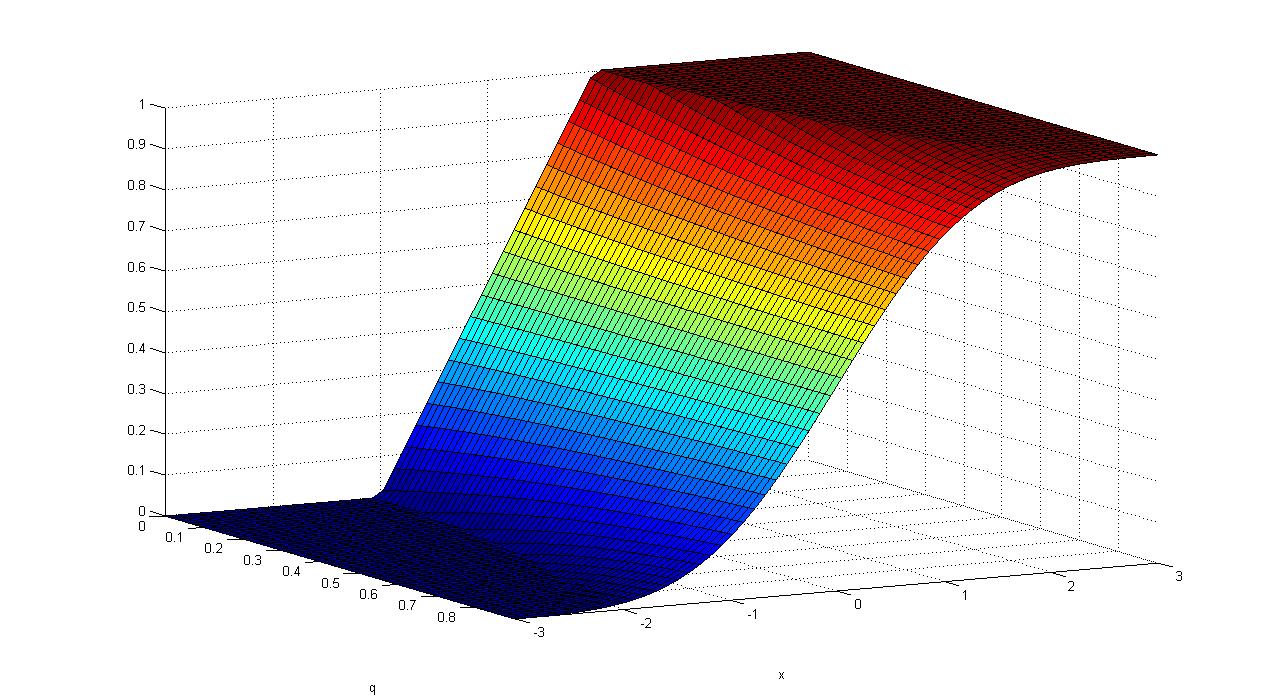
The cumulative distribution function of the Gaussian q-distribution is given by
: G_q(x) = \begin{cases} 0 & \text{if } x \displaystyle \frac{1}{c(q)}\int_{-\nu}^{x} E_{q^2}^{-q^2 t^2/[2]} , d_qt & \text{if } -\nu \leq x \leq \nu \[12pt] 1 & \text{if } x\nu \end{cases}
where the integration symbol denotes the Jackson integral.
The function G**q is given explicitly by
: G_q(x)= \begin{cases} 0 & \text{if } x \displaystyle \frac{1}{2} + \frac{1-q}{c(q)} \sum_{n=0}^\infty \frac{q^{n(n+1)}(q-1)^n}{(1-q^{2n+1})(1-q^2)_{q^2}^{n}}x^{2n+1} & \text{if } -\nu \leq x \leq \nu \ 1 & \text{if}\ x \nu \end{cases}
where
: (a+b)q^n=\prod{i=0}^{n-1}(a+q^ib) .
Moments
The moments of the Gaussian q-distribution are given by
: \frac{1}{c(q)}\int_{-\nu}^\nu E_{q^2}^{-q^2 x^2/[2]} , x^{2n} , d_qx =[2n-1]!! ,
: \frac{1}{c(q)}\int_{-\nu}^\nu E_{q^{2}}^{-q^2 x^2/[2]} , x^{2n+1} , d_qx=0 ,
where the symbol [2n − 1]!! is the q-analogue of the double factorial given by
: [2n-1][2n-3]\cdots[1]= [2n-1]!!. ,
References
- Exton, H. (1983), q-Hypergeometric Functions and Applications, New York: Halstead Press, Chichester: Ellis Horwood, 1983, , ,
This article was imported from Wikipedia and is available under the Creative Commons Attribution-ShareAlike 4.0 License. Content has been adapted to SurfDoc format. Original contributors can be found on the article history page.
Ask Mako anything about Gaussian q-distribution — get instant answers, deeper analysis, and related topics.
Research with MakoFree with your Surf account
Create a free account to save articles, ask Mako questions, and organize your research.
Sign up freeThis content may have been generated or modified by AI. CloudSurf Software LLC is not responsible for the accuracy, completeness, or reliability of AI-generated content. Always verify important information from primary sources.
Report