From Surf Wiki (app.surf) — the open knowledge base
Gartner hype cycle
Graphical presentation of the maturity of specific technologies
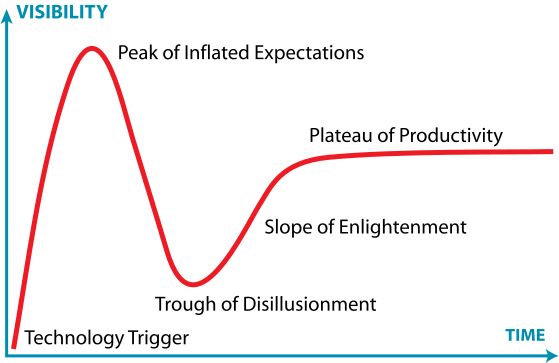
Graphical presentation of the maturity of specific technologies
The Gartner hype cycle is a graphical presentation to represent the maturity, adoption, and social application of specific technologies. The hype cycle's veracity has been largely disputed, with studies pointing to it being inconsistently true at best.
History
The hype cycle framework was introduced in 1995 by Gartner analyst Jackie Fenn, who had joined the firm the year before. In her research reports, Fenn identified common patterns related to the maturity of emerging technologies. Fenn referred to this familiar progression as a "hype cycle" and created a graph depicting its ups and downs with each distinct stage given a title, starting with Technology trigger and ending with Plateau of productivity. The chart was included in a one-off research report, but it was popular with other Gartner analysts and clients and the "Hype Cycle of Emerging Technologies" was soon developed into an annual report.
Five phases

Each hype cycle consists of five key phases of a technology's life cycle.
;1. Technology trigger :A potential technology breakthrough kicks things off. Early proof-of-concept stories and media interest trigger significant publicity. Often no usable products exist and commercial viability is unproven. ;2. Peak of inflated expectations :Early publicity produces a number of success stories—often accompanied by scores of failures. Some companies take action; most do not. ;3. Trough of disillusionment :Interest wanes as experiments and implementations fail to deliver. Producers of the technology shake out or fail. Investment continues only if the surviving providers improve their products to the satisfaction of early adopters. ;4. Slope of enlightenment :More instances of the technology's benefits start to crystallize and become more widely understood. Second- and third-generation products appear from technology providers. More enterprises fund pilots; conservative companies remain cautious. ;5. Plateau of productivity :Mainstream adoption starts to take off. Criteria for assessing provider viability are more clearly defined. The technology's broad market applicability and relevance are clearly paying off. If the technology has more than a niche market, then it will continue to grow.
The term "hype cycle" and each of the associated phases are now used more broadly in the marketing of new technologies.
Hype in new media
Hype (in the more general media sense of the term "hype") has played a large part in the adoption of new media. Analyses of the Internet in the 1990s featured large amounts of hype, and that created "debunking" responses. A longer-term historical perspective on such cycles can be found in the research of the economist Carlota Perez. Desmond Roger Laurence, in the field of clinical pharmacology, described a similar process in drug development in the seventies.
Criticisms of the model
There have been numerous criticismsFirst published in the 2005 blog:
| access-date = March 10, 2016 | access-date = March 10, 2016
- The cycle is not scientific in nature, and there is no data or analysis that would justify the cycle.
- With the (subjective) terms disillusionment, enlightenment and expectations it cannot be described objectively or clearly where technology now really is.
- The terms are misleading in the sense that one gets the wrong idea what they can use a technology for. The user does not want to be disappointed, so should they stay away from technology in the Trough of Disillusionment?
- No action perspective is offered to move technology to a next phase.
- This appears to be a very simplified impulse response of an elastic system representable by a differential equation. Perhaps more telling would be to formulate a system model with solutions conforming to observable behavior. An analysis of Gartner Hype Cycles since 2000 shows that few technologies actually travel through an identifiable hype cycle, and that in practice most of the important technologies adopted since 2000 were not identified early in their adoption cycles.
The Economist researched the hype cycle in 2024:
We find, in short, that the cycle is a rarity. Tracing breakthrough technologies over time, only a small share—perhaps a fifth—move from innovation to excitement to despondency to widespread adoption. Lots of tech becomes widely used without such a rollercoaster ride. Others go from boom to bust, but do not come back. We estimate that of all the forms of tech which fall into the trough of disillusionment, six in ten do not rise again.
References
References
- Edwards, Chris. (May 2015). "Waiting for the drop". Engineering & Technology.
- (2008). "Mastering the Hype Cycle: How to Choose the Right Innovation at the Right Time". [[Harvard Business Review.
- (2020). "Technology Strategy". Bloomsbury.
- Chaffey, Dave. (2016). "Digital marketing". Pearson.
- Flew, Terry. (2008). "New Media: An Introduction". OUP Australia and New Zealand.
- (2013). "The dynamics of Silicon Valley: Creative destruction and the evolution of the innovation habitat". Social Science Information.
- (July 2010). "Scrutinizing Gartner's hype cycle approach". IEEE Xplore.
- (2016-12-07). "8 Lessons from 20 Years of Hype Cycles". LinkedIn Pulse.
- (August 19, 2024). "Artificial intelligence is losing hype". The Economist.
This article was imported from Wikipedia and is available under the Creative Commons Attribution-ShareAlike 4.0 License. Content has been adapted to SurfDoc format. Original contributors can be found on the article history page.
Ask Mako anything about Gartner hype cycle — get instant answers, deeper analysis, and related topics.
Research with MakoFree with your Surf account
Create a free account to save articles, ask Mako questions, and organize your research.
Sign up freeThis content may have been generated or modified by AI. CloudSurf Software LLC is not responsible for the accuracy, completeness, or reliability of AI-generated content. Always verify important information from primary sources.
Report