From Surf Wiki (app.surf) — the open knowledge base
Garden Island (New South Wales)
Locality in Sydney, New South Wales, Australia

Locality in Sydney, New South Wales, Australia
| Field | Value |
|---|---|
| name | Garden Island |
| city | Sydney |
| state | nsw |
| image | Garden Island from Sydney Tower.jpg |
| caption | Garden Island from Sydney Tower, in 2007 |
| lga | City of Sydney |
| postcode | 2000 |
| near-n | *Port Jackson* |
| near-w | *Sydney CBD* |
| near-e | Darling Point |
| near-sw | Woolloomooloo |
| near-s | Potts Point |
| near-se | Elizabeth Bay |
| dist1 | 2 |
| dir1 | north-east |
| location1 | Sydney CBD |
| near-nw = | near-n = Port Jackson | near-ne = | near-w = Sydney CBD | near-e = Darling Point | near-sw = Woolloomooloo | near-s = Potts Point | near-se = Elizabeth Bay Garden Island is an inner-city locality of Sydney, Australia, and the location of a major Royal Australian Navy (RAN) base. It is located to the north-east of the Sydney central business district and juts out into Port Jackson, immediately to the north of the suburb of Potts Point. Used for government and naval purposes since the earliest days of the colony of Sydney, it was originally a completely-detached island but was joined to the Potts Point shoreline by major land reclamation work during World War II.
Today, Garden Island forms a major part of the RAN's Fleet Base East. It includes active dockyards (including the Captain Cook Graving Dock), naval wharves and a naval heritage and museum precinct. Approximately half of the major fleet units of the RAN use the wharves as their home port.
The northern tip of Garden Island is open to the public and formerly contained the Royal Australian Navy Heritage Centre museum, which was closed permanently in 2021, and an outdoor heritage precinct. Immediately south and above Garden Island on the Potts Point ridgeline is HMAS Kuttabul, the RAN's major administrative, training and logistics support establishment for the Sydney area. Although HMAS Kuttabul is administratively a separate facility to Garden Island, the two names are often referred to interchangeably.
Geography
Garden Island was originally an island in Sydney Harbour, but extension of the base and the construction of a dry dock in the channel between the island and the mainland have resulted in its connection to the mainland shore at Potts Point from the 1940s. The wharves of the naval base now stretch the length of the eastern side of Woolloomooloo Bay, from the suburb of Woolloomooloo to the end of the original island.
History

'Bayinguwa' is the First Nations name for a small island at the end of Woolloomooloo Bay in Port Jackson Harbour.- It was renamed Garden Island in 1788 after it was planted in the first months of European settlement in Australia, to serve as a kitchen-garden by officers and crew of the First Fleet vessel . Initials carved into a sandstone rock on the site are believed to be the oldest colonial graffiti in Australia, comprising the letters "FM 1788," representing Frederick Meredith who served as Sirius steward. On 7 September 1811, ownership of Garden Island was declared to have transferred to the Governor's estate with produce dedicated for the exclusive use of Government House. The transfer had practical effect but due to an administrative error it was not formally registered, leaving the land in the legal ownership of the Navy, which successfully sought its return in 1866.
Sandstone fortifications, built on the island during the 1820s to protect Sydney from a much-feared Russian attack, also survive. Garden Island also boasts what is claimed to be Australia's first lawn tennis court. Built in 1880, it is still in use, although the lawn was replaced in 1960.
Captain Cook Graving Dock
Prior to World War II, the nearest sizable naval graving dock was at Singapore Naval Base; an 8000 nmi round trip for a potentially damaged warship. Consequently, in 1938, the Australian cabinet approved the idea of building a large naval graving dock. The cost of construction was predicted at around A£3 million. A far cheaper alternative, a second-hand floating drydock being sold by Southern Railway was considered early on. Despite the A£175,000 cost, the acquisition was opposed by Admiral Ragnar Colvin, as it would be expensive and difficult to maintain, would be unable to accommodate the draught of ships being acquired for the RAN, and would be incredibly risky to tow from England to Australia. Three sites were considered (one in Adelaide, and two in Sydney Harbour: Potts Point or near the Sydney Harbour Bridge), with Potts Point chosen as the cheapest location. The dock itself was built by the reclamation of 30 acre of land, connecting Garden Island to the mainland.
By September 1944, work had been completed to the stage where initial flooding tests could occur. On 2 March 1945, the British aircraft carrier underwent an emergency docking: although the drydock was not due to open for another three weeks, the advanced state of building made the docking possible.

The dock is 1139 ft long, with a width of 147 ft. The dock is 45 ft deep at spring tide. When filled, the dock has a capacity of 50000000 impgal. The dock can be drained in a four-hour period through the use of three 60 in centrifugal pumps (each with a discharge capacity around 70500 impgal per minute).
Hammerhead crane
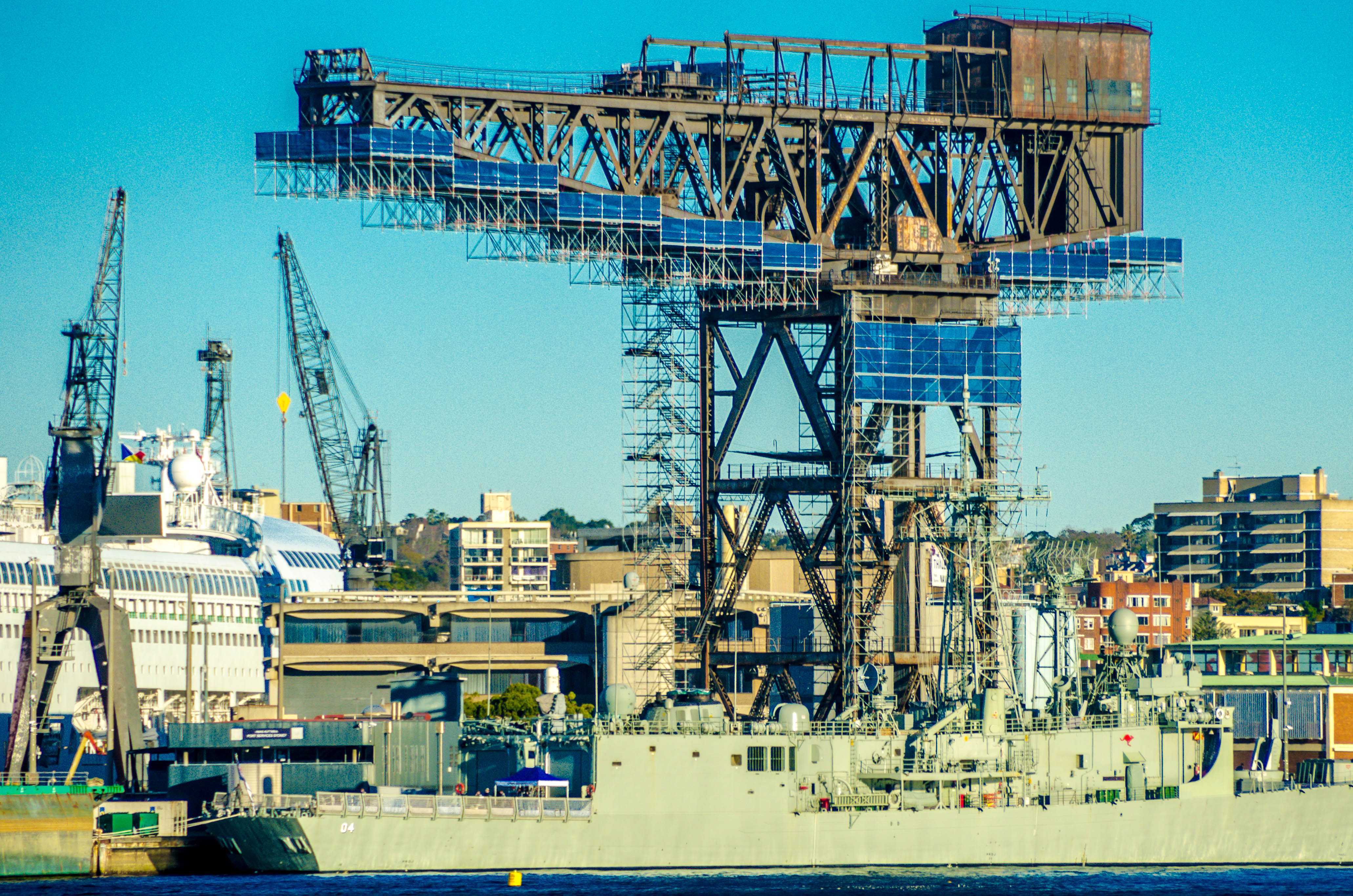
The hammerhead crane was built between 1944 and 1951 on the Fitting Out Wharf at Garden Island. The crane's primary purpose was the removal and installation of warship gun turrets, although it was regularly used for other machinery and loads, and had a lifting capacity of up to 250 tonnes. It was last used in 1996.
In August 2013, the Federal Government announced the removal of the hammerhead crane, at an estimated cost of $10.3 million. Other options, such as preserving the crane as a heritage structure and tourist attraction, restoring it to working order, or converting it to a new purpose, were ruled out due to cost and the risk to security at the naval base.
Tunnel system
Main article: Garden Island Tunnel System
There is a tunnel system under Garden Island that was once used by the Royal Australian Navy. Within this tunnel system was a power station, offices and air raid shelters. This tunnel complex also had a command centre. Other tunnels also exist which headed further in towards Kings Cross. The island also has a pit that was built in the 1800s and was used as a storage facility in case the island was ever attacked. The entrance to this pit has now been sealed.
Current usage
Dockyard
The dockyard facilities are today leased to and operated by the defence contractor Thales Australia, a part of the international Thales Group. They are used to service naval and civilian vessels.
Wharves
The various wharves that line Garden Island remain under the control of the navy and are used as the home port facilities for about half the Royal Australian Navy's major ships. The wharves on the western side of the island have sufficient depth of water to berth the largest United States Navy aircraft carriers.
Royal Australian Navy Heritage Centre
Main article: Royal Australian Navy Heritage Centre
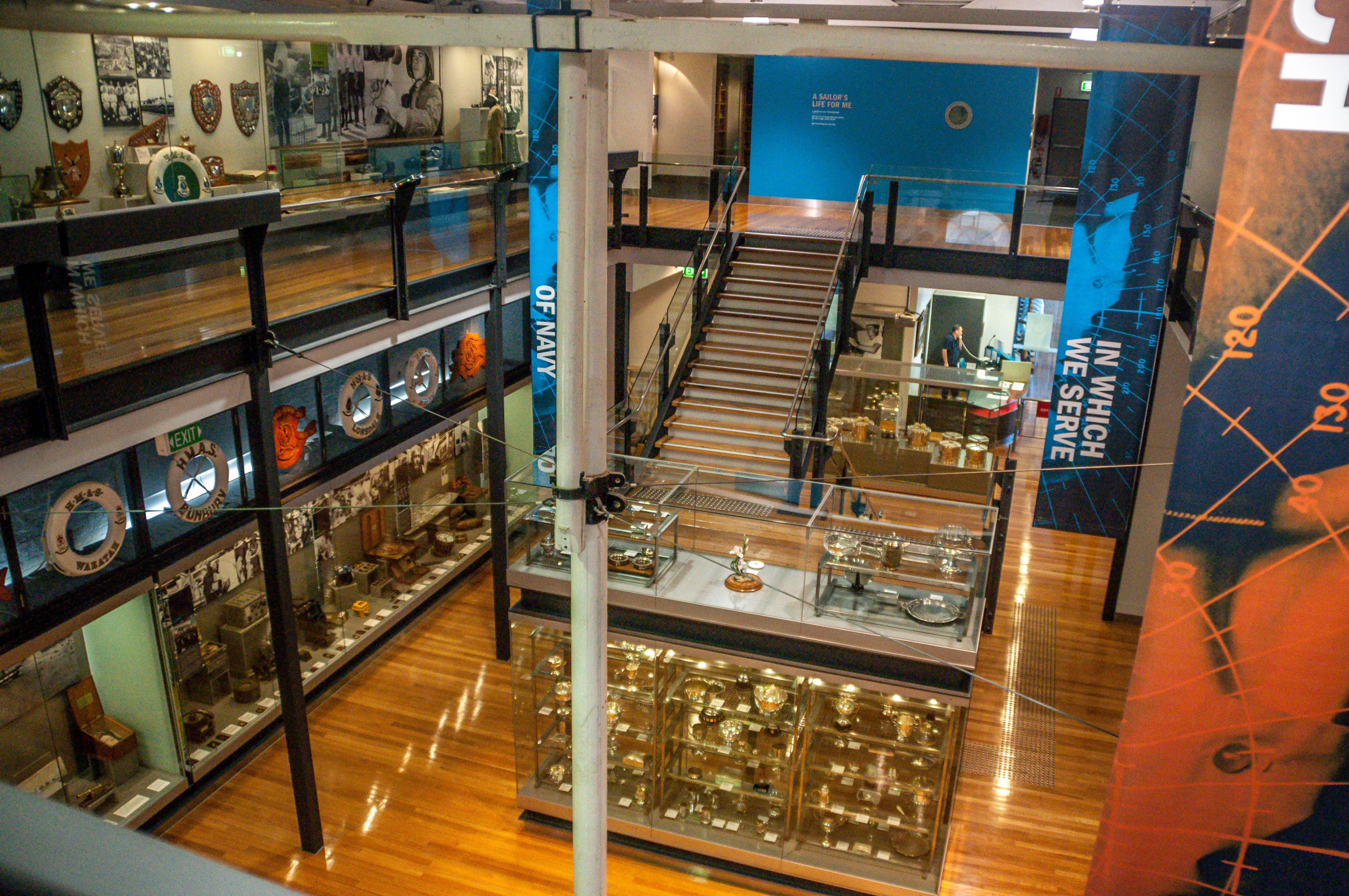
The Royal Australian Navy Heritage Centre was opened in 2005 and is the official museum of the Royal Australian Navy. It is located in the Public Access Precinct of Garden Island: a section at the northern end of the island opened in 2002 that includes several heritage buildings and structures, historical relics, and naval monuments. The museum's exhibits include the conning tower from one of the Japanese midget submarines that attacked Sydney Harbour in 1942. The heritage precinct is isolated from the mainland by the naval and dockyard facilities, with public access limited to the Sydney Ferries service between Circular Quay and Double Bay, with the Garden Island ferry wharf at the north end of the island. Private pre-booked bus groups are allowed to transit through the naval base and dockyard to the heritage precinct under strict conditions.
Other facilities
Various workshops and other buildings on the island are under the control of the nearby HMAS Kuttabul naval base and are used for training and other logistical purposes.
Proposed future usage
Since 2000 the global cruising industry has been building a number of very large ships, some of which were too large to berth at the Overseas Passenger Terminal at Circular Quay, although modifications were made in 2014 to accommodate some larger vessels. Some large ships are permitted to berth at Garden Island's naval wharves, initially on an ad-hoc basis, followed in 2012 by an agreement to permit three cruise ships to berth per year. There have been calls for increased cruise ship access to the naval wharves, with some suggesting that the RAN should relocate entirely.
The RAN and the Department of Defence have opposed these proposals due to the security risks and loss of capability the increased civilian presence would bring, and the enormous cost of replicating the existing capability at a new location (a 2013 defence white paper estimated a cost of over $6 billion, although naval personnel stated that this did not include the creation of support facilities like the graving dock, or relocating supporting companies and industries like Thales). Most of the potential locations for a replacement base would require large-scale, ongoing dredging works to allow access to large naval ships, and have narrow access channels which could be easily blocked in wartime.
Historic buildings and structures
The first naval buildings on the site were minor structures, but in the 1880s the Admiralty (with financial incentives from the Government of New South Wales) began to invest more heavily in the site as a base for the Royal Navy in the southern hemisphere. A number of sizeable buildings were constructed (several designed by James Barnet) providing accommodation, office space, stores of various kinds and a sizeable steam engineering factory. These were later taken over by the Royal Australian Navy, and most remain in use today.
Heritage listings
Garden Island has a number of heritage-listed sites, including:
- Cowper Wharf Roadway: Sydney Harbour Naval Precinct
Gallery
File:Naval Chapel GI1.JPG|Rigging House of 1887 (boat shed below, sail loft above partly converted into a chapel in 1902) File:RAN-IFR 2013 D5 47.JPG|Interconnected Spar Shed/Torpedo Store (left), Sawmill (centre) and Steam Factory (right) of 1889 File:Garden Island, New South Wales (7).jpg|Naval Stores Building of 1893 File:Garden Island, New South Wales (5).jpg|Administration Building of 1894–5 File:RAN Heritage Centre.JPG|Gun-mounting Workshop of 1922
List
| Heritage Items | Date | Description | Details | |
|---|---|---|---|---|
| 1945 | Captain Cook Dock | Constructed between 1941–45 and opened 24 March 1945 as the largest Graving Dock in southern hemisphere | ||
| 1888 | Royal Navy/Royal Marine Barracks | Northern & southern balconies added in 1892 | ||
| 1888 | Kitchens/Laundry | Meals were prepared in kitchens and taken into Barracks for eating | ||
| Detention Quarters | Cell door bolted to wall behind Barracks. The only relic remaining of Detention Quarters | |||
| 1942 | Tanks/air raid shelter | Underground water tanks for kitchens made into air raid shelters for 100 people | ||
| 1928 | Lubricating Oil Store | Modernised and lift added in 1984 to become Dockyard Supply Centre | ||
| 1893 | Sheerlegs Crane | Constructed by Easton & Anderson, then the largest crane in the world. Design Load 160T and Test loaded to 200T. Removed in 1940 | ||
| 1951 | Hammerhead Crane | One of only 15 still standing around the world, the crane has not been used since 1996. Department of Defence has announced removal. | ||
| 1788 | Original Gardens | Gardens were first started on 11 February 1788 for crew of HMS Sirius and used by various ships till 1806. Hence the name Garden Island, given in 1788 in January | ||
| 1893 | Naval Stores | Water hydraulics provides the power for the lifts and hoists | ||
| 1893–c.1960 | Standard gauge rail | Tramway operated around the Island. It was extended to Dock in the 1940s. Steam crane locomotives provided motive power | ||
| 1889 | Chain & Anchor Store/Battery Shop | Submarine batteries maintained. Fire station located at end of Store | ||
| 1889 | Spar Shed/Torpedo Store | Early Church Services in upstairs Dining Room | ||
| 1889 | Sawmill/Factory | Machinery in factory run by belts from a main steam driven shaft | ||
| 1916–1960s | Cable & Chain Testing Machine | Used to pull cables & chain to test links and ends | ||
| 1895 | Coal Store | Storage for nearly 500 tons of coal, with its timber Coaling Wharf at the front, serviced with rail lines | ||
| 1913 | Bow | Stern is located in a park in Parramatta | ||
| 1924 | Gun workshop and store | Converted to the Royal Australian Navy Heritage Centre in 2005 | ||
| Various | Memorials dedicated to ships of the Royal Australian Navy | |||
| 1893 | Tidal Baths | Closed in 1973 due to Harbour water quality and condition of the pool | ||
| 1886 | 2nd Boat Shed | Since 2005 the Dockyard Display for the Royal Australian Navy Heritage Centre | ||
| 1896 | 3rd Boat Shed | First boatshed built west of island in 1858 | ||
| 1893–95 | Administration Building | Originally with single story on each side. Extended in 1920s & 30s. | ||
| 1942 | HMAS *Kuttabul* Memorial | The site of the sinking of the ferry with a loss of 21 lives | ||
| 1887–89 | Rigging House | First major building constructed. Upper floor was a sail loft, lower floor-boat shed and | ||
| 1942 | Slipways/ Air Raid Shelter | Northern Slipway later used as a steel reinforced air raid shelter. The steel plate was originally for , which was lost in battle | ||
| 1950 | Tarakan Disaster Memorial | Landing craft 's petrol tanks exploded, claiming 8 lives | ||
| 1905–1948 | Detention Quarters | Navy gaol with 20 cells. Closed in 1943, demolished in 1948 | ||
| 1884–1888 | Original End of Island | Reclaimed from Hill spoil. Original end of island close to north end of Rigging House. A rocky shoal extended south where Rigging House is now situated | ||
| 1902 | Coffer Dam | Constructed to surround a basin to drain in order for the Dock to be constructed | ||
| 1996 | Church/Memorial Chapel | Balcony inside had 20 partitions for prisoners from gaol to occupy | ||
| 1885 & 1895–96 | Residences | Constructed for Supervisors on call, continued use till the 1990s | ||
| 1880 | 1st Tennis Court | Built around 1880 just south of the residences | ||
| 1884 | 2nd Tennis Court | Built around 1884 on the area south of the present fuel tank remained till c.1930 | ||
| 1788 | Rock Carvings of Initials FM,WB & IR | 3 men surveying Port Jackson landed and carved their initials | ||
| 1902 | 1st Signal Station | |||
| 1910 | 2nd Signal Station | A 72 m mast was constructed in 1912. Shortened flag mast now located at the Australian National Maritime Museum | ||
| 1925 | 3rd Signal Station | |||
| 1917 | Oil Fuel Tank | 5,000-ton oil fuel tank planned in 1913, excavations began in 1915, continuing till 1917 when tank was constructed for the new fuel oil burning ships |
References
Bibliography
- Keesing, Nancy (1975). Garden Island People. Sydney: Wentworth Books. Illustrated by Cedric Emanuel.
References
- "Naval history of Garden Island". Thales Australia.
- [https://www.australiandefence.com.au/general/indigenous-lead-for-garden-island-refurb Indigenous lead for Garden Island refurb], Australian Defense, 2018.
- Correspondence, [[Daniel Southwell]], Midshipman HMS ''Sirius'', 19 February 1789. Cited in Bladen (ed.) 1978, p.694
- "RAN Heritage Centre". Royal Australian Navy.
- (2 April 1922). "Story of Garden Island". Hugh Donald McIntosh, The Sunday Times Newspaper Company.
- Elbourne, Sean. (Winter 2006). "Wonderful Kuttabul – a long history of service". Royal Australian Navy.
- Macey, Richard. (22 November 2002). "Island's tourism birth a date with history". The Sydney Morning Herald.
- Frame, ''No Pleasure Cruise'', p. 147
- Frame, ''No Pleasure Cruise'', p. 194
- The Captain Cook Graving Dock was formally opened by [[Prince Henry, Duke of Gloucester]] in his role as the [[Governor-General of Australia]], with the [[Ribbon-cutting ceremony. ribbon cutting]] performed by the bow of the frigate {{HMAS. Lachlan. K364. Anson. 79
- Frame, ''No Pleasure Cruise'', p. 148
- Wright, Mike. (December 2005). "Hammerhead Crane, Garden Island, NSW". Melbourne Meccano Club.
- McKenny, Leesha. (8 August 2013). "Garden Island crane to be removed". The Sydney Morning Herald.
- Smart, Tanya. (23 June 2014). "Decision to demolish historic Hammerhead crane on Garden Island Dockyard will change harbour vista forever". The Daily Telegraph.
- Barlass, Tim. (2023-09-30). "After Pearl Harbour, the navy scrambled to build tunnels in Sydney. They still remain".
- Dunn, Peter. (10 August 2004). "Potts Point Tunnels, Sydney, NSW during WW2". Australia@War.
- (22 July 2014). "Thales to continue operating Sydney's Garden Island". Asia Pacific Defence Reporter.
- "Guiding Home Kitty Hawk". Navy News.
- Bajkowski, Julian. (5 March 2014). "Stopping Boats Stymies Sydney Visitor Arrivals". Intermedia Group.
- (15 July 2012). "Garden Island to host Cruise Ships: PM". The Sydney Morning Herald.
- Wood, Alicia. (8 March 2015). "Pressure on to allow cruise ships to dock at Garden Island as Sydney Harbour can't cope". The Daily Telegraph.
- (27 August 2013). "Australia's Most Valuable Land is Garden Island Say Developers". Domain.
- Wroe, David. (27 August 2013). "Garden Island Naval Base Faces Closure Under Kevin Rudd". The Sydney Morning Herald.
- Ellery, David. (28 August 2013). "Military Elders Warn Against Moving Navy HQ to Brisbane". The Canberra Times.
- (2013). "Support for the Fleet: architecture and engineering of the Royal Navy's bases 1700-1914". English Heritage.
- {{cite NSW SHR. 5055190. Sydney Harbour Naval Precinct
This article was imported from Wikipedia and is available under the Creative Commons Attribution-ShareAlike 4.0 License. Content has been adapted to SurfDoc format. Original contributors can be found on the article history page.
Ask Mako anything about Garden Island (New South Wales) — get instant answers, deeper analysis, and related topics.
Research with MakoFree with your Surf account
Create a free account to save articles, ask Mako questions, and organize your research.
Sign up freeThis content may have been generated or modified by AI. CloudSurf Software LLC is not responsible for the accuracy, completeness, or reliability of AI-generated content. Always verify important information from primary sources.
Report