From Surf Wiki (app.surf) — the open knowledge base
Gallic acid
3,4,5-Trihydroxybenzoic acid
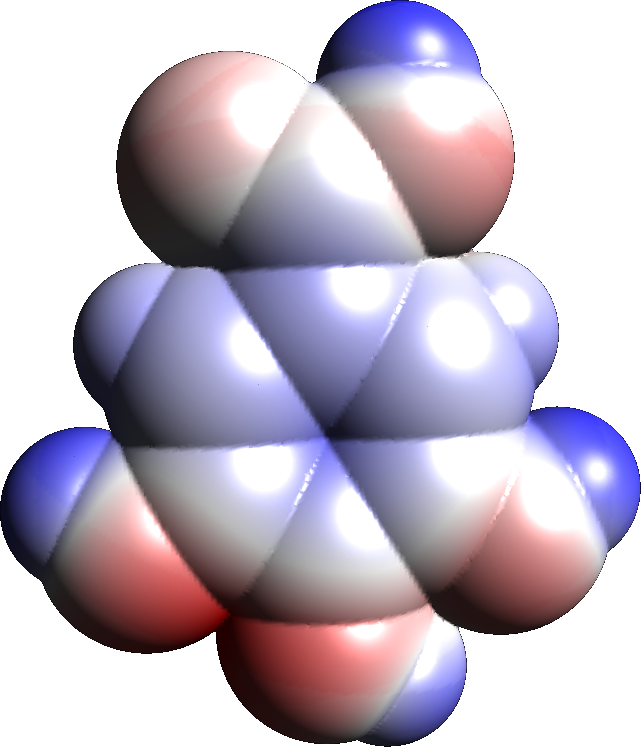
3,4,5-Trihydroxybenzoic acid
pale fawn-colored crystals. 1.5 g/100 mL, 20 °C (monohydrate) negligible in benzene, chloroform, petroleum ether | NFPA-H = 1 | NFPA-F = 0 carboxylic acids
Gallic acid (also known as 3,4,5-trihydroxybenzoic acid) is a trihydroxybenzoic acid with the formula C6H2(OH)3CO2H. It is classified as a phenolic acid. It is found in gallnuts, sumac, witch hazel, tea leaves, oak bark, and other plants. It is a white solid, although samples are typically brown owing to partial oxidation. Salts and esters of gallic acid are termed "gallates".
Its name is derived from oak galls, which were historically used to prepare tannic acid. Despite the name, gallic acid does not contain gallium.
Isolation and derivatives
Gallic acid is easily freed from gallotannins by acidic or alkaline hydrolysis. When heated with concentrated sulfuric acid, gallic acid converts to rufigallol..
Biosynthesis

Gallic acid is formed from 3-dehydroshikimate by the action of the enzyme shikimate dehydrogenase to produce 3,5-didehydroshikimate. This latter compound aromatizes.
Reactions
Oxidation and oxidative coupling
Alkaline solutions of gallic acid are readily oxidized by air. The oxidation is catalyzed by the enzyme gallate dioxygenase, an enzyme found in Pseudomonas putida.
Oxidative coupling of gallic acid with arsenic acid, permanganate, persulfate, or iodine yields ellagic acid, as does reaction of methyl gallate with iron(III) chloride. Gallic acid forms intermolecular esters (depsides) such as digallic and cyclic ether-esters (depsidones).
Hydrogenation
Hydrogenation of gallic acid gives the cyclohexane derivative hexahydrogallic acid.
Decarboxylation
Heating gallic acid gives pyrogallol (1,2,3-trihydroxybenzene). This conversion is catalyzed by gallate decarboxylase.
Esterification
Many esters of gallic acid are known, both synthetic and natural. Gallate 1-beta-glucosyltransferase catalyzes the glycosylation (attachment of glucose) of gallic acid.
Historical context and uses
Gallic acid is an important component of iron gall ink, the standard European writing and drawing ink from the 12th to 19th centuries, with a history extending to the Roman empire and the Dead Sea Scrolls. Pliny the Elder (23–79 AD) describes the use of gallic acid as a means of detecting an adulteration of verdigris and writes that it was used to produce dyes. Galls (also known as oak apples) from oak trees were crushed and mixed with water, producing tannic acid. It could then be mixed with green vitriol (ferrous sulfate)—obtained by allowing sulfate-saturated water from a spring or mine drainage to evaporate—and gum arabic from acacia trees; this combination of ingredients produced the ink.
Gallic acid was one of the substances used by Angelo Mai (1782–1854), among other early investigators of palimpsests, to clear the top layer of text off and reveal hidden manuscripts underneath. Mai was the first to employ it, but did so "with a heavy hand", often rendering manuscripts too damaged for subsequent study by other researchers.
Gallic acid was first studied by the Swedish chemist Carl Wilhelm Scheele in 1786. In 1818, French chemist and pharmacist Henri Braconnot (1780–1855) devised a simpler method of purifying gallic acid from galls; gallic acid was also studied by the French chemist Théophile-Jules Pelouze (1807–1867), among others.
When mixed with acetic acid, gallic acid had uses in early types of photography, like the calotype to make the silver more sensitive to light; it was also used in developing photographs.
Occurrence
Gallic acid is found in a number of land plants, such as the parasitic plant Cynomorium coccineum, the aquatic plant Myriophyllum spicatum, and the blue-green alga Microcystis aeruginosa. Gallic acid is also found in various oak species, Caesalpinia mimosoides, and in the stem bark of Boswellia dalzielii, among others. Many foodstuffs contain various amounts of gallic acid, especially fruits (including strawberries, grapes, bananas), as well as teas, cloves, and vinegars. Carob fruit is a rich source of gallic acid (24–165 mg per 100 g).
Esters
Also known as galloylated esters:
- Methyl gallate
- Ethyl gallate, a food additive with E number E313
- Propyl gallate, or propyl 3,4,5-trihydroxybenzoate, an ester formed by the condensation of gallic acid and propanol
- Octyl gallate, the ester of octanol and gallic acid
- Dodecyl gallate, or lauryl gallate, the ester of dodecanol and gallic acid
- Epicatechin gallate, a flavan-3-ol, a type of flavonoid, present in green tea
- Epigallocatechin gallate (EGCG), also known as epigallocatechin 3-gallate, the ester of epigallocatechin and gallic acid, and a type of catechin
- Gallocatechin gallate (GCG), the ester of gallocatechin and gallic acid and a type of flavan-3ol
- Theaflavin-3-gallate, a theaflavin derivative
Gallate esters are antioxidants useful in food preservation, with propyl gallate being the most commonly used. Their use in human health is scantly supported by evidence.
Spectral data
| UV-Vis | IR | NMR | MS | ||
|---|---|---|---|---|---|
| Lambda-max: | 220, 271 nm (ethanol) | ||||
| [[File:Gallic acid spectrum.PNG | thumb | left | Spectrum of gallic acid]] | ||
| Extinction coefficient (log ε) | D (22°C) : -- | ||||
| Major absorption bands | ν : 3491, 3377, 1703, 1617, 1539, 1453, 1254 cm−1 (KBr) | ||||
| Proton NMR | δ : | ||||
| Carbon-13 NMR | δ : | ||||
| Other NMR data 19F chem. shifts, omit if not used -- | |||||
| Masses of | |||||
| main fragments | ESI-MS [M-H]- m/z : 169.0137 ms/ms (iontrap)@35 CE m/z product 125(100), 81( |
References
References
- (1994). "Plant polyphenols (vegetable tannins): Gallic acid metabolism". Natural Product Reports.
- Andrew Pengelly. (2004). "The Constituents of Medicinal Plants". Allen & Unwin.
- [http://www.metacyc.org/META/NEW-IMAGE?type=PATHWAY&object=PWY-6707 Gallic acid pathway on metacyc.org]
- (1969). "Phenol Biosynthesis in Higher Plants. Gallic Acid". Biochemical Journal.
- Edwin Ritzer. (2007). "Ullmann's Encyclopedia of Industrial Chemistry". Wiley.
- Albert W. Burgstahler and Zoe J. Bithos. (1962). "Hexahydrogallic Acid and Hexahydrogallic Acid Triacetate". Organic Syntheses.
- Pliny the Elder with John Bostock and H.T. Riley, trans., ''The Natural History of Pliny'' (London, England: Henry G. Bohn, 1857), vol. 6, [https://books.google.com/books?id=IEoMAAAAIAAJ&pg=PA196 p. 196.] In Book 34, Chapter 26 of his ''Natural History'', Pliny states that verdigris (a form of copper acetate (Cu(CH3COO)2·2Cu(OH)2), which was used to process leather, was sometimes adulterated with copperas (a form of iron(II) sulfate (FeSO4·7H2O)). He presented a simple test for determining the purity of verdigris. From p. 196: "The adulteration [of verdigris], however, which is most difficult to detect, is made with copperas; ... The fraud may also be detected by using a leaf of papyrus, which has been steeped in an infusion of nut-galls; for it becomes black immediately upon the genuine verdigris being applied."
- Fruen, Lois. "Iron Gall Ink".
- L.D. Reynolds and N.G. Wilson, "Scribes and Scholars" 3rd Ed. Oxford: 1991, pp 193–4.
- Carl Wilhelm Scheele (1786) [https://books.google.com/books?id=6eE4AAAAMAAJ&pg=PA30 "Om Sal essentiale Gallarum eller Gallåple-salt"] (On the essential salt of galls or gall-salt), ''Kongliga Vetenskaps Academiens nya Handlingar'' (Proceedings of the Royal [Swedish] Academy of Science), '''7''': 30–34.
- Braconnot Henri. (1818). "Observations sur la préparation et la purification de l'acide gallique, et sur l'existence d'un acide nouveau dans la noix de galle". Annales de Chimie et de Physique.
- J. Pelouze (1833) [https://books.google.com/books?id=ISpCAAAAcAAJ&pg=PA337 "Mémoire sur le tannin et les acides gallique, pyrogallique, ellagique et métagallique,"] ''Annales de chimie et de physique'', '''54''': 337–365 [presented February 17, 1834].
- (2007). "Impressed by Light: British Photographs from Paper Negatives, 1840-1860". Metropolitan Museum of Art.
- (11 January 2013). "Evaluation of Antioxidant Potential of "Maltese Mushroom" (Cynomorium coccineum) by Means of Multiple Chemical and Biological Assays". Nutrients.
- (2000). "Myriophyllum spicatum-released allelopathic polyphenols inhibiting growth of blue-green algae Microcystis aeruginosa". Water Research.
- (2000). "Analysis of oak tannins by liquid chromatography-electrospray ionisation mass spectrometry". Journal of Chromatography A.
- (2007). "Antimicrobial gallic acid from Caesalpinia mimosoides Lamk". Food Chemistry.
- (2007). "Antibacterial phenolics from Boswellia dalzielii". Nigerian Journal of Natural Products and Medicine.
- (2015). "Gallic acid attenuates dextran sulfate sodium-induced experimental colitis in BALB/c mice". Drug Design, Development and Therapy.
- (2007). "Influence of maceration temperature in red wine vinification on extraction of phenolics from berry skins and seeds of grape (Vitis vinifera)". Bioscience, Biotechnology, and Biochemistry.
- (2000). "Gallic acid metabolites are markers of black tea intake in humans". Journal of Agricultural and Food Chemistry.
- (2004). "TLC Densitometric Method for the Quantification of Eugenol and Gallic Acid in Clove". Chromatographia.
- (1994). "Analysis of polyphenolic compounds of different vinegar samples". Zeitschrift für Lebensmittel-Untersuchung und -Forschung.
- (10 November 2016). "Functional Components of Carob Fruit: Linking the Chemical and Biological Space". International Journal of Molecular Sciences.
This article was imported from Wikipedia and is available under the Creative Commons Attribution-ShareAlike 4.0 License. Content has been adapted to SurfDoc format. Original contributors can be found on the article history page.
Ask Mako anything about Gallic acid — get instant answers, deeper analysis, and related topics.
Research with MakoFree with your Surf account
Create a free account to save articles, ask Mako questions, and organize your research.
Sign up freeThis content may have been generated or modified by AI. CloudSurf Software LLC is not responsible for the accuracy, completeness, or reliability of AI-generated content. Always verify important information from primary sources.
Report