From Surf Wiki (app.surf) — the open knowledge base
Galena
Natural mineral form of lead sulfide

Natural mineral form of lead sulfide
| Field | Value |
|---|---|
| name | Galena |
| category | Sulfide mineral |
| image | Galena - Huallanca, Bologesi, Ancash, Peru.jpg |
| imagesize | 275px |
| caption | Galena with minor pyrite |
| formula | PbS |
| IMAsymbol | Gn |
| strunz | 2.CD.10 |
| dana | 2.8.1.1 |
| system | Cubic |
| class | Hexoctahedral (mm) |
| H–M symbol: ( ) | |
| symmetry | *Fm*m |
| unit cell | *a* = 5.936 Å; *Z* = 4 |
| color | Lead gray and silvery |
| habit | Cubes and octahedra, blocky, tabular and sometimes skeletal crystals |
| twinning | Contact, penetration and lamellar |
| cleavage | Cubic perfect on {001}, parting on {111} |
| fracture | Subconchoidal |
| tenacity | Brittle |
| mohs | 2.5–2.75 |
| luster | Metallic on cleavage planes |
| opticalprop | Isotropic and opaque |
| streak | Lead gray |
| gravity | 7.2–7.6 |
| fusibility | 2 |
| diaphaneity | Opaque |
| other | Natural semiconductor |
| references |
H–M symbol: ( ) Galena, also called lead glance, is the natural mineral form of lead(II) sulfide (PbS). It is the most important ore of lead and an important source of silver.
Galena is one of the most abundant and widely distributed sulfide minerals. It crystallizes in the cubic crystal system often showing octahedral forms. It is often associated with the minerals sphalerite, calcite and fluorite.
As a pure specimen held in the hand, under standard temperature and pressure, galena is insoluble in water and so is almost non-toxic. Handling galena under these specific conditions (such as in a museum or as part of geology instruction) poses practically no risk; however, as lead(II) sulfide is reasonably reactive in a variety of environments, it can be highly toxic if swallowed or inhaled, particularly under prolonged or repeated exposure.
Occurrence
Galena is the main ore of lead, used since ancient times, since lead can be smelted from galena in an ordinary wood fire. Galena typically is found in hydrothermal veins in association with sphalerite, marcasite, chalcopyrite, cerussite, anglesite, dolomite, calcite, quartz, barite, and fluorite. It is also found in association with sphalerite in low-temperature lead-zinc deposits within limestone beds. Minor amounts are found in contact metamorphic zones, in pegmatites, and disseminated in sedimentary rock.
Argentiferous galena In some deposits, the galena contains up to 0.5% silver, a byproduct that far surpasses the main lead ore in revenue. In these deposits significant amounts of silver occur as included silver sulfide mineral phases or as limited silver in solid solution within the galena structure. These argentiferous galenas have long been an important ore of silver. Silver-bearing galena is almost entirely of hydrothermal origin; galena in lead-zinc deposits contains little silver.
Galena deposits are found worldwide in various environments. the Madan and Rhodope Mountains in Bulgaria; the Sullivan Mine of British Columbia; Broken Hill and Mount Isa in Australia; and the ancient mines of Sardinia.
In the United States, it occurs most notably as lead-zinc ore in the Mississippi Valley type deposits of the Lead Belt in southeastern Missouri, which is the largest known deposit, and in the Driftless Area of Illinois, Iowa and Wisconsin, providing the origin of the name of Galena, Illinois, a historical settlement known for the material. Galena also was a major mineral of the zinc-lead mines of the tri-state district around Joplin in southwestern Missouri and the adjoining areas of Kansas and Oklahoma. Galena is also an important ore mineral in the silver mining regions of Colorado, Idaho, Utah and Montana. Of the latter, the Coeur d'Alene district of northern Idaho was most prominent.
Australia is the world's leading producer of lead as of 2021, most of which is extracted as galena. Argentiferous galena was accidentally discovered at Glen Osmond in 1841, and additional deposits were discovered near Broken Hill in 1876 and at Mount Isa in 1923. Most galena in Australia is found in hydrothermal deposits emplaced around 1680 million years ago, which have since been heavily metamorphosed.
The largest documented crystal of galena is composite cubo-octahedra from the Great Laxey Mine, Isle of Man, measuring 25 ×. This specimen is on permanent display in the minerals gallery of the Natural History Museum, London.
Importance
Galena is the official state mineral of the U.S. states of Kansas, Missouri, and Wisconsin; the former mining communities of Galena, Kansas, Galena, Illinois, Galena, South Dakota and Galena, Alaska, take their names from deposits of this mineral.
Structure
Galena belongs to the octahedral sulfide group of minerals that have metal ions in octahedral positions, such as the iron sulfide pyrrhotite and the nickel arsenide niccolite. The galena group is named after its most common member, with other isometric members that include manganese bearing alabandite and niningerite.
Divalent lead (Pb) cations and sulfur (S) anions form a close-packed cubic unit cell much like the mineral halite of the halide mineral group. Zinc, cadmium, iron, copper, antimony, arsenic, bismuth and selenium also occur in variable amounts in galena. Selenium substitutes for sulfur in the structure constituting a solid solution series. The lead telluride mineral altaite has the same crystal structure as galena.
Geochemistry
Within the weathering or oxidation zone galena alters to anglesite (lead sulfate) or cerussite (lead carbonate).
Uses
One of the oldest uses of galena was to produce kohl, an eye cosmetic now regarded as toxic due to the risk of lead poisoning. In Ancient Egypt, this was applied around the eyes to reduce the glare of the desert sun and to repel flies, which were a potential source of disease.
In pre-Columbian North America, galena was used by indigenous peoples as an ingredient in decorative paints and cosmetics, and widely traded throughout the eastern United States. Traces of galena are frequently found at the Mississippian city at Kincaid Mounds in present-day Illinois. The galena used at the site originated from deposits in southeastern and central Missouri and the Upper Mississippi Valley.
Galena is the primary ore of lead, and is often mined for its silver content.
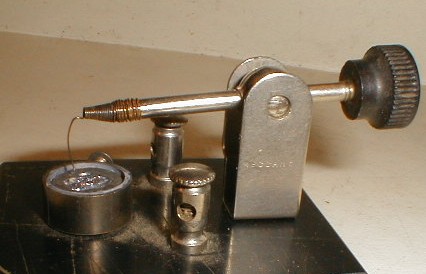
Galena is a semiconductor with a small band gap of about 0.4 eV, which found use in early wireless communication systems. It was used as the crystal in crystal radio receivers, in which it was used as a point-contact diode capable of rectifying alternating current to detect the radio signals. The galena crystal was used with a sharp wire, known as a "cat's whisker", in contact with it.
In modern times, galena is primarily used to extract its constituent minerals. In addition to silver, it is the most important source of lead, for uses such as in lead-acid batteries.
References
References
- Warr, L.N.. (2021). "IMA–CNMNC approved mineral symbols". Mineralogical Magazine.
- (1990). "Handbook of Mineralogy". Mineralogical Society of America.
- "Galena". Webmineral.
- [http://www.mindat.org/min-1641.html Galena]. Mindat.org
- (2008). "Hydrometallurgy 2008: Proceedings of the Sixth International Symposium". SME.
- (2014-03-25). "Lead Sulfide SDS (Safety Data Sheet)".
- (May 1928). "Silver in Ancient Times". The Journal of Egyptian Archaeology.
- Winder, C.. (1993b). "The history of lead – Part 3". LEAD Action News.
- (1993). "Manual of mineralogy (after James D. Dana)". Wiley.
- Hobart M. King. "Galena Mineral {{!}} Uses and Properties". geology.com.
- (2021). "Sending Laurion Back to the Future: Bronze Age Silver and the Source of Confusion". Internet Archaeology.
- Calvo, Miguel. (2003). "Minerales y Minas de España. Vol. II. Sulfuros y sulfosales.". Museo de Ciencias Naturales de Alava.
- (4 March 2018). "Lead". Australian Government.
- (1998-12-01). "Geology and mineralization of the Cannington Ag-Pb-Zn deposit; an example of Broken Hill-type mineralization in the eastern succession, Mount Isa Inlier, Australia". Economic Geology.
- Rickwood, P. C.. (1981). "The largest crystals". American Mineralogist.
- "Official state mineral". Kansas Legislature.
- "Office of the Secretary of State, Missouri – State Symbols". State of Missouri.
- "Wisconsin State Symbols". State of Wisconsin.
- Rydjord, John (1972) ''Kansas Place-Names'', University of Oklahoma Press. p. 77 {{ISBN. 0-8061-0994-7
- Gannett, Henry. (1905). "The Origin of Certain Place Names in the United States". Govt. Print. Off..
- Galena Historical Society. (June 21, 2006). "History Highlights".
- [http://www.dec.state.ak.us/SPAR/CSP/sites/galena.htm state.ak.us]
- (2004). "Kinetics and mechanism of the bacterial and ferric sulphate oxidation of galena". Hydrometallurgy.
- (17 December 2019). "Toxic trends". Wellcome Collection.
- Metropolitan Museum of Art. (2005). "The Art of Medicine in Ancient Egypt".
- (21 October 2019). "Lead pollution from Native Americans attributed to crushing galena for glitter paint, adornments". [[Indiana University–Purdue University Indianapolis]].
- [https://www.atlasobscura.com/articles/found-precolumbian-glitter-in-illinois The Glittery Legacy of Lead at a Historic Native American Site], [[Atlas Obscura]], November 7, 2019
- It is used as a source of lead in [[ceramic glaze]].[http://www.thepotteries.org/types/glaze.htm Glaze]. thepotteries.org
- (2007). "The (Pre-)History of the Integrated Circuit: A Random Walk".
This article was imported from Wikipedia and is available under the Creative Commons Attribution-ShareAlike 4.0 License. Content has been adapted to SurfDoc format. Original contributors can be found on the article history page.
Ask Mako anything about Galena — get instant answers, deeper analysis, and related topics.
Research with MakoFree with your Surf account
Create a free account to save articles, ask Mako questions, and organize your research.
Sign up freeThis content may have been generated or modified by AI. CloudSurf Software LLC is not responsible for the accuracy, completeness, or reliability of AI-generated content. Always verify important information from primary sources.
Report