From Surf Wiki (app.surf) — the open knowledge base
Funnel (ship)
Ship structure for expelling exhaust gases
.jpg)
Ship structure for expelling exhaust gases
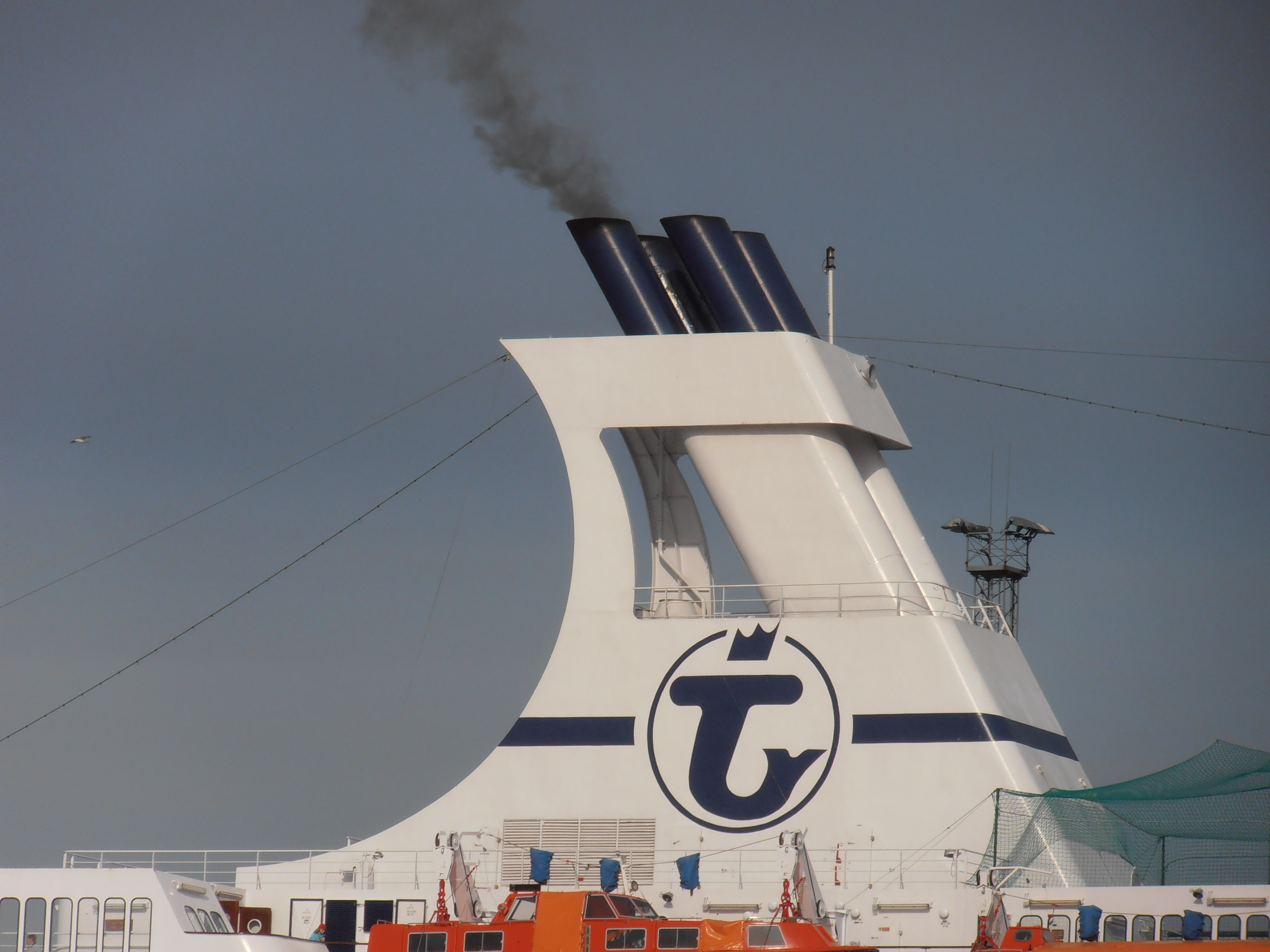
A funnel is the smokestack or chimney on a ship used to expel boiler steam and smoke or engine exhaust. They are also commonly referred to as stacks.
Purpose
_at_anchor_1942.jpg)

The primary purpose of a ship's funnel(s) is to lift the exhaust gases clear of the deck, in order not to foul the ship's structure or decks, and to avoid impairing the ability of the crew to carry out their duties.
In steam ships the funnels also served to help induce a convection draught through the boilers.
Design
Since the introduction of steam-power to ships in the 19th century, the funnel has been a distinctive feature of the silhouette of a vessel, and used for recognition purposes.
Funnel area
The required funnel cross-sectional area is determined by the volume of exhaust gases produced by the propulsion plant. Often this area is too great for a single funnel. Early steam vessels needed multiple funnels ( had 5 when launched), but as efficiency increased new machinery needed fewer funnels.
Merchant ships
Merchant shipping companies (and particularly liner companies such as Cunard and ferries such as Red Funnel) were quick to recognise the publicity value of distinctive funnels, both in terms of shape, number of funnels, and the colours they were painted. In an era when ship hulls were uniformly painted black (to conceal inevitable dirt when loading the ship with coal) and superstructures were white (to control the temperature in the passenger accommodation in hot summers) the funnel was one of the few parts of the ship that a company could use to clearly differentiate its ships from those of its competitors. Each company would have their own "house colours", which were often used in publicity material as well as for recognition, making funnel colours an early form of trademark.{{cite web |access-date=10 February 2011 |archive-url=https://web.archive.org/web/20000829075303/http://www.theshipslist.com/ships/lines/funnels.html |archive-date=29 August 2000 |url-status=dead
Sometimes the shape of the funnel is used as distinguishing feature rather than just the colour. Cunard fitted ships of its Saxonia class with streamlined round tops to the funnels. Intended as an aerodynamic aid to keep exhaust clear of the deck the modification had very little practical effect but was retained because it made the four ships of the class immediately recognisable and gave Cunard a suitable modern image. There was a trend for 'designer funnels' on liners in the 1960s as fashion and aerodynamic advances combined to offer designers more options that the traditional cylindrical smokestack. The Italian Line fitted the liners Michelangelo and Raffaello with funnels topped by flat discs supported on exposed diagonal bracing while P&O's Oriana and Canberra had tall, thin funnels with aerofoil cross sections.
In the late 19th and the first half of the 20th century the number of funnels became associated with speed and reliability. For this reason a number of the great liners carried additional false funnels that they did not need. Examples included the White Star Line's , Hamburg America Line's , and later the French Line's . In most cases there was only a single false funnel placed as the aftermost of the funnels. The false funnels did have more uses than simply aiding aesthetics however - a stoker who survived the sinking of the Titanic escaped the boiler room by ascending the false funnel, the aft funnel of Normandie housed the passengers' dog kennels, and Disney Cruise Line's Disney Magic's forward funnel plays host to a teens-only club.
Naval ships
A key part of the deception practiced by ships carrying out commerce raiding during both the First World War and Second World War was to disguise their ship's outline, and this included using false funnels or by changing the height or diameter of the actual funnel(s).{{cite web |access-date=10 February 2011 |url-status=deviated

Five naval ships with six funnels each were constructed in the late 19th and early 20th centuries: two Italia-class ironclad battleships operated by the Italian Navy from 1885 to 1921, the French armored cruiser Ernest Renan, and the two Edgar Quinet-class armored cruisers operated by the French Navy from 1911 to 1932. Both had their funnels in two groups of three before and abaft of center.
Macks
A mack is a combined stack and mast, as fitted to some classes of 20th century warships. Although they can reduce top-weight, they have not gained universal popularity due to the problem of exhaust gases corroding electrical aerials and equipment.
References
This article was imported from Wikipedia and is available under the Creative Commons Attribution-ShareAlike 4.0 License. Content has been adapted to SurfDoc format. Original contributors can be found on the article history page.
Ask Mako anything about Funnel (ship) — get instant answers, deeper analysis, and related topics.
Research with MakoFree with your Surf account
Create a free account to save articles, ask Mako questions, and organize your research.
Sign up freeThis content may have been generated or modified by AI. CloudSurf Software LLC is not responsible for the accuracy, completeness, or reliability of AI-generated content. Always verify important information from primary sources.
Report