From Surf Wiki (app.surf) — the open knowledge base
FTV-2203
American reconnaissance satellite
American reconnaissance satellite
| Field | Value |
|---|---|
| name | FTV-2203 |
| mission_type | Reconnaissance |
| operator | US Air Force |
| Harvard_designation | 1962 Alpha Lambda 1 |
| mission_duration | 15-30 days (planned) |
| spacecraft_type | Samos-E5 |
| launch_date | UTC |
| launch_rocket | Atlas LV-3A Agena-B 114D |
| launch_site | Point Arguello LC-1-2 |
| disposal_type | Failed deorbit |
| deactivated | |
| decay_date | 31 December 1961 |
| orbit_epoch | 22 December 1961, 14:12:00 UTC |
| orbit_reference | Geocentric |
| orbit_regime | Low Earth |
| orbit_eccentricity | 0.0334 |
| orbit_periapsis | 244 km |
| orbit_apoapsis | 702 km |
| orbit_inclination | 89.2 degrees |
| orbit_period | 94.5 minutes |
| apsis | gee |
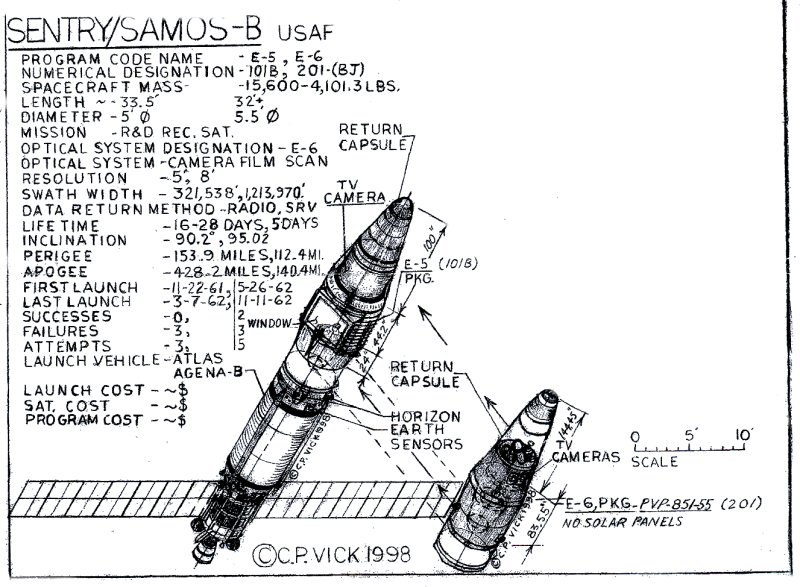
FTV-2203, also known as Samos 5, was an American reconnaissance satellite launched in 1961 as part of the Samos programme. It was a film return reconnaissance spacecraft, meaning that it returned images in a film capsule at the end of its mission. FTV-2203 was a Samos-E5 spacecraft, based on the Agena-B. It carried a camera with a focal length of 1.67 m and a resolution of 1.5 m.
The launch
The launch of FTV-2203 occurred at 19:12:33 UTC on 22 December 1961. An Atlas LV-3A Agena-B rocket was used, flying from Launch Complex 1-2 at the Point Arguello Naval Air Station. During the launch, the first stage sustainer engine failed to shut down on time, and instead burned until all of its oxidiser had been depleted. As a result, the spacecraft reached a higher orbit than had been planned. It was assigned the Harvard designation 1961 Alpha Lambda 1.
Following launch, FTV-2203 was in a low Earth orbit with an apogee of 650 km, a perigee of 230 km, and 89.6 degrees of inclination. Within a few days of launch, it was commanded to deorbit in order to return its film capsule. This was conducted, however due to the additional altitude provided by the anomaly during launch, it was unable to fully deorbit. The burn lowered its orbit, and it reentered the atmosphere on 31 December 1961. The film capsule, which had separated following the attempted deorbit burn, decayed on 9 January 1962. The satellite had a mass of 2580 kg, and measured 10.21 m in length, with a diameter of 1.52 m.
References
References
- "NASA - NSSDCA - Spacecraft - Trajectory Details".
- Wade, Mark. "Samos". [[Encyclopedia Astronautica]].
- Krebs, Gunter. "Samos E-1". Gunter's Space Page.
- McDowell, Jonathan. "Launch Log". Jonathan's Space Page.
- McDowell, Jonathan. "Samos 5". Jonathan's Space Page.
- McDowell, Jonathan. "Satellite Catalog". Jonathan's Space Page.
- "Sentry/Samos-B". FAS.
This article was imported from Wikipedia and is available under the Creative Commons Attribution-ShareAlike 4.0 License. Content has been adapted to SurfDoc format. Original contributors can be found on the article history page.
Ask Mako anything about FTV-2203 — get instant answers, deeper analysis, and related topics.
Research with MakoFree with your Surf account
Create a free account to save articles, ask Mako questions, and organize your research.
Sign up freeThis content may have been generated or modified by AI. CloudSurf Software LLC is not responsible for the accuracy, completeness, or reliability of AI-generated content. Always verify important information from primary sources.
Report