From Surf Wiki (app.surf) — the open knowledge base
Fruit salad
Dish consisting of fruits
Dish consisting of fruits
| Field | Value |
|---|---|
| name | Fruit salads |
| image | Fruktsallad (Fruit salad).jpg |
| image_size | 250px |
| caption | A plate of fruit salad made of pear, satsuma mandarin, kiwifruit, passion fruit, pomegranate seeds, and Greek yogurt mixed with honey, cardamom and vanilla sugar |
| alternate_name | Fruit cocktail, fruit cup |
| course | Appetizer, dessert, snack, main meal |
| type | Salad |
| main_ingredient | Fruit, fruit juice or syrup |
| variations | Macedonia |
Fruit salad is a dish consisting of various kinds of fruit, sometimes served in a liquid, either their juices or a syrup. In different forms, fruit salad can be served as an appetizer or a side as a salad. A fruit salad is sometimes known as a fruit cocktail (often connoting a canned product), or fruit cup (when served in a small container).
There are many types of fruit salad, ranging from the basic (no nuts, marshmallows, or dressing) to the moderately sweet (Waldorf salad) to the sweet (ambrosia salad). Another "salad" containing fruit is a jello salad, with its many variations. A fruit cocktail is well-defined in the US to mean a well-distributed mixture of small diced pieces of (from highest percentage to lowest) peaches, pears, pineapple, grapes, and cherry halves. Fruit salad may also be canned (with larger pieces of fruit than a cocktail).
Description
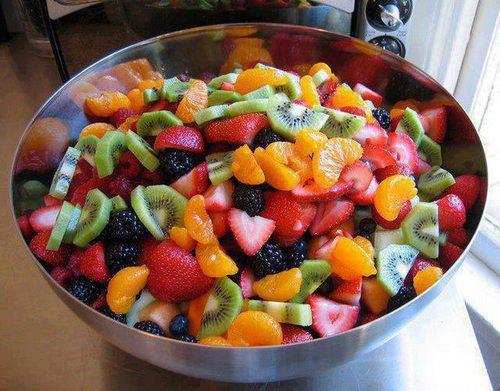
There are several home recipes for fruit salads that contains different kinds of fruit, or that use a different kind of sauce other than the fruit's juice or syrup. Common ingredients used in fruit salads include strawberries, pineapple, honeydew, watermelon, grapes, and kiwifruit. Various recipes may call for the addition of nuts, fruit juices, certain vegetables, yogurt, or other ingredients.
One variation is a Waldorf-style fruit salad, which uses a mayonnaise-based sauce. Other recipes use sour cream (such as in ambrosia), yogurt, or even custard as the primary sauce ingredient. A variation on fruit salad uses whipped cream mixed in with many varieties of fruits (usually a mixture of berries), and also often includes miniature marshmallows. Rojak, a Malaysian fruit salad, uses a spicy sauce with peanuts and shrimp paste. In the Philippines, fruit salads are popular party and holiday fare, usually made with buko, or young coconut, and condensed milk in addition to other canned or fresh fruit. In Hawaii by influence of Cantonese immigrants during the sugar plantation days,"almond float" was introduced, where almond flavored gelatin is prepared, cubed, and typically mixed with canned fruit cocktail and canned lychee. Sicilian orange salad is a typical dish of Sicily (Italy) and Spain in which orange slices are dressed with olive oil, salt, and black pepper.
Mexico has a popular variation of the fruit salad called Bionico which consists of various fruits drenched in condensed milk and sour cream mix. Guacamole may also be considered a fruit salad, consisting predominantly of various fruits and fruit juices such as avocados, lemon and/or lime juice, tomatoes, chili peppers, and black peppercorns.
There is also an extended variety of fruit salads in Moroccan cuisine, often as part of a kemia, a selection of appetizers or small dishes analogous to Spanish tapas or eastern Mediterranean mezze.
A fruit salad ice cream is also commonly manufactured, with small pieces of real fruit embedded, flavored either with juices from concentrate, fruit extracts, or artificial chemicals.
Another type of fruit salad is one of the recipes that went viral on TikTok in 2024, named Hwachae. Korean fruit salad is a dessert that aims to be hydrating and refreshing. Made with fresh fruits, strawberry milk, seven-up and jelly or jell-o, this recipe is very popular in Asia.
Fruit cocktail

Fruit cocktail is often sold canned and is a staple of cafeterias, but can also be made fresh. The use of the word "cocktail" in the name does not mean that it contains alcohol, but refers to the secondary definition: "an appetizer made by combining pieces of food, such as fruit or seafood".
In the United States, the USDA stipulates that canned "fruit cocktail" must contain a certain percentage distribution of pears, grapes, cherries, peaches, and pineapples to be marketed as fruit cocktail. It must contain fruits in the following range of percentages:
- 30% to 50% diced peaches, any yellow variety
- 25% to 45% diced pears, any variety
- 6% to 16% diced pineapple, any variety
- 6% to 20% whole grapes, any seedless variety
- 2% to 6% cherry halves, any light sweet or artificially colored red variety (like maraschino cherries)
Both William Vere Cruess of the University of California, Berkeley and Herbert Gray of the Barron-Gray Packing Company of San Jose, California, have been credited with the invention of fruit cocktails. Barron–Gray was the first company to sell fruit cocktail commercially, beginning in 1930, and California Packing Corporation began selling it under its Del Monte brand a few years later.
Canned fruit cocktails and canned fruit salad are similar, but fruit salad contains larger fruit while fruit cocktail is diced. Commercially, the fruit used was healthy but cosmetically damaged, such as a peach or pear that was bruised on one side. The bruised parts would be cut away and discarded, and the rest would be diced into small pieces.
In popular culture
"Fruit Salad" (also known as "Fruit Salad Yummy Yummy") is the name of a song by Australian children's band the Wiggles.
"Fruit-salad" is also a slang term used for medals on a soldier's uniform, e.g. "Look at the fruit-salad on that colonel." The term refers to the bright colors of a high percentage of the ribbons that usually go with medals.
"Fruit salad" is an alternative name for the party game Fruit Basket Turnover.
References
References
- "Watermelon Salad: A Different kind of fruit salad". Watermelon Salad.
- Barroll, M.L.H.. (1913). "Around-the-world Cook Book: The Culinary Gleanings of a Naval Officer's Wife". Century Company.
- (10 March 2008). "Very Basic Fruit Salad". Food.com.
- (29 Mar 2000). "Almond flavors a classic dessert".
- "Michelle goûte au hwachae coréen | Mordu".
- "Fruit Product Sheets". US Department of Agriculture.
- link. (2010-03-08)
- Cruess, William (Vere) in ''The Cambridge Dictionary of American Biography'': http://encyclopedia2.thefreedictionary.com/Cruess,+William
- "Cannery Life - 1917-1966 - the Mystery of Fruit Cocktail - History Jan José".
- Pizarro, Sal. (13 May 2021). "Fruit Cocktail Day: Origins and myths behind the San Jose creation". The Mercury News.
- (1995-12-31). "Fruit Processing". Springer Science & Business Media.
- (May 21, 1996). "Mystique Of Military Coloured Ribbons". New Straits Times.
This article was imported from Wikipedia and is available under the Creative Commons Attribution-ShareAlike 4.0 License. Content has been adapted to SurfDoc format. Original contributors can be found on the article history page.
Ask Mako anything about Fruit salad — get instant answers, deeper analysis, and related topics.
Research with MakoFree with your Surf account
Create a free account to save articles, ask Mako questions, and organize your research.
Sign up freeThis content may have been generated or modified by AI. CloudSurf Software LLC is not responsible for the accuracy, completeness, or reliability of AI-generated content. Always verify important information from primary sources.
Report