From Surf Wiki (app.surf) — the open knowledge base
French ironclad Trident
French Colbert-class ironclad
French Colbert-class ironclad
| Field | Value | |||||
|---|---|---|---|---|---|---|
| section1 | {{Infobox ship/image | |||||
| image | Trident ship model.jpg | |||||
| image_caption | A model of *Trident* in the Musée national de la Marine, Paris, with her torpedo net deployed | |||||
| section2 | {{Infobox ship/career | |||||
| country | France | |||||
| flag | ||||||
| name | *Trident* | |||||
| namesake | Trident | |||||
| builder | Arsenal de Toulon | |||||
| laid_down | April 1870 | |||||
| launched | 9 November 1876 | |||||
| completed | 1 November 1878 | |||||
| renamed | *Var*, 1904 | |||||
| struck | Condemned, 5 April 1900 | |||||
| fate | Sold for scrap, 1909 | |||||
| section3 | {{Infobox ship/characteristics | |||||
| class | ||||||
| displacement | 8814 t | |||||
| length | 102.1 m | |||||
| beam | 17.7 m | |||||
| draft | 8.58 m | |||||
| power | *4600 ihp | |||||
| propulsion | 1 shaft, 1 Horizontal return connecting rod-steam engine | |||||
| speed | 14 kn | |||||
| range | approximately 3300 nmi at 10 kn | |||||
| sail_plan | Ship rigged | |||||
| complement | 774 | |||||
| armament | *8 × single 274 mm guns | |||||
| *1 × single {{convert | 240 | mm | in | abbr | on | 1}} guns |
| *6 × single {{convert | 138 | mm | in | abbr | on}} guns | |
| *4 × {{convert | 356 | mm | in | abbr | on}} torpedo tubes | |
| armor | *Belt: 180 - | |||||
| *Battery: {{convert | 160 | mm | in | abbr | on | 1}} |
| *Deck: {{convert | 150 | mm | in | abbr | on | 1}} |
| *Bulkheads: {{convert | 120 | mm | 1 | abbr | on}} |
- 8 oval boilers
- 1 × single 240 mm guns
- 6 × single 138 mm guns
- 4 × 356 mm torpedo tubes
- Battery: 160 mm
- Deck: 150 mm
- Bulkheads: 120 mm
The '*French ironclad Trident''' was the second and last ship of the s that were built for the French Navy in the 1870s. The ship was the flagship of the deputy commander of the Mediterranean Squadron for most of her career. She took part in the French occupation of Tunisia, notably shelling and landing troops in Sfax in 1881. *Trident'' was reclassified as a training ship in 1894 and condemned in 1900, before she was finally sold for scrap in 1909.
Design and description
The Colbert-class ships were designed by Constructor Sabattier as improved versions of the ironclad . As a central battery ironclad, Trident had her armament concentrated amidships.
The ship measured 102.1 m overall, with a beam of 17.7 m. Trident had a maximum draft of 8.58 m and displaced 8814 t.
Propulsion
Trident had a single Wolf three-cylinder horizontal return connecting-rod compound steam engine that drove one propeller. The engine was powered by eight oval boilers and was designed for a capacity of 4600 ihp. She carried a maximum of 620 MT of coal which allowed her to steam for approximately 3300 nmi at a speed of 10 kn. Trident was ship rigged with three masts and had a sail area around 23000 sqft.
Armament
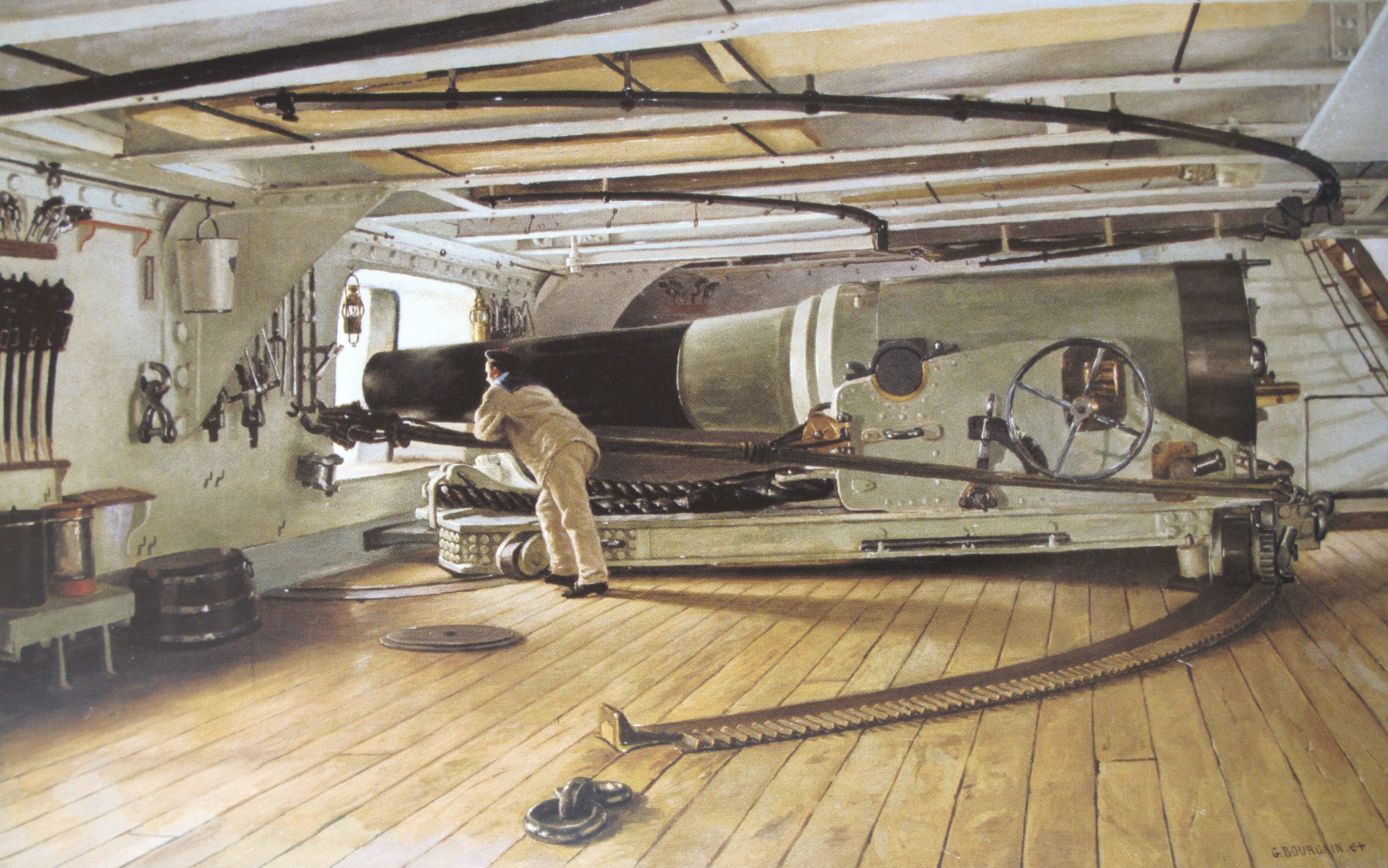
Trident had two 274 mm guns mounted in barbettes on the upper deck, one gun at the forward corners of the battery, with six additional guns on the battery deck below the barbettes. The side of the upper deck were cut away to improve the ability of the barbette guns to bear fore and aft. One 240 mm was mounted in the forecastle as a chase gun. The ship's secondary armament consisted of six 138 mm guns, four forward of the battery and two aft. These latter two guns were replaced in 1878 by another 240-millimeter gun as a stern chaser. The ship also mounted four above-water 356 mm torpedo tubes.
All of the ship's guns could fire both solid shot and explosive shells. The 274-millimeter Modèle 1870 gun was credited with the ability to penetrate a maximum 14.3 in of wrought iron armor while the 240-millmeter Modèle 1870 gun could penetrate 14.4 in of wrought iron armor.
At some point the ship received fourteen to eighteen 37 mm Hotchkiss 5-barrel revolving guns.
Armor
The Colbert-class ships had a complete wrought iron waterline belt that was 220 mm thick amidships and tapered to 180 mm at the stern. It was backed by 89 mm of wood. The sides of the battery itself were armored with 160 mm of wrought iron, backed by 62 mm of wood, and the ends of the battery were closed by transverse armored bulkheads 120 mm thick, backed by 480 mm of wood. The barbettes were unarmored, but the deck was 15 mm thick.
Service
Trident, named after the weapon that symbolized mastery of the seas, was laid down in April 1870 in Toulon and launched on 9 November 1876. The ship was completed on 1 November 1878 She was disarmed and placed in reserve in 1886–89, but was recommissioned on 17 February 1889 and resumed her role as flagship until she was again placed in reserve in 1894. The ship served as a gunnery training ship until she was condemned on 5 March 1900. Trident was renamed Var in 1904 and was sold for scrap five years later.
Footnotes
References
- {{cite book
References
- Like most ironclads of her era she was equipped with a plough-shaped [[Naval ram. ram]]. Her crew numbered 774 officers and men. The [[metacentric height]] of the ship was low, a little above {{convert. 2. ft. m. 1
- Silverstone, p. 65
- Gille, p. 37
- On [[sea trial]]s, the engine produced {{convert. 4882. PS. 14.18. kn
- de Balincourt and Vincent-Bréchignac, pp. 28–29
- Brassey, p. 477
- de Balincourt and Vincent-Bréchignac, p. 29
- Silverstone, p. 114
- While the exact reason for such prolonged construction time is not known, it is believed that reduction of the French Navy's budget after the [[Franco-Prussian War]] of 1870–71 and out-of-date work practices in French dockyards were likely causes.Ropp, pp. 31, 55–58
- French ironclad. Colbert. 2, bombarded the Tunisian port of [[Sfax]] on 15–16 July 1881 as the French occupied Tunisia.Wilson, pp. 2–4
This article was imported from Wikipedia and is available under the Creative Commons Attribution-ShareAlike 4.0 License. Content has been adapted to SurfDoc format. Original contributors can be found on the article history page.
Ask Mako anything about French ironclad Trident — get instant answers, deeper analysis, and related topics.
Research with MakoFree with your Surf account
Create a free account to save articles, ask Mako questions, and organize your research.
Sign up freeThis content may have been generated or modified by AI. CloudSurf Software LLC is not responsible for the accuracy, completeness, or reliability of AI-generated content. Always verify important information from primary sources.
Report