From Surf Wiki (app.surf) — the open knowledge base
Fractional part
Excess of a non-negative real number beyond its integer part
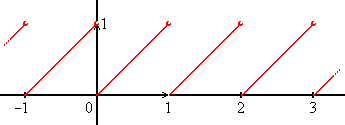
Excess of a non-negative real number beyond its integer part
The fractional part or decimal part of a non‐negative real number x is the excess beyond that number's integer part. The latter is defined as the largest integer not greater than x, called floor of x or \lfloor x\rfloor. Then, the fractional part can be formulated as a difference:
:\operatorname{frac} (x)=x - \lfloor x \rfloor,; x 0.
The fractional part of logarithms, specifically, is also known as the mantissa; by contrast with the mantissa, the integral part of a logarithm is called its characteristic. The word mantissa was introduced by Henry Briggs.
For a positive number written in a conventional positional numeral system (such as binary or decimal), its fractional part hence corresponds to the digits appearing after the radix point, such as the decimal point in English. The result is a real number in the half-open interval 0, 1).
For negative numbers
However, in case of negative numbers, there are various conflicting ways to extend the fractional part function to them: It is either defined in the same way as for positive numbers, i.e., by \operatorname{frac} (x)=x-\lfloor x \rfloor , or as the part of the number to the right of the radix point \operatorname{frac} (x)=|x|-\lfloor |x| \rfloor , or by the [odd function:
:\operatorname{frac} (x)=\begin{cases} x - \lfloor x \rfloor & x \ge 0 \ x - \lceil x \rceil & x \end{cases}
with \lceil x \rceil as the smallest integer not less than x, also called the ceiling of x. By consequence, we may get, for example, three different values for the fractional part of just one x: let it be −1.3, its fractional part will be 0.7 according to the first definition, 0.3 according to the second definition, and −0.3 according to the third definition, whose result can also be obtained in a straightforward way by :\operatorname{frac} (x)= x - \lfloor |x| \rfloor \cdot \sgn(x).
The x - \lfloor x \rfloor and the "odd function" definitions permit for unique decomposition of any real number x to the sum of its integer and fractional parts, where "integer part" refers to \lfloor x \rfloor or \lfloor |x| \rfloor \cdot \sgn(x) respectively. These two definitions of fractional-part function also provide idempotence.
The fractional part defined via difference from ⌊ ⌋ is usually denoted by curly braces: :{ x } := x-\lfloor x \rfloor.
Relation to continued fractions
Every real number can be essentially uniquely represented as a simple continued fraction, namely as the sum of its integer part and the reciprocal of its fractional part which is written as the sum of its integer part and the reciprocal of its fractional part, and so on.
References
References
- "Decimal part". [[OxfordDictionaries.com.
- Ashton, Charles Hamilton. (1910). "Five Place Logarithmic Tables: Together with a Four Place Table of Natural Functions". C. Scribner's Sons.
- Magazines, Hearst. (February 1913). "Popular Mechanics". Hearst Magazines.
- Gupta, Dr Alok. (2020-07-04). "Business Mathematics by Alok Gupta: SBPD Publications". SBPD publications.
- Schwartzman, Steven. (1994-12-31). "The Words of Mathematics: An Etymological Dictionary of Mathematical Terms in English". American Mathematical Soc..
- (1992). "Concrete mathematics: a foundation for computer science". Addison-Wesley.
- Daintith, John. (2004). "A Dictionary of Computing". Oxford University Press.
- [http://mathworld.wolfram.com/FractionalPart.html Weisstein, Eric W. "Fractional Part." From MathWorld--A Wolfram Web Resource]
This article was imported from Wikipedia and is available under the Creative Commons Attribution-ShareAlike 4.0 License. Content has been adapted to SurfDoc format. Original contributors can be found on the article history page.
Ask Mako anything about Fractional part — get instant answers, deeper analysis, and related topics.
Research with MakoFree with your Surf account
Create a free account to save articles, ask Mako questions, and organize your research.
Sign up freeThis content may have been generated or modified by AI. CloudSurf Software LLC is not responsible for the accuracy, completeness, or reliability of AI-generated content. Always verify important information from primary sources.
Report