From Surf Wiki (app.surf) — the open knowledge base
Formula 18
Catamaran class
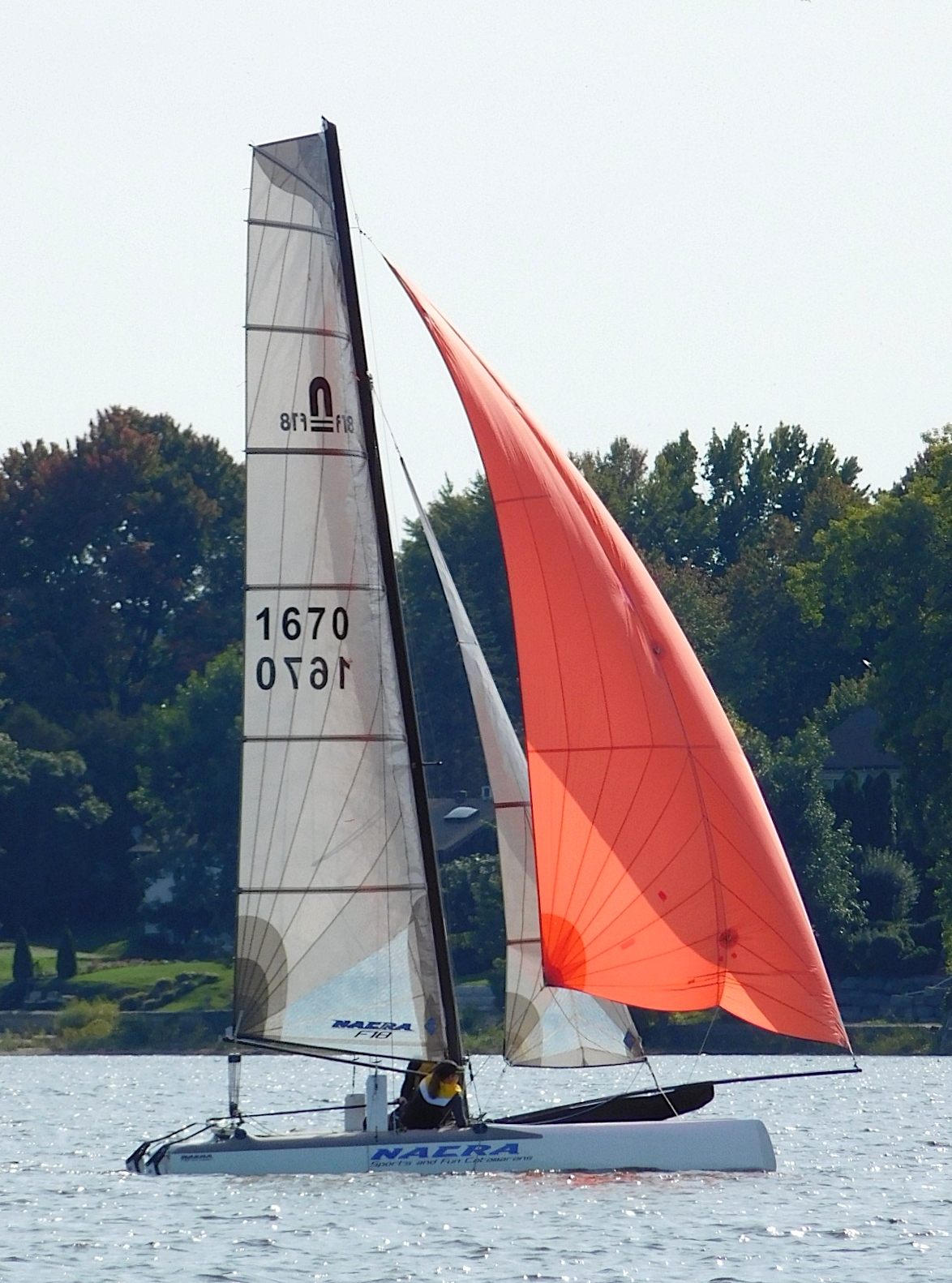
Catamaran class
| Field | Value |
|---|---|
| name | F18 |
| insignia size | 540 mm (h) x 630 mm (l) |
| image boat | File:Formula 18 catamaran sailboat 1655.jpg |
| image alt | Formula 18 catamaran sailboat |
| designer | various |
| year | 1994 |
| design | Box Rule |
| class | International Formula 18 Class Association |
| brand | various |
| builder | various |
| crew | 2 person |
| trapeze | helm and crew |
| draft | 1.40 m (upwind) |
| displacement | 180 kg |
| hull type | catamaran |
| loh | 5.52 m |
| beam | 2.60 m |
| keel type | optional: daggerboards / centerboards |
| mast length | 9.10 m (maximum) |
| sailarea main | 17 m2 (mainsail and mast combined area) |
| sailarea headsail | 4.3 m2 |
| sailarea gen | 21 m2 |
| sailarea upwind | 21.3 m2 |
| sailarea downwind | 42.3 m2 |
| status | World Sailing Multihull |
|d-pn = |rya-pn =
The Formula 18 (F18) class is a non-foiling, restricted development, formula-design sport catamaran class. It was started in the early 1990s and quickly grew getting class recognition by World Sailing, with large racing fleets all over the globe.
Design goals
The overall objective of the class is to offer popular, safe, exciting and fair racing in 18-foot catamarans.
The F18 class is a "box rule" class, which means that any boat that adheres to the limited set of general design specifications may participate in all F18 races. This has led to a score of homebuilders and professional builders to design their own F18 boats and race them in this class. However, it is the mainstream production F18 designs that have dominated the top of the class. The presence of multiple boat builders and sailmakers in the class stimulates innovation and helps to limit costs to sailors.
The F18 box rule allows limited development, striking a balance between the class remaining close to the front edge of multihull design and preserving capital invested in the fleet. Since its introduction, the F18 has seen a steady evolution in both hull and sail shapes, which has led to remarkably improved performance in terms of both handling and speed. The latest innovation adoption was the introduction of the mainsail "decksweeper" at the 2017 Worlds. Crewed by experienced teams F18s can reach speeds of over 13 knots upwind and more than 20 knots downwind.
The relatively high boat weight facilitates robust construction and limits the benefits from fragile advanced construction techniques, keeping costs down and increasing longevity. It also supports adding interchangeable parts to the platform, for example for use of the platform as a foiling catamaran outside F18 racing. Moreover, the relatively high boat weight reduces the sensitivity of performance to crew weight.
The F18 class also uses an equalizing system, with crew extra weights, to offer competitive racing for a larger crew weight range.
Class development
-0187.jpg)
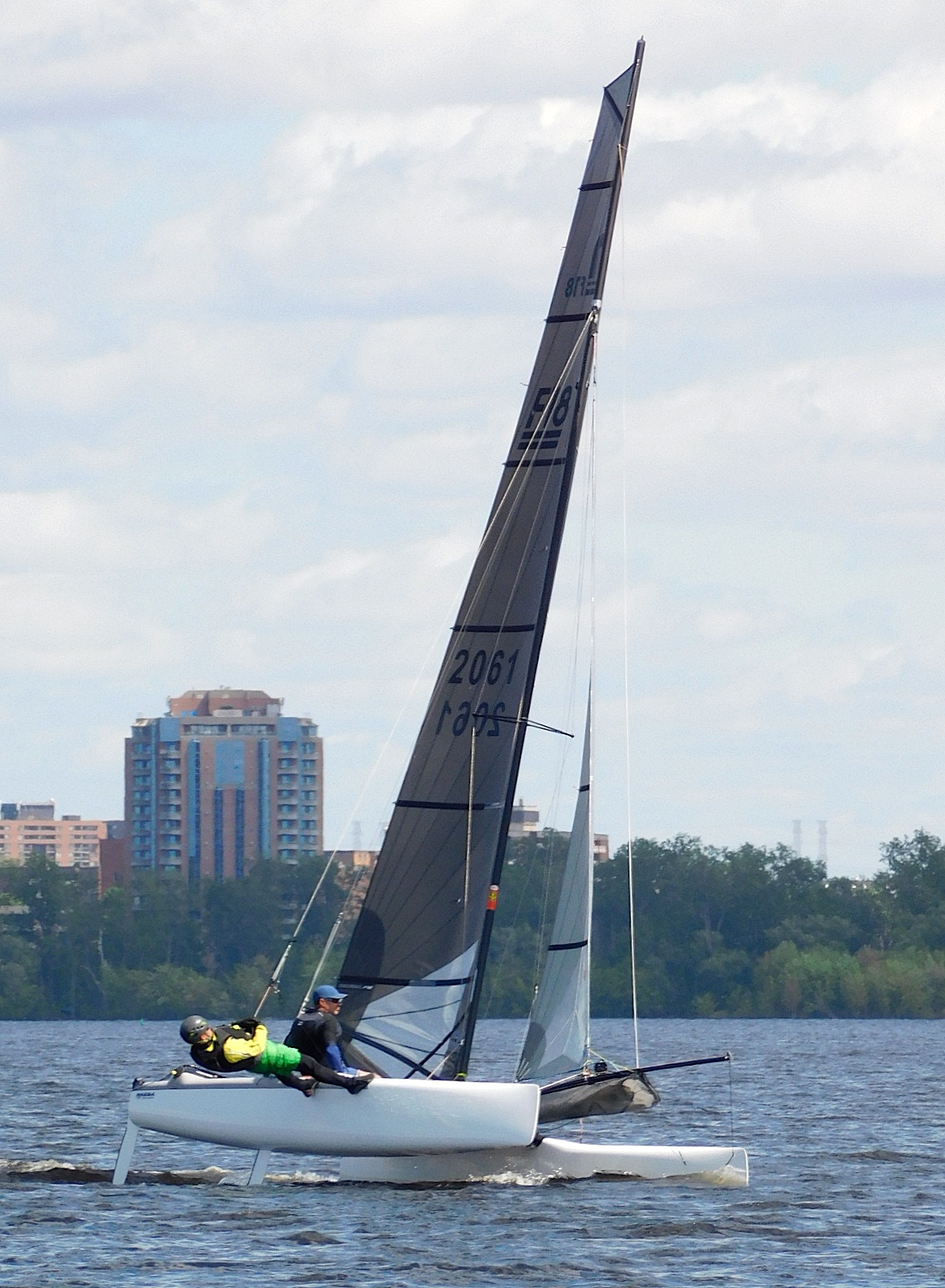
The Formula 18 was created in 1994 by Olivier Bovyn and Pierre-Charles Barraud to introduce first across the line / elapsed time (versus handicap / corrected time) competition to the sport catamaran sailing community at an affordable cost. The concept became popular very quickly and due to its fast growth, the F18 attained ISAF Recognised Class status already in 1996, within 18 months after its inception.
Mainly a Europe-based class at the beginning, class membership eventually spread to Australia and the Americas and the F18 class currently has full racing circuits in many places around the globe. Several thousand boats have been sold over the years. The F18 attracts both female and male as well as mixed crews and it is particularly popular among teams with combined crew weights of approximately 140–170 kg.
Its design and popularity has led the F18 to be the boat of choice for long-distance raid events such as the Stockholm Archipelago Raid, the Costarmoricaine, and the Worrell 1000.
The boats are equipped with double trapezes and a gennaker, and as a result, they require a skilled and physically fit crew to be competitive. However, many crews also use this catamaran for purely recreational sailing.
Over time the class has seen many talented sailors who also made their appearances in Olympic sailing classes, the America's Cup, Jules Verne Trophy and Volvo Ocean Race, including Carolijn Brouwer, Glenn Ashby, Darren Bundock, Jimmy Spithill, Mitch Booth and Franck Cammas.
The Formula 18 class is governed by the International Formula 18 Class Association and is recognized as a World Sailing Multihull Class.
The early success of the F18 class during the 1990s inspired the founding of the Formula 16 class. In addition, a number of Formula 18 designs have gone on to have competitive one-design racing including the Hobie Tiger, Hobie Wildcat and Nacra Infusion.
Popular Designs
Design in bold are in production
| Name | Years | Designer | Builder | No Built | Notes | Ref. | Akurra | Cirrus 901 | eXploder Scorpion | Nacra F18 Infusion MK3 | Nacra F18 Evolution |
|---|---|---|---|---|---|---|---|---|---|---|---|
| Alado 18 | J. VALER | ALADO CAT | |||||||||
| 2021–Present | Goodall Design | Goodall | |||||||||
| AHPC C2 | 2010-2020 | Greg Goodall | AHPC | ||||||||
| AHPC Capricorn | 2004-2009 | Greg Goodall | |||||||||
| Martin Fischer | AHPC (AUS) | ||||||||||
| AHPC Taipan | Greg Goodall | BOYER FIBERCRAFT (aus) | |||||||||
| Bimare HT | Michelangelo Petrucci | ||||||||||
| Cirrus 18 | |||||||||||
| Cirrus R | |||||||||||
| Cirrus R2 | |||||||||||
| 2021–Present | |||||||||||
| Diam 18 | MULTI (FRA) | ||||||||||
| 2015–Present | Martín Vanzulli | eXploder (POL) | |||||||||
| Dart Hawk | 1996 - 2000s | Reg White / | |||||||||
| Yves Loday | White Formula / | ||||||||||
| Performance Sailcraft Europe (GBR) | Mass Produced | ||||||||||
| Falcon | |||||||||||
| Flash | MATTIA & CECCO | ||||||||||
| Nacra Inter 18 | 90s-00s | Morelli & Melvin | PERFORMANCE CATAMARAN (USA) | ||||||||
| Nacra Inter 2 | 90s-00s | Alain Comyn | PERFORMANCE CATAMARAN (USA) | ||||||||
| Nacra F18 Infusion | 2008 | Nacra Sailing (NED) | |||||||||
| Nacra F18 Infusion MK2 | Nacra Sailing (NED) | New Hull with dreadnaught bow | |||||||||
| Nacra Sailing (NED) | Convertible to foiling | ||||||||||
| 2021–Present | Nacra Sailing | ||||||||||
| Hobie Wildcat | 2009 | Martin Fischer | Hobie Cat Europe (FRA) | ||||||||
| Hobie Tiger | 1995 | J. Valer | Hobie Cat Europe (FRA) | ||||||||
| Hunter | 1999-00s | Mischa Heemskerk | Twister Catamarans NL | ||||||||
| MV Challenge | Jacques Valer | Mediavoile / RLM Composite | |||||||||
| RaceCat MV18 | 2006 | (ARG) | |||||||||
| Phantom | |||||||||||
| Phenix | |||||||||||
| Shockwave | Reg White / | ||||||||||
| Yves Loday | White Formula (GBR) | ||||||||||
| Mystere Twister | J. VALER | MYSTERE EUROPE (FRA) | |||||||||
| Windrush Edge |
Events
Main article: Formula 18 World Championship
References
References
- (2018-12-15). "Constitution". Formula 18.
- "Class Rules - Formula 18 Catamaran".
- "Formula 18".
- "Akurra : Goodall Design".
- Bovyn, Olivier. (November 19, 2020). "Goodall Design announces new F18 flagship Akurra".
- "Akurra : Goodall Design".
- "F-18 HT : STW002104 : the SailingTheWeb sailboat datasheet".
- (June 20, 2021). "New F18 Cirrus 901: QA with Manu Boulogne & Matthieu Marfaing - Catamaran Racing, News & Design".
- "F18".
- "New and used technical specifications Dart Hawk - Multihulls World".
- "Inter 2".
- Bovyn, Olivier. (September 29, 2019). "New F18 Evolution presented by Nacra Sailing".
- "MEDIAVOILE - Accélérateur de notoriété - Voile & Nautisme | Challenge des villes de Bretagne |".
- "RaceCat".
- "Shockwave".
- "MULTYPASS : Mystère catamarans - Bateaux Boutemy".
This article was imported from Wikipedia and is available under the Creative Commons Attribution-ShareAlike 4.0 License. Content has been adapted to SurfDoc format. Original contributors can be found on the article history page.
Ask Mako anything about Formula 18 — get instant answers, deeper analysis, and related topics.
Research with MakoFree with your Surf account
Create a free account to save articles, ask Mako questions, and organize your research.
Sign up freeThis content may have been generated or modified by AI. CloudSurf Software LLC is not responsible for the accuracy, completeness, or reliability of AI-generated content. Always verify important information from primary sources.
Report